How to Switch From Propane to Electric Heating
On this page 6 sections
Get the change wrong and you can spend money twice, once on the new equipment and again on corrections the inspector or utility requires. You can also end up with uneven heat, a tripped breaker, or a gas line that was left capped poorly.
The job is safest when you treat it as a system change, not an appliance swap: heat source, wiring, controls, and any abandoned gas piping all have to be handled in the right order.
How To Switch From Propane To Electric Heating

Switching from propane to electric heating means removing or isolating the propane appliance, verifying that your electrical service and panel can handle the new load, then installing the electric replacement on dedicated circuits sized for continuous use. Most whole-home conversions aren’t simple DIY projects because they combine gas line shutdown, venting removal, load calculations, and often 240 V wiring that local code requires a licensed electrician to handle.
The basic path starts with sizing the electric system to match your heating need, not just swapping appliances one-for-one. A propane furnace rated at 80,000 BTU/h doesn’t translate neatly to a single electric unit, and the electrical demand can jump from a few hundred watts for a propane system’s blower and igniter to several kilowatts of continuous draw once you’re heating entirely with resistance coils or a heat pump compressor.
Many propane heating systems already use electricity for the blower motor, thermostat, ignition system, and sometimes a small circulation pump, so they aren’t fuel-only appliances. That existing electrical load is usually light—a few amps at 120 V—but the conversion changes everything. An electric furnace, heat pump, or baseboard bank becomes the primary energy source, and the breaker panel sees a new continuous load that can reach 15 to 30 kW or more in a cold climate.
Heat pumps offer the lowest operating cost in moderate climates but need refrigerant lines and outdoor unit placement. Electric furnaces and baseboards are simpler to install but cost more to run because they convert every watt to heat without the efficiency multiplier a heat pump provides. Electric boilers work with existing hydronic loops, keeping the radiators or radiant floors you already have. Each option changes the wiring plan, so choose the system type before you buy breakers and wire.
Check Your Electrical Service Before You Buy
Your main service size—100 A, 150 A, or 200 A at 240 V—sets the ceiling for how much electric heat you can add without a utility upgrade. Open the panel cover and check the main breaker label, count spare slots for new double-pole breakers, and look for rust, burn marks, or a panel so old that replacement breakers are no longer made. If the panel is full or the service is already near capacity with water heater, range, dryer, and air conditioning, adding a large heating load means calling an electrician for a load calculation and possibly a service upgrade.
Plug-in space heaters top out at 1,500 W and 12.5 A because that’s what a standard 120 V household circuit can supply without tripping. Whole-home electric heat pulls far more: a single-zone heat pump outdoor unit might draw 25 to 40 amps at 240 V, an electric furnace 60 to 100 amps, and a baseboard bank split across several 20 or 30 amp circuits. None of those loads run on the same 15 A outlets you use for lamps and phone chargers.
| Electric heat type | Typical load | Circuit requirement | Panel impact |
|---|---|---|---|
| Plug-in space heater | 1,500 W | Existing 120 V / 15 A outlet | Minimal; shares circuit |
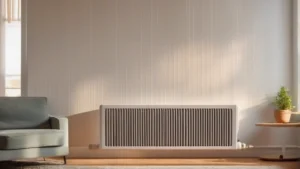
| Baseboard heaters | 250 W per foot | Dedicated 240 V / 20–30 A per zone | One or more circuits |
| Heat pump (mini-split) | 2–4 kW outdoor unit | Dedicated 240 V / 15–25 A | One double-pole breaker |
| Electric furnace | 15–25 kW | Dedicated 240 V / 60–100 A | Large breaker, heavy wire |
Every electric heating appliance nameplate lists minimum circuit ampacity and maximum overcurrent protection—the wire size and breaker rating the manufacturer requires. A 4.8 kW baseboard heater needs a 25 amp breaker and 10 AWG wire; a 12 kW heat pump air handler might call for 60 amps and 6 AWG. The breaker must match the appliance instructions, not just the wire, because continuous loads—anything that runs three hours or more—are derated to 80 percent of breaker capacity under NEC rules.
If you’re comparing propane heating systems for efficiency before making the switch, remember that high-efficiency propane units still burn fuel and vent combustion gases, while electric systems move the emissions upstream to the power plant. The electrical infrastructure question matters more than the appliance’s rated efficiency once you’ve decided to leave propane behind.
Handle Permits, Gas Lines And Venting The Right Way
Gas line work, electrical upgrades and major appliance swaps—propane furnaces, propane boilers and propane water heaters—almost always need permits and licensed trades in your jurisdiction. A building inspector wants to see that fuel lines are capped safely, that venting is sealed or removed to code, and that new electrical circuits meet NEC wire gauge and breaker requirements. Skip the permit and you’ll face trouble at resale, during insurance claims, or when an inspector shows up for unrelated work.
Propane lines should be shut off at the supply valve, purged and capped by a licensed plumber or gas fitter. Hardware-store pipe caps and thread tape aren’t enough; codes require black iron or corrugated stainless steel tubing fittings torqued to spec and tested for leaks with a manometer. If a propane tank sits outside, arrange for the supplier to collect it or safely disconnect the service line.
Vented appliances—furnaces, boilers and some propane stoves—leave behind flues, vent collars and chimney liners that must be sealed according to the listing and local fire code. An open flue draws cold air and moisture into walls and attics, inviting mold and ice dams. Metal B-vent can be removed or capped at the roof and the appliance collar; masonry chimneys need a stainless cap or a sealed top plate. Your HVAC contractor or chimney sweep will know which applies.
Avoid The Mistakes That Cause Damage Or Leaks
Most conversion failures come down to five mistakes: leaving an abandoned vent open to the weather, capping a gas line with the wrong fitting, undersizing the new electric circuit, ignoring clearance rules for the replacement heater, and assuming that propane fireplaces or heating appliances can be swapped for plug-in electric units on any outlet. Each one costs money to fix and some create safety problems that don’t show up until the coldest night of the year.
Unsealed flues leak cold air, snow and rain into the envelope. A vent pipe or chimney that once served a propane furnace or fireplace needs a cap, a top seal or complete removal according to the appliance listing and building code. Moisture in an abandoned flue can rot framing, rust out metal vent sections and invite animals. Check with the inspector or a chimney professional before you drywall over the opening.
Electric heaters need three feet of clearance from curtains, furniture and bedding, and they should never run through an extension cord or power strip. Breaker trips, short cycling and rooms that won’t reach setpoint usually trace back to undersized wiring, shared neutral legs or a panel that’s already maxed out. A conversion done right sizes the circuit first, then picks the heater.
Compare Electric Heat Choices For Your Home
Once the propane appliance is out, you’ll pick an electric system based on what infrastructure you already have and how much power your service can deliver. Heat pumps offer the best efficiency—moving heat instead of creating it—while resistance systems like baseboards and electric furnaces are simpler but cost more per BTU. Your climate, insulation quality and whether you have ducts or hydronic loops already in place narrow the field fast.
Heat Pumps For Whole-Home Efficiency
A heat pump can deliver two to three times more heat per kWh than resistance heating because it concentrates warmth from outdoor air instead of running current through a coil. Mini-splits work in homes without ducts; ducted heat pumps drop into existing forced-air systems. Performance falls below about 25°F, so cold-climate models or a backup strip help in northern zones. Expect a 240 V circuit at 30 to 60 A depending on tonnage, and a licensed HVAC tech for the refrigerant work.
Baseboard And Wall Heaters For Room-By-Room Control
Electric baseboard heaters install along exterior walls on dedicated 240 V circuits—typically 15 or 20 A per room—and let you zone heating without ductwork. Each watt produces 3.41 BTU, so a 1,500 W baseboard delivers about 5,100 BTU per hour. Wall-mount panel heaters work the same way. Running costs are higher than a heat pump: 1,500 W for eight hours at 17 cents per kWh is about $2.04 a night. Baseboard suits older homes where adding ducts isn’t practical and the electrical panel has spare slots.
Electric Furnaces And Boilers Where Infrastructure Exists
Homes with forced-air ducts can swap a propane furnace for an electric one on a 240 V circuit, usually 40 to 80 A. Hydronic systems—baseboard loops or radiant floors fed by a propane boiler—can take an electric boiler instead, though heat-pump water heaters are gaining ground for that job. Both options keep the existing distribution but draw heavy loads; check your service size first.
| System | Best for | Typical circuit | Efficiency edge |
|---|---|---|---|
| Heat pump (mini-split or ducted) | Whole home, moderate to mild winters | 240 V, 30–60 A | 2–3× resistance heat |
| Electric baseboard | Room-by-room, no ducts | 240 V, 15–20 A per room | None; pure resistance |
| Electric furnace | Existing duct system | 240 V, 40–80 A | None; pure resistance |
| Electric boiler | Existing hydronic loops | 240 V, varies | None; pure resistance |
Readers weighing both directions can compare the trade-offs in our guide on how to switch from electric heat to gas heating. Propane space heaters and propane vs electric space heaters offer portable zone heating if a full conversion isn’t in the budget yet.