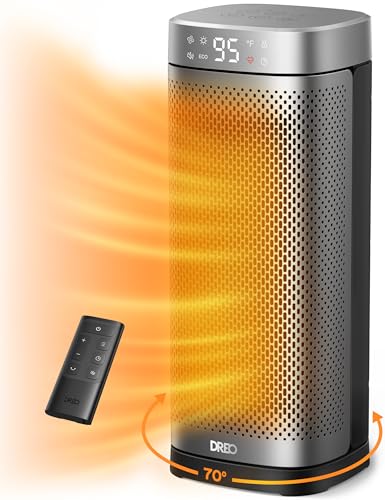
For fast heat, the 1,500 W DREO heater is a strong starting pick, with 70° oscillation and a listed coverage claim of 250 sq ft. It moves warm air quickly and spreads it across the room; choose a quieter or wall-mounted option if those features matter more.
A plug-in heater warms the air near you quickly, but it won’t replace a home’s main heating system in a cold, leaky room. These picks are electric indoor models, so the comparison comes down to airflow, controls, noise and where you can place the heater.
Best Indoor Heaters for Fast Warmth
#1Best for Fast Warmth
DREO 1500W Oscillating Heater
Best for Quick, circulating warmth in bedrooms, offices, and other everyday rooms
The 1,500 W PTC system and listed 11.5 ft/s airflow are built to warm a room quickly, while 70° oscillation spreads the heat. Choose it if you want fast-moving warmth with a quiet fan and a remote.
Heat output 1,500 WOscillation 70°Airflow speed 11.5 ft/sNoise As low as 34 dBTimer 12 hours
Why it made the cut
70° oscillation spreads airflow across the room
Listed airflow speed of 11.5 ft/s
Quiet operation listed as low as 34 dB
ETL-certified with tip-over and overheat protection
Good to know
A fan moves the heat, so you’ll hear some airflow
The 1,500 W output may not keep a poorly insulated or oversized room comfortable
Skip it if Skip it if you want heat without fan noise; an oil-filled radiator may suit you better.
Best for Rooms where broad oscillation and a stated coverage area matter
This 16-inch model lists coverage up to 250 sq ft and airflow speed of 11.8 ft/s. Its 70° oscillation and digital thermostat make it a practical choice when you want warmth spread across a larger room; actual results depend on insulation and room layout.
Heat output 1,500 WListed coverage Up to 250 sq ftAirflow speed 11.8 ft/sOscillation 70°Thermostat range 41–95°F
Why it made the cut
Lists coverage up to 250 sq ft
70° oscillation
Digital thermostat adjusts in 1°F increments
Shield360° includes tip-over and overheat protection
Good to know
Coverage is a listed claim, not a guarantee for every room
Fan-based heat won’t feel like a silent, stationary radiator
Skip it if Skip it if your room is poorly insulated or you need a heater designed for primary whole-room heating.
Best for Bedrooms and offices where low fan noise matters
The brushless DC motor and winglet fan design are listed at 34 dB, making this a fit for rooms where fan noise can distract. It also has a 1,500 W PTC system, remote, and thermostat adjustable from 41–95°F in 1°F increments.
Best for Rooms where adjustable output and temperature maintenance are priorities
ECO mode can run at 1,000 W or 1,500 W and adjusts operation using its temperature sensor. The 70° oscillation helps spread warmth, while the 12-hour timer and 24-hour automatic power-off add control for everyday use.
Heat output 1,000 W or 1,500 W in ECO modeOscillation 70°Noise 34 dBTimer 12 hoursAutomatic power-off 24 hours
Why it made the cut
ECO mode has 1,000 W and 1,500 W settings
70° oscillation
34 dB noise claim
ETL-certified with tip-over and overheat protection
Good to know
No specific coverage area is given in the product data
The 24-hour automatic power-off can interrupt longer use
Skip it if Skip it if you want a heater with a stated coverage figure for your room size.
Best for Well-insulated rooms up to the listed 200 sq ft zone-heating claim
This model can be wall-mounted to free up floor space, or used as a portable heater. Wi-Fi and remote controls let you adjust it from a distance, and its ECO mode uses a thermostat to maintain the set temperature.
Heat output 1,500 WListed zone heating Up to 200 sq ft in a well-insulated roomControls Wi-Fi, remote, and touch controlTimer 24 hoursHeating modes 3
Why it made the cut
Wall-mounted or portable setup
Wi-Fi and remote control
Lists zone heating up to 200 sq ft in a well-insulated room
ETL-listed with tip-over and overheat protection
Good to know
Wi-Fi works with 2.4 GHz, not 5G Wi-Fi
The stated 200 sq ft coverage applies to a well-insulated room
Skip it if Skip it if your home network is 5 GHz only or you don’t want to mount a heater.
A fan heater can make you feel warm quickly by blowing heated air toward you; infrared heat feels immediate on the person or surface it reaches, rather than warming all the room air first. For metal, hot liquid transfers heat through direct contact—the liquid needs to be hotter than the metal, and the result depends on both materials and their temperatures. There’s no special liquid that makes metal heat fast regardless of conditions.
Metal can heat up fast in hot weather because the surrounding air and sun may transfer heat to it; thin metal exposed to strong sunlight can warm quickly. Infrared feels fast because it transfers energy directly to the surfaces and people in its path. It doesn’t have to heat the room’s air first.
Myth
Radiant heat warms a whole room faster than a fan heater.
Fact
Radiant heat can feel immediate where it lands, but that doesn’t mean it heats all the room air quickly. A fan heater sends warm air around; neither method can make a poorly insulated large room warm instantly.
Oil-filled radiators usually take longer to warm up because the heating element first warms the oil and metal body. Once hot, the radiator keeps giving off warmth after the element cycles off. Rapid heating can also stress or damage a semiconductor, depending on the material and how unevenly it heats.
To warm a room faster, close doors, reduce drafts, and place the heater so its airflow reaches you. A 1,500 W plug-in heater produces heat at a fixed rate; it can’t overcome large heat losses instantly. For more on choosing a fast-heating model, see electric heaters best rated.
1,500 W
Common maximum for a plug-in space heater
That’s the heater’s rated power, not a promise that every room will feel warm right away. Room size and heat loss still matter.
Match the Portable Heater to Your Room
Pick a portable heater for how you want its heat delivered and controlled; at 1,500 W, electric resistance models don’t turn the same electricity into meaningfully different amounts of heat. Oscillation, airflow, noise, thermostat settings and controls change where the heat goes and how comfortably the heater runs.
Need
Model to consider
What to check
Fast heat spread across a room
DREO Quiet Space Heater
Its listed 70° oscillation and 250 sq ft coverage claim; coverage is not guaranteed.
Quieter bedroom or office use
DREO Space Heaters for Indoor Use with Thermostat
Check the stated noise level and thermostat range on the product listing.
Portable quiet use with several modes
DREO Space Heater, Portable Electric Heaters for Indoor Use
Compare its listed noise level and available modes with your preferences.
Wall mounting and Wi-Fi
GiveBest Smart Wall Heater
Choose it if wall mounting and Wi-Fi control fit your room and setup.
ECO mode and temperature sensing
DREO Space Heaters for Indoor Use, 16 Inch Electric Heater
Check the product listing for its ECO mode and temperature-sensing details.
Confirm exact specifications on the product listing; don’t assume a feature from a model name.
Treat stated room coverage as a product claim, not a promise: insulation, ceiling height, outdoor temperature and open doorways all affect what a heater can manage. For a broader comparison of portable models, see top-rated portable heaters.
A useful review separates stated specifications from unsupported claims. Look for listed wattage, noise level, thermostat range and controls; don’t treat a coverage claim as a guarantee, or assume a short review proves long-term reliability or savings.
Good to compare
A 1,500 W rating makes the models comparable by electrical output.
Oscillation, mounting, modes and controls can help match a heater to your room.
Don’t assume
A coverage figure can’t account for your insulation, ceiling height or drafts.
Feature differences don’t mean one resistance heater creates substantially more heat from the same electricity.
A 1,500 W Heater Suits a Room-Size Zone
A 1,500 W heater can help warm one reasonably insulated room, but its coverage claim isn’t a sizing guarantee. Product 5 lists coverage of up to 250 sq ft, while Product 4 claims zone heating up to 200 sq ft in a well-insulated room; drafts, ceiling height, outdoor temperature and the room’s layout all change what you’ll feel.
At 120 V, a standard 1,500 W plug-in heater draws about 12.5 A and uses 1.5 kWh per hour at full power. That’s close to the practical limit of a standard 15 A, 120 V circuit, so don’t run another high-wattage appliance on the same circuit.
Example: One Evening of Heat
Say you run a 1,500 W heater for 6 hours and pay an assumed 17 cents per kWh. At full power, it uses 1.5 × 6 = 9 kWh, costing 9 × $0.17 = $1.53. A thermostat can switch the heating element off as the room warms, lowering actual use; the fan may still run on some models.
Assumed electricity rate$0.17/kWh
Hours at full power6
Estimated full-power cost9 kWh for six hours of operation at 1,50
Heater
Watts
Per hour
Per day (6 h)
Per month (1 days)
1,500 W heater
1,500 W
26¢
$1.53
$1.53
Calculated at 17¢ per kWh. Example only: assumes 6 hours at full power and electricity at $0.17/kWh. Thermostat cycling can reduce actual use.
Small solar panels and batteries generally can’t run a 1,500 W heater for long: the heater needs substantial continuous power. Check the battery’s usable capacity and inverter’s continuous wattage rating, not just its advertised peak. In a large, open or poorly insulated space, one portable heater is a poor substitute for sealing drafts or fixing inadequate central heat.
Safety Checks Before You Plug In
Plug an electric space heater directly into a wall outlet, keep at least 3 feet of clearance, and don’t leave it running while you sleep or leave home unless the manufacturer explicitly says that model is designed for it. Extension cords and power strips can overheat under a heater’s sustained load.
Before buying, check for tip-over and overheat protection and a UL, ETL or CSA listing. Those features don’t make careless placement safe, but they’re basic checks for a portable electric heater.
Fuel Heaters Need More Checks
Propane heaters burn fuel to make heat, so carbon monoxide is a serious risk; it’s odorless and can be fatal. Use a portable propane heater indoors only if it’s rated for indoor use and has an oxygen depletion sensor. Follow the manual’s ventilation requirements and keep a working CO alarm in the area. Never use a patio, outdoor or construction heater indoors, in a tent or in a vehicle cabin. Portable natural-gas ventless heaters may be banned or restricted locally, so check local code and the appliance manual before buying or using one indoors.
Before You Buy or Plug In
Room fit: check the heater’s coverage claim against insulation, drafts and room layout.
Outlet: use a suitable wall outlet directly; no extension cord or power strip.
Clearance: keep at least 3 feet between the electric heater and anything that can burn.
Listing: look for a UL, ETL or CSA listing.
Safety shutoffs: confirm tip-over and overheat protection on an electric heater.
Manual: read the placement, operating and ventilation instructions.
CO alarm: confirm a working alarm is present if using an eligible indoor fuel-burning model.
Frequently Asked Questions
How does a portable propane heater work?
A portable propane heater burns propane to create heat, which it transfers to the room by radiant heat, convection, or both. Use only a model specifically rated for indoor use, follow its ventilation instructions, and keep a working carbon monoxide alarm nearby; an oxygen depletion sensor does not replace those precautions.
Can a portable solar-powered heater warm a room?
A small solar panel generally can’t supply enough power to run a room-heating appliance steadily. For scale, a 1,500 W heater needs 1.5 kWh for each hour it runs, so a solar setup would need substantial panel and battery capacity to cover even a short stretch.
Is there a battery-operated indoor heater that can run all night?
A typical portable battery pack won’t run a useful electric room heater all night because resistance heating draws a lot of power. A 1,500 W heater would use 12 kWh over eight hours; check a battery’s usable capacity in kilowatt-hours and its continuous output before considering one.
Are portable natural-gas ventless heaters safe indoors?
A ventless natural-gas heater releases combustion products, including water vapor, into the room, so safe use depends on the model, room conditions, ventilation, and local rules. Check the manual and local code before buying; vent-free gas heaters are restricted or banned in some places, and a carbon monoxide alarm is essential.
How do you take apart a portable fan heater?
Unplug the heater and let it cool completely before cleaning or opening anything. For routine dust removal, follow the manual and use only the access points it specifies; don’t defeat safety switches or work on live wiring, and replace the unit or use a qualified repairer if the cord, plug, or internal parts are damaged.
What should you look for in a small portable indoor heater?
Check that its wattage suits the outlet and room, then look for tip-over and overheat protection plus a UL, ETL, or CSA listing. A thermostat helps avoid running full power after the room warms, while a handle and stable base make placement easier; plug it directly into a wall outlet and leave 3 feet of clearance.
Do oil-filled radiators heat up fast?
Usually not as fast as a fan heater: the oil and metal radiator need time to warm before they deliver strong heat. Once hot, the radiator continues releasing stored heat after its thermostat clicks off, which can make its output feel steadier but doesn’t make it a quick warm-up pick.