For most people shopping for an efficient electric indoor heater with Eco mode, the DREO pick is the strongest fit: it has a 1,500 W output, adjustable thermostat, 34 dB noise claim and multiple modes. Eco mode can reduce use by lowering or cycling heat, but no plug-in resistance heater makes heat more efficiently than another.
What to remember
Choose a thermostat and usable low-power setting before paying extra for an Eco label.
A 1,500 W heater uses 1.5 kWh per hour at full power.
Use a plug-in heater for a person or room, not as a cheap substitute for whole-home heating.
Plug it directly into a wall outlet and keep 3 feet of clearance.
The common mistake is treating an Eco label as a promise of a lower bill. If the heater runs at full power for the same hours, it uses the same electricity; the savings come from using less heat or heating a smaller area.
The search phrase also brings up water heaters. These picks heat room air, not tap water; a tank or tankless water heater is a different appliance.
Best Efficient Electric Indoor Heaters
#1Best Overall
DREO 1500W Ceramic Space Heater
Best for Bedrooms and offices where quiet, adjustable heat matters
The adjustable thermostat has a wide 41–95°F range in 1°F increments, so you can set a target instead of leaving the heater at full power. Its 34 dB noise claim and remote suit bedrooms or offices, while Eco mode offers another way to control heat output.
Heat output 1500WThermostat range 41–95°FTimer 12 hoursNoise claim 34 dB
Why it made the cut
Thermostat adjusts in 1°F increments
34 dB noise claim
Remote, timer and multiple modes
Good to know
No specific room-size claim is provided
Eco-mode savings aren’t quantified
Skip it if Skip it if you need a stated room-size rating before choosing.
Best for Small rooms where a longer timer and quiet operation help
A 24-hour timer gives you more scheduling flexibility than the shorter timers listed for several other picks. It also claims coverage up to 200 sq ft and 35 dB operation, with a thermostat, remote and Eco mode for everyday adjustments.
Heat output 1500WRoom-size claim Up to 200 sq ftTimer 24 hoursNoise claim 35 dBSafety details ETL-certified; tip-over and overheat protection
Why it made the cut
24-hour timer
Claims coverage up to 200 sq ft
35 dB noise claim and remote
Good to know
The claimed 20% Eco-mode savings aren’t independently established
The stated coverage may not reflect a poorly insulated room
Skip it if Skip it if you want independently verified energy-savings figures.
Best for Rooms up to 200 sq ft where remote control and a child lock are useful
The listed room-size claim is up to 200 sq ft, and the remote lets you change settings without walking over to the heater. Its Eco mode, 12-hour timer and child lock make the controls practical for a home office or bedroom.
Heat output 1500WRoom-size claim Up to 200 sq ftTimer 12 hoursSafety details Tip-over and overheat protection
Why it made the cut
Claims coverage up to 200 sq ft
Remote, 12-hour timer and child lock
Tip-over and overheat protection
Good to know
No numeric noise claim is provided
The listed mode descriptions don’t specify thermostat range
Skip it if Skip it if a stated noise level is important to your choice.
Best for Small rooms where choosing a lower wattage is useful
Unlike the other portable heaters here, this model lists three fixed heat outputs: 700W, 1000W and 1500W. The lower settings can reduce electricity use while it runs, and the remote, thermostat and 1–12-hour timer cover basic day-to-day control.
Heat output 700W, 1000W or 1500WTimer 1–12 hoursControls Remote and thermostatSafety details ETL-certified; tip-over and overheat protection
Why it made the cut
Three listed heat outputs
Remote and thermostat
1–12-hour timer
Good to know
No room-size or noise claim is provided
No Eco mode is stated in the listed features
Skip it if Skip it if you need a heater with a different control setup.
Best for Living rooms where a recessed fireplace and supplemental heat are wanted
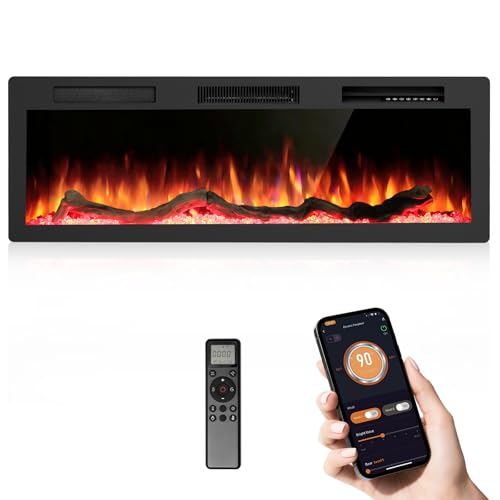
This is the only pick here designed for wall-mounted or recessed installation, and its heating modes are listed at 750W and 1500W. The product claims supplemental zone heating up to 400 sq ft and offers remote, app and voice controls; choose it for a fixed room feature, not portable spot heat.
Heat output 750W or 1500WRoom-size claim Up to 400 sq ftInstallation Wall-mounted or recessedTemperature range 59–95°F
Why it made the cut
750W and 1500W heating modes
Claims supplemental heating up to 400 sq ft
Remote, touch, smartphone and Alexa controls
Good to know
Requires wall-mounted or recessed installation
No numeric noise claim or timer duration is provided
Skip it if Skip it if you need a portable heater or a quantified Eco mode.
Electric room heaters are energy efficient at turning electricity into heat: standard plug-in resistance models convert nearly all the electricity they use into heat in the room. A ceramic element, fan or oil-filled casing doesn’t make more heat from the same watt-hours, so the most efficient indoor electric heater is usually the one that keeps you comfortable with the least runtime.
That applies to electric heaters generally, including electric fan heaters and electric radiators. A fan heater moves warm air quickly; a ceramic heater also responds quickly; an oil-filled radiator warms more gradually and keeps releasing warmth after its element cycles off. Those are differences in heat delivery and feel, not proof that one uses less electricity to produce the same heat. A fan heater’s efficiency is still close to all the electricity it draws becoming heat at the point of use.
What Eco Mode Can—and Can’t—Do
Eco mode usually lowers output or cycles the thermostat to maintain the set temperature. It can reduce consumption if the room stays comfortable with less heater runtime, but the product data here doesn’t establish a guaranteed percentage saving.
For an energy-efficient electric heater, look for a thermostat that can hold a comfortable temperature, a lower wattage setting for mild conditions, and a timer or shutoff you’ll actually use. Treat square-foot coverage as a manufacturer claim, and check the noise description if the heater will sit near your bed or desk. The DREO lists an adjustable thermostat, multiple modes and a 34 dB noise claim; VOCRS is worth comparing only on its listed features, not an assumed energy saving. For more choices, see smart heaters with timers and Eco modes.
Appliance
What it heats
What to compare
Plug-in room heater
Room air and nearby surfaces
Thermostat, settings and runtime
Electric water heater
Domestic hot water
Appliance type and efficiency rating
Room-heater rankings don’t tell you how efficiently a water heater heats water.
A space heater doesn’t heat domestic water. If you’re asking about water-heater efficiency, compare the water-heater type and its efficiency rating instead; a room-heater ranking won’t help you choose one. For the most efficient way to heat a room with electricity, focus on the thermostat setting and how long the heater needs to run.
Electricity Use of a 1,500 W Heater
A 1,500 W heater uses 1.5 kWh for each hour it runs at full power, so the best energy-efficient electric heater is one that meets your room’s needs without unnecessary runtime. For most plug-in heaters, 1,500 W is the common maximum—not a promise that the heater will draw that much every minute.
Eight Hours at Full Power
At an assumed electricity rate of $0.17 per kWh, a 1,500 W heater running at full power for eight hours uses 1.5 × 8 = 12 kWh. That costs 12 × $0.17 = $2.04 per day, or about $61.20 for 30 days of daily use.
Heater1,500 W
Runtime8 hours per day
Assumed rate$0.17/kWh
Daily costabout $2.04 per night
Heater
Watts
Per hour
Per day (8 h)
Per month (30 days)
1,500 W heater
1,500 W
26¢
$2.04
$61.20
Calculated at 17¢ per kWh. Assumes full-power operation for eight hours daily and an electricity rate of $0.17/kWh; actual use can be lower when the thermostat cycles.
Your actual bill depends on your local rate, thermostat cycling, insulation and runtime; Eco mode doesn’t guarantee a fixed reduction. At 120 V, a 1,500 W heater draws about 12.5 A, so avoid running another high-draw appliance on the same circuit.
Use the heater in the room you’re occupying and close the door where practical. Coverage figures are manufacturer claims, not sizing guarantees: a drafty room or open-plan space can overwhelm a heater even when the listed square footage looks sufficient. Portable heat isn’t automatically cheaper than central heat; that comparison depends on your home’s equipment, electric rate and how much of the home you heat.
Safe Indoor Use of Electric Space Heaters
Safe, efficient electric space heaters are suitable indoors when they’re listed, used as directed and kept clear of anything that can burn. The safest indoor non-electric heater is one explicitly rated for indoor use; follow its ventilation instructions and use a working carbon-monoxide alarm. “Cozy & Green” is a search phrase, not evidence that a heater or fuel is safe or efficient.
Check Before Using an Electric Heater
Look for a UL, ETL or CSA listing, plus tip-over and overheat protection. The VOCRS listing states ETL certification, and the R.W.FLAME mini listing states ETL certification; don’t assume other models share those certifications.
Plug the heater directly into a wall outlet, never an extension cord or power strip.
Keep at least 3 feet of clearance around the heater.
Don’t run it while you’re asleep or away unless the manual explicitly says that model is designed for it.
Non-electric heaters for indoor use need more scrutiny because burning fuel can produce carbon monoxide. Choose only an indoor-rated model, follow the manual’s ventilation requirements and keep a working CO alarm in the space. A brand name or fuel type alone doesn’t establish that a heater is suitable.
Keep Outdoor Heaters Outside
Never bring a patio, outdoor, torpedo or construction heater into a room, tent or vehicle cabin. A diesel heater must exhaust outside the cabin. Kerosene heaters must use 1-K kerosene only, never gasoline. Vent-free gas heater rules vary by location, so check local code before buying or using one.
Those rules apply to non-electric heaters for indoors, including portable non-electric heaters: the model must be explicitly rated for indoor use, with the manual’s ventilation requirements followed. Outdoor-only equipment doesn’t become safe indoors because a door or window is open.
What to Do Before You Buy
The best electric heaters for energy efficiency are the ones that fit your room and schedule; among plug-in resistance heaters, no model turns electricity into heat more efficiently just because it has Eco mode. Here’s the order to choose an efficient electric space heater without guessing.
1
1. Name the room and hours
Decide whether you’re heating a bedroom, office or larger open area, and how long the heater will run. For a bedroom or office, put thermostat control, a timer and low noise high on the list.
2
2. Check the outlet and circuit
Check that the heater can use the wall outlet and circuit you plan to use. Plug it directly into the outlet—never use an extension cord or power strip.
3
3. Match the controls
Choose output settings and a thermostat that suit the room, plus a timer or quieter operation if your schedule calls for them. A compact 1,500 W heater may not heat a large or open area adequately; consider whether the fixed heating system is a better fit.
4
4. Verify safety features
Check the specific model’s listing, tip-over protection and overheat protection. Don’t transfer a certification from one product to another.
5
5. Compare running cost
Use the heater’s wattage, expected hours of operation and your electricity rate to estimate the bill. Eco mode may manage runtime by lowering or cycling heat; it isn’t a special high-efficiency heating technology.
A Simple Choice Rule
Pick the model whose controls match your room and schedule. If you’ll use it in a bedroom or office, prioritize thermostat control, timer and noise; don’t expect a compact unit to cover a large open space.
Questions People Ask
Are electric fan heaters less efficient than other electric heaters?
No. A fan heater and an oil-filled radiator turn nearly all the electricity they use into room heat; the fan mainly changes how quickly that heat spreads. A fan model may feel warmer sooner, while a radiator continues releasing stored heat after its element cycles off.
Are electric oil-filled radiators energy efficient?
They’re about as efficient at converting electricity to heat as other plug-in resistance heaters. The oil stores heat and releases it gradually, which can make the warmth feel steadier, but it doesn’t reduce the energy needed to heat the room.
What is the most efficient way to heat one room with electricity?
Heat only the occupied room, keep its door closed, and set the thermostat to the lowest temperature that feels comfortable. Reducing drafts and avoiding unnecessary runtime usually saves more electricity than choosing between fan, ceramic and oil-filled resistance heaters.
Is an electric space heater the same thing as an electric water heater?
No. A space heater warms room air; an electric water heater heats water in a tank or as it flows through a unit. They have different power requirements and installation rules, so a plug-in room heater can’t serve as a water-heating appliance.
Can I use a propane heater indoors without a carbon monoxide alarm?
No. Carbon monoxide can build up from fuel-burning heaters, so use only a model specifically rated for indoor use, follow its ventilation instructions and keep a working CO alarm nearby. Never use a patio or construction propane heater inside.