For most bedrooms, choose product 1: it combines 1,500 W of heat, a claimed 200-square-foot coverage area, a 35 dB noise rating and ETL certification. If quiet matters more than room coverage, product 4 is rated at 34 dB; product 3 adds 70-degree oscillation and a thermostat adjustable from 41°F to 95°F.
What to remember
Product 1 is the balanced bedroom pick, with a stated 200-square-foot coverage area and 35 dB rating.
Product 4 has the lowest stated noise rating in this group: 34 dB.
A 1,500 W heater draws about 12.5 A on a 120 V circuit; avoid sharing that circuit with other high-draw appliances.
Plug an electric heater directly into a wall outlet, keep 3 feet of clearance, and don’t leave it running unattended unless its manual permits it.
The common mistake is buying by wattage alone. Most plug-in heaters top out at 1,500 W, so paying for extra modes won’t fix a cold, drafty room or make a heater suitable for overnight use.
These are electric heaters, not backup heat for a power outage. If you searched for non-electric or solar options, the short answer is that the products below need household power; the safety and backup section explains the limits of fuel and battery alternatives.
Best Quiet Portable Heaters for Bedrooms
#1Best Overall
R.W.FLAME Mini Ceramic Heater
Best for Bedrooms up to 200 sq ft where quiet operation matters
The 1,500 W output and claimed 200-square-foot coverage suit many bedrooms, while the stated 35 dB noise level is a useful fit for quiet spaces. An adjustable thermostat, 24-hour timer and ETL certification add practical control and safety details.
Heat output 1,500 WNoise rating 35 dBCoverage Up to 200 sq ftTimer 24 hoursCertification ETL-certified
Why it made the cut
35 dB noise rating
Claimed coverage up to 200 sq ft
Thermostat, 24-hour timer and remote
Good to know
No oscillation listed
Coverage is the manufacturer’s claim, not a room-size guarantee
Skip it if Skip it if the lowest stated noise level matters more than coverage; product 4 is rated at 34 dB.
Best for Bedrooms where the lowest stated noise rating is the priority
Its 34 dB noise rating is the lowest listed among these picks. The 70-degree oscillation spreads warmth across a wider area, and the thermostat adjusts from 41°F to 95°F in 1°F increments.
Heat output 1,500 WNoise rating As low as 34 dBOscillation 70 degreesThermostat range 41°F to 95°FTimer 12 hours
Why it made the cut
34 dB noise rating
70-degree oscillation
Thermostat adjusts from 41°F to 95°F
Good to know
No coverage area is stated
A fan-based heater may still be audible in a very quiet room
Skip it if Skip it if you need a stated room-coverage figure before choosing.
Best for Bedrooms where adjustable heat and oscillation matter
The digital thermostat adjusts from 41°F to 95°F in 1°F increments, giving you finer control than a simple low/high setting. Its 70-degree oscillation moves heat around the room, and the stated noise rating is 37.5 dB.
Heat output Up to 1,500 WNoise rating As quiet as 37.5 dBOscillation 70 degreesThermostat range 41°F to 95°FTimer 12 hours
Why it made the cut
70-degree oscillation
Thermostat adjusts in 1°F increments
ETL-listed with tip-over and overheat protection
Good to know
37.5 dB rating is higher than products 1 and 4
No coverage area is stated
Skip it if Skip it if the quietest listed rating is your main requirement; product 4 is rated at 34 dB.
Best for Small bedrooms where two heat settings and a fan are useful
Two heat settings, 1,500 W and 750 W, let you choose between higher and lower output, and the cool-air fan adds a non-heating mode. Its thermostat cycles the heater to maintain your setting; the listing describes it as quiet but gives no decibel rating.
Heat settings 1,500 W and 750 WFan mode Cool airNoise rating —Cord length 2-prong connection
Why it made the cut
Two heat settings and a cool-air fan
Automatic thermostat control
Tip-over and overheat protection
Good to know
No numerical noise rating
No timer or thermostat range is stated
Skip it if Skip it if you need a verified noise figure or a listed coverage area to compare.
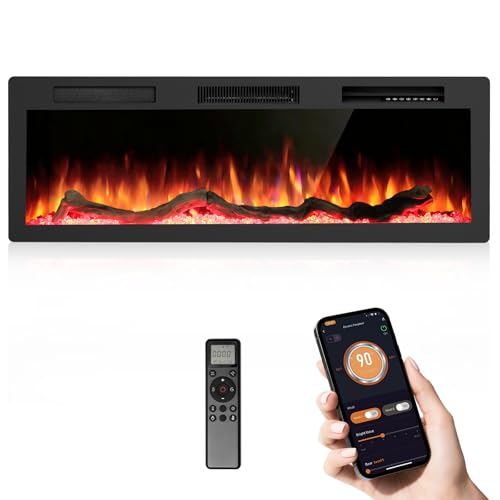
Best for Bedrooms suited to a wall-mounted or recessed fireplace
This is a fixed fireplace rather than a portable bedroom heater, but its 750 W and 1,500 W modes provide two heating levels. Choose it when you want supplemental zone heating and adjustable flame effects; the listing describes operation as low-noise without giving a decibel figure.
Heat output 750 W or 1,500 WNoise rating Low noise; no dB figure statedCoverage Up to 400 sq ftThermostat range 59°F to 95°FDimensions 50 in L × 17.32 in H × 5.71 in W
Why it made the cut
750 W and 1,500 W heating modes
Claimed zone heating up to 400 sq ft
Wall-mounted or recessed installation
Good to know
Requires wall-mounted or recessed installation
No numerical noise rating
Skip it if Skip it if you need a heater you can move between rooms.
A portable heater for indoor use that’s non-electric can’t deliver sustained bedroom heat without a fuel supply, and none of the recommended heaters here runs on solar power or a battery. The five picks in this guide are electric and need a household outlet; portable heaters for indoor use with no power aren’t among them.
Myth
A small solar panel or battery can replace a plug-in bedroom heater.
Fact
A 1,500 W resistance heater uses 1.5 kWh of electricity every hour. A portable battery or small solar setup generally isn’t a practical substitute for that draw over a cold night. A portable solar powered heater also needs enough stored or incoming energy to produce useful heat; the word “solar” doesn’t remove that requirement.
A non-electric portable heater isn’t a safe bedroom substitute unless it’s specifically rated for indoor use and set up exactly as its manual requires. Never run an outdoor, patio, torpedo or construction heater in a bedroom. Fuel-burning models can produce carbon monoxide; use an indoor-rated unit with the required ventilation and a working CO alarm, and choose a propane model with an oxygen depletion sensor. That sensor doesn’t replace ventilation or the alarm.
Before Considering an Indoor-Rated Fuel Heater
Confirm the heater is specifically rated for indoor use and read its ventilation requirements.
For propane, confirm it has an oxygen depletion sensor.
Use a working carbon monoxide alarm in the home.
Check local code: vent-free gas heaters are banned or restricted in some states and cities.
Safe indoor portable heaters without electricity aren’t a simple category: fuel, ventilation, the room and local rules all matter. A properly installed vented heating system is a different category from a portable bedroom heater; don’t assume a vent-free gas model is legal where you live. If you need dependable heat during outages, plan for an approved heating system rather than bringing an outdoor heater indoors.
How to Choose a Quiet Heater for a Bedroom
For a portable heater for a bedroom, compare the stated noise, airflow and safety features—not just the heat setting. The manufacturer-provided ratings are 34 dB for the DREO Quiet Space Heater, 35 dB for the R.W.FLAME Small Space Heaters for Indoor Use and 37.5 dB for the DREO Space Heater; none guarantees that fan noise will be inaudible.
Pick
Stated noise
Useful distinction
DREO Quiet Space Heater
34 dB
ETL-certified; lowest stated noise here
R.W.FLAME Small Space Heaters for Indoor Use
35 dB
ETL-certified; claimed coverage of 200 sq ft
DREO Space Heater
37.5 dB
ETL-listed; 70-degree oscillation and thermostat adjustable from 41°F to 95°F
Noise figures are manufacturer-provided; room acoustics and the heater’s operating mode affect what you hear.
Ceramic heaters use a fan to move warmed air, so airflow and fan sound come with the format. Oscillation spreads that airflow across a wider area; a thermostat cycles heat on and off to maintain its setting. Oil-filled radiators heat more slowly and don’t use a fan, but they aren’t among these product picks.
12.5 A
Approximate draw of a 1,500 W heater at 120 V
That’s a substantial load for a standard household circuit. Plug the heater directly into a wall outlet, not an extension cord or power strip.
For a safe electric space heater for a bedroom, look for tip-over and overheat shutoff plus a UL, ETL or CSA listing. Product 1 and product 4 are ETL-certified; product 3 is ETL-listed. Simple controls matter at night, too—an impressive feature set is less useful if you have to fumble through it half asleep.
Match the Heater to Your Priority
Lowest stated noise: product 4, rated at 34 dB.
Broader airflow: product 3, with 70-degree oscillation.
Claimed coverage: product 1, listed for 200 square feet.
Installed smart controls: product 2, the R.W.FLAME Smart Electric Fireplace, with Wi-Fi and Alexa controls. It’s a wall-mounted or recessed electric fireplace, not a portable heater or movable bedside unit.
The safest indoor portable heater is one with the right safety shutoffs and a recognized listing, used as its manual directs; no feature makes unsafe placement safe. For a closer look at bedroom safety features, see this safe electric space heater for bedroom guide.
What a 1,500 W Bedroom Heater Costs to Run
Portable electric heaters for indoor use draw 1.5 kWh for every hour a 1,500 W heater runs at full power, so a portable heater used eight hours nightly can add up. At an assumed $0.17 per kWh, that’s $2.04 a night before thermostat cycling.
Heater
Watts
Per hour
Per day (8 h)
Per month (30 days)
1,500 W portable heater
1,500 W
26¢
$2.04
$61.20
Calculated at 17¢ per kWh. Assumes the heater runs at full power for 8 hours each day and electricity costs $0.17 per kWh.
A thermostat can lower the bill by switching the heating element off when the room reaches its set temperature. The fan may continue running, depending on the model. Cycling reduces actual electricity use compared with running continuously, but it doesn’t make the heater more efficient at turning electricity into heat. ECO mode is a control strategy, not a guaranteed savings percentage.
Coverage Depends on the Room
R.W.FLAME’s Small Space Heater and GiveBest’s portable heater each claim coverage up to 200 square feet. Treat that as a product claim, not a promise: poor insulation, drafts, high ceilings and cold outside walls can leave a room harder to heat.
A Small Bedroom Example
Say your bedroom is 10 by 12 feet, or 120 square feet. That’s below the products’ stated 200-square-foot coverage, but a drafty window can still make the heater run longer and cost more than the full-power estimate suggests.
Room area120 sq ft
Full-power use1.5 kWh per hour
At $0.17/kWhAbout $0.26 per hour
About 12.5 A
Current draw at 1,500 W and 120 V
A standard 15 A circuit can trip if the heater shares it with another heater or a large appliance. Check what else is on that circuit before adding a heavy load.
Safe Bedroom Heater Setup and What to Do Next
To use a portable heater safely, plug it directly into a wall outlet, keep 3 feet of clearance, and don’t run it while you sleep or leave home unless the manufacturer says that model is designed for it. Check the manual, and keep the heater clear of bedding, curtains and furniture.
Before You Turn It On
Never use an extension cord or power strip with an electric heater. Choose a model with tip-over and overheat protection and a UL, ETL or CSA listing. Stop using it if the cord, plug or case is damaged, or if it smells burnt; unplug it when safe to do so.
A fan heater blows room air across an electric heating element and sends the warmed air back into the room. For the search “portable fan heaters stripdown how,” the safe answer is: don’t open or strip down a heater to troubleshoot it. Use the manual’s checks or have a qualified repair person assess it.
1
Measure the room and check drafts
Note the floor area and look for cold air around windows and doors. A stated coverage area may not account for a drafty or poorly insulated room.
2
Choose your noise and control tradeoff
Compare the listed noise rating with features such as oscillation and thermostat adjustment; pick the controls you’ll actually use.
3
Confirm the outlet and circuit
Use a wall outlet, and check that another heater or large appliance isn’t sharing the 15 A circuit.
4
Set it on a clear, stable surface
Keep 3 feet between the heater and bedding, curtains, furniture or other combustibles.
5
Set the thermostat and timer
Follow the manual’s instructions. Don’t leave the heater running unattended or overnight unless its manufacturer explicitly permits that use.
Searches for portable heaters for indoor use at Walmart, portable space heaters indoor at Walmart, or Amazon portable heaters don’t guarantee a particular model is in stock. Availability varies; check the product’s safety features and manual before you buy or use it.
Questions People Ask
Are portable gas heaters safe to use indoors?
Only a heater specifically rated for indoor use is suitable, and it must be operated with the ventilation required by its manual and a working carbon monoxide alarm. Never use a patio, construction or other outdoor gas heater in a bedroom.
How does a portable propane heater work?
A portable propane heater burns propane to produce heat, so it also produces combustion gases that need proper ventilation. For indoor use, choose an indoor-rated model with an oxygen depletion sensor, follow its manual, and keep a working CO alarm nearby.
Are portable natural gas heaters ventless?
Some natural gas heaters are designed to operate without a flue, but vent-free models are restricted or banned in some states and cities. Check local code before buying, and follow the model’s installation and ventilation instructions.
Can a portable solar-powered heater warm a bedroom?
Solar panels can power electric heat only when they provide enough electricity for the heater’s demand; a typical plug-in heater draws up to 1,500 W. A small portable solar setup is unlikely to provide that output steadily through the night, especially without a suitably sized battery.
Is there a safe battery-operated indoor heater?
Battery-powered electric heaters are generally limited by the large amount of energy resistive heat needs, so they’re not a practical substitute for a plug-in bedroom heater. Don’t use a fuel-burning heater in a bedroom unless its manufacturer specifically rates it for indoor use.
Can I leave a portable electric heater on while I sleep?
Only if the manufacturer explicitly says that model is designed for unattended or overnight use. Otherwise, turn it off before sleeping; plug it directly into a wall outlet and keep it at least 3 feet from bedding and other combustibles.
Why does my portable fan heater make noise?
The fan motor and moving air are usually the main sources, and dust on the intake or fan can make the sound louder. Turn the heater off and unplug it before checking for visible dust; stop using it if you hear scraping, rattling or electrical buzzing.