Product 3 is the best rated space heater for most readers who want fast warm-up. Its 1500W PTC heat, 34dB noise level, and tight thermostat control make it a strong pick for bedrooms and offices up to about 200 sq. ft. The usual mistake is buying by looks or a big-sounding marketing claim, then discovering the room is too large or the circuit is already crowded.
What to remember
Choose 1,500W for most plug-in space heaters; that is the ceiling for a normal 120V household outlet.
Match the room size to the heater’s stated coverage, then give yourself a little margin for drafty rooms.
Pick a model with tip-over and overheat protection, and plug it straight into the wall.
For sleep or a home office, a 34dB to 35dB heater is easier to live with than a loud fan model.
If you want to cut run time, use ECO mode or a thermostat instead of blasting full heat all night.
Fast heat comes from 1,500 watts, a small room, and a heater that moves air well. In a typical bedroom or office, that means warm air within seconds, not after the room has already gone cold enough to develop opinions.
The trap is picking the wrong size. A heater that is too small runs flat out and still feels weak; one that is too large can cycle hard, dry the air, and waste power if you only needed spot heat.
Best Rated Space Heaters That Warm Up Fast
#1Best for most rooms
DREO Portable Electric Heater with Thermostat
Best for Bedrooms and offices up to 200 sq ft where noise matters
The 1500W PTC system and heat funnel design push warm air up to 200% farther than older heaters, so you feel it in seconds. The NTC thermostat holds temperature in 1°F steps from 41 to 95°F, and the brushless DC motor keeps noise at 34dB—quieter than a whisper. The tilt sensor and V0 flame-retardant case meet ETL standards, and the 12-hour timer shuts it off while you sleep.
Heat output 1500W PTC ceramicCoverage Up to 200 sq ftNoise level 34dBThermostat range 41–95°F, ±1°F incrementsSafety ETL-certified, tip-over and overheat protection, V0 flame re
Why it made the cut
34dB operation won’t wake light sleepers
Thermostat adjusts in 1°F increments for tight control
Tilt-detection sensor and overheat shutoff
ECO mode and fan-only setting extend use year-round
Good to know
No oscillation, so you’ll need to aim it
Remote required for some settings
Handle design limits placement on narrow shelves
Skip it if Skip it if you need to heat a room larger than 200 sq ft or want oscillation to spread warmth without repositioning the unit.
Best for Living rooms and basements up to 250 sq ft that need wide-angle heat
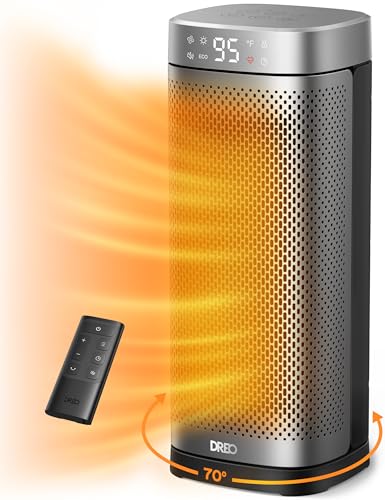
Hyperamics tech pushes heat at 11.8 ft per second, and the 70° oscillation spreads it across 250 sq ft without repositioning. The digital thermostat works in 1°F steps between 41 and 95°F, so ECO mode can cycle the heater to hold your target and cut waste. Shield360° safety includes tip-over and overheat shutoffs, a 24-hour auto-off, and a safety plug.
Heat output 1500W PTC ceramicCoverage Up to 250 sq ftOscillation 70° wide-angleNoise level 34dBSafety ETL-listed, Shield360° with tip-over, overheat, 24-hour auto
Why it made the cut
70° oscillation covers more floor area
Heats up to 250 sq ft, larger than most plug-in models
34dB brushless motor for quiet bedrooms
24-hour auto-off if you forget it
Good to know
16-inch height may block outlets on crowded walls
No remote mentioned in the data
Oscillation motor adds one more part to fail
Skip it if Skip it if your room is under 200 sq ft; the oscillation and larger footprint are overkill for a home office or single bedroom.
Best for Large rooms where you want set-and-forget heating with a remote
The trackball oscillation system is rated for over 750,000 cycles and boosts heating coverage by 20% with its 70° sweep. ECO mode uses the built-in sensor to toggle between 1000W and 1500W, holding your set temperature without constant adjustments. At 34dB the oblique airflow fan runs 12% quieter than older designs, and the remote lets you change modes from across the room.
Best for Desks, RVs, and bedrooms up to 200 sq ft where you move the heater daily
The handle and lightweight body let you carry it from bedroom to bathroom in seconds, and the 2-second PTC ceramic element delivers heat the moment you plug it in. The thermostat holds temperature within ±1°F, and ECO mode claims to save 20% over traditional heaters by cycling the element. Child lock, 45° tip-over shutoff, and overheat protection cover the safety basics, and the 24-hour timer shuts it off after eight hours in bed.
Heat output 1500W ceramic PTCCoverage Up to 200 sq ftNoise level 35dBThermostat ±1°F precisionSafety ETL-certified, tip-over, overheat, child lock
Why it made the cut
Lightweight with carry handle for daily moves
Remote and touch controls for couch or desk use
ETL-certified with child lock and tip-over shutoff
Best for Living rooms up to 400 sq ft where you want a fireplace look and app control
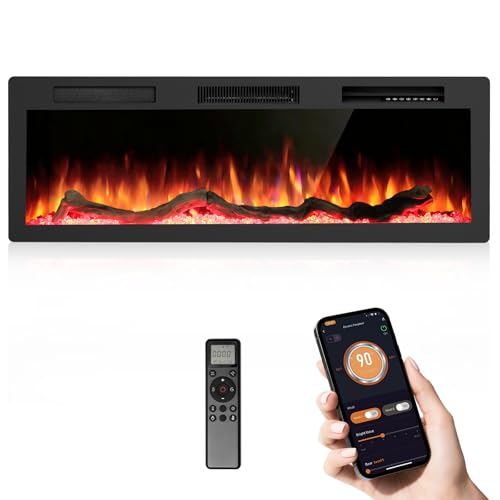
This isn’t a portable heater—it mounts to the wall or recesses into a 48 × 16.9-inch opening and heats up to 400 sq ft at 1500W. The 12 flame colors, five speed settings, and six brightness levels give you 144 combinations, and the sound effects (crackling firewood, rain, ocean) play through built-in speakers. Alexa and smartphone control mean you can start it from bed, but the real draw is the visual: it’s decor that also heats.
Heat output 750W or 1500WCoverage Up to 400 sq ftDimensions 50 × 17.32 × 5.71 inchesInstallation Wall-mounted or recessedControl Remote, touch panel, smartphone, Alexa
Why it made the cut
400 sq ft coverage, largest of this group
Wall-mount or recessed install for permanent placement
Alexa and app control from anywhere in the house
144 flame color combinations and six sound effects
Good to know
Requires wall installation, not portable
50-inch width won’t fit smaller rooms or apartments
Flame effects and speakers add cost over a plain heater
Skip it if Skip it if you need to move your heater or rent your home; this is a semi-permanent install for homeowners who want a fireplace without the chimney.
Electric Space Heaters Best Rated For Fast Warm-Up
A 1,500 W ceramic heater with a fan is the fastest practical choice for most rooms on a standard 120 V outlet. That’s the upper limit before you trip a 15 A breaker, and it’s enough to noticeably warm a bedroom or office in about ten minutes if the room is reasonably insulated and the heater sits close to where you need it.
PTC ceramic heating elements paired with a fan push heated air across the room instead of waiting for convection to carry it. The fan makes the difference: radiation from a panel or oil-filled radiator warms objects slowly, while forced air circulates and mixes with cool air fast enough that you feel the change within a few minutes. A built-in thermostat stops the heater once the target is reached, so the room doesn’t overshoot and waste power cycling on and off all night.
In short
Look for 1,500 W, a PTC ceramic element, a fan, and a thermostat that holds a temperature instead of just high and low settings. Those four features together deliver the speed most people search for.
The DREO Space Heater (Product 3) is the best overall pick for readers who want fast warm-up without guessing. It delivers the full 1,500 W, runs at 34 dB on lower settings, and offers tight thermostat control from 41°F to 95°F. For bedrooms, the same model works well because the noise stays low and the timer runs up to 24 hours. Larger rooms up to about 250 sq. ft. are better served by the DREO 16 Inch Electric Heater (Product 4), which adds oscillation to spread warm air instead of heating one corner. If you want smart-home control, the R.W.FLAME Smart Electric Fireplace (Product 2) ties into voice assistants and app scheduling, though it’s designed for a fixed wall mount rather than moving room to room.
Buying filters that matter
1,500 W on a standard plug
Thermostat with a degree range, not just high and low
Noise rating under 40 dB for bedrooms
Timer that runs at least 8 hours
Tip-over and overheat shutoff
UL, ETL or CSA listing
Myth
The heater with the most features or the brightest display warms fastest
Fact
Wattage and airflow determine speed. A 1,500 W ceramic heater with a fan will always outpace a 1,000 W model with a nicer remote, and it’ll match any other 1,500 W unit because plug-in heaters top out at the same power draw on a household circuit.
The most common mistake is chasing the brightest-looking heater or the biggest marketing claim without checking the room size it’s rated for, the circuit capacity in the room, or whether the noise level suits a bedroom. A heater that’s too small for the space will run nonstop and never feel warm enough, while one plugged into a power strip shared with a laptop and a lamp will trip the breaker on the coldest night. Match the heater to the room and the outlet, and the speed will follow.
From HeaterGuides · our own guidePage 6: heat only the rooms you use. Page 10 covers space-heater safety.Winter Heating Bill CutterSee what every heater in your home really costs, heat the rooms you use, and cut the waste in 30 days.Cost-per-hour tables for every heaterThermostat schedule and draft-proofing planRunning-cost and bill calculator (Excel)$14.99$9.99Get it for $9.99See what's inside and watch the 2-minute video →14-page printable PDF + Excel calculator · instant download · 30-day refund
How Big A Room Each Heater Can Handle
The R.W.FLAME Small Space Heaters (Product 1) and the DREO Space Heater (Product 3) are rated for rooms up to about 200 sq. ft., while the DREO 16 Inch Electric Heater (Product 4) reaches about 250 sq. ft. Those numbers assume a room with average insulation, 8-foot ceilings, and doors that close. A drafty room, a space with 10-foot ceilings, or an uninsulated garage will need more heat than the label promises, so the safe move is to buy one size up if the room leaks air or you’re heating a basement or a bonus room over the garage.
Three rooms, three fits
A tight bedroom with one exterior wall and a closed door stays warm with a 200 sq. ft. heater running at medium once the room reaches temperature. A basement office with concrete walls and a small window needs the same heater running closer to high because concrete pulls heat away. A living room with open traffic to the kitchen and a stairwell will feel uneven unless you pick a model with oscillation to spread warm air, and even then it’s better to close off the room or accept that the far corner stays cooler.
Bedroom200 sq. ft. heater, medium setting
Basement office200 sq. ft. heater, high setting
Open living room250 sq. ft. heater with oscillation
Say your room is 12 by 14 feet. That’s 168 sq. ft., and a 1,500 W heater is the right class for that size. The room will warm in ten to fifteen minutes if you close the door and the heater sits a few feet from where you’re working or sleeping. If the room has a vaulted ceiling or a sliding door to a deck, expect the warm-up to take longer and the heater to cycle more often to hold temperature.
250 sq. ft.
Upper coverage for a plug-in heater
Beyond that size, a single 1,500 W unit struggles to keep up in cold weather. Two heaters on separate circuits or a permanently wired baseboard become better options than one portable heater running at full blast all day.
Oscillation helps in larger rooms by sweeping warm air across the space instead of blasting one corner and leaving the rest cold. The DREO 16 Inch Electric Heater oscillates and covers more ground than a fixed unit, which is why it’s rated for 250 sq. ft. instead of 200. In a narrow room or a home office where you sit in one spot, oscillation doesn’t add much, and a fixed heater pointed at your desk is often the better call. For garages, workshops, or other spaces where insulation is thin, consider a ventless garage heater designed for that environment instead of expecting a bedroom heater to warm an uninsulated two-car bay.
Open floor plans
A space heater warms the air it can reach. In a room with an open doorway to a hallway or a pass-through to the kitchen, warm air drifts out and cold air replaces it. Close interior doors while the heater runs, or accept that it’ll work harder and cost more to maintain temperature.
What Running A 1,500W Heater Costs
Your electric bill depends on three things: how many watts the heater pulls, how many hours it runs, and what your utility charges per kilowatt-hour. Most plug-in space heaters max out at 1,500 W on a standard 120 V outlet, but the real cost hinges on duty cycle—how often the heater actually fires once the thermostat or ECO mode takes over.
Here’s the arithmetic: divide watts by 1,000 to get kilowatts, multiply by hours, then multiply by your electric rate. Running 1,500 W for 8 hours straight is 12 kWh; at 17 cents per kWh that’s about $2.04 for the night. Most heaters cycle on and off, so the average draw is lower. ECO mode on the DREO Space Heater (Product 3) cuts runtime by keeping the element off once the room reaches your set point, which can halve the monthly total compared to leaving it on high all day. For a battery‑powered option, see the milwaukee space heater review.
Heater
Watts
Per hour
Per day (8 h)
Per month (30 days)
1,500 W space heater (high, continuous)
1,500 W
26¢
$2.04
$61.20
1,500 W heater with thermostat (50% duty cycle)
750 W
13¢
$1.02
$30.60
500 W personal heater
500 W
8.5¢
68¢
$20.40
Calculated at 17¢ per kWh. A thermostat that cycles the heater on and off can cut the bill in half compared to continuous high heat, even though the nameplate wattage stays the same.
Use case matters more than the spec sheet. Heating a bedroom for an hour while you get dressed costs pennies; leaving the same heater on all evening in a drafty living room adds up fast. Products 1, 3, 4 and 5 all pull the same 1,500 W at full power, so the one with the tightest thermostat control and the quietest fan wins on monthly cost because it shuts off sooner and stays off longer.
Check your rate
Your utility’s price per kWh appears on your bill, usually under the supply or energy charge line. Rates range from about 11 cents in Louisiana to over 30 cents in California, so the same heater’s monthly cost can triple depending on where you plug it in.
Safety And Certification For Plug-In Heaters
Plug straight into a wall outlet, never into an extension cord or power strip. Space heaters pull 12.5 amps at 1,500 W, close to the 15-amp limit of most household circuits, and the extra resistance in a cord or strip can overheat the connection. Products 1, 3, 4 and 5 all need a dedicated outlet with nothing else drawing power on the same circuit.
Clearance is non-negotiable
Keep 3 feet of open space around the heater—front, back and sides. Curtains, bedding, clothing and furniture that drift into that zone are the leading cause of space heater fires. Don’t run a heater where blankets can fall onto the grille or under a desk where your feet can block the intake.
Look for an ETL or UL listing on the label or in the manual, along with tip-over shutoff, overheat protection, and flame-retardant housing. Every heater on this list carries those features. Products 3 and 5 add a timer and an auto-shutoff after a set number of hours, which matters if you tend to fall asleep with the heater on. No space heater should be left running when you leave the house unless the manufacturer explicitly says the model is designed for unattended operation; none of these five make that claim.
Myth
A small plug-in heater is automatically safe because it only draws household current.
Fact
Size and wattage alone don’t guarantee safety. Every 1,500 W heater produces the same heat and pulls about 12.5 amps. What matters more is the presence of a tip-over switch, an overheat cutoff, keeping the heater clear of combustibles, and plugging it directly into a properly rated wall outlet rather than an extension cord or power strip not designed for high current.
Before you plug it in
Confirm the outlet is on a dedicated 15 A circuit with no other high-draw appliances
Clear 3 feet around the heater in every direction
Check that the cord is intact, with no fraying or loose prongs
Set the heater on a hard, level surface—never on carpet, bedding or furniture
Test the tip-over switch by gently tilting the unit; it should shut off immediately
Bathrooms and laundry rooms need extra caution. Keep the heater outside the tub and shower splash zone, and don’t run it where steam can condense inside the housing. Products 3 and 4 specify indoor use but do not carry an IP rating for wet locations, so treat them as dry-room appliances.
Highest Rated Tankless Water Heaters And Wood Stoves
Highest rated tankless water heaters and wood stoves solve different problems than plug-in space heaters, and buying the wrong category costs you time and money. Tankless water heaters deliver endless hot water for showers, dishes and laundry, sized by flow rate—gallons per minute—and how much they can raise the inlet temperature in your climate. Gas models from Rinnai and Rheem earn high marks, as do 240 V electric units from Stiebel Eltron and EcoSmart, but gas connections, venting and high-voltage electrical work are licensed-plumber and licensed-electrician jobs in most places. Set the outlet temperature no higher than 120°F to avoid scald risk at the tap.
Highest rated wood stoves are EPA-certified models matched to your square footage and chimney. Brands like Jøtul, Vermont Castings and Drolet publish heat-output ranges and required clearances to walls and combustibles; those numbers come from the safety listing and aren’t negotiable. Installation follows the manufacturer’s manual and local code, and chimneys need yearly inspection and sweeping. Wood stoves heat whole rooms or open floor plans—they’re not a substitute for a bedroom space heater you plug in and move around.
Different jobs, different tools
If your water runs cold after one shower or you want to heat a cabin with cordwood, a tankless heater or wood stove is the right answer. If you need warmth in one room this winter without opening walls or hiring trades, stick with a plug-in electric space heater.
Never cap or plug a T&P valve
Water heaters—tank or tankless—have a temperature-and-pressure relief valve. It’s a safety device, not an optional part. If it drips or leaks, replace the valve or call a plumber; never plug or cap it.
For fast warm-up in a bedroom, office or basement room, portable ceramic space heaters deliver heat in minutes on a standard outlet. Tankless water heaters and wood stoves are whole-house decisions with permitting, installation cost and ongoing fuel or maintenance. Choose the category that matches the job in front of you, not the one with the highest star rating on a retail site.
Questions People Ask
Which electric space heater warms up the fastest?
A 1,500 W ceramic heater with a fan delivers heat within seconds because the PTC ceramic element heats almost instantly and the fan pushes warm air into the room right away. Oil-filled radiators take 15 to 30 minutes to reach full output because they heat thick oil first, then radiate that warmth slowly. If you need warmth the moment you flip the switch, ceramic with a fan is the clear winner.
What size space heater do I need for a 200 sq. ft. room?
A 1,500 W heater covers about 150 to 200 sq. ft. in a room with standard insulation and 8-foot ceilings; that’s roughly a 14 by 14 foot bedroom or a 12 by 16 office. Poorly insulated rooms, high ceilings, or a lot of single-pane glass will push you toward the low end of that range. Measure your room’s length and width, multiply to get square feet, and stay within the heater’s rated coverage.
How much does a 1,500W space heater cost to run for 8 hours?
At the national average of about 17 cents per kWh, running 1,500 W for 8 hours costs roughly $2.04 per night: 1,500 W ÷ 1,000 × 8 hours = 12 kWh, then 12 × $0.17 = $2.04. Your bill will be lower if the heater cycles on and off with a thermostat instead of running flat out. Check your utility bill for your exact rate, which can range from 10 cents in some states to over 30 cents in others.
Is a ceramic space heater better than a fan heater?
Most plug-in space heaters with fans use ceramic heating elements, so the two terms overlap more than they compete. The advantage of a ceramic PTC element is that it heats up in seconds and has built-in thermal protection that stops it from overheating. An old-style coil heater with a fan also warms quickly, but ceramic models tend to run a bit safer and more efficiently at the same wattage.
Can I use a space heater with an extension cord?
No. A 1,500 W heater pulls about 12.5 amps, close to the 15-amp limit of a standard household circuit, and even a heavy-duty extension cord adds resistance that can overheat the wire and start a fire. Plug the heater straight into a wall outlet with nothing else on the same circuit. If the outlet is too far away, move the heater or have an electrician install a new outlet closer to where you need it.
What is the safest space heater for a bedroom?
Look for a heater with tip-over shutoff, overheat protection, and a UL or ETL listing, and one that stays cool to the touch on the outside. The DREO Space Heater (Product 3) and similar models with enclosed ceramic elements and automatic shutoff meet those marks. Keep 3 feet of clearance on all sides, never leave it running while you sleep unless the manual explicitly says the model is designed for unattended use, and plug it directly into the wall.
Before you go · a welcome giftGet the Winter Heating Bill Cutter for $4.99See what every heater in your home really costs, heat the rooms you use, and cut the waste in 30 days. Normally $14.99; your welcome price saves $10.00. We'll email your link right now.or buy it now for $9.99 without the gift →One email with your link now. We never share your address.




 Winter Heating Bill CutterSee what every heater in your home really costs, heat the rooms you use, and cut the waste in 30 days.Cost-per-hour tables for every heaterThermostat schedule and draft-proofing planRunning-cost and bill calculator (Excel)