The best HEATAK Outdoor Patio Heater for most readers is Product 2: its 70,000 BTU output, 20-lb hopper, and gravity-fed pellet system give you the strongest long-burn heat for a patio or deck. Choose Product 4 if you want electric heat for a small seated area near an outlet.
The essentials
Product 2 is the best pick for most people who want the strongest long-burn patio heat from this lineup.
Product 1 gives you the highest BTU rating here, but the 6-hour burn claim makes it more of a large-space heater than a quick tabletop warmer.
Product 3 is the propane pick if you want wheels, piezo ignition, and simple on-demand heat.
Product 4 is the quiet electric option, but 900 W is for a small spot, not a whole patio.
Product 5 is the budget-style electric choice for close-range warmth, and it needs a wall outlet, not an extension cord.
A patio heater is one of those purchases that looks simple until you start comparing BTU, fuel, and how far the warmth really reaches. The half-true part is that higher BTU usually means more heat; the part that matters is whether that heat matches your seating area and fuel plan.
For this search, the HEATAK wood pellet models are the main draw. They give you flame-and-heat output you can feel, while the propane and electric options fit smaller spaces, lower mess, or places where you already have power.
HEATAK Patio Heaters Ranked By Use
#1Best Overall
HEATAK Pellet Patio Heater 70,000 BTU
Best for Patios and decks needing strong heat over 100 sq ft
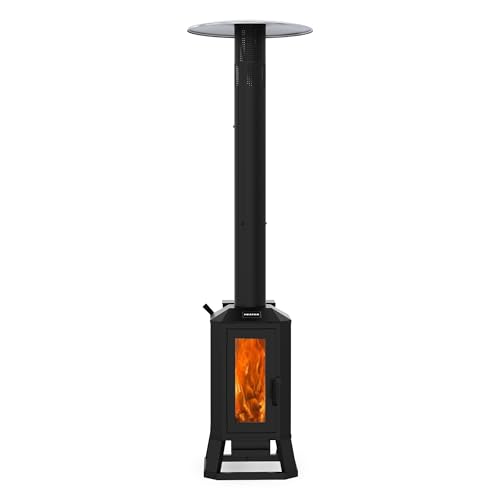
Product 2 is the strongest all-around pick for a patio or deck, with 70,000 BTU output and a 20-pound hopper. Its gravity-fed pellet system keeps heat consistent with less hands-on tending, while the glass flame window adds a pleasant glow.
Heat output 70,000 BTUFuel system 20-pound gravity-fed pellet hopperCoverage Over 100 sq ftConstruction Powder-coated steel body with steel chimney and stainless reIgnition Match or lighter
Why it made the cut
70,000 BTU output
20-pound gravity-fed hopper
Built-in glass flame window
Wheels make it easier to move
Good to know
Needs wood pellets and match or lighter ignition
The product data doesn’t state a runtime
Skip it if Skip it if you need electric heat near an outlet or only want to warm a very small seated area.
Best for Outdoor gatherings where up to 6 hours between refills matters
Product 1 gives you the highest listed heat output here at 75,000 BTU and can run for up to 6 hours without refilling. The glass viewing window suits patios, gardens, porches, and gatherings where the flame is part of the appeal.
Heat output 75,000 BTUFuel Wood pelletsRuntime Up to 6 hours without refillingAssembly Most parts pre-assembledViewing feature Glass viewing window
Why it made the cut
75,000 BTU output
Runs up to 6 hours without refilling
Glass viewing window
Most parts come pre-assembled
Good to know
The product data doesn’t state a heating area
Pellet fuel requires a refill after the listed runtime
Skip it if Skip it if you want a stated coverage area or a gravity-fed hopper system.
Best for Patios up to 200 sq ft where quick propane ignition matters
Product 3 is the practical propane alternative, with coverage listed up to 200 square feet and a push-button piezoelectric ignition. Its adjustable control valve, table design, and wheels make it useful around patio seating, coffee tables, or outdoor gatherings.
Heat output 50,000 BTUFuel PropaneCoverage Up to 200 sq ftIgnition PiezoelectricDesign Table design with stainless steel burner
Why it made the cut
Heats up to 200 sq ft
Piezoelectric ignition needs no battery
Adjustable temperature control
Wheels support repositioning
Good to know
Uses propane instead of wood pellets or electricity
Setup takes less than an hour according to the product data
Skip it if Skip it if you specifically want a HEATAK pellet heater or have no propane supply available.
Best for Small seated areas up to 15 sq ft near an electrical outlet
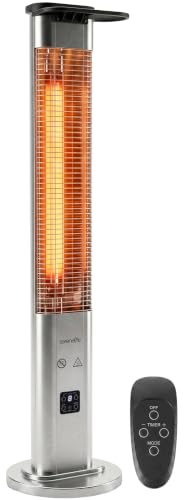
Product 4 makes sense when you want instant, odorless infrared heat without gas or pellets. Its 900-watt element, remote control, two heat levels, and IP65 design fit a small covered patio or porch area, while the tip-over and overheat protection add useful safeguards.
Power 900 wattsHeating range Up to 15 sq ftWeather rating IP65Controls Remote control and two heat levelsSafety 360-degree tip-over switch and overheat protection
Why it made the cut
Instant infrared heat
Two heat levels with remote control
IP65 weather-resistant design
Tip-over and overheat protection
Good to know
Heating range is limited to 15 sq ft
Requires an electrical outlet
Skip it if Skip it if you need to warm a large patio or want the reach of a fuel-burning heater.
Best for Compact spaces needing three electric heat settings
Product 5 is the portable electric option, measuring 6 by 8 by 15 inches and using a carrying handle for easy placement. Its 25-, 750-, and 1,500-watt modes let you choose between air circulation and heat, and the ceramic element reaches hot airflow in 2 seconds.
Power settings 25, 750, and 1,500 wattsSize 6 by 8 by 15 inchesHeating technology PTC ceramicHeating speed Hot airflow in 2 secondsSafety Automatic shutdown at 75 °C
Why it made the cut
Three output modes
Compact 6 by 8 by 15-inch size
Carrying handle
Overheat protection and automatic shutdown
Good to know
The product data doesn’t state a heating area
The 1,500-watt setting needs a suitable electrical outlet
Skip it if Skip it if you need infrared heat for a defined seated area or a larger outdoor heating range.
The right HEATAK Outdoor Patio Heater depends first on fuel: wood pellets give you a visible flame and a longer burn, propane starts faster, and electric heat works best over a small seating zone near an outlet. Wood pellet patio heaters for outdoor use suit dinners and longer stays, while outdoor gas patio heaters suit quick heat and simple fuel swaps.
The strongest long-burn pellet choice is Product 2, offering 70,000 BTU and a 20-lb hopper. If peak output matters more than hopper size, Product 1 reaches 75,000 BTU and runs up to 6 hours. Product 3 provides a propane option at 50,000 BTU. For smaller electric zones, Product 4 produces 900 W, while Product 5 delivers 1,500 W.
Heater type
Best fit
Product clue
Wood pellet
Visible flame and longer outdoor sessions
Product 2: 70,000 BTU, 20-lb hopper
Wood pellet
Higher stated output with a defined burn time
Product 1: 75,000 BTU, up to 6 hours
Propane
Fast starts and easy fuel changes
Product 3: 50,000 BTU
Electric or infrared
A small seated area beside power
Product 4: 900 W; Product 5: 1,500 W
Fuel-burning heaters generally suit more open-air space; electric outdoor heaters usually serve the seat cluster.
Decide Before You Buy
Measure the patio and mark where people actually sit.
Choose pellets, propane, or an outlet as your fuel source.
Decide if watching the flame matters to you.
Check if wheels will help you move the heater after it cools.
Infrared outdoor patio heaters are usually electric radiant heaters: they warm people and nearby surfaces rather than trying to heat all the moving air. That makes electric outdoor heaters useful beside a table or loveseat, but a poor match for a large exposed deck without nearby power. If that is your setup, compare electric infrared patio heaters for outdoor comfort before choosing a small plug-in model.
In short
Pick Product 2 for the best balance of strong pellet heat and long operation, Product 3 for quick propane heat, or Product 4 for a compact electric seating zone. Product 1 favors higher stated BTU, while Product 5 gives the highest electric output in this lineup.
Check Heat Radius Before You Buy
The heat radius of an outdoor wood pellet patio heater has no single number because open-air heat fades quickly; wind, chair placement, and the reflector shape can matter as much as BTU. Product 2 claims over 100 sq ft, while Product 3 claims up to 200 sq ft, but those figures work best as planning limits rather than a promise that every chair will feel equally warm.
Outdoor space
Practical starting point
Product fit
Small nook, up to about 15 sq ft
One or two seats close to the heater and an outlet
Product 4, rated up to 15 sq ft
Four-seat table or compact patio
Center the heater near the seating, then account for wind
Product 2, stated for over 100 sq ft
Larger open deck
Use a fuel-burning heater and keep the warm zone near the reflector
Product 3, stated for up to 200 sq ft
One chair or movable spot
Treat the heater as personal heat; no area claim is given
Product 5, small portable electric heater
Use the stated coverage as a ceiling for planning, not as a guarantee in windy weather.
Worked Example
Say your patio has four chairs around a table on a 12 by 14 ft deck, or 168 sq ft. A 900 W electric unit rated up to 15 sq ft will suit one seated nook, not all four chairs. A pellet heater such as Product 2 or a propane heater such as Product 3 is the more sensible starting point for the larger open deck, with chairs kept within the reflector’s warm side.
Patio12 × 14 ft
Area168 sq ft
Small electric claimUp to 15 sq ft
Product 2 claimOver 100 sq ft
Infrared heaters for outdoors can feel effective at close range because radiant energy reaches your body directly, even while the surrounding air stays cold. An infrared outdoor heater still needs the right angle and distance: aim it at the seated area, and don’t expect one small portable unit to warm an entire open patio.
200 sq ft
Largest stated coverage in this lineup
Product 3 lists up to 200 sq ft, but wind and an open layout can reduce the comfortable area.
Use an outdoor patio heater table like the one above as a seating-layout check, then compare the heater’s claimed area with the space you actually occupy. If you need mobility between seating areas, a heater from a guide to outdoor patio heaters on wheels may fit better than a fixed central unit.
Run The Numbers On Fuel And Power
For an outdoor gas heater on asphalt, there’s no universal cost estimate: propane cost depends on your tank price and burn time, while electric cost follows watts, hours and your utility rate. An outdoor propane heater is easier to price after you know the refill or exchange cost; pellet cost depends on the bag price and how long the hopper lasts.
Heater
Watts
Per hour
Per day (8 h)
Per month (30 days)
1,500 W electric heater
1,500 W
26¢
$2.04
$61.20
900 W electric heater
900 W
15¢
$1.22
$36.72
Calculated at 17¢ per kWh. Assumes 8 hours per day, 30 days, and electricity at 17 cents per kWh. Your bill changes with your actual rate and runtime.
The electric math is clean: watts ÷ 1,000 × hours gives kWh, and kWh × your rate gives the running cost. Propane heaters outdoor and outdoor heaters propane can be cheaper or dearer than electric depending on the refill price, flame setting, wind and how long the heater runs. Don’t compare BTU alone.
Refill Less Often
Product 2’s 20-lb hopper and Product 1’s claim of up to 6 hours matter more than headline BTU if you dislike carrying fuel outside. A larger hopper can make pellet heat easier to live with, but the actual burn time still depends on the setting and pellets.
If you heat only a few evenings each week and sit close to the source, electric can be cheaper to run because you pay for the hours you use and avoid fuel handling. If you need heat across a whole patio often, a pellet or propane unit is usually the better fit.
Buy For Safety And Clearance First
Outdoor gas patio heaters and pellet heaters belong outdoors only, with the clearances listed in the manual; use a working carbon-monoxide alarm nearby when the heater design or local code calls for one. An outdoor propane heater is not an outdoor tankless water heater, and a water-heater search result doesn’t belong in a patio-heater cart.
Keep Electricity Simple
Plug electric models straight into a wall outlet, never an extension cord or power strip. Keep at least 3 feet of clearance from curtains, furniture, siding and other combustibles, and don’t run the heater unattended unless its instructions specifically allow it.
Among the electric models, Product 4 stands out with ETL certification, tip-over and overheat protection, plus an IP65 rating. Product 5 also has ETL certification and overheat protection. Product 3 features a triple protection system, but you still need to follow the manual’s placement and clearance rules carefully.
Myth
Infrared outdoor patio heaters can be used anywhere because they don’t burn fuel.
Fact
Electric infrared heat still needs a suitable outlet, 3 feet of clearance and the protection features listed for that model. Product 4’s ETL, tip-over and overheat protections are useful checks; they don’t replace safe placement.
Before You Light Or Plug In
Confirm the heater is rated for outdoor use and sits on a stable surface.
Read the manual for clearance above, behind and beside the heater.
Keep pellet and propane models away from enclosed spaces, tents and vehicle cabins.
Check local rules before buying a vent-free gas model; those rules vary by state and city.
Keep the plug, cord and outlet dry on electric models.
What To Do Next For Your Patio
For the best pellet outdoor heaters, start with Product 2: this wood pellet outdoor patio heater is the strongest all-around choice for long, visible heat, while Product 1 suits the biggest output need.
1
Measure the seating area
Mark the chairs and table you actually want to heat, then account for wind and the heater’s clearance space. An open, windy patio needs more heating power than a sheltered corner.
2
Choose the fuel
Pick pellets for long-burning flame heat, propane for simpler portability, or electric for a smaller zone beside a suitable outlet. A 900 W electric unit can struggle outdoors when wind carries heat away; a larger pellet or propane heater is the more practical choice.
3
Check the clearance space
Confirm the heater can sit on a stable, noncombustible surface with the manufacturer’s required distance from furniture, walls, overhead cover and foot traffic. Don’t buy first and measure later.
4
Match the pick to the job
Choose Product 2 for the best pellet balance and long burn, Product 1 for the biggest pellet output, Product 4 for a smaller electric seating zone, or Product 3 when moving a propane heater matters most.
Make the decision
If your patio is open and windy, choose Product 1 or Product 2 before a 900 W electric heater. If you sit near an outlet, choose Product 4; if the heater must move around the yard, choose Product 3.
More Questions, Answered
What is the heat radius of a wood pellet patio heater?
There isn’t a dependable fixed radius for a wood pellet patio heater because wind and seating distance change the result. Treat the listed output and reflector as comparison points, then place chairs close enough to share the radiant heat without crowding the heater or its required clearances.
Are outdoor electric heaters good for a covered patio?
They can be a good fit for a covered patio if the model is rated for that location and the outlet can handle its load. Keep the heater away from rain, follow the mounting clearance, and plug it directly into a suitable wall outlet rather than an extension cord or power strip.
How long does a pellet patio heater run on one hopper?
A 20-lb hopper doesn’t provide one guaranteed runtime because pellet feed rate changes with the heat setting and heater design. Product 2’s gravity-fed hopper supports a longer burn, but use the manufacturer’s burn-rate or runtime figure before planning an evening around one fill.
Is a propane patio heater better than a pellet heater?
Propane is the better choice when you want quick startup and simple heat control, while pellets suit you if a visible flame and longer unattended burn matter more. Propane also needs a compatible tank and safe outdoor placement; pellets need fuel storage, ash cleanup, and time to light.
Can I use a patio heater indoors or in a garage?
No—don’t use an outdoor patio heater in a room, tent, or garage, even with the door open. Combustion can produce carbon monoxide, and the heater’s clearances and ventilation are designed for outdoor air; choose an indoor-rated heater made for the space instead.