For most homes, the best hot water heater temperature setting is 120°F. It limits scald risk while providing enough hot water for everyday use. Check the temperature at a tap rather than trusting a dial, since a control marked “Hot” or “A” doesn’t tell you the water’s actual temperature.
The essentials
Start at 120°F for a typical home and verify the result at a hot-water tap.
Wait several hours after changing a tank thermostat before checking the new temperature.
Electric tank thermostats are usually behind access panels; turn off the breaker before opening one.
A tankless heater’s outlet setting does not guarantee the same temperature at every tap.
Use a mixing valve or ask a plumber about safer delivery temperatures if someone at home is especially vulnerable to burns.
A temperature setting is a trade-off: hotter storage can reduce the risk of bacteria growing in a tank, but water above 120°F can scald. Household needs, plumbing, and any mixing valve affect the right setup.
If you’re shopping because your heater can’t hold temperature or supply enough hot water, compare models by the job they can actually do—not by a temperature dial alone.
Tankless Heaters for Specific Hot-Water Jobs
#1Best for whole homes
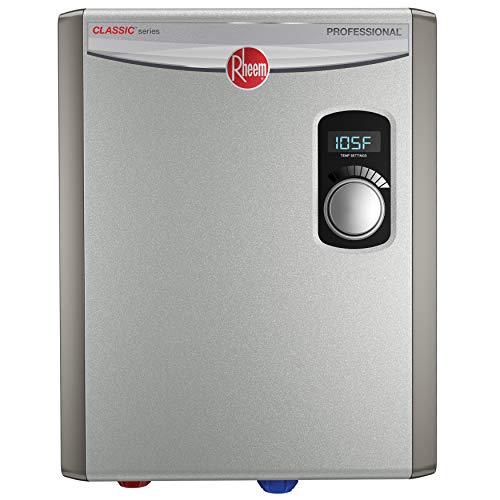
Rheem 18kW Whole-Home Tankless Heater
Best for Homes needing tankless hot water at multiple fixtures
Product 4 is the only model here with a stated flow rate up to 4.4 GPM, making it the strongest fit for broader household demand. Its self-modulation adjusts power as hot-water demand changes, while the external digital control shows the selected temperature with ±1 degree accuracy. Plan for proper electrical installation before choosing it.
Power 18kWVoltage 240VFlow rate Up to 4.4 GPMTemperature control External digital thermostatic control with LED display, ±1 d
Why it made the cut
Up to 4.4 GPM flow rate
Self-modulating power
External digital thermostatic control
Good to know
18kW, 240V installation is a substantial electrical project
The data does not state a temperature range
Skip it if Skip it if you need a simple under-sink heater or aren’t prepared for a 240V installation.
Best for A kitchen or bathroom sink that needs point-of-use hot water
Product 3 fits a single sink because its compact design mounts under the sink and its LED display shows the outlet temperature. The 3000W element can raise water by 82°F at 0.3 GPM or 131°F at 0.5 GPM, so flow and incoming water temperature decide how hot the stream gets. Its dry-boil, overheating and leakage protections add useful safeguards.
Power 3000WVoltage 110VTemperature control LED display; outlet temperature requirementFlow rate 0.3 GPM at 82°F rise; 0.5 GPM at 131°F rise
Why it made the cut
Compact under-sink design
LED temperature display
Dry-boil and overheating protection
Good to know
The stated flow rates are limited
Vertical installation only
Skip it if Skip it if you need simultaneous hot water at several fixtures.
Best for Under- or over-sink hot water where a 120V hardwired circuit is available
Product 5 gives you a 86°F to 131°F setting range, a digital display and 1° temperature adjustments for a single faucet. Its self-modulating control changes power with inlet flow and temperature, while the 0.4 to 0.66 GPM range suits point-of-use work. The 32A double-pole breaker and 10AWG minimum wire requirement make the electrical setup a serious part of the purchase.
Power 3500WVoltage 120VTemperature control 86°F-131°F range; 1° incrementsFlow rate 0.4 GPM-0.66 GPM
Why it made the cut
86°F to 131°F temperature range
Temperature adjusts in 1° increments
Self-modulating power
Good to know
Must be hardwired; it has no plug
Requires a 32A double-pole breaker and 10AWG minimum wire
Flow rate is limited to 0.4-0.66 GPM
Skip it if Skip it if you want a plug-in appliance or don’t have the required circuit installed by a qualified professional.
Best for Supplemental warmth in a bedroom, office or other small room
Product 1 heats room air, not water, so it can’t replace or adjust a water heater. Its 1500W ceramic element, thermostat and 45° tip-over shutoff may help with a chilly room while you work on the actual hot-water system. Use it only for the space-heating job it was designed to do.
Power 1500WVoltage —Temperature control Thermostat with ±1°F precisionFlow rate —
Why it made the cut
1500W ceramic heating
Thermostat with ±1°F precision
45° tip-over shutoff and overheat protection
Good to know
Does not heat water
The data does not state a voltage
Skip it if Skip it if your problem is tap temperature or a tankless water-heater setting.
Best for Supplemental room heat with an electric-fireplace installation
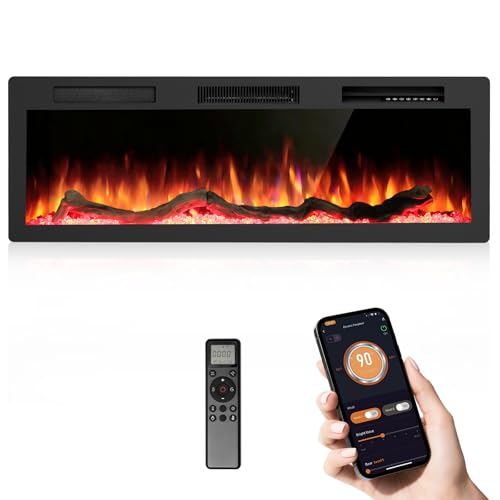
Product 2 is a wall-mounted or recessed electric fireplace for room air, not a domestic hot-water appliance. Its two heat modes provide 750W or 1500W, with a 59°F to 95°F temperature setting range and supplemental coverage up to 400 square feet. It belongs in a room-heating decision, not a water-heater setting decision.
Power 750W or 1500WVoltage —Temperature control 59°F-95°F setting rangeFlow rate —
Why it made the cut
750W and 1500W heat modes
59°F-95°F temperature setting range
Wall-mounted or recessed installation
Good to know
Does not heat water
Designed for supplemental zone heating
The data does not state a voltage or flow rate
Skip it if Skip it if you’re trying to set a tank, point-of-use heater or whole-home tankless unit.
Finding the Best Hot Water Heater Setting Seamlessly
For most homes, the best hot water heater temperature setting is 120°F, the usual household starting point and the standard temperature most people mean. It’s also the recommended setting for ordinary taps because hotter water can scald, especially children and older adults.
Your heater’s dial doesn’t confirm the temperature coming out of the tap. Controls and labels vary by model, and a mark such as “Hot” or “A” isn’t a temperature reading. Check the actual water with a thermometer.
1
Run the hot water
Choose a nearby hot-water tap and let it run until the temperature stops changing.
2
Collect a sample
Fill a cup with hot water, keeping your hands out of it.
3
Measure carefully
Place a thermometer in the cup and read the temperature without touching the water.
Don’t trust the label
A dial position is a starting point, not proof that the water reaches 120°F. The tap measurement is what matters.
If the result is above 120°F, the water may burn before you can react. Keep the maximum temperature at ordinary household taps to 120°F unless a qualified professional advises otherwise. Unusual health risks, vulnerable occupants, or equipment requirements can change the right setup; ask a professional whether a mixing valve is appropriate rather than simply raising the storage temperature.
From HeaterGuides · our own guidePages 9 to 13 are the fault flowcharts: no hot water, noises, smells and leaks, in order.Water Heater Owner's ToolkitFix the common faults yourself, keep it running for years, and know when a repair is money wasted.No-hot-water flowcharts, gas and electricFlush, anode, relief valve and descaling stepsRepair-or-replace calculator (Excel)$14.99$9.99Get it for $9.99See what's inside and watch the 2-minute video →18-page printable PDF + Excel calculator · instant download · 30-day refund
Adjust the Control Without Guessing
Change the water heater control in small steps, then give a storage tank several hours to stabilize before checking the tap temperature again. The right procedure depends on whether your heater is electric, gas, or tankless.
1
Electric tank
The thermostats are commonly behind access panels. Switch off the heater’s breaker before removing a panel, and follow the model manual for the adjustment. The breaker supplies power; it doesn’t set the water temperature.
2
Gas tank
Use the marked temperature control as described in the manual. Don’t remove covers or disturb gas connections to reach or change the control.
3
Tankless unit
Use the unit’s temperature control or display and follow its manual. Don’t assume a dial position on one model means the same temperature on another.
If you’re searching for “electric hot water heater save settings,” use a labeled energy-saving or vacation mode only as the manufacturer directs. These modes differ by model, so there’s no universal dial position to copy.
“Pilot” is a gas heater operating position, not a temperature setting for everyday use. It keeps the pilot flame lit and normally suspends water heating; use it only as the manual instructs.
Leave electrical panels and gas connections alone
The breaker in the fusebox supplies power to an electric heater; it doesn’t control its temperature. Don’t open an electrical panel or alter wiring to adjust the setting, and don’t disturb gas connections. If the control or its instructions aren’t clear, contact a qualified technician.
After the adjustment, allow several hours for a tank to settle and recheck the water at a tap with a thermometer. For other water-heater settings and what they do, see water heater settings.
Balance Scald Protection With Tank Hygiene
Set a home water heater to 120°F at the tap as the usual maximum for burn prevention; above 120°F, scalds become more likely and hotter water can cause a more severe burn in less time. That is the practical answer to “doe water heater temperature setting 120 f safety” and “water heater temperature setting safe.”
A hotter tank can help limit bacterial growth during storage, but raising the thermostat also increases burn risk and energy loss. No single temperature setting eliminates Legionella risk, so follow the heater instructions and local requirements rather than treating 120°F as a guarantee.
Myth
A thermostat marked 120°F means every fixture delivers water at exactly 120°F.
Fact
The dial is a setting, not a measurement at the faucet. Pipe length, mixing valves, temperature swings and control accuracy can change the water temperature, so check the hottest frequently used tap with a thermometer.
Protect Higher-Risk Households
Children, older adults and anyone with reduced heat sensation can be burned before they react. If your household needs hotter stored water for its equipment or hygiene plan, ask a licensed plumber about a thermostatic mixing valve. It blends cold water into the hot supply at delivery, reducing the tap temperature while the tank stores hotter water.
Before Raising The Setting
Measure the tap temperature instead of trusting “Hot,” “A” or a thermostat number.
Follow the heater manufacturer’s temperature and mixing-valve instructions.
Check local plumbing requirements before changing storage temperature.
Use extra caution at showers, tubs and sinks used by children or people with reduced sensation.
Set Tankless Heaters for the Water You Need
Set a tankless heater’s outlet target around 120°F for ordinary household use, then size the unit for required flow and winter inlet-water temperature. The display temperature is only the goal; incoming water temperature and gallons per minute determine whether the heater can reach it.
That makes 120°F the sensible answer for a tankless hot water heater temperature setting, the economical starting point for a Whirlpool 50-gallon heater, and the usual electric water-heater setting to turn on. Lowering the target can save energy, but a setting that leaves you mixing in more hot water or running out during use hasn’t solved the demand problem.
As flow rises, each gallon gets less heating capacity. A shower, kitchen faucet and washing machine running together can require more flow than a small point-of-use heater can supply, even if its screen shows a high maximum temperature.
Worked Example
Say a small hand-washing sink needs low flow at one fixture. A point-of-use heater may serve that job, but the same unit shouldn’t be assumed to supply a shower and a sink together. Whole-home sizing starts with the combined gallons per minute you need and the colder inlet water arriving in winter.
Control targetAbout 120°F
Sizing inputsRequired flow and winter inlet temperatu
Capacity limitHigher flow leaves less heating capacity
Unit
What It Does
Check Before Buying
Rheem 18kW 240V Tankless Electric Water Heater
18 kW, 240 V, digital temperature control and up to 4.4 GPM
Confirm your electrical service and actual flow needs; the 4.4 GPM figure isn’t a promise at every winter inlet temperature.
Tankless Water Heater Electric 110V
3,000 W, 110 V point-of-use unit
Its listed temperature rise varies with flow; don’t treat it as a whole-house or shower-capacity heater.
Tankless Small Water Heater Electric 120V 29.2Amp
3,500 W, 120 V hardwired point-of-use unit
Requires a 32 A double-pole breaker and minimum 10 AWG wire.
Match the heater to the fixture and electrical requirements, not the display’s largest temperature number.
Check The Electrical Service
The Rheem 18kW unit needs a 240 V supply, while the Tankless Small Water Heater Electric 120V 29.2Amp requires its specified 32 A double-pole breaker and minimum 10 AWG wire. A licensed electrician should handle required electrical work, and a licensed plumber or qualified installer should handle water-heater installation; gas connections and venting also belong to licensed tradespeople in most places.
For a broader sizing comparison before you buy, see best size hot water heater for your home. A larger temperature number on a product page won’t compensate for inadequate flow capacity, cold inlet water or an electrical service that can’t support the heater.
More Questions, Answered
What are the implications of setting a food-service water heater to 120°F instead of 140°F?
A 120°F setting reduces scald risk but may not meet sanitation requirements for some food-service uses. Follow your local health code and equipment instructions; commercial systems may use hotter storage with a properly installed mixing valve at fixtures.
Is “Hot” a good setting on a water heater?
“Hot” is only a label, not a temperature measurement. Check the water at a tap with a thermometer, then adjust the control so the delivered water is near 120°F.
What is the normal temperature setting for a gas hot water heater?
For ordinary household use, set a gas water heater to deliver about 120°F at the tap. The dial’s setting can vary by model, so test the water after an adjustment and keep the pilot, burner, venting and gas connections untouched unless a qualified technician handles them.
What is the hottest temperature setting on a hot water heater?
The maximum depends on the heater’s control and manual, so there is no single answer for every model. Don’t turn the dial to its highest mark just to find out; water above 120°F can scald quickly, and the manual or a qualified technician should guide any higher setting.
What temperature setting should a new hot water heater have?
Start a new household water heater at 120°F, then verify the temperature at the nearest and farthest frequently used taps. Allow a storage tank several hours to settle after an adjustment, and consider a licensed professional for gas, 240-volt or safety-valve work.
Before you go · a welcome giftGet the Water Heater Owner's Toolkit for $4.99Fix the common faults yourself, keep it running for years, and know when a repair is money wasted. Normally $14.99; your welcome price saves $10.00. We'll email your link right now.or buy it now for $9.99 without the gift →One email with your link now. We never share your address.



 Water Heater Owner's ToolkitFix the common faults yourself, keep it running for years, and know when a repair is money wasted.No-hot-water flowcharts, gas and electricFlush, anode, relief valve and descaling stepsRepair-or-replace calculator (Excel)