Skip to content
HeaterGuides
Infrared Heating

Electric Infrared Patio Heaters for Outdoor Comfort, 1500W

On this page 8 sections
  1. Compare Heat Output, Mounting, And Weather Rating
  2. Top Electric Infrared Patio Heater Picks
  3. Electric Infrared Patio Heaters for Outdoor Comfort, 1500W
  4. Compare Heat Output, Mounting, And Weather Rating
  5. Size The Heater To The Space You Actually Use
  6. Check Controls, Safety, And Weather Protection
  7. What Most Buyers Forget Before They Click Buy
  8. More Questions, Answered
Bottom line
Briza Infrared Electric Patio Heater is the best pick for most readers because it gives you 1500W infrared heat, wall or ceiling mounting, a tripod option, a remote, and IP55 weather protection in one unit. For a patio, that mix is easier to live with than a fancier heater that only fits one setup.

Compare Heat Output, Mounting, And Weather Rating

RankModelBest forHeat outputMountingWeather ratingPrice
1
Briza Infrared Patio HeaterBest for most patios
Patios where you want a choice of fixed or portable mounting900W, 1200W, 1500WWall, ceiling, or adjustable tripod standIP55Check price
2
VAGKRI Infrared Patio HeaterBest power adjustment
Patios where you want three distinct power settings and adjustable height700W, 1000W, 1500WWall mount or tripod stand—Check price
3Covered seating areas where you prefer a freestanding tower620W to 1500W; nine heat levelsFreestanding towerIPX5Check price
4Patios where a permanent wall-mounted heater is the right fit1500W; three heat levelsWall mountIP55Check price
5Small indoor rooms, not outdoor patio heating1500WPortable; handle—Check price

Electric infrared patio heaters warm people and furniture directly, so they feel fast on a patio, porch, or garage opening even when the air is cold. A 1500W unit on a normal 120V circuit draws about 12.5A, so the real questions are where you’ll mount it, how much area you want to cover, and whether the weather rating matches the space.

Skip a model if the mounting, coverage, or ingress rating doesn’t fit the job. Outdoor comfort is simple once you separate the heaters that can live outside from the ones that merely look like they should.

Top Electric Infrared Patio Heater Picks
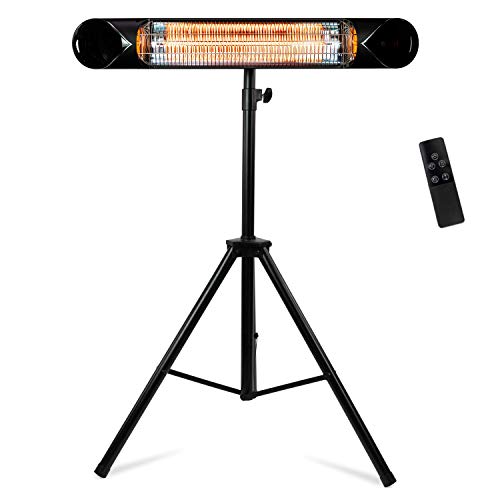
#1Best for most patios
Briza Infrared Patio Heater

Briza Infrared Patio Heater

Best for Patios where you want a choice of fixed or portable mounting
The 1500W infrared heater can mount to a wall or ceiling, or sit on its adjustable tripod, so you can match it to your patio layout. Three heat levels and a remote make it easier to adjust from your seat, while its IP55 rating adds protection from dust and water.
Maximum output 1500WMounting Wall, ceiling, or adjustable tripod standWeather rating IP55Controls Remote; three heat levels
Why it made the cut
Wall, ceiling, or tripod mounting
Three heat levels: 900W, 1200W, and 1500W
IP55 weather protection
Good to know
A tripod takes up floor space
No timer duration is specified in the product data
Skip it if Skip it if you need a stated timer setting or a tower-style heater.
#2Best power adjustment
VAGKRI Infrared Patio Heater

VAGKRI Infrared Patio Heater

Best for Patios where you want three distinct power settings and adjustable height
Choose this model if you want to step down from full power: its three settings are 700W, 1000W, and 1500W. Wall mounting or the tripod stand gives you two placement options, and the adjustable height runs from 33 to 77 inches.
Maximum output 1500WPower settings 700W, 1000W, and 1500WMounting Wall mount or tripod standAdjustable height 33 to 77 inchesTimer 12 hours
Why it made the cut
Three power settings, including 700W
Wall mount or tripod stand
12-hour timer
Good to know
Weather rating is not stated in the product data
Height adjustment requires the tripod setup
Skip it if Skip it for an exposed patio if you need a stated weather-protection rating.
#3Best tower controls
HAIMMY 42-Inch Infrared Tower Heater

HAIMMY 42-Inch Infrared Tower Heater

Best for Covered seating areas where you prefer a freestanding tower
The 42-inch tower has nine heat levels, from 620W to 1500W, for finer adjustments than a heater with only a few settings. Its 1-to-9-hour timer and safety lock are useful if children or pets might reach the controls.
Maximum output 1500WHeat levels Nine, from 620W to 1500WHeight 42 inchesWeather rating IPX5Timer 1 to 9 hours
Why it made the cut
Nine heat levels from 620W to 1500W
1-to-9-hour timer
IPX5 water resistance
Good to know
Freestanding tower takes up patio floor space
No wall or ceiling mounting option is listed
Skip it if Skip it if you need a heater that mounts overhead or flush to a wall.
#4Best fixed wall mount
hykolity 1500W Wall-Mount Heater

hykolity 1500W Wall-Mount Heater

Best for Patios where a permanent wall-mounted heater is the right fit
This 1500W model mounts flush against a wall and has three power levels, so it suits a fixed seating area without a tripod in the way. Its IP55 rating and remote-controlled timer, adjustable from 0 to 24 hours, add practical flexibility for outdoor use.
Maximum output 1500WMounting Wall mountWeather rating IP55Timer 0 to 24 hoursHeat levels Three
Why it made the cut
Flush wall mounting
IP55 weather protection
Remote and timer adjustable from 0 to 24 hours
Good to know
No tripod or ceiling mounting option is listed
Fixed placement is less flexible if your seating area changes
Skip it if Skip it if you need to move the heater between seating areas.
#5Best for indoor use
R.W.FLAME Mini Ceramic Heater

R.W.FLAME Mini Ceramic Heater

Best for Small indoor rooms, not outdoor patio heating
This is a portable indoor ceramic heater, not an infrared patio heater. Its 1500W output, thermostat, remote, and ETL certification may suit a small indoor space, but the product data does not give it an outdoor weather rating.
Maximum output 1500WCoverage claim Up to 200 sq. ft.Timer 24 hoursNoise claim 35 dBCertification ETL-certified
Why it made the cut
1500W output
Thermostat and remote control
ETL-certified
Good to know
Indoor ceramic heater, not an infrared patio model
No outdoor weather rating is listed
Skip it if Skip it for patio use; choose a heater with an outdoor weather rating instead.

Electric Infrared Patio Heaters for Outdoor Comfort, 1500W

electric infrared log set reviews: Electric Infrared Patio Heaters for Outdoor Comfort, 1500W

For electric infrared patio heaters for outdoor comfort, the Briza Infrared Electric Patio Heater is the best pick for most people: it offers wall or ceiling mounting, an optional tripod setup, and IP55 weather protection. Infrared is used in electric heat; it warms people and nearby surfaces directly, so you feel warmth quickly without trying to heat all the air under an open sky.

At 120V, a 1,500W heater draws about 12.5A, near the common ceiling for a plug-in electric heater. Choose the setup that fits your patio: wall or ceiling mounted to keep the floor clear, a tripod if you want to reposition the heat, or a tower if you prefer a freestanding unit.

In short
Infrared heat works outdoors because it warms what it reaches, not the open air around you. Pick the mounting style first, then check weather protection and controls.
Your setupA sensible fit
Wall or ceiling space availableA mounted heater keeps the floor clear.
You want to move the heatA tripod unit is easier to reposition, but uses floor space.
You want a freestanding footprintConsider a tower-style heater, and check its stated weather rating.
Open patio with exposure to weatherLook for a stated outdoor rating such as IP55.
Mounting and weather exposure can narrow the choice before wattage does.
Check the outlet
A 1,500W heater draws about 12.5A at 120V. Plug an electric patio heater directly into a wall outlet, never an extension cord or power strip, and follow the manual’s clearance instructions.

If you’re browsing electric infrared log set reviews, those are a different product category: log sets are made for indoor fireplaces, not outdoor patio use. For more options in this category, see infrared patio heaters.

Compare Heat Output, Mounting, And Weather Rating

Compare the listed wattage, mounting options, and weather rating first; features such as a remote and timer can matter more in daily use than a small difference in output. If you searched “electric infrared patio heater not working hkw check termostat,” start by checking the outlet, controls, and manual; don’t assume a thermostat is fitted, since the product details here don’t confirm one.

ProductOutput and settings statedMounting or format statedWeather rating stated
R.W.FLAME Small Space Heaters for Indoor UseNot providedIndoor space heaterNot provided
VAGKRI Outdoor HeatersNot providedOutdoor heater; mounting details not providedNot provided
Briza Infrared Electric Patio Heater1,500WWall or ceiling mount; tripod optionIP55
Outdoor Electric Patio HeaterNot providedNot providedNot provided
hykolity 1500W Infrared Wall Mount Heater 35.5”1,500WWall mountNot provided
Only specs supplied for these products are shown; check the product listing and manual for other settings.

IP55 or IPX5 indicates protection against water jets, which is useful where an outdoor heater may face rain or spray. That doesn’t make every installation suitable: check the model’s manual and mounting requirements. A lower rating, or no rating stated, limits what you can confidently choose for an uncovered patio, damp garage, or screened porch.

Wall and ceiling mounts save floor space; tripod and tower units are easier to move but occupy room and can be in the way. A remote and timer can make routine use simpler, while wattage alone doesn’t tell you whether the heater suits your layout.

Don’t guess at missing specs
The product details supplied here don’t state heat levels, adjustable heights, or timer lengths for these models. Check the exact listing before buying; a feature shown on a similar-looking heater may not belong to the model you’re considering.
Mounted heaters
Save floor space
Keep the heater in a fixed position
Freestanding heaters
Need a suitable mounting location
Are less convenient to reposition

If an electric patio heater won’t start, confirm the outlet works and check the unit’s power switch, remote batteries, and reset instructions in the manual. Don’t open the heater or bypass a safety switch; unplug it if you see damaged wiring or signs of overheating.

Size The Heater To The Space You Actually Use

A 1,500W infrared patio heater warms a sitting zone, not a dependable number of square feet across an open yard. For an electric infrared patio heater for a small patio, size the choice to the chairs or table you want warm; wind, open sides, mounting height, and heater direction all affect what you feel.

1,500 W
Practical plug-in limit on a standard 15A circuit
At 120 V, 1,500 W draws about 12.5 A. That leaves little room on the same circuit for other high-wattage appliances, and going bigger usually means a different electrical setup—not another plug-in heater.
Match the heater to the seats
Say you have a compact seating area beneath a covered patio and can aim a 1,500W heater toward the chairs. That’s a better match than trying to warm a wide, windy deck with no walls, where heat disperses and exposed seats may still feel cold.
UseA defined seating zone
Better placementAim heat toward people
Open deckExpect less even comfort

For a fixed table, choose a wall- or ceiling-mounted unit so the heat stays aimed at the same spot. Pick a tripod or tower if your seating moves; flexible placement can do more for comfort than chasing extra watts.

Myth
A 1,500W heater covers the same area in every patio.
Fact
There’s no reliable square-foot figure that applies to every setup. Infrared heat warms people and objects in its path, so an exposed, breezy deck won’t behave like a sheltered seating nook.

Check Controls, Safety, And Weather Protection

For an electric infrared patio heater that isn’t working, check the outlet, breaker, remote batteries, and selected heat setting before suspecting a thermostat; many patio models use simple power and timer controls rather than a room thermostat. The best smart controls are ones you’ll use: a remote and timer make a wall-mounted heater easier to shut off without crossing a cold deck.

Tip-over shutoff, overheat protection, and a safety lock are useful checks around children, pets, and crowded seating. A tip-over switch cuts power if a portable unit falls; overheat protection responds if the unit gets too hot, while a lock can help prevent accidental control changes. Confirm which features the specific model lists.

Use the right outlet and location
Plug an electric heater straight into a wall outlet, never an extension cord or power strip. Use it outdoors only if the manual permits outdoor installation, follow its mounting clearances, and check the heater’s listed weather rating; an indoor-only heater isn’t patio gear.
Check the remote first
If the heater has power but won’t respond, replace the remote batteries and try the unit’s own controls. Then check the breaker and manual before assuming a thermostat fault.
Useful controls
A remote lets you change settings from your seat.
A timer can shut the heater off without a return trip across the deck.
Limits to check
A remote and timer don’t make an indoor-rated heater safe outdoors.
Control features vary by model; verify them in the product details and manual.

What Most Buyers Forget Before They Click Buy

Placement and mounting fit matter as much as the heater model: infrared warms people and surfaces it reaches, so a heater above your seated area usually works better than one aimed across open air. Yes, infrared is used in electric heat; an electric element sends out radiant energy that warms nearby people and objects.

If an electric infrared patio heater isn’t working, don’t start by checking a thermostat: many models don’t use one to control room temperature. Check the outlet, breaker, remote batteries, and heat setting first. A covered porch, pergola, or garage opening can change which mounting position and weather protection you need more than the brand does. A heater exposed to rain needs a suitable outdoor rating; an enclosed or partly enclosed area also needs the clearances and use conditions in the manual.

Before ordering, confirm the unit is UL, ETL, or CSA listed, and that its cord and plug are intended for that heater. Check that the instructions clearly show how to mount it to your wall or ceiling; don’t improvise brackets or assume a ceiling can support it. The Briza offers several mounting options, while a fixed wall model such as the hykolity suits a spot where you can keep the required clearance.

Before You Buy or Mount
Will the heater sit above the area where you’ll be seated?
Does the porch, pergola, or garage opening match the heater’s approved use and weather rating?
Is the unit UL, ETL, or CSA listed?
Are its supplied cord and plug meant for this unit?
Do the mounting instructions fit your wall or ceiling, with the required clearances?

More Questions, Answered

How much area does a 1500W infrared patio heater cover?
There isn’t a reliable square-foot figure for an open patio. A 1,500W heater works best when aimed at a defined seating area; wind, mounting height, and how directly the heat reaches people all change the result.
Can I use an electric infrared patio heater on an uncovered patio?
Yes, if the heater is rated for the exposure and installed as its manual directs. Check the IP rating, protect the plug and connection from water, and don’t use the heater if its cord, housing, or outlet is wet or damaged.
Do infrared heaters need a fan to work outdoors?
No. Infrared heaters warm people and nearby surfaces directly, so they can provide warmth without blowing heated air. A fan won’t solve poor placement or wind carrying warmth away from the seating area.
What IP rating do I need for a patio heater?
Choose an IP rating that matches the heater’s actual exposure, and follow the manufacturer’s instructions for rain and installation. IP ratings describe resistance to dust and water under specified test conditions; they don’t mean every connection or outlet is weatherproof.
Why does my electric infrared patio heater keep shutting off?
Start with the simplest checks: confirm the outlet has power, reset a tripped breaker, replace remote batteries, and select a heat setting. If it still shuts off, check the manual for timer or overheat behavior and inspect for blocked vents, loose connections, or damage; stop using it if you see scorching or smell burning.

Joye Editor

HeaterGuides covers home heating, water heating and HVAC: how the equipment works, what it costs to run, and how to use it safely.

More in Infrared Heating