For most people shopping for a room heater, the 1,500 W DREO ceramic heater (Product 3) is the strongest first pick: it has thermostat-controlled ECO mode, 70-degree oscillation, and listed tip-over and overheat protection. It suits a room that needs supplemental heat, not a whole-home replacement.
A thermostat can make a heater easier to live with, but it doesn’t make electric resistance heat cheaper per unit of warmth. The useful half of the “set it and forget it” idea is steadier comfort; the bill still follows watts and run time.
Five Heaters, Matched to Different Needs
#1Best Overall
DREO 1500W Ceramic Space Heater
Best for Supplemental heat in bedrooms, offices and living rooms
For a room that needs supplemental heat, this is the strongest first pick: its thermostat-controlled ECO mode switches between 1000W and 1500W to maintain your set temperature. The 70° oscillation spreads warmth across more of the room, while listed tip-over and overheat protection address two common heater hazards.
Best for A larger room where you want thermostat control and caster wheels
The DR-968 combines an infrared quartz tube with PTC heating, plus high and low settings and an electronic thermostat. Caster wheels make it easier to move between rooms, and its 12-hour automatic shut-off is useful if you want a timer built in.
Heat output 1500W; rated around 5200 BTUThermostat range 50 to 85 degreesNoise 39 dBWeight 19 lbPower cord 72 inches
Why it made the cut
Infrared quartz tube plus PTC heating
High and low settings with an electronic thermostat
Caster wheels and a 12-hour automatic shut-off
Good to know
At 19 lb, it’s heavier than a small portable heater
No square-foot coverage figure is provided
Skip it if Skip it if you need a compact heater with a stated room-size rating.
Best for A bedroom or office where low operating noise matters
Its brushless DC motor and winglet fan design are listed at 34dB, making this a quiet option for work or rest. The thermostat adjusts in 1°F increments across a 41–95°F range, and the heat-funnel design is specified to send warm air farther than traditional heaters.
Heat output 1500WThermostat range 41–95°FTemperature increments 1°FNoise 34dBTimer 12 hours
Why it made the cut
Listed noise level of 34dB
Thermostat adjusts in 1°F increments
Remote control and multiple modes
Good to know
No room-size coverage figure is provided
No oscillation specification is listed
Skip it if Skip it if you want a heater with a stated square-foot coverage figure or listed oscillation.
Best for A bedroom or living room where built-in fireplace styling matters
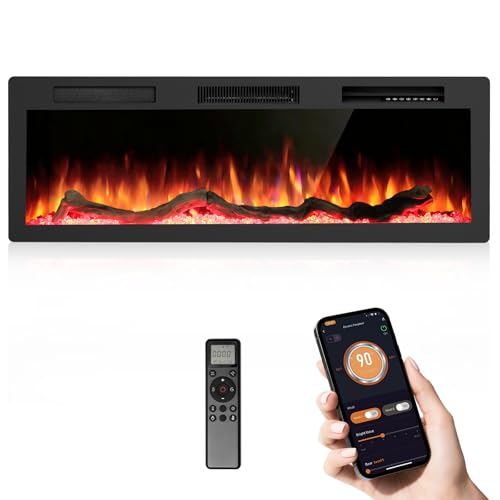
This 50-inch electric fireplace offers 750W and 1500W heating modes, with a listed supplemental zone-heating area of up to 400 square feet. You can wall-mount it or recess it, then adjust the flame colors and brightness separately from the heat.
Heat output 750W or 1500WListed zone-heating area Up to 400 square feetTemperature setting range 59–95°FDimensions 50 in L × 17.32 in H × 5.71 in WFlame colors 12
Why it made the cut
Two heating modes: 750W and 1500W
Listed for supplemental zone heating up to 400 square feet
Remote, touch panel, smartphone and Alexa controls
Good to know
Requires wall-mounted or recessed installation
Its 50-inch size may not suit a small room
Skip it if Skip it if you want a portable heater you can move between rooms.
Best for A room that needs portable heating, cooling and dehumidifying
This rolling portable unit combines heating with air conditioning, dehumidifying and fan modes, making it useful across seasons. It includes a remote and a window-mount exhaust kit, and its product listing gives a room-size figure of up to 550 square feet for the air-conditioning function.
Heating output Four operating modesCooling output 12,000 BTU (ASHRAE) / 7,000 BTU (SACC)Listed room size Up to 550 sq ftOperating modes Cooling, heating, dehumidifier and fanControls Digital touch control panel and remote
Why it made the cut
Heating, cooling, dehumidifier and fan modes
Rolling wheels for moving the unit
Remote control and window-mount exhaust kit included
Good to know
The listed 550-square-foot figure appears with the air-conditioning details, not a separate heating coverage rating
No noise figure is provided
Skip it if Skip it if you only need a simple electric room heater or need a clearly stated heating-area rating.
For most people looking for supplemental heat in one room, the DREO Space Heaters for Indoor Use with Thermostat, 1500W is the best home heating unit in this group: it offers ECO mode, 70-degree oscillation, and listed tip-over and overheat protection. The promise “Once you try this heater, you’ll never go back!” is a catchy headline, not a sizing rule; choose by the room and the features you’ll use.
Pick
What stands out
Best fit
DREO 1,500 W ceramic heater
ECO switches between 1,000 W and 1,500 W; 70-degree oscillation; stated tip-over and overheat protection
Moving a heater between rooms and setting a target temperature
DREO portable heater
Listed 34 dB noise level; 41–95°F temperature range; 1°F increments
Quiet portable use with fine temperature adjustments
R.W.FLAME 50-inch electric fireplace
Recessed or wall-mounted; 750 W or 1,500 W heat; listed coverage up to 400 sq ft
A fireplace look with supplemental heat
SereneLife portable air conditioner with heat
10,500 BTU heating; also cools and dehumidifies
A room that needs cooling and dehumidifying as well as heat
Features and coverage are as listed for each product; they are not directly comparable sizing standards.
Pick the DREO DR-968 if you want wheels, a timer, and infrared quartz with PTC. For a quieter unit, Product 5 lists 34 dB and adjusts temperature in 1°F increments; its listed range is 41–95°F. Choose the R.W.FLAME for wall or recessed installation, or the SereneLife if cooling and dehumidifying matter too.
Myth
A higher BTU number always means a better room heater.
Fact
BTU ratings alone don’t tell you how well a unit suits your room. The SereneLife’s 10,500 BTU heating rating belongs to a portable air conditioner with heating; compare the heater’s purpose, controls, installation and listed features, too.
Treat square-foot coverage as a rough claim, not a guarantee. Insulation, ceiling height, outdoor temperature, drafts and an open doorway all change how much heat a room needs; fan noise and portability matter when the heater will run near you.
Size the Heater and Estimate the Bill
Choose a heater by the room’s heat loss and how you’ll use it: plug-in models commonly top out at 1,500 W, so they’re best for supplemental, room-by-room heat rather than replacing a properly sized central system. A 1,500 W heater costs $2.04 for eight hours at an assumed rate of 17 cents per kWh, before thermostat cycling reduces its actual use.
1,500 W = about 12.5 A
At 120 V
That’s near the practical limit for a typical 15 A household circuit, so account for other devices on the same circuit.
Check the room before choosing
Say a room is 12 by 14 feet, has average insulation, and its door usually stays shut. Those dimensions help describe the space, but they don’t establish that any product’s advertised coverage will be enough; drafts, ceiling height and outdoor temperature matter too.
Room dimensions12 × 14 ft
Check nextInsulation, drafts, ceiling height, door
How do I choose the right heating unit for my home? Start with the room dimensions, insulation, drafts and ceiling height, then decide whether the door stays open and whether you need portability, quiet operation or cooling as well. Don’t treat one product’s square-foot claim as equivalent to another’s.
Heater
Watts
Per hour
Per day (8 h)
Per month (30 days)
750 W setting
750 W
13¢
$1.02
$30.60
1,500 W setting
1,500 W
26¢
$2.04
$61.20
Calculated at 17¢ per kWh. Example assumes 8 hours daily for 30 days and electricity at $0.17 per kWh. Full-power arithmetic is an upper-use estimate: a thermostat cycling the heater off lowers actual consumption. Your rate and runtime change the bill.
How much does a 1500 watt heater cost to run? Use watts ÷ 1,000 × hours per day × days × your price per kWh. At 1,500 W, eight hours a day for 30 days at $0.17 per kWh gives 1.5 × 8 × 30 × $0.17; the cost block compares that full-power estimate with 750 W. Lower wattage uses less electricity per hour, but the bill depends on runtime and your rate.
Know Which Heater Is Most Efficient
A properly sized heat pump is often the most efficient home heating unit because it moves heat instead of making all of it with electrical resistance. For regular whole-home or large-zone heating, it’s often the most energy-efficient heating option where the climate, equipment and installation suit it.
Portable resistance heaters turn electricity into heat where you use them, but ceramic, infrared and oil-filled models produce about the same heat per watt. A 1,500 W model draws 1,500 W; its heater type doesn’t make that electricity go further. Targeting one occupied room can still save energy if you turn down the central heat, rather than heating the whole home to warm one room.
Myth
Ceramic, infrared or oil-filled heaters use less electricity for the same amount of heat.
Fact
They deliver heat differently, but resistance models convert electricity into heat at the point of use. Thermostats and room-by-room use can affect how long a heater runs; the technology label alone doesn’t make it more efficient.
Type
How it heats
Best fit
Heat pump
Moves heat from outdoors indoors
Regular whole-home or large-zone heating where climate and installation are suitable
Plug-in resistance heater
Turns electricity into heat at the unit
Short, localized supplemental heating
Choose by heating duty and operating conditions, not by a marketing label.
The SereneLife portable AC/heat unit lists 10,500 BTU of heating output. That is a heating-output figure, separate from its cooling BTU ratings; the product information doesn’t establish that it’s a heat pump or give an efficiency rating. Don’t treat the number alone as proof of lower energy use.
For frequent whole-home or large-zone heating, compare a suitable heat pump; for brief heat in one occupied room, a portable electric heater is the practical choice. The DREO ceramic model may suit that second job, but the available specifications don’t justify calling any one listed heater the most efficient.
Use Electric Heaters Safely
A space heater should have tip-over and overheat protection, a UL, ETL or CSA listing on the actual unit, and at least 3 feet of clearance from combustible materials. No extension cord: plug an electric space heater or electric fireplace straight into a wall outlet.
12.5 A
Current drawn by a 1,500 W heater at 120 V
A standard 15 A, 120 V circuit is near its practical limit with a heater this size. Avoid running other high-draw appliances on the same circuit.
Before You Switch It On
Plug the heater directly into a wall outlet, never an extension cord or power strip.
Keep at least 3 feet between the heater and curtains, bedding, furniture or other combustibles.
Set it on a stable, level surface and follow the manufacturer’s manual.
Check the actual unit for tip-over and overheat protection and a UL, ETL or CSA listing.
Check what else is running on the same circuit; stop if the plug or outlet becomes hot or damaged.
Don’t Leave It Running Unattended
Don’t run a portable heater while you’re asleep or away from home unless the manufacturer says that model is designed for unattended use. Unplug it if the plug or outlet is hot, loose, discolored or damaged, and don’t use it again until the problem is checked.
The DREO Space Heaters for Indoor Use with Thermostat, 1500W is described as ETL-certified; that claim applies to this model only, not the other picks. Confirm the listing and safety features on the heater you buy, even if the product name sounds familiar.
Frequently Asked Questions
What does a 1,500-watt space heater cost to run for eight hours?
At an assumed electricity rate of 17 cents per kWh, it costs about $2.04: 1,500 W ÷ 1,000 × 8 hours × $0.17. A thermostat may reduce the actual cost by cycling the heater off, while a heater running continuously uses the full 12 kWh.
Can a portable heater warm a whole house?
A typical 1,500 W plug-in heater is meant to warm one room, not replace a central heating system. Heat has to travel through doorways and hallways, and rooms farther away will usually stay cooler; use your main system for whole-house heat.
Is a ceramic heater better than an infrared heater?
Ceramic heaters are a practical choice for warming room air, often with a fan to spread heat; infrared heaters warm people and objects more directly. Choose ceramic for general supplemental room heat and infrared for a spot where you sit, since neither type makes the same wattage of electricity produce more heat.
Can you leave an electric fireplace heater on overnight?
Only if the manufacturer says that specific model is designed for unattended or overnight operation. Plug it directly into a wall outlet, keep 3 feet of clearance, and check that its safety protections and listing are identified on the unit; otherwise, turn the heater off before bed.
Does a portable AC heater work as well as a heat pump?
A portable air conditioner with a heat-pump mode can move heat indoors and may use less electricity than resistance heat, but its performance depends on the model and outdoor temperature. Check the manual’s heating capacity and operating-temperature range; some portable units use resistance heat instead.
What should you check if a space heater keeps tripping a breaker?
Unplug the heater and check whether other high-wattage appliances share that circuit; a 1,500 W heater draws about 12.5 A at 120 V, close to the capacity of a standard 15 A circuit. Don’t use an extension cord or power strip, and stop using the heater if the plug or outlet is hot, damaged, or discolored; have a persistent breaker problem checked by an electrician.