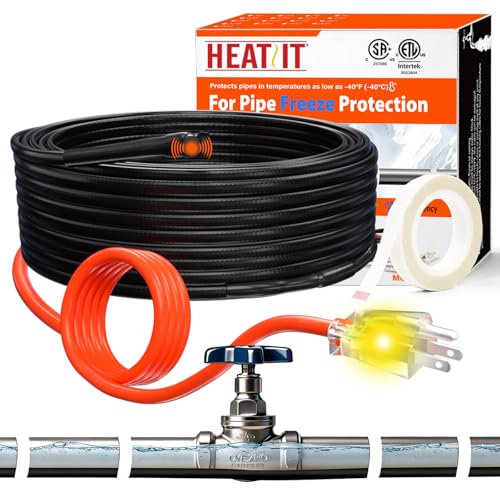
The best heat tape for plastic water pipes is a self-regulating, 120V cable with a built-in thermostat and a safety listing; for most readers, Product 1 is the best overall because it combines CSA certification, 5W/ft output and plastic-pipe compatibility for freeze protection down to -40°F.
What to remember
Pick self-regulating cable first if you want the easiest way to avoid overheating on plastic pipe.
Use a product rated for water-filled pipes only; some heat tapes are not meant for empty pipe, fuel lines or gutters.
A built-in thermostat saves power because the cable only heats near freezing, not all night for fun.
Insulate after the cable is installed; bare heat tape wastes energy to the air.
If a run is buried, curved or hard to access, plan the layout before you buy the length.
A common belief is half right: heat tape does keep pipes from freezing, but only if it matches the pipe, the water inside it and the installation the manual calls for. Use the wrong cable on the wrong pipe and you can buy trouble as well as heat.
For plastic water pipes, the short list is simple: self-regulating cable, a thermostat that switches on near freezing, a real safety certification, and enough length to cover the vulnerable run without crossing or spiraling unless the instructions allow it.
Best Heat Tape Picks for Plastic Water Pipes
#1Best Overall
MAXKOSKO Self-Regulating Pipe Heat Cable
Best for Plastic or metal water pipes needing freeze protection down to -40°F
This 120V cable is rated for plastic and metal pipes, delivers 5W per foot, and has a built-in thermostat that turns on at 38°F. Its CSA certification and self-regulating output make it the strongest fit for most home water-supply pipes.
Voltage 120VHeat output 5W/ftThermostat turns on 38°FPipe compatibility Plastic and metalFreeze protection Down to -40°F
Why it made the cut
CSA certified
Self-regulating 5W/ft output
Built-in thermostat turns on at 38°F
Good to know
The power cord is 3 feet long, which may limit access to a nearby outlet
Packaging may not yet show the CSA mark during the transition
Skip it if Skip it if you need a cable longer than the available length or cannot plug it in within 3 feet.
Best for Plastic or metal water pipes where a 3W/ft cable is a better fit
The 3W/ft output is lower than the 5W/ft options, while self-regulating operation adjusts heat output as conditions change. Its built-in thermostat activates at 38°F, and the cable is ETL certified for plastic and metal pipes.
Voltage —Heat output 3W/ftThermostat turns on 38°FPipe compatibility Plastic and metalCertification ETL
Why it made the cut
ETL certified
Self-regulating 3W/ft output
Built-in thermostat turns on at 38°F
Good to know
Lower heat output than the 5W/ft options
Power cord is 2 feet long
Skip it if Choose another option if you want a CSA listing or need more than 3W/ft of heat output.
Best for Short, water-filled plastic or metal pipe sections
This 3-foot cable has a built-in thermostat that turns on at 37°F and off at 50°F, plus CSA and ETL certifications. It must run straight, so it suits a short, accessible pipe section better than a longer or irregular run.
Length 3 feetVoltage 120VHeat output 7W/ftThermostat Turns on at 37°F; off at 50°FPipe compatibility Water-filled plastic, including PEX, or metal
Why it made the cut
CSA and ETL certified
Grounded plug with indicator light
Built-in thermostat turns on at 37°F and off at 50°F
Good to know
Must be installed straight; no crossing, spiraling, or overlapping
For water-filled pipes only
Skip it if Skip it if the pipe run needs a spiral layout or is longer than 3 feet.
Best for Long water-filled plastic or metal pipe runs needing 50 feet of cable
The 50-foot version provides 5W/ft output and is described for water-filled plastic and metal pipes, including PVC and PEX. Its product data says the cable is certified, but doesn’t name a certification mark, so check the cable and packaging before installation.
Length 50 feetVoltage 120VHeat output 5W/ftFreeze protection Down to -40°FPlug 5-foot grounded plug with indicator light
Why it made the cut
50-foot cable length
5W/ft output
Listed for plastic and metal water pipes
Good to know
The specific certification mark isn’t identified in the product data
The product data warns against use on empty pipes
Skip it if Choose a product with a named safety certification if you need to verify a specific listing before buying.
Best for Long water-filled plastic or metal pipe runs needing 100 feet of cable
This 100-foot version has 5W/ft output and is described for water-filled plastic and metal pipes, including PVC and PEX. The product data identifies UL certification for the full cable, which gives you a named listing to check when verifying the cable itself.
Length 100 feetVoltage 120VHeat output 5W/ftFreeze protection Down to -40°FCertification UL full-cable certified
Why it made the cut
100-foot cable length
5W/ft output
UL certification stated for the full cable
Good to know
The product data warns against use on empty pipes
A 100-foot run may be more cable than a short pipe section needs
Skip it if Skip it if your pipe run is short or you need a built-in thermostat confirmed in the product data.
For most plastic water pipes, choose the MAXKOSKO 6ft Self Regulating Heat Tape: it is a 120V, 5W/ft cable with a built-in thermostat, CSA certification, and compatibility with plastic and metal pipes. That combination gives you controlled freeze protection without guessing how much heat the pipe needs.
In short
Heat tape protects a water-filled pipe from freezing; it won’t correct undersized plumbing or replace pipe insulation. The MAXKOSKO is the best overall fit for most plastic-pipe freeze-protection jobs, while the 3-foot HEATIT suits a very short exposed section.
Pick
Best use
What to know
MAXKOSKO 6ft Self Regulating Heat Tape
Most plastic water pipes
120V, 5W/ft, self-regulating, built-in thermostat, CSA certified, and listed for plastic and metal pipes.
HEATIT 3FT Water Pipe Heat Tape
Short water-filled pipe sections
7W/ft constant-wattage cable for a compact run where the full 3 feet is enough.
Longer pipe heating cable
Exposed runs longer than 6 feet
Match the cable length to the pipe section; don’t compensate for a short cable with a hotter one.
Choose by pipe length and approved use, not wattage alone.
Heat tape belongs on water-filled pipe that faces freezing temperatures. It isn’t a water-heating device, and it won’t make an undersized pipe deliver more hot water. Insulation still matters because it slows heat loss; the cable supplies the small amount of heat needed to keep the water from freezing.
Can you use plastic pipe for hot water pipes? Yes, if the pipe is specifically rated for hot-water service and the installation follows local rules. Heat tape doesn’t change a pipe’s temperature rating. For a Belgium installation, check the pipe’s hot-water approval and local requirements before choosing the cable; our guide to the best plastic pipe for hot water in Belgium covers that separate decision.
Myth
Heat tape can’t be used on plastic pipe.
Fact
Heat tape can be used on plastic pipe, but only when the cable is rated for plastic and installed exactly as directed. A cable approved for metal pipe alone isn’t a safe shortcut, and the pipe must be water-filled if the product instructions require it.
A 6-foot or 3-foot cable covers only a short exposed section. Measure the pipe that actually needs protection, including bends if the instructions allow them, then buy a matching length. Product 2 is the tighter choice when that run is short and contains water; its constant 7W/ft output makes it less flexible than a self-regulating cable for changing conditions.
Best overall
MAXKOSKO 6ft Self Regulating Heat Tape for Water Pipes Heating Cable
Choose the MAXKOSKO for most plastic-pipe freeze-protection jobs because its self-regulating output, built-in thermostat, 5W/ft rating, and CSA listing cover the common combination of plastic pipe and changing outdoor temperatures.
For plastic water pipes, buy by four filters: self-regulation, thermostat control, safety certification, and stated pipe compatibility. Those details decide whether the cable protects the pipe or creates a warm spot that ages the plastic faster.
Filter
What to look for
Why it matters
Heat output
Self-regulating cable
Output falls as the cable warms, reducing overheating risk at contact points on a plastic jacket.
Temperature control
Built-in thermostat around 38°F to 50°F
The cable turns on near freezing and shuts off as the pipe area warms.
Certification
UL, ETL or CSA listing for the complete product
The cord, plug and cable should be built for the electrical load—not only the plug.
Pipe rating
Plastic compatibility and any water-filled-pipe restriction
Some cables suit plastic and metal; others require a water-filled pipe or have narrower installation rules.
Check the product label and manual, not only the listing headline.
Self-regulating heat tape is the safer match for plastic because its heat output changes with surrounding temperature. A colder section produces more heat; a warmer section produces less, so the plastic jacket sees less sustained stress than it would from a cable delivering the same output everywhere.
Heat can change plastic’s stiffness and strength, especially at a concentrated contact point. Repeated heating and cooling also makes the pipe and fittings expand and contract, which can slowly stress joints and embrittle aging material. That doesn’t make heat tape unsafe; it makes correct wattage, insulation and thermostat control worth checking before you stick anything to the pipe.
5W/ft
Gentler output for plastic
Product 1, MAXKOSKO 6ft Self Regulating Heat Tape, uses 5W/ft. Product 2 uses 7W/ft, which provides stronger heat but is less forgiving when the pipe is poorly insulated or isn’t water-filled.
No outlet, no heat tape
A powerless indoor pipe has no useful electrical heat-tape option. Use passive insulation, stop drafts and protect or drain the vulnerable pipe instead; adding a cable without a proper power source isn’t freeze protection.
For efficient electrical heat, choose a self-regulating cable with a built-in thermostat rather than a constant-wattage cable that runs at its rated output whenever energized. Product 1 or Product 4 fits the practical thermostat pattern to look for: automatic control in roughly the 38°F to 50°F range. Product 2’s 7W/ft constant output can suit a colder or harder-to-protect run, but it deserves closer attention to insulation and installation instructions.
Certification matters because the heat trace cable, molded plug and supply cord work as one loaded electrical assembly. HEATIT models listed with CSA and ETL certification, plus a UL-certified plug, provide the kind of complete labeling you should seek; a familiar-looking plug by itself proves very little.
Sizing And Installation That Actually Works
Proper heat tape installation starts with the pipe length, then follows the maker’s layout rules; an exposed, accessible pipe is usually a reasonable DIY job, while a buried line or hidden plumbing problem deserves a plumber. For curved or irregular pipes, follow the pipe’s path, keep the cable in firm contact, and use only the mounting buckle, clips, or other attachment method supplied by the maker.
Answer the common question early: don’t improvise a spiral or overlap. The MAXKOSKO 6ft Self Regulating Heat Tape allows straight, spiraled, or overlapped installation, but the HEATIT 3FT Water Pipe Heat Tape must run straight with no crossing. If your manual says something different, its instructions win.
1
Measure the heated section
Measure the actual water-filled pipe that needs freeze protection, including the curved portions. Choose enough cable to cover that section according to the product instructions; a short cable that stops before the cold spot leaves the weak link untouched.
2
Test the cable first
Test the heat tape exactly as the manual says before attaching it to the pipe. A dead cable is cheaper to find on the bench than behind a wall, under insulation, or after the first hard freeze.
3
Lay out the cable
Run the cable along the pipe and keep it in firm contact without sharp bends, pinching, or unsupported loops. Use the supplied attachment method, and keep the plug and thermostat positioned as the manual directs.
4
Handle bends without guessing
On a curved or irregular pipe, trace the pipe line rather than cutting across an open gap. Follow the manufacturer’s rule for spacing, spiraling, or overlap; Product 1 permits all three listed layouts, while Product 2 requires a straight run with no crossing.
5
Add insulation afterward
Mount and secure the cable first, then install compatible pipe insulation or thermal insulation wrap as the instructions allow. Insulation traps the cable’s heat against the pipe instead of letting moving air carry it away.
Know When To Stop
Don’t install heat tape inside a finished wall, on a buried pipe, or over plumbing you suspect is leaking, damaged, or improperly routed. Finding the cold section may require opening the wall or tracing a larger plumbing fault; a licensed plumber is safer than covering the problem and hoping the cable fixes it.
Keep The Layout Visible
Photograph the installed cable before adding insulation or closing a wall. Record the cable model, pipe section, and test result so the next inspection doesn’t become a cold-weather archaeology project.
Before Powering It
The cable length matches the pipe section and the manual’s coverage rule
The cable passed the manufacturer’s pre-installation test
No crossing, overlap, or spiral violates the product instructions
The cable stays in firm contact with the pipe
The attachment method comes from the manufacturer
Insulation is added only after the cable is mounted
A hidden, buried, leaking, or damaged line has been referred to a plumber
Running Cost And Year-Round Use
Heat tape can be left on year-round only when the manufacturer allows continuous operation; for most freeze-protection jobs, switch it off after freezing weather unless your climate or installation instructions call for longer use. A built-in thermostat reduces unnecessary runtime, while self-regulating cable also lowers its output as the pipe and surrounding air warm.
For an affordable, efficient setup, use the shortest cable that covers the exposed pipe and add pipe insulation over it. A 5W/ft self-regulating cable is usually the sensible starting point for a typical plastic water pipe; a 7W/ft constant-wattage cable can use more electricity and does not automatically reduce output as temperatures rise. The HEATIT 3FT Water Pipe Heat Tape uses the 7W/ft design, while the MAXKOSKO 6ft uses 5W/ft self-regulating cable.
Heater
Watts
Per hour
Per day (24 h)
Per month (30 days)
5W/ft cable, 10-foot example
50 W
0.9¢
20¢
$6.12
7W/ft cable, 10-foot example
70 W
1.2¢
29¢
$8.57
Calculated at 17¢ per kWh. Illustration assumes a 10-foot cable running 24 hours a day for 30 days at $0.17 per kWh. A thermostat or self-regulating cable may run below its full rated output.
In short
The most efficient heat option is usually a correctly sized self-regulating cable paired with insulation, not an oversized heater. Buy a longer cable only when the exposed pipe requires it; extra footage adds cost and power use without protecting pipe that isn’t there.
There isn’t one dependable average lifespan for heat tape products. Service life depends on ultraviolet exposure, insulation quality, moisture, and physical treatment: a cable left in harsh sunlight or wet conditions can age faster, while one kinked, crushed, or overlapped during installation can fail early. Follow the maker’s replacement guidance and inspect the plug, jacket, and connections before each freeze season.
Read the fine print
Year-round use is a manufacturer question, not a blanket rule for every heat trace cable. Some products are intended for seasonal pipe freeze prevention, and some are approved for continuous service; check the instructions for the exact model, pipe type, and installation location before leaving the cable energized.
Safety And Code Checks
Yes, heat tape can cause fire or damage on plastic pipes if it’s misapplied, so use only a cable labeled for water-filled plastic pipes and follow its installation instructions. A heat tape rated for pipe freeze prevention isn’t automatically suitable for fuel lines, gutters, roofs, empty pipes, or any use the product excludes.
Plastic Can Overheat
Never let the cable cross itself, coil around itself, bundle tightly, or sit under insulation the manual doesn’t allow. Those arrangements trap heat in one spot and can soften plastic pipe or damage the cable. Keep the cable secured as directed, and don’t cover a connection, thermostat, or plug with insulation unless the instructions specifically permit it.
Buried or underground plastic pipe needs the manufacturer’s approval before you install heat tape. Soil moisture changes the electrical and heat-transfer conditions, buried pipe is harder to inspect, and insulation can prevent heat from escaping as designed. If the manual doesn’t clearly cover underground use, choose another freeze-protection method or ask the manufacturer rather than burying a plug-in cable and hoping winter behaves.
Underground Is a Separate Job
A cable approved for an exposed crawl-space pipe may still be unsuitable below grade. Check the product’s pipe, burial, moisture, insulation, and installation limits together; approval for plastic alone doesn’t answer the underground question.
Safety certifications are worth checking before the cable reaches your cart: look for UL, CSA, or ETL certification, a grounded plug connection, and instructions that identify the approved pipe types and installation method. For example, the HEATIT Water Pipe Heat Tape line is listed with CSA and ETL certification and a UL-certified plug. A listing doesn’t excuse crossed cable or poor installation, but it gives you a meaningful safety mark to verify.
Before Powering It
The label allows use on a water-filled plastic pipe.
The cable has UL, CSA, or ETL certification and a grounded plug.
The thermostat, plug, and end connection remain accessible as the instructions require.
The cable was checked for cuts, crushed sections, melted plastic, or loose connections.
The instructions and warranty are saved with your purchase record.
Warranty coverage usually applies to a cable or component that fails under stated operating conditions, while improper installation, misuse, physical damage, or ignored instructions may be excluded. Some products include product liability insurance and a warranty, but those are different protections: liability coverage doesn’t turn a bad installation into a covered failure. Keep the receipt, model information, instructions, and installation photos so you can show how the cable was used.
A plug-in replacement can stay within the existing electrical setup, but new receptacles, hidden wiring changes, wet-location work, or a circuit that needs alteration belong to a licensed electrician where local rules require one. Check local electrical code before routing power through a crawl space or outdoors; a grounded plug is useful, not a substitute for compliant wiring.
Questions People Ask
What is the most energy-efficient heat tape for plastic pipes?
A self-regulating heat cable with a built-in thermostat is usually the efficient choice because it reduces output as surrounding temperatures rise. The 5W/ft MAXKOSKO cable is a practical option for plastic water pipes, provided its thermostat and safety instructions suit your installation.
How do I properly install heat tape on curved or irregular pipes?
Follow the cable’s layout instructions rather than wrapping it wherever it fits. Test the cable first, run it along the pipe as directed, and secure it without creating overlaps or tight bends that the manufacturer forbids.
Can heat tape be safely left on year-round?
Only leave heat tape energized year-round if its manufacturer allows continuous operation. A built-in thermostat limits unnecessary heating, but you should still inspect the cable, plug, and pipe insulation before freezing weather.
What is the average lifespan of heat tape products?
There is no dependable lifespan that applies to every heat tape product. Service life depends on the cable’s construction, weather exposure, installation, and storage; use the warranty terms as a guide and replace any cable with cracked insulation, damaged plugs, or unreliable switching.
Are there any risks of fire or damage using heat tape on plastic pipes?
Yes, misapplied heat tape can damage plastic or create a fire hazard. Use only a cable labeled for water-filled plastic pipes, test it before installation, follow its spacing and insulation rules, and keep damaged electrical parts out of service.
Can heat tape be used on underground or buried plastic pipes?
Only use it underground when the product instructions specifically approve buried plastic-pipe installation. A buried cable is difficult to inspect or replace, so pipe depth, insulation, drainage, electrical protection, and local requirements should be addressed before installation.