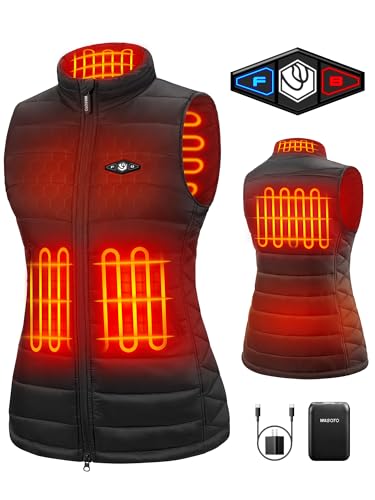
For most skiers, the Soaccks Heated Vest with 16000mAh battery is the best heated vest for skiing: 12 heating zones, up to 12 hours on low, and easy size adjustment over base layers. A heated shawl is fine for the lodge, but on the slopes you want zip-in, body-hugging warmth.
The essentials
For all-day resort skiing, aim for a 7.4 V heated vest with at least a 10–12 hour rated runtime on low so you still get 5–7 hours on medium in real cold.
Prioritize heating zones over hype: panels on the back, chest and collar keep you warmer on lifts than extra pads low on the stomach.
Women usually get better warmth and comfort from women’s cuts or adjustable vests so the heating panels sit flat against the core instead of floating.
Rechargeable heated vests cost only a few cents per full battery charge, but a second battery is smart for very cold days or multi-day trips.
Use a heated shawl in the lodge or at home; for actual skiing, a fitted heated vest plus good gloves and socks is safer and much more practical.
A full ski day is usually 6–8 hours outside, which means a vest that only runs 4 hours on medium will leave you cold before the last lifts. Battery capacity and heat levels matter more than the logo on the chest once you are standing in 15°F wind on a stopped chairlift.
The picks below cover unisex and women’s cuts, from simple 5 V USB fleece to 7.4 V vests with included 16,000 mAh packs. I’ll walk you through how to match them to your jacket, your cold tolerance and your budget so you buy once and stay warm all winter.
Best Heated Vests for Skiing: Detailed Picks
#1Best Overall Skiing
Soaccks Heated Vest 16000mAh 12-Zone
Best for Most skiers who want all-day, adjustable warmth that fits over changing base layers.
The Soaccks heated vest is the most complete skiing pick, pairing a 16000 mAh battery with up to 12 hours of runtime so you aren’t watching the gauge instead of the snow. Twelve heating zones with independent front and rear control let you tune where the heat goes as the wind shifts on the lift. Three temperature settings from 122–150°F cover everything from cold groomers to icy storm days. The dual-side waist zippers make the size adjustable, so you can snug it over thin base layers or open it up over thicker midlayers without feeling squeezed.
Battery capacity 16000 mAh battery pack includedHeating zones 12 heating zonesMax runtime Lasts up to 12 hoursHeat levels 3 temperature settings (122–150°F)Fit Dual-side waist zippers for adjustable sizing
Why it made the cut
16000 mAh battery pack included with up to 12 hours of heat
12 heating zones with independent front and rear control
Three temperature settings from 122–150°F
Adjustable waist zippers to tweak fit over different layers
Windproof and waterproof nano-scale outer fabric that’s machine washable
Good to know
Higher heat levels will cut into the maximum 12-hour runtime
More heating zones and features than some casual users need
Skip it if Skip this if you only need occasional lodge and lift warmth and prefer a simpler, lighter vest.
Best for Men who want a fitted fleece heated vest for skiing and cold chairlift rides.
The CHAPAREL heated vest suits skiers who like a fleece midlayer feel with heat built in. A 7.4V 16000 mAh battery gives up to 10 hours of warmth and can also top up your phone or other devices. Six heating zones and three adjustable levels let you dial in both temperature and where you feel the heat most. The fitted silhouette works cleanly under a shell; you can always size up one if you prefer more room.
Battery capacity 16000 mAh, 7.4V batteryHeating zones 6 heating zonesMax runtime Battery works for up to 10 hoursHeat levels 3 adjustable heat settingsFit note Designed for a fitted silhouette; size up for looser fit
Why it made the cut
16000 mAh 7.4V battery with up to 10 hours of use
Six heating zones with three heat levels
Battery can charge phones or other devices
Soft fleece fabric for midlayer comfort
Machine washable once the battery is removed
Good to know
Designed for a fitted silhouette, which can feel snug over thicker layers
Men’s cut only; sizing note means you may need to order up
Skip it if Skip this if you want a more size-adjustable unisex vest to share or layer over bulky gear.
Best for Women who split time between skiing and cycling and want long runtime with more coverage.
The WASOTO women’s heated vest is built for active use like cycling and skiing, with four heating areas that cover 35% of the vest for broader warmth. Its built-in 16000 mAh battery can run for up to 11 hours and offers fast-charging USB and Type‑C outputs for your phone or bike lights. The upgraded power button lets you turn the indicator lights off while heating, which is handy if you don’t want a glowing chest on night ski laps. Polar fleece at the collar and pockets plus a waist-cinching design keep it comfortable and flattering when you’re off the hill too.
Battery capacity 16000 mAh built-in power bankHeating zones 4 heating areas (35% coverage)Max runtime Up to 11 hours working timePower outputs USB 9V and Type‑C 9V device chargingFabric & fit Polar fleece collar/pockets with waist-cinching design
Why it made the cut
16000 mAh battery with up to 11 hours working time
Four heating areas covering 35% of the vest
USB and Type‑C 9V outputs for charging mobile devices
Power button can turn indicator lights on or off
Polar fleece collar and pockets with two-way zipper and hip elastic buckle
Good to know
Heating level count isn’t clearly specified
Women’s cut and waist-cinching design won’t suit all body types
Skip it if Skip this if you want a unisex or straighter cut vest to share across sizes or genders.
Best for Women who mainly want extra lift and lodge warmth without bulk under a jacket.
The ORORO women’s heated vest works best as a light, low-bulk core warmer for resort days and daily winter use. A 7.38V 4800 mAh battery delivers up to 10 hours of heat on low, with three levels to match changing conditions. Four heating zones at the collar, mid‑back, and both pockets keep your core and hands comfortable on slow chairs and in lift lines. FELLEX insulation keeps it warm yet light, so it layers easily under a ski shell or over a base layer around town.
Battery capacity 7.38V 4800 mAh (35.4Wh) batteryHeating zones 4 zones: collar, mid‑back, both pocketsMax runtime Up to 10 hours on lowHeat levels 3 adjustable heat levelsInsulation FELLEX insulation for lightweight warmth
Why it made the cut
Up to 10 hours of warmth on low from the included battery
Four core heating zones at collar, mid‑back, and both pockets
Three adjustable heat levels
Lightweight FELLEX insulation to avoid bulk
Good crossover for commuting and everyday winter use
Good to know
Battery capacity is smaller than the 16000 mAh packs in some vests
Four zones and lighter insulation are better for resort and everyday use than extreme cold
Skip it if Skip this if you need maximum heating coverage and battery capacity for very long, frigid back-to-back ski days.
Best for Budget-minded skiers who already carry a power bank and want lots of zones, mainly for moderate cold.
The HSOSK heated vest is a simple USB‑powered option that plugs into any 5V/2.1A power bank and includes a portable, detachable 10000 mAh pack. It uses 11 carbon fiber heating pads covering five core body areas, giving you broad warmth where most people feel the cold first. Three color‑coded heat levels from about 25–45°C let you step the temperature up or down quickly. Fleece fabric keeps it soft and light, and it can go in the washing machine in a laundry bag once you remove the battery.
Battery capacity Portable, detachable 10000 mAh power supplyHeating zones 11 high-performance carbon fiber padsMax runtime Can keep heating for 8 hoursHeat levels 3 levels, approx. 25–45°C (red/high, blue/medium, white/low)Power 5V USB powered, works with 5V/2.1A supplies
Why it made the cut
11 carbon fiber heating pads over five body areas
Includes a 10000 mAh portable battery
Three heating levels (red, blue, white) from about 25–45°C
USB powered, works with 5V/2.1A power supplies
Soft fleece fabric that’s hand- and machine-washable
Good to know
Max runtime of about 8 hours is shorter than larger-battery vests
USB 5V system runs cooler than higher-voltage ski-focused vests
Skip it if Skip this if you ski long, very cold days and want higher-temperature output and longer runtime from a 7.4V system.
The best heated vest for skiing is a 7.4 V, battery-pack design that hugs your core under a regular shell, and the same rule picks a good heated vest for women or men. Think of 7.4 V models like the Soaccks Heated Vest for Men Women with 16000mAh Battery Pac…, the CHAPAREL Heated Vest for Men, and womens heated vests such as the ORORO Women’s Heated Vest or WASOTO Heated Vest Women for Cycling Skiing, then choose based on power, panel layout and fit under your ski jacket.
On snow, 7.4 V vests with dedicated 16000 mAh batteries usually beat 5 V USB-only vests like the HSOSK Heated Vest USB Electric Heated Vest Heating Jacket W… for both heat output and consistency. A 7.4 V, 16,000 mAh pack holds roughly twice the energy of a typical 5 V phone power bank, and the higher voltage lets the vest drive the panels harder before the cold saps performance. Medium heat often uses about twice the power of low, so a vest advertised at 10–12 hours on low usually gives around 5–7 hours of steady medium heat in sub-freezing lift-line temperatures.
≈120 Wh
Energy in a 7.4 V, 16,000 mAh battery
7.4 V × 16 Ah is about 120 watt-hours; if your vest draws around 24 W on medium, you get roughly 5 hours of continuous heat (120 ÷ 24) before the battery is flat.
Heating zones matter less than where they sit. For skiing, prioritize big panels across the upper and lower back, plus the chest; collar and pocket heat are a bonus on cold lifts. A woman heated vest for cold back should have a back panel that reaches down to cover the waistband of your snow pants, not stop at mid-back. High zone counts, like the 12 heating areas on the Soaccks vest, help only if they cover those core areas; a simpler vest that warms spine, kidneys, and chest will feel better than a busy map of tiny panels in low-value spots.
Fabric has to play nicely with your ski shell. Lightweight fleece-style heated vests feel soft and disappear under an insulated jacket, which is what you see on many womens heated vests. Slightly more wind-resistant fabrics slide easily under a shell and add a little extra draft blocking for chair rides, but if the shoulders or armholes are bulky they can bunch and restrict your turns. Under a proper ski jacket, you want the vest to feel like a mid-layer, not a second coat.
Heat controls make a real difference over a full ski day. Three temperature settings are standard; for resort skiing, look for buttons you can press with gloves and, if possible, separate front and back control so you can run just the back panel on low while you’re moving. Some newer vests tuck the LED power light in a less obvious spot or use a dimmer glow so it doesn’t light up night-skiing photos; if yours has a bright chest logo button, plan to cover it with your jacket flap when the camera comes out.
A heated vest under a regular ski jacket usually beats one massive insulated coat because you can tune warmth to the conditions instead of being stuck too hot or too cold. Many skiers asking about womens heated vest or coats end up happiest with a mid-weight shell plus a heated vest: crank the vest up on icy morning groomers, drop it to low at lunch in the lodge, then open vents and turn it off on warm spring afternoons without changing jackets.
What to prioritize in a ski heated vest
7.4 V battery with around 16000 mAh for solid heat output; 5 V USB vests are better kept for short, mild days or lodge wear.
Runtime that matches your day: a claimed 10–12 hours on low usually means about 5–7 hours on medium in real cold.
Back, chest, and ideally collar and pocket panels before chasing a higher “zone” number.
Slim, low-bulk fabric at shoulders and armholes so the vest moves cleanly under your ski jacket.
Controls you can work with gloves and an LED light you can hide or live with during night skiing and photos.
A cut (men’s, women’s, or unisex) that fits close over your normal base layers without gaping at the armholes or riding up over your waistband.
Build the whole warm system
Once your core is sorted with the right vest, you can often run it on a lower setting if you also heat your feet with heated socks and use good gloves, which stretches that 7.4 V battery through more ski days.
Get Heated Vest Sizing Right, Especially for Women
Sizing makes or breaks any heated vest, and that’s especially true for a heated vest for women because the panels only work when they sit snug against your core. If you’re hunting for the best heated vest for women, a heated womens vest for skiing, or just a simple heated women’s vest for lift days, start with cut and measurements, not the logo.
Men’s cuts tend to be straighter and longer through the torso, with broader shoulders, while womens heated vests add room in the chest and shape in at the waist so the main back panel hits both mid- and lower-back. Unisex vests usually follow a straighter line; on curvier bodies they can ride up, leaving the lower spine and top of the hips cold and putting the pocket heaters too high to warm your hands comfortably.
Fitted silhouettes like the CHAPAREL Heated Vest for Men and the ORORO Women’s Heated Vest are designed to sit close, almost like an insulated mid-layer, which is great for heat transfer but leaves less room for bulky sweaters. Adjustable designs such as the Soaccks Heated Vest for Men Women with 16000mAh Battery Pac… let you open or cinch the sides so you can swap between thin and thicker base layers. If you ski in heavy thermals or a fleece top, check the size chart carefully and consider sizing up one step in a very tailored vest, while staying closer to your usual size in adjustable designs so the panels don’t float away from your body.
1
Measure chest over ski layers
Put on the base layers and light mid-layer you normally ski in, then measure around the fullest part of your chest under the arms. Compare that number to the vest chart and aim for a size with 1–2 inches of room, not more.
2
Measure waist and hips
Measure at the narrowest part of your waist, then around the top of your hip bones over your snow pants. If your hips are much wider than your chest size suggests, favor the size that matches your hip number so the vest can zip comfortably without flaring open.
3
Check vest length against your waistband
Ideally the hem of the vest should land just at or slightly below the waistband of your ski pants so the back panel covers your lower back on the lift but doesn’t bunch under a hip belt or harness.
4
Test ski movements
Once the vest arrives, zip it fully and mimic skiing motions: reach forward like planting poles, twist as if looking uphill, and bend slightly at the waist. You shouldn’t feel tightness across the shoulders or see big gaps opening at the armholes or hem.
For many women, the cold spots on lifts are the lower back and upper chest, so a womens heated vest should keep panels firmly against those areas. A women heated vest for cold back should overlap the waistline of your snow pants by at least an inch when you sit, and the front panels should sit high enough to warm the upper chest without gaping at the sides. If the vest is overly loose, cold air funnels up from the hem and the heated pads pull away from your base layer, cutting their effect dramatically.
Movement still has to feel natural. When you reach both arms forward or overhead, the fabric should slide, not bite into your shoulders, and the zipper shouldn’t strain; if it does, swap to a less tailored cut or go up a size so you can pole plant, skate and push off chairlifts without feeling restricted.
Sizing safety net
If you’re between sizes or buying a gift, check the brand’s return or exchange window before you order. It’s often easier to try two sizes and send one back than to chase whatever a store calls the best rated women’s heated vest and hope it happens to fit.
Plan Battery Runtime and Charging Before Your Trip
Battery runtime on the hill is always shorter than the number on the tag, so plan for that before you pick or pack a ski heated vest. Most women’s heated vests are rechargeable now, from slim ski pieces to warehouse brands like a costco heated vest for women rechargeable, and all the talk in women’s heated vests rechargeable reviews really boils down to how long the heat actually stays on in the cold.
If you’re comparing rechargeable heated vests for women or a single rechargeable heated vest for women like the ORORO Women’s Heated Vest, treat it like any battery heated vest for women: look at the battery’s capacity and voltage first, then the style. Capacity in mAh is the “tank size,” but the real energy is in watt-hours: mAh × volts ÷ 1,000. A 10,000 mAh, 5 V USB pack is about 50 Wh, while a 16,000 mAh, 7.4 V pack is around 118 Wh, over twice the usable energy.
Voltage affects how hot the vest can feel at the same mAh, because higher voltage can push more power through the heating elements. A 7.4 V ski vest like the Soaccks model can run the pads warmer and still hold a long runtime, while a 5 V USB vest may feel milder unless you crank it and accept shorter life.
Cold drains lithium batteries, so a pack that tests at 10–12 hours on low in a warm room may give you only about 60–70% of that on a chairlift all day. If the spec sheet promises 12 hours on low, expect something like 7–8 hours when it’s well below freezing and the vest is under a cold shell.
Worked example
Say you’ve got a 16,000 mAh, 7.4 V vest battery the maker rates for 12 hours on low, 7 hours on medium and 4 hours on high at room temperature. That 16,000 mAh × 7.4 V is about 118 Wh; 118 Wh ÷ 12 h is roughly 10 W on low, 17 W on medium, 30 W on high. On a full ski day from 9 a.m. to 4 p.m. at 15°F, it’s realistic to get about 8 hours on low, 4–5 hours on medium, or 2.5–3 hours on high once you factor in the 30–40% hit from the cold. If you start the morning on low, bump to medium only during long, windy lift rides, and switch the vest off on hard runs when you’re sweating, that one pack will comfortably cover the day.
Resort day7 hours on snow
Battery16,000 mAh, 7.4 V (~118 Wh)
Realistic cold runtime~8 h low, 4–5 h medium, 2.5–3 h high
Smart use matters as much as battery size: start on low while you boot up and ride the first lifts, save medium for cold chairs or long waits, and turn the vest off entirely on vigorous runs if you tend to run hot. That pattern stretches even a modest pack across a long day without you feeling under-heated.
A spare battery makes sense if you ski very cold resorts, like to stay out from first chair to last, or are on a multi-day trip without easy outlets. Before buying, match voltage (5 V USB vs 7.4 V pack), connector type and size; many vests need their own brand’s 7.4 V pack, while some accept standard USB power banks. If you’re chasing a naturally long-lasting battery for my heated vest, a higher Wh rating and a realistic plan for how you use the heat will help more than any marketing phrase.
Heater
Watts
Per hour
Per day (4 h)
Per month (30 days)
Heated vest battery (about 100 Wh per day)
100 W
1.7¢
6.8¢
$2.04
1,500 W space heater in a cabin
1,500 W
26¢
$1.02
$30.60
Calculated at 17¢ per kWh. What the numbers mean for the reader.
Charging costs are tiny: a roughly 100 Wh vest battery is about 0.1 kWh per full charge, so even daily skiing only adds up to a few cents, while a 1,500 W space heater running for several hours can show up as real money on your bill.
Charge gently, not fast
Use the charger that came with your vest or one the manual approves, and avoid fast-charging hacks or random phone bricks. Slow, proper charging helps the battery last more seasons and reduces the risk of overheating while it’s plugged in.
Use Heated Vests Safely on Snow and Lifts
Safe use on snow means treating your heated vest like an electrical appliance wrapped in fabric: keep a layer between it and your skin, keep it dry under a shell, and retire anything that looks damaged. If you’re using a women’s wrap around shoulders heated vest or shawl-style piece in the lodge, the same rules apply, and a non heated mid-layer is still smart as backup if you ever need to switch the electronics off.
Always wear at least a thin base layer between the heating panels and your skin, especially over your spine and chest. Direct contact on high can create hot spots or even mild burns over a long chair ride, and the fabric layer spreads the heat more evenly while still letting you feel the benefit.
Biggest heated vest risks
Don’t use a vest with frayed wires, a nicked or loose USB lead, a swollen or cracked battery, or controls that smell hot or make the power flicker. Avoid charging with a random high-output phone charger, don’t sleep in a heated vest, and never rely on one for children who can’t say when it’s too hot.
Inspect the cable runs and battery pack before each ski day: look for worn insulation, bent connectors, or any swelling or cracking of the case. If you ever notice a burning smell, unusual warmth from the battery pocket, or the lights flickering on and off, shut the vest down, disconnect the pack and stop using it until it’s checked or replaced.
Light snow and brief dampness are expected, but the electronics aren’t designed for immersion or heavy rain without a waterproof shell over the top. Turn the vest off before you stash it in a ski locker or a hot car, and if it gets soaked in a fall or wet lift seat, power it down, remove the battery and let everything dry completely before you use it again.
For washing, read the tag: some vests are machine-washable once the battery is removed and the connector is capped, others want hand washing only. When machine washing, zip the vest, put it in a laundry bag, use cold water and a gentle cycle, and then air dry flat; don’t tumble-dry on high heat, which can damage both fabrics and wiring.
People with implanted medical devices, serious heart conditions or problems sensing temperature should talk with a healthcare professional before using heated clothing. Gentle warmth is the goal, not intense heat, so if you ever feel lightheaded, overheated or notice skin irritation under the panels, turn the vest off and cool down.
Quick safety check before you ski
Confirm you have a base layer between your skin and every heating panel.
Look over the vest for frayed fabric, exposed wires or loose USB/battery connectors.
Check the battery pack for cracks, swelling or leaks; replace it if anything looks off.
Make sure you’re using the correct charger listed in the manual, and charge on a hard surface.
Turn the vest off before storing it in a locker, car or gear bin.
Remove and unplug the battery before washing or if the vest gets soaked, and let it dry fully.
Skip using the vest on small children, pets, or anyone who can’t tell you that it feels too hot.
Plan to wear a non heated layer as backup in case you need to shut the vest down during the day.
Choose Between a Heated Vest and Heated Shawl
Heated shawls are excellent for lodge chairs and car rides, but a heated vest is the piece that actually works on skis and chairlifts. If you’re hunting for the best heated shawl, typing things like best heated shawl 2026, top rated heated shawl, best rated heated shawl, amazon heated shawl or even “what is the best heated shawl,” you’re really shopping for off-slope comfort, not something to wear bombing groomers.
A heated shawl is basically a heated throw shaped to drape over your shoulders: open at the front, usually powered by a 5 V USB pack, great on low for sitting still but prone to slipping as soon as you move. A heated vest like the Soaccks Heated Vest with 16000mAh Battery zips up, hugs your core, runs on a higher-voltage pack, and stays put under a shell while you skate to the lift, ride the chair and ski down. Shawls can flap in the wind, get caught under backpack straps or a safety bar, and slide off one side so your core is half exposed; a vest just sits there and quietly does its job.
Heated Shawl – Good for
Reading or working in the lodge between runs
Long car rides to the mountain or home afterward
Office or couch use on low where movement is minimal
Spectators sitting in bleachers or on a bench for long stretches
Heated Shawl – Not for
Active skiing, snowboarding or snowshoeing where it will shift and bunch
Chairlifts on windy days, where a shawl can flap and expose your core
Wearing a backpack, avalanche pack or kid carrier that can trap and twist the shawl
Anything where a lift bar, safety harness or poles could snag loose fabric
Most skiers are better off with a heated vest for actual time on snow, then tossing a shawl over the top in the lodge if they run cold. Parents or race fans who mostly stand at the fence can reasonably pick either: a heated vest under the jacket if you’re pacing around, a shawl over the coat if you’re mostly parked in a camp chair and want something you can peel off quickly.
Heated shawls vs heated carpets
Searches about “heated carpets” are talking about electric floor mats, not clothing. Those are fine on a cabin floor for warming feet or drying boots, as long as they’re used on a dry, indoor surface and per the manual, but they don’t belong under skis, in snow or worn like a vest or shawl.
For a full cold-weather system on the mountain, think layers: a zip-up heated vest for your core, windproof gloves or heated gloves for skiing so your fingers still work the zips and buckles, and naturally warm and comfy heated socks to keep toes from tapping out early. Shawls fit in as a comfort item for the drive and lodge, while the vest and other heated gear handle the real work once you click into bindings.
More Questions, Answered
Can I wear a heated vest under my ski jacket?
Yes, that’s exactly how most heated vests are designed to be worn. Run a wicking base layer next to your skin, the heated vest over that, then an insulating mid-layer or your ski shell so the elements stay off the electronics. If you ski with an avalanche beacon, keep the battery pack and wiring at least 8 inches away from the transceiver to reduce electronic interference.
What is the best women’s heated vest for skiing?
For most skiers, the best women’s heated vest is one that’s actually cut for a female torso and still fits under your existing jacket. Look for bust darts or princess seams, stretch side panels, and a drop tail so your lower back stays covered on the lift. If your chest and hip measurements land in different sizes, prioritize a snug-but-comfortable fit around your ribs and use side adjustments or stretch panels to accommodate the rest.
Are heated shawls good for skiing or only for the lodge?
Heated shawls shine in the lodge or car, not mid-run on the hill. They’re usually 5 V USB pieces with looser fabric and open sides, which can flap, bunch in a harness, or block your arm movement if you tried to ski in one. Use a shawl to pre-warm or to wrap up while you’re off the snow, then switch to a zip-front heated vest when you click into your bindings again.
How long do rechargeable heated vest batteries really last in the cold?
In real winter cold, expect 30–50% less runtime than the printed number, because lithium batteries lose capacity as they chill and you’ll often use medium or high settings. A pack that promises 10 hours on low might give you 5–7 hours around 10–20°F, and only a few hours on max. Keeping the battery in an inner pocket against your body heat and cycling the vest off on easy laps can stretch a charge through a full ski day.