Best Diesel Heater for House Use in 2026
On this page 9 sections
- Diesel Heater Comparison
- Best Diesel Heater for House Picks
- Best Diesel Heater For House: What To Buy
- How To Choose The Right Diesel Heater
- How Long A 20 Lb Tank Lasts
- Indoor Use, Attached Garages, And Venting
- Maintenance, Noise, And Cold-Start Reliability
- Before You Buy Or Call A Technician
- Frequently Asked Questions
Diesel Heater Comparison
| Rank | Model | Best for | Heat output | Fuel use | Controls | Price |
|---|---|---|---|---|---|---|
| 1 | VEVOR 8KW Diesel Heater with CO AlarmBest for most | Attached garages and small home zones where you want CO monitoring and flexible power | 8 kW | 0.18–0.35 L/h | App, remote, display | See current price |
| 2 | VEVOR 8KW Diesel Heater with CO Alarm (Alt)Higher efficiency | Readers who want the CO alarm and slightly better combustion efficiency | 8 kW | 0.18–0.4 L/h | App, remote, display | See current price |
| 3 | LF Bros 5KW Diesel Heater with 110VPlug-in ready | Garages and basements with standard 110V outlets and no vehicle battery | 5 kW (4,700–17,000 BTU) | 0.18–0.53 L/h | Remote, LCD display | See current price |
| 4 | VEVOR 8KW Bluetooth Diesel HeaterNo installation | Outdoor camping or job sites where you need heat without venting work | 8 kW | 0.16–0.62 L/h | App, remote | See current price |
| 5 | VEVOR 2KW Bluetooth Diesel HeaterSmall spaces | Single rooms or RVs under 160 sq ft where lower output is enough | 2 kW | 0.12–0.26 L/h | App, remote | See current price |
Say your attached garage is 20 by 24 feet and you want one warm work zone without firing up the whole house. An 8 kW air heater can make sense there, but only if the exhaust goes outside and the room has the clearances the manual asks for.
For a true whole-house job, a diesel air heater usually isn’t the right tool. It’s a spot-heating machine with a fuel tank, a fan, and a combustion chamber, not a replacement for a central furnace.
Best Diesel Heater for House Picks

VEVOR 8KW Diesel Heater with CO Alarm

VEVOR 8KW Diesel Heater with CO Alarm (Alt)

LF Bros 5KW Diesel Heater with 110V
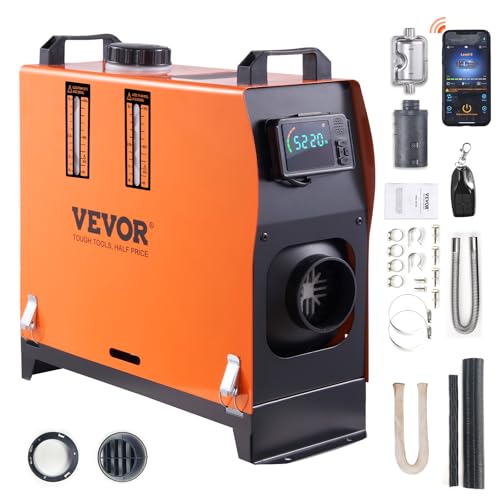
VEVOR 8KW Bluetooth Diesel Heater

VEVOR 2KW Bluetooth Diesel Heater
Best Diesel Heater For House: What To Buy

The VEVOR 8KW Diesel Heater (Product 3) is the best diesel heater for house use because it pairs an 8,000 W output with a built-in CO alarm, quiet operation at 75 dB or lower, and 12V/24V flexibility that matters more than raw power when you’re heating a single zone, workshop, or attached garage. Most diesel heaters sold for “home” use are really parking heaters adapted from trucks and RVs. They work well in those settings, but indoors they need external venting, a working carbon monoxide alarm, and enough airflow to keep combustion gases outside the living space.
Product 3 adds the CO alarm other models skip, which catches exhaust leaks before they’re dangerous. The unit runs quieter than competing 8 KW models, so you won’t hear the combustion fan cycling every few minutes if you’re working nearby. It accepts 12V or 24V power without a transformer, which simplifies wiring in a detached shop or a vehicle-based install. The 8,000 W output suits a well-insulated 400 to 500 square foot space when the venting and combustion air are handled correctly.
These heaters fit a vented garage, workshop, or one room better than a whole house. Diesel heaters move air through a heat exchanger and exhaust combustion gases outside, so they need a vent pipe routed through a wall or floor and sealed against backdraft. Running one indoors without that vent and a CO alarm is the mistake that sends people to the emergency room. If you want central heat for a whole house, a furnace with ductwork or a heat pump is the safer, code-approved choice.
How To Choose The Right Diesel Heater
Pick a diesel heater by matching its output to your space, then check whether you can reach the controls once it’s installed. Most diesel heaters land between 2 kW and 8 kW. A 2 kW unit suits a small workshop or an insulated shed up to about 200 square feet. An 8 kW model like the VEVOR heaters covers a single-car garage or a bonus room around 400 to 600 square feet, depending on insulation and how cold it gets outside. Diesel heaters don’t heat a whole house the way a furnace does—they’re zone heaters, warming one room or an outbuilding at a time.
| Output | Typical Space | Who It Suits |
|---|---|---|
| 2 kW | Up to 200 sq ft | Workshops, small sheds, truck cabs |
| 5 kW | 250 to 400 sq ft | One-car garages, studios, campers |
| 8 kW | 400 to 600 sq ft | Two-car garages, bonus rooms, barns |
Controls matter because most diesel heaters mount low or out of sight to keep the exhaust pipe short. Bluetooth app control—found on the VEVOR models and the LF Bros—lets you adjust temperature and runtime from across the room or upstairs without kneeling next to the unit. An LCD remote does the same job if you keep it handy. Basic models with only an onboard LCD display work fine when the heater sits within arm’s reach, but they’re inconvenient once it’s bolted under a workbench or behind stored gear.
Voltage determines what powers the unit. Most diesel heaters run on 12V or 24V DC, drawing from a car battery, a deep-cycle battery bank, or a wall adapter that converts household AC. A 12V heater pulls higher amperage for the same wattage, so the wiring needs to handle it; 24V cuts that draw in half and suits RVs or solar setups already running 24V systems. The LF Bros all-in-one model includes a 110V AC transformer in the box, so you plug it straight into a household outlet without rigging a separate power supply. That’s the simplest choice for a garage or shop with standard outlets and no existing 12V setup.
Fuel tank size changes how often you refill, not how warm you’ll be. A 10-liter tank on an 8 kW heater running halfway gives you roughly a full day before it’s empty; a 25-liter tank doubles that. Built-in tanks keep the setup tidy. External tanks let you top off without moving the heater, but they add another hose and a leak point to watch.
Altitude compensation adjusts the fuel-air mix as elevation rises and oxygen thins. Most modern units handle it automatically up to about 18,000 feet, like the VEVOR models that compensate to 18,045 feet. If your garage sits above 6,000 feet and the heater lacks that feature, it’ll run rich, soot up the combustion chamber, and lose efficiency. Check the spec sheet before buying if you’re in the mountains.
How Long A 20 Lb Tank Lasts
Diesel heaters don’t run on propane tanks—they burn liquid diesel from a built-in or external fuel reservoir, measured in liters or gallons. Runtime depends on how hard you run the unit and how much fuel you start with.
Product 4 consumes 0.18 to 0.53 liters per hour depending on output setting, Product 5 burns 0.18 to 0.4 L/h, and Product 1 runs leaner at 0.12 to 0.26 L/h. A five-gallon (19-liter) tank feeding Product 1 at half power lasts about 100 hours; the same tank powering Product 4 at full output runs dry in 36 hours.
Fuel use climbs when outdoor temps drop below freezing, insulation is poor, or the space has high ceilings or air leaks. Thermostat control helps: once the heater reaches setpoint it cycles down or off, cutting consumption by half compared to running flat-out.
Diesel costs vary by region and season. At $4.00 per gallon, running Product 1 at 0.2 L/h (about 0.05 gallons per hour) for eight hours costs roughly $1.60 a day. Product 4 at 0.5 L/h (0.13 gallons per hour) for the same period costs about $4.16. Show your own math: burn rate in liters per hour ÷ 3.785 to get gallons per hour, then multiply by hours and your local diesel price.
Diesel heat works best as zone or supplemental heating—warming one room, a garage, or a cabin—rather than replacing a whole-house furnace. Running any of these units all day in a drafty two-story house drains fuel fast and costs more than propane or natural gas in most markets. Size the heater to the space you actually occupy, insulate what you can, and use the thermostat to keep it from burning fuel when the room’s already warm.
Indoor Use, Attached Garages, And Venting
Diesel heaters designed for indoor or attached garage use must have their exhaust gases vented outdoors. These heaters burn diesel fuel in a combustion chamber, producing exhaust that includes carbon monoxide and other harmful gases. A dedicated, sealed exhaust pipe must carry these gases outside to avoid indoor air contamination. The heater’s warm air is blown into the space through a separate channel that never mixes with the exhaust. Running a diesel heater indoors without proper venting risks dangerous buildup of toxic fumes.
Attached garages can work, but only when you vent the exhaust properly, maintain clearances from walls and stored materials, and install a working CO alarm. Run the exhaust pipe through an exterior wall or the roof, not into an attic or crawl space. Keep the intake clear of dust and debris. Check that your homeowners policy and local code allow unvented fuel-burning appliances in attached structures; some jurisdictions treat them the same as living space.
Venting requirements start with the heater’s manual. Most units in the 5 to 8 kW range call for a 24 mm (roughly 1 inch) exhaust pipe run to the outside, with as few bends as possible and a minimum clearance—often 12 inches—from combustible surfaces. Vertical runs should pitch slightly downward toward the heater to drain condensation. Terminate the pipe where snow, leaves, or wind-blown debris won’t block it, and cap it with a mesh guard if rodents or birds are common. Local building codes may add requirements for pipe material, roof penetrations, or permits.
For continuous indoor home use, treat installation the way you would a vented gas appliance. Hire a technician familiar with your jurisdiction’s mechanical code if the job involves cutting through siding, flashing a roof penetration, or running wire to a new circuit. DIY installation is common in workshops and detached garages where codes are less strict, but living spaces usually require inspection. Product 3 and Product 5 ship with venting kits; you’ll still need to supply the through-wall fittings and sealant.
Clearance rules matter as much as venting. Keep the heater at least three feet from cardboard boxes, paint cans, gasoline, and anything else that can ignite. Mounting brackets let you secure the unit to a wall or under a workbench, which keeps it away from foot traffic and reduces tip-over risk. Product 4 includes wall-mount hardware; others expect you to fabricate your own or set the unit on a non-combustible base.
Building codes and homeowners association rules still apply. Some municipalities restrict or ban fuel-burning appliances in attached garages or require a fire-rated wall between the garage and living space. Others mandate a dedicated makeup-air vent if you’re heating a sealed room. Check with your local building department before you drill the first hole.
Maintenance, Noise, And Cold-Start Reliability
Regular maintenance on a diesel heater takes about ten minutes every few months and keeps it running cleanly through the season. You’ll need to keep the air intake and exhaust clear, check the fuel line for cracks or kinks, and inspect the wiring connections and hose clamps for tightness. Some models call for a fuel filter replacement once a year or after a few hundred hours of use; your manual will specify the interval.
Cold-start performance is where diesel heaters shine. Models rated to operate from -40 °F to 104 °F will fire up on a January morning without complaint, as long as the fuel hasn’t gelled and the battery or power supply delivers enough current to spin the glow plug and fan. Smart controls help here: you can preheat from inside the house five or ten minutes before you head to the garage. Reliability still depends on using clean diesel, venting the exhaust properly, and installing the unit where vibration and moisture won’t loosen connections.
Noise comes from two sources: the fuel pump’s rhythmic tick and the combustion fan. Product 5 runs at 75 dB or lower, which is about the volume of a window air conditioner or a washing machine on spin cycle. You’ll hear it, but it won’t drown out conversation. The pump tick is most noticeable at startup and at low power settings, when the fan runs slower and the click stands out. If the heater sits on the other side of a wall or in a vented garage enclosure, the sound drops further.
Expected lifespan runs anywhere from three to ten years, depending on how many hours you put on it each season and how well you maintain it. A heater that runs eight hours a night for four months a year will log about 960 hours annually. Clean fuel, regular filter changes, and a proper install that doesn’t stress the wiring or exhaust will push a unit toward the longer end of that range. Carbon buildup in the combustion chamber is the usual wear item; some owners run a high-heat burn cycle once a month to keep it clean.
Before You Buy Or Call A Technician
Installation is DIY-friendly if you’re comfortable routing exhaust through a wall and matching voltage, but any uncertainty about venting, through-wall holes, or electrical wiring means you should hire a pro. Attached garages with living space above them, homes with shared HVAC systems, or spaces where you can’t guarantee fresh air all warrant a call to a licensed HVAC technician before you drill anything. Getting the venting wrong turns a clean-burning heater into a carbon monoxide risk.
Stacking multiple diesel heaters sounds like a way to zone-heat a large shop or basement, but it only makes sense when you already have safe venting for each unit, enough incoming air to feed all the combustion chambers, and a real reason two zones need independent control. Running two heaters badly—one starved for air, one venting into a shared crawl space—creates more problems than it solves. A single correctly sized heater, mounted where it can pull fresh air and exhaust cleanly, heats more evenly and costs less to maintain than two small ones fighting for oxygen.
Heating your house without electricity requires a diesel heater with 12V or 24V operation, which you can run from a battery bank, a vehicle, or a solar-charged deep-cycle setup. Models like the LF Bros 5KW support 12V, 24V, and 110V through a transformer, giving you options when the grid goes down. Keep in mind that the heater’s control board and fan still draw current—budget about 1 to 3 amps per hour depending on the model and heat setting—so your battery needs enough reserve for an overnight run. Propane and kerosene heaters also work off-grid, but diesel heaters exhaust outside and let you carry one fuel type for a generator and heat.
Check your space one more time before you commit. Measure the wall thickness where the exhaust will exit, confirm the heater will fit where you want it mounted, and read the manual’s clearance requirements—most call for six inches from combustibles and a foot above the floor. Skipping that last check is how people end up with a heater that works great but blocks the workbench or sits too close to stored paint.