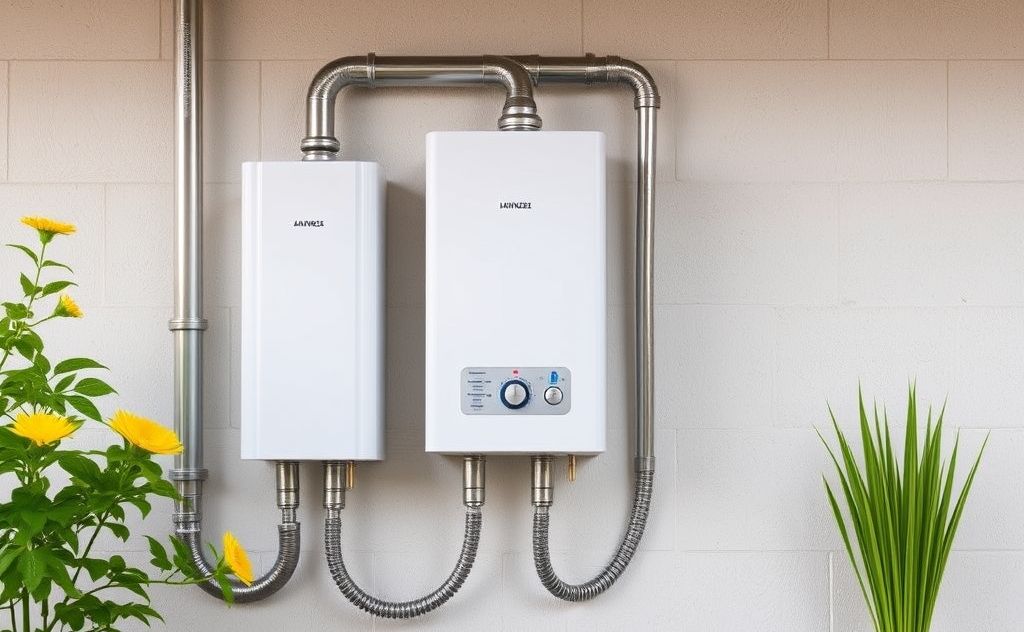
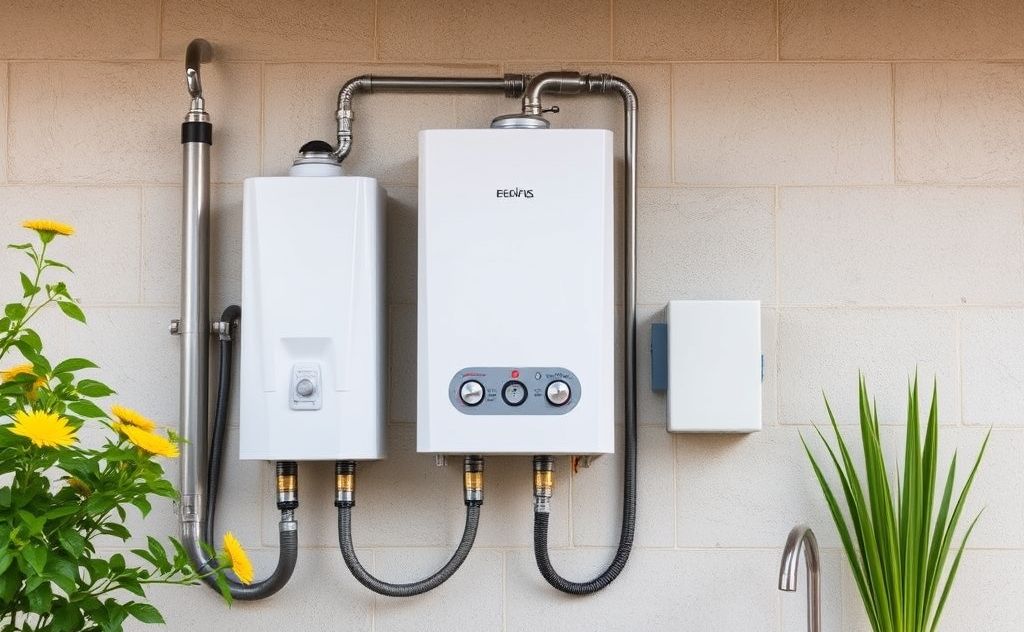
You’ve made the switch or you’re about to. A 50-gallon tank is sitting in your utility closet, and the idea of endless hot water sounds great. But here’s the catch: tankless units don’t come in a one-size-fits-all package. Pick one too small, and you’ll get lukewarm water the moment someone flushes a toilet. Pick one too big, and you’ll pay for electrical work or gas lines you didn’t need, plus wait longer for hot water to arrive at the tap.
This guide walks through the exact math plumbers use. You’ll learn how to calculate your family’s peak demand in gallons per minute (GPM), figure out your temperature rise (delta T), and match those numbers to a performance chart. You’ll also see why a family of four in Florida needs a very different unit than a family of four in Minnesota. By the end, you’ll have a concrete number to shop with, not a guess.
NOVIEEX
27kW Tankless Water Heater Electric, NOVIEEX 240V…
- 【WHOLE HOUSE HEAVY DUTY】 The NOVIEEX 27kW tankless hot water heater electric is a heavy-duty solution custom-built to satisfy full…
- 【3-4 MULTI-POINT LUXURY FLOW】 It delivers a massive, industry-topping water flow of up to 7.4 Gallons Per Minute (GPM). This high-…
- 【WHAT TEMPERATURE CAN IT REACH? - SMART MASTER TEMPERATURE LOCK】 Reaching a wide temperature spectrum from 77°F to 140°F (approx.…
If you’re leaning toward electric, the NOVIEEX 27kW electric tankless water heater is a solid example of what a modern 240V unit can do. It pushes up to 7.4 GPM and handles 3-4 points of use simultaneously, which puts it in the right ballpark for many four-person households. We’ll reference it later when we compare options.

The Short Answer: What Size Do You Actually Need?
For most families of four, you need a unit that delivers at least 6-7 GPM at a 45°F temperature rise. That’s the sweet spot. It covers two people showering at once, which is the most common peak scenario in a four-person home.
But that number shifts dramatically based on where you live. In the south, where groundwater sits around 70°F, a 6 GPM unit at a 30°F rise is plenty. In the north, where inlet water drops to 40°F in winter, you need the same 6 GPM but at a 60°F rise — which takes a much bigger burner or heating element.
So the real answer isn’t a single number. It’s a calculation. Let’s do it step by step.
Step 1: Calculate Your Family’s Peak Demand (GPM)
Peak demand means the maximum amount of hot water your family uses at the exact same moment. You’re not sizing for the whole day’s usage. You’re sizing for that 7:30 AM rush when two people are in the showers and someone starts the dishwasher.
Here’s the standard fixture flow rates used in the industry:
- Shower: 2.5 GPM (standard head) or 1.5-2.0 GPM (low-flow head)
- Bathroom faucet: 1.0-1.5 GPM
- Kitchen sink: 1.5-2.0 GPM
- Dishwasher: 1.5-2.0 GPM
- Washing machine: 2.0-3.0 GPM
The “Two-Shower” Rule of Thumb
For a family of four, the most intense realistic scenario is two showers running simultaneously. That’s 5.0 GPM with standard heads. Add a bathroom faucet running for shaving or brushing teeth, and you’re at 6.0-6.5 GPM. That’s your peak.
If you have teenagers who take 20-minute showers, or if someone regularly fills a large bathtub, add another 1-2 GPM to that number. Bathtubs are the hidden demand killer — a garden tub can pull 8-10 GPM while filling.
How Low-Flow Fixtures Change the Math
Here’s where you can save real money. If you swap out standard 2.5 GPM showerheads for 1.8 GPM low-flow models, your two-shower scenario drops from 5.0 GPM to 3.6 GPM. Add a faucet, and you’re at 4.6-5.1 GPM instead of 6.0-6.5 GPM.
That one change can let you buy a smaller, cheaper unit. It’s the single most effective way to reduce your required GPM without changing your habits. Check your showerheads before you buy anything — you might already have low-flow models and not realize it.
Step 2: Calculate Your Temperature Rise (Delta T)
Temperature rise is the difference between your incoming groundwater temperature and your desired hot water temperature. Most people want water at 110-120°F at the tap. Let’s say 115°F as a target.
The formula is simple: Delta T = Desired Temp – Inlet Water Temp
Here’s the catch: your inlet temperature changes with the seasons. In summer, groundwater might be 75°F, giving you a 40°F rise. In winter, that same groundwater drops to 45°F, and you need a 70°F rise. You must size for the worst case — winter.
Why Your Climate is the Biggest Variable
Let’s look at two real examples:
- Houston, TX: Winter inlet temp around 55°F. Delta T = 60°F. A 6 GPM unit at 60°F rise works fine.
- Minneapolis, MN: Winter inlet temp around 35°F. Delta T = 80°F. That same 6 GPM unit might only deliver 4 GPM at an 80°F rise.
You can find your local groundwater temperature from your water utility company or a simple online lookup based on your zip code. Don’t guess on this one — it’s the difference between a working system and a cold shower in January.
Step 3: Match GPM + Delta T to a Performance Chart
Every tankless water heater comes with a performance chart. It’s a simple graph or table showing the maximum GPM at various temperature rises. This is the only number that matters when comparing units.
Here’s what that looks like in practice. A typical 27kW electric unit (like the NOVIEEX mentioned earlier) might deliver:
| Temperature Rise (°F) | Max Flow Rate (GPM) | Best For |
|---|---|---|
| 35°F | 7.4 GPM | Mild climates, summer use |
| 45°F | 6.0 GPM | Moderate climates, two showers |
| 60°F | 4.5 GPM | Cold climates, single shower + sink |
| 80°F | 3.4 GPM | Very cold climates, limited simultaneous use |
Find the row that matches your winter delta T. Then check if the GPM at that row meets your peak demand from Step 1. If it does, the unit is big enough. If not, you need a larger unit or a gas model.
For a family of four in a cold climate, this is where electric units start to struggle. A 27kW unit at an 80°F rise only delivers about 3.4 GPM — not enough for two showers. You’d need a 36kW unit or a gas model to cover that gap.
Gas vs. Electric: Why the Sizing Method Differs
Gas units are rated in BTUs (British Thermal Units), not kilowatts. A typical whole-home gas tankless unit runs 150,000-200,000 BTUs. The sizing math is the same, but gas units have a much higher output ceiling.
Here’s the practical difference: a 199,000 BTU gas unit can deliver 8+ GPM at a 70°F rise. That’s enough for three showers running at once in a cold climate. Electric units top out around 36kW, which delivers roughly 7.5 GPM at a 35°F rise, but drops to 4.5 GPM at 60°F.
So which should you choose? It depends on your climate and your electrical panel. Electric units need 2-3 dedicated 240V breakers. Many older homes don’t have the panel capacity. Gas units need a venting route and a gas line, which can be expensive to run if you don’t already have one.
If you live in a mild climate (delta T under 45°F), electric is simpler and cheaper to install. If you’re in a cold climate, gas is usually the more reliable choice for a family of four. For more detail on the best gas options, check this gas unit guide for large households.
The Hidden Cost of Oversizing (and Undersizing)
Everyone warns about undersizing — cold showers, frustrated kids, and a unit that runs constantly. But oversizing has real downsides too, and they’re less obvious.
An oversized unit costs more upfront. It also requires heavier electrical wiring or a bigger gas line. But the operational cost is the sneaky part: a tankless unit that’s too powerful will heat water faster than needed, then cycle on and off frequently at low flow rates. That short-cycling wastes energy and wears out components faster.
There’s also the wait time issue. A bigger burner heats water instantly, but the water still has to travel from the unit to your tap. Oversizing doesn’t fix that. You’ll still wait 10-20 seconds for hot water at a distant faucet, same as a correctly sized unit.
Undersizing is worse, of course. You’ll notice it immediately — the shower goes cold when the washing machine kicks on. The fix is either upgrading the unit (expensive) or changing your habits (annoying). Neither is fun.
The goal is to buy the smallest unit that meets your winter peak demand. Nothing more, nothing less.
What If You Have a Recirculation Pump?
A recirculation pump keeps hot water circulating through your pipes so it’s ready at the tap instantly. It solves the wait-time problem, but it changes your sizing math in one important way.
With recirculation, you don’t need to oversize the unit to compensate for cold water sitting in the pipes. The pump handles that. But the pump itself draws hot water continuously, so your tankless unit will fire up more often — even when nobody’s using water. That increases the total load on the unit over time.
Sizing-wise, the peak demand calculation stays the same. The recirculation pump adds a baseline load, not a peak load. You still need the same GPM at your delta T for simultaneous showers. Just make sure your unit is rated for recirculation use — some manufacturers void warranties if you run a recirc loop without a buffer tank.
If you’re on well water, the sizing math is identical, but you’ll want to read about well water compatibility before committing to a unit.
The Upgrade Dilemma: Fixing an Existing Undersized Unit
You already bought a tankless unit and it’s not keeping up. What are your options?
First, confirm the problem is actually the unit’s capacity and not something else. Check the inlet filter for debris, make sure the gas line is sized correctly, and verify the unit isn’t throwing an error code. A 10-minute diagnostic can save you from buying a new unit unnecessarily.
If the unit truly is too small, you have three paths:
- Replace it with a larger unit. This is the cleanest solution but the most expensive.
- Add a second unit in parallel. Two smaller units can combine their output. This works well if you have the space and the electrical or gas capacity.
- Install a buffer tank. A small 5-10 gallon tank between the tankless unit and your fixtures can smooth out peak demand. It’s a workaround, not a fix — you’ll still run out of hot water if the peak lasts longer than the buffer tank holds.
For most families, replacing the undersized unit is the right call. The labor cost of installing a second unit or a buffer tank often approaches the cost of a new, properly sized unit anyway.
A Simple Final Sizing Checklist for a Family of 4
Grab a piece of paper. Work through these steps in order:
- List every fixture that could run hot water at the same time. Be honest about your family’s habits.
- Add up the GPM for that worst-case scenario. Use 2.5 GPM per shower unless you have low-flow heads.
- Find your winter groundwater temperature. Write it down.
- Subtract that from 115°F (your desired hot water temp). That’s your delta T.
- Look at performance charts for units you’re considering. Find the GPM at your delta T.
- Confirm the GPM at your delta T meets or exceeds your peak demand.
- Check your electrical panel capacity (for electric) or gas line size (for gas).
If you did this right, you’ll have a specific model number and a specific GPM rating to shop for. If you’re still unsure, a 27kW electric unit like the NOVIEEX 27kW model is a strong baseline for mild-to-moderate climates. For colder regions, look for a 36kW electric or a 199,000 BTU gas unit.
Frequently Asked Questions
Is 6.5 GPM enough for a family of four?
Yes, in most cases. 6.5 GPM covers two showers (5.0 GPM) plus a faucet (1.5 GPM) simultaneously. That’s the typical peak for a four-person household. The catch is the temperature rise. If your winter delta T is above 60°F, a unit rated at 6.5 GPM will only deliver 4-5 GPM. Check the performance chart, not the marketing number.
Can I install two smaller units instead of one big one?
You can, and it’s sometimes the smart play. Two 18kW electric units might cost less than one 36kW unit, and they let you zone your home — one for the bathrooms, one for the kitchen and laundry. The downside is double the installation labor and twice the points of failure. If you have the panel capacity and the space, it’s a legitimate strategy.
What’s the difference between whole-home and point-of-use tankless units?
Whole-home units are sized to handle your entire house’s peak demand — typically 6-10 GPM. Point-of-use units are small, 2-4 kW electric units mounted right at a single sink or shower. For a family of four, a point-of-use unit alone won’t cut it for showers. But you can pair a whole-home unit with point-of-use units at distant faucets to reduce wait times.
Does a recirculation pump change the size I need?
Not for peak demand. The pump adds a constant low-level load, but your peak scenario (two showers) still dictates the required GPM. What the pump does change is how often the unit cycles on, which can affect longevity. Make sure your chosen unit supports recirculation.
My current tankless is too small. What are my upgrade options?
You have three paths: replace it with a larger unit, add a second unit in parallel, or install a small buffer tank to smooth out peaks. Replacement is the most reliable. Adding a parallel unit works if you have the space and power. A buffer tank is a band-aid, not a permanent fix.
What to Do With This Information
- Measure your actual shower flow rate with a bucket and a stopwatch. Don’t trust the fixture’s label.
- Find your local groundwater temperature before you shop. It’s the single biggest variable in sizing.
- Size for winter, not summer. The unit that feels fine in July won’t cut it in January.
- Swap in low-flow showerheads first. It can drop your required GPM by 30% or more.
- Compare performance charts, not maximum GPM ratings. The number at your delta T is the only one that matters.
- Check your electrical panel or gas line capacity before you buy. Installation costs can exceed the unit’s price.
- If you’re between two sizes, buy the larger one — but only if your delta T demands it. Oversizing wastes money; undersizing wastes comfort.
Related guides
5400W Electric Shower Head Heater: Instant Hot Water Anytime!
Get the scoop on the 5400W Electric Shower Head Heater! Find out why it's the ultimate choice for…
Stiebel Eltron Instant Hot Water Heater: Fast Heating You Can Trust
Get the inside scoop on the Stiebel Eltron Instant Hot Electric Water Heater! Find out why it's a…
Stiebel Eltron Mini Instant Electric Water Heater: A Game Changer!
Get the inside scoop on the Stiebel Eltron Mini Instant Electric Water Heater. Find out why it’s the…