The CAMPLUX 4.5kW 120V tankless water heater is the best pick for most small-space needs because it delivers instant hot water with efficient energy use and a compact design ideal for under-sink installation.
What to remember
A 4.5kW 120V unit like CAMPLUX suits most single-sink setups, delivering hot water within seconds and saving energy.
Check your electrical panel: small tankless heaters often need dedicated circuits with 30-40 amp breakers and proper wiring.
Flow rate (gallons per minute) determines if a heater can support your faucet or shower; small units usually max out around 1 GPM, enough for hand washing or dishwashing.
Electric small tankless heaters are best for point-of-use applications, not whole-house or multiple simultaneous taps.
Installation safety matters: hard wiring, ground fault protection, and compliance with local codes keep you safe and your heater reliable.
Many homeowners think all tankless water heaters are large and complicated, but small electric models offer instant hot water without the bulk or the wait. These compact units fit in tight spaces and save energy by heating only what you use.
Choosing the right small tankless water heater means balancing power, flow rate, and installation requirements. This guide cuts through the jargon and points you to the best options for kitchens, bathrooms, and small condos.
Best Small Tankless Water Heaters for Tight Spaces
#1Best Overall
CAMPLUX 4.5kW Point-Of-Use Heater
Best for Under-sink hot water when you can provide a dedicated 40A circuit
The CAMPLUX combines a 4.5kW output with self-modulating power, so it adjusts its input as flow and temperature change. Its 0.26 GPM activation flow, LED temperature display, and compact 10.95 × 2.52 × 7.4-inch body suit one sink in a kitchen, wet bar, or other tight space. Choose it only if hard-wiring a 40A circuit is practical.
Power 4.5kWVoltage 110-120VTemperature rise 50°F at 1.0 GPMActivation flow 0.26 GPMWater connection 1/2-inch NPT
Why it made the cut
Self-modulates power based on flow and temperature
Activates at 0.26 GPM for one sink
Compact body with touch controls and LED display
Good to know
Requires hard wiring with a 40A circuit breaker
Designed for one sink, not multiple fixtures
Skip it if Skip it if you need a plug-in unit or don’t have room for the required 40A electrical work.
Best for Hand washing and sink use where remote or touch control is useful
KENUOS gives you both remote and touch-screen control, along with an LED display and a 95°F to 131°F setting range. Overheat, dry-burning, and electric-leakage protection add useful safeguards for a compact under-sink unit. Its own usage guidance limits it to sink washing and similar low-demand jobs, not showers.
Power 3000WVoltage 110VTemperature range 95°F to 131°FWater connection 1/2 inchWire requirement 2.5mm²
Why it made the cut
Remote and touch-screen controls
95°F to 131°F temperature range
Includes overheat, dry-burning, and leakage protection
Good to know
Not suitable for shower use
Requires a circuit breaker of at least 32A
Limited to sink washing and similar uses
Skip it if Skip it if one heater must supply a shower or more than one fixture.
Best for One low-flow sink where a plug-in connection matters
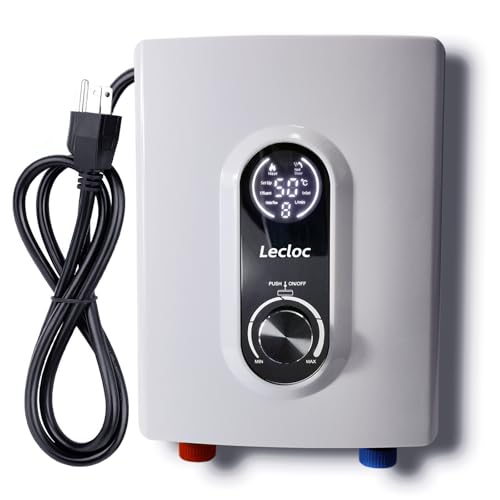
This LECLOC is the practical choice when you need a 3kW, 120V unit that plugs in rather than requiring a hard-wired connection. A control knob handles power and temperature, while overheat, leakage, dry-heating, over-pressure, and IPX4 protection cover the common small-heater hazards. Keep the job to one low-flow point of use.
Power 3kWVoltage 120VDimensions 7.1 × 9.8 × 2.8 inchesInstallation Plug-inUse 1 point of use
Why it made the cut
120V plug-in installation
Simple control knob with LED display
Includes overheat, leakage, dry-heating, and over-pressure protection
Good to know
Low-flow use only
Not suitable for showers or multiple taps
Output temperature changes with flow and inlet-water conditions
Skip it if Skip it if you need shower flow, multiple taps, or higher heating capacity.
Best for A compact single-sink setup with knob control and listed water protection
The second LECLOC option keeps the same low-flow, one-point-of-use role but spells out its 30°C to 55°C thermostatic range and IPX4 water protection. Its LED display and single control knob are easy to read and adjust under a sink. Consider it for a kitchen, laundry, office, or other single tap—not a shower circuit.
Power 3kWVoltage 120VDimensions 7.1 × 9.8 × 2.8 inchesTemperature range 30°C to 55°CInstallation Plug-in
Why it made the cut
30°C to 55°C thermostatic range
Plug-in 120V design
IPX4 and multiple built-in safety protections
Good to know
Not suitable for showers or multiple taps
Designed for low-flow use only
Temperature depends on wattage, flow, and inlet-water conditions
Skip it if Skip it if you need to serve multiple fixtures or want Fahrenheit temperature settings.
The right small tankless water heater is chosen by matching its voltage, wattage and flow capacity to the sink or faucet you actually need to supply. A 110V model is usually the smallest class; the KENUOS Electric Tankless Water Heater 110V 3000W is an example, while the CAMPLUX Tankless Water Heater Electric 120V uses a higher-power circuit for more heating capacity.
A 110V, 3,000W unit draws about 27.3 amps (3,000 ÷ 110), so it won’t run from an ordinary 15-amp receptacle. A 120V, 4,500W unit draws 37.5 amps. Check the nameplate before ordering: voltage, wattage, breaker requirements and wire size must agree, and the circuit should be installed by a qualified electrician.
Spec
What to check
Why it matters
Voltage
110V or 120V
The heater must match the available circuit.
Power
Wattage and amperage
More watts can heat more water, but demand a larger circuit.
Flow rate
Gallons per minute at your temperature rise
A unit may struggle if the faucet needs more flow than it can heat.
Mounting
Under-sink or wall-mount instructions
Compact spaces still need service access and room for plumbing.
The product listing and installation manual should provide these figures.
For a small condo, an electric tankless hot water heater makes the most sense when you need one hand-washing sink, a bathroom basin or a point-of-use fixture rather than an entire home. A compact under-sink unit avoids storing a tank, but a low-voltage model may provide only warm water in winter if incoming water is cold and the faucet flow is high.
Features worth checking
Dry-fire protection that prevents the heating element from energizing without water flow
A leakage sensor or leak alarm, if the model lists one
Overheat protection and an accessible shutoff
A clear flow or temperature control rather than a vague heat setting
A recognized safety listing shown on the product or manual, such as UL, ETL or CSA
Worked example
Say you want a heater beneath a bathroom sink. The faucet needs 0.5 gallons per minute, the available circuit is 120V, and the unit’s manual permits under-sink mounting. A 120V model rated for that flow and the expected temperature rise is a better fit than choosing the physically smallest box and hoping it keeps up.
FixtureOne bathroom sink
Flow to match0.5 gallons per minute
Circuit120V, confirmed from the panel and namep
MountingUnder sink, with service access
Smallest isn’t always simplest
Measure the cabinet, then check the electrical panel and plumbing connections. A heater that fits the cupboard but needs a new high-amperage circuit is a poor compact-space bargain.
From HeaterGuides · our own guideTankless? Page 8 is the descaling routine, page 15 checks the size.Water Heater Owner's ToolkitFix the common faults yourself, keep it running for years, and know when a repair is money wasted.No-hot-water flowcharts, gas and electricFlush, anode, relief valve and descaling stepsRepair-or-replace calculator (Excel)$14.99$9.99Get it for $9.99See what's inside and watch the 2-minute video →18-page printable PDF + Excel calculator · instant download · 30-day refund
Sizing And Running Costs For Small Units
Size a small tankless heater by flow rate and temperature rise, then estimate its cost from watts, run time and your electric rate. A unit that heats one half-gallon-per-minute hand-washing flow may be unsuitable for a shower, even if both fixtures are nearby.
To measure a faucet, catch its water in a container for a timed interval and convert the result to gallons per minute. For example, 1 gallon collected in 30 seconds equals 2 gallons per minute. Use the lowest comfortable flow that gives the fixture a usable rinse; every extra gallon per minute makes the heater work harder.
Temperature rise is the outlet temperature minus the incoming water temperature. If the water enters at 50°F and you want 100°F at the sink, the required rise is 50°F. Winter inlet water can be much colder than summer water, so the same wattage may deliver less hot water or require a lower flow in January.
Worked example
Suppose a 3,000W heater runs for 45 minutes each day while supplying a small sink. Convert 45 minutes to 0.75 hour, then use 3 kW × 0.75 hour × 30 days. At an electricity rate of $0.17 per kWh, that calculation gives the monthly energy use and cost shown below; actual use falls when the faucet is closed.
Heater3,000W = 3kW
Daily run time0.75 hour
Billing period30 days
Assumed electric rate$0.17 per kWh
Heater
Watts
Per hour
Per day (0.75 h)
Per month (30 days)
3,000W point-of-use heater
3,000 W
51¢
38¢
$11.48
Calculated at 17¢ per kWh. This assumes the element runs for 45 minutes every day at $0.17 per kWh. Standby use is low because the heater heats water only when flow activates it.
A change from a water-heater tank to tankless usually costs more than buying the heater alone. The final amount depends on removing or abandoning the tank, adapting water lines, supplying the required electrical circuit, and meeting permit or code requirements; a gas conversion can also involve venting. Get the installation quote before treating the compact unit as a simple swap.
Separate energy cost from conversion cost
On-demand heating can reduce energy wasted keeping a storage tank hot, but it won’t erase the upfront plumbing and electrical work. Compare the expected monthly kWh with the installer’s complete scope, not with the heater’s box price.
Installation And Safety Considerations
A small tankless water heater needs the right circuit, plumbing connections and safety controls before it ever makes hot water. Videos showing how to install wires to a small tankless water heater can explain the layout, but don’t copy a generic wiring diagram: the unit’s manual and local electrical code decide the breaker, wire size and disconnect. A 5,500 W, 220 V under-sink heater draws about 25 A (5,500 ÷ 220), so a licensed electrician should handle that installation.
1
Confirm the circuit
Check the nameplate for voltage, wattage and required overcurrent protection. A high-wattage unit normally needs a dedicated breaker and correctly sized copper conductors; sharing the circuit with an outlet, disposal or dishwasher can trip the breaker or overheat the wiring.
2
Choose the connection method
Some compact heaters plug into a properly rated receptacle, while larger 220 V or 240 V models are hardwired through a junction box or disconnect. Never add an ordinary plug to a hardwired unit, and don’t use an extension cord or power strip.
3
Connect the water lines
Install the inlet and outlet in the direction marked on the heater, add shutoff valves where the manual calls for them, and check every threaded connection for leaks before energizing the unit. A water leak near live electrical parts is a serious fault, not a small inconvenience.
4
Test the protection
Use the required ground connection and a GFCI-protected circuit where the manual or local code requires it. Test the GFCI after installation; it should interrupt power during a ground fault rather than leave the metal case energized.
Don’t bypass the safety parts
Don’t defeat the ground, bridge the breaker, or bypass a flow switch, thermal cutoff or GFCI to stop nuisance trips. Repeated tripping points to a wiring, leak, pressure or heater fault that needs diagnosis.
Before power goes on
The voltage and wattage match the branch circuit.
The breaker is dedicated and the wire gauge follows the manual and local code.
The unit is listed by a recognized safety organization such as UL or CSA for its intended indoor use.
All plumbing joints are dry, the case is grounded and the GFCI test passes.
A licensed electrician handles the 220 V or 240 V wiring, with a plumber involved where local rules require it.
What Competitors Leave Out: Real-World Installation Challenges
Small tankless heaters often fail to make hot water because the faucet doesn’t provide enough flow or pressure to activate them. A low-pressure condo supply, clogged aerator or partly closed shutoff valve can leave the flow switch below its model-specific minimum, so the heater stays off or produces lukewarm water.
Hard water creates a second problem: mineral scale narrows the inlet screen, restricts the heat exchanger and makes the heater work poorly. Follow the manual’s cleaning interval and descaling method, clean the inlet filter when the supply is shut off, and investigate a sudden drop in flow before blaming the heating element. Don’t pour a cleaning chemical into the unit unless the manufacturer permits it.
Measure the space before ordering
Under-sink room must hold the heater, shutoff valves, wiring connection and service access without crushing the cables or water lines. Leave the clearances listed in the manual, keep the unit away from places where a leak can soak electrical connections, and make sure you can remove the cover for filter or element service.
Condo installation check
Measure the cabinet width, height and depth, including the space needed for fittings and service.
Check water pressure and confirm the faucet’s flow can meet the heater’s activation requirement.
Look for a clogged aerator, inlet screen or partly closed valve before replacing the heater.
Use replacement parts matched to the exact model; a generic harness, sensor or heating element may have the wrong rating.
Keep the factory wiring harness, ground and thermal protections intact. Never install a bypass to force heating.
For furnishing a small condo, parts for sale are useful only when they match the heater’s voltage, wattage and connection layout. A replacement wire harness or inlet screen can solve a real fault; a harness bypass removes a safety check and can leave the element energized without adequate water flow. If you still need to compare sellers and compatible units, use this guide to where to buy a tankless water heater.
Pre-Buy Checklist: What To Confirm Before You Order Or Install
The smallest tankless electric water heater isn’t one universal model: the KENUOS 110V 3000W is the lowest-power option among these four, while physical size and connection spacing still need checking on its listing. Installing a small electric tankless water heater means matching its electrical load, water connections and required flow before you order.
Confirm Before Ordering
Read the data plate or manual for voltage, wattage, breaker requirement and minimum activation flow.
Check your electrical panel has room and capacity for the manufacturer’s required dedicated circuit. A 120V, 4.5kW heater draws about 37.5 amps; a 110V, 3,000W unit draws about 27.3 amps.
Measure the mounting space, including room for pipe bends, shutoff valves and access to controls.
Measure the existing inlet and outlet pipe connections, then compare them with the heater’s specified fittings. Don’t assume a small cabinet means small plumbing.
Check local plumbing and electrical code, permit rules and any required inspection before installation.
Confirm the faucet’s flow is high enough to activate the heater and that the unit can raise incoming water to your target temperature.
Check
Why It Can Stop The Install
Panel and breaker
A standard 15A receptacle won’t supply a 27.3A or 37.5A heater.
Space and connections
The cabinet may fit while the pipes or service clearance don’t.
Flow and demand
A hand-washing unit may struggle with a higher-flow faucet or shower.
Local rules
Electric units don’t need combustion venting, but electrical and plumbing requirements still apply.
Use the manufacturer’s manual as the final authority for circuit, fittings and clearances.
1
Match the actual job
Write down the faucet’s flow and the incoming water temperature. A point-of-use sink heater has a much smaller job than a shower supply.
2
Plan the installation
Have a licensed electrician handle new circuit work and a licensed plumber handle connections where local rules require it. Turn off power and water before service, and test for leaks before energizing the heater.
Don’t Guess The Breaker
Never install a larger breaker to stop nuisance trips. The breaker, wire size and disconnect must match the heater manual and local code; an electrician can verify the panel can carry the load.
Questions People Ask
How do I install the wires to a small tankless hot water heater?
Have a licensed electrician connect the heater according to its nameplate, installation manual and local code. The circuit must match the unit’s voltage and amperage, and the heater may need a dedicated breaker rather than a shared bathroom or kitchen circuit. Turn off power at the breaker before any work; a voltage tester is not a substitute for required electrical expertise.
Will installing a small electric water heater cause my tankless water heater to malfunction?
A properly isolated point-of-use heater shouldn’t make an existing tankless unit malfunction. Problems can follow if both heaters share an undersized circuit, are plumbed in a way that restricts flow, or receive conflicting temperature-control signals. An electrician should check the load, while a plumber should confirm that check valves, shutoffs and flow direction match the installation plan.
What is the smallest 110-volt tankless water heater available?
Among the four models compared here, the KENUOS 110V 3000W is the lowest-power option. That small electrical demand makes it easier to place near a sink, but 3,000 watts provides limited flow and temperature rise, so treat it as a point-of-use heater rather than a whole-home or shower unit. Confirm its connection size and activation flow before ordering.
Can I use a small tankless water heater for showering in a condo?
Usually not if the unit is a compact 110-volt model, because a shower needs more flow and temperature rise than a 3,000W heater can normally provide. A shower installation may require a higher-capacity circuit, suitable plumbing and approval from the condo association or local inspector. Check the heater’s flow-versus-temperature-rise table before assuming it can supply the shower.
Before you go · a welcome giftGet the Water Heater Owner's Toolkit for $4.99Fix the common faults yourself, keep it running for years, and know when a repair is money wasted. Normally $14.99; your welcome price saves $10.00. We'll email your link right now.or buy it now for $9.99 without the gift →One email with your link now. We never share your address.




 Water Heater Owner's ToolkitFix the common faults yourself, keep it running for years, and know when a repair is money wasted.No-hot-water flowcharts, gas and electricFlush, anode, relief valve and descaling stepsRepair-or-replace calculator (Excel)