

Walk into almost any plant and you’ll find the same quiet problem: a process runs slightly hotter than it should, nobody notices for a few hours, and then a batch gets scrapped. It happens in food processing, plastics, pharmaceuticals, chemical plants, and even data centers. The loss isn’t just the product. It’s the energy wasted, the labor spent, the line time lost, and the customer who has to wait.
This article walks through the top challenges in industrial temperature control and what you can actually do about them. You’ll get specific numbers, real-world conditions, and practical fixes. By the end, you should know where your money is leaking out and which control strategy stops the leak.
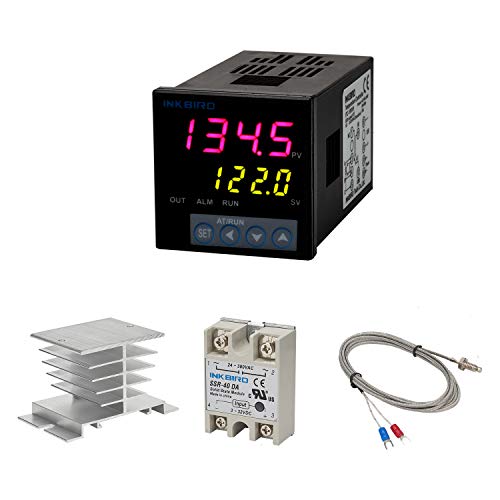
Inkbird
Inkbird PID Temperature Controller Kit, High Voltage…
- Alarm Output: With 1 alarm relay output, AC250 V, 3 A (Resistive load), ON or NC, you can wire a buzzer
- Supports 3-Wire Sensor: a 3-wire sensor or 2-wire sensor, like the K type thermocouple and Cu500, is supported by this PID tempera…
- SSR Output: With 1 relay output for external SSR, an SSR or relay is a must for this temperature controller; A 40DA SSR is include…
One tool that solves a chunk of these problems on smaller systems is a reliable PID controller. The Inkbird PID Temperature Controller Kit handles high-voltage loads (100–240 VAC), works with K-type thermocouples and Cu500 sensors, and includes a 40DA SSR. It shows both the real-time temperature and setpoint on two separate displays, which sounds minor until you’ve squinted at a single readout and misread a digit. Check the current price on Amazon if that fits your setup.

What Poor Temperature Control Actually Costs You
Most people think a temperature excursion is just a bad batch. It’s not. The total cost of ownership (TCO) of poor thermal management includes four buckets: direct product loss, energy waste, downtime, and compliance penalties.
Product loss is the obvious one. In pharmaceutical manufacturing, a single temperature deviation can scrap an entire batch worth hundreds of thousands of dollars. Food processing sees similar hits—a few degrees over the limit for thirty minutes can trigger a full recall. The FDA’s cold chain guidelines require strict documentation, and a gap in that record means disposal.
Energy waste is sneakier. An oversized heater cycling on and off because the controller has a wide deadband wastes 15–20% of its energy input. Over a year, that’s real money. A poorly tuned PID loop oscillates, overshoots, and settles slowly, burning extra power every cycle.
Downtime is the biggest single cost in most plants. A failed temperature sensor or a burned-out SSR stops the line. Industry benchmarks put unplanned downtime at $250,000 to $500,000 per hour in automotive and electronics manufacturing. Even in less intense industries, an hour of lost production is rarely cheap.
Compliance penalties vary by sector, but the trend is toward harsher fines. GDPR fines for data centers, FDA warning letters for pharma, and EPA rules for chemical plants all tie back to temperature control failures. One warning letter can cost more than a full control system upgrade.
Add these up and the case for fixing temperature control stops being about engineering pride and starts being about survival.
Challenge 1: Thermal Inconsistency and Uneven Heat Distribution
Hot spots and cold spots plague every industrial heating process. An oven with a single thermocouple in the center might read 200°C, but the corners sit at 185°C and the door edge at 195°C. Your product in the corner doesn’t get the same treatment as the product in the middle.
This happens for three reasons. First, air circulation is poor—stagnant zones form behind racks or near doors. Second, the heating elements are placed unevenly, so radiant heat doesn’t reach all surfaces equally. Third, the load itself absorbs heat at different rates; a dense metal part heats slower than a thin plastic sheet.
Thermal mapping is the fix. Run a temperature profiling study with multiple sensors placed throughout the chamber. Log data for a full cycle, not just a few minutes. You’ll see exactly where the deviations are and how long they last.
Once you have the map, you can act. Add baffles or fans to improve air circulation. Reposition heating elements. Or, if the imbalance is too large, split the chamber into zones with separate control loops. Each zone gets its own sensor and its own heater output. That’s more expensive upfront, but it pays back quickly when scrap rates drop.
One caveat: more sensors mean more maintenance. Every thermocouple can drift or fail. But the cost of one undetected hot spot usually exceeds the cost of several sensors.
Challenge 2: Equipment Failure and Unplanned Downtime
Temperature control equipment fails in predictable ways. Thermocouples drift as the wire oxidizes. SSRs short or fail open when they overheat. Contactors weld shut. Controllers lose their calibration. Each failure mode has a signature, and you can catch most of them before they stop production.
Thermocouple drift is the classic one. A K-type thermocouple used near its upper range can drift several degrees per year. In a process that needs ±1°C accuracy, that drift alone can push you out of spec. Regular calibration against a known reference catches this.
SSR failure is more dramatic. An SSR that fails shorted leaves the heater on full power—no control, just heat. That can melt product, damage the chamber, and create a fire risk. A failed-open SSR does the opposite: no heat, process stalls. Both are bad.
The fix is predictive maintenance. Track the resistance of heating elements over time—it changes as they age. Monitor SSR case temperature; overheating is the first sign of trouble. Log controller output percentages; a loop that’s working harder than usual indicates a problem downstream.
You don’t need a fancy system for this. A simple logbook works, but a connected system is better. Modern controllers can send alarms when output hits a threshold. The future of industrial temperature control includes this kind of self-diagnosing hardware.
Keep spare parts on hand. A spare thermocouple, SSR, and controller cost little compared to an hour of downtime. When something fails, swap it and sort out the root cause later.
Challenge 3: The Hidden Costs of Energy Inefficiency
Most industrial heating systems run at 60–70% efficiency. The rest goes up the stack or into the room. Poor control makes it worse.
Overshoot is the biggest waste. A controller with a wide deadband lets temperature swing 5°C above setpoint before cutting power. That extra heat radiates away. Over a year, those overshoots add up to hundreds of dollars per heater.
Oscillation is worse. A badly tuned PID loop cycles the heater on and off rapidly, never settling. Each cycle loses energy to the environment. The heater also wears out faster from thermal stress.
Proper PID tuning fixes most of this. Set the proportional band, integral time, and derivative time correctly for your specific thermal mass. Autotune features on modern controllers get you close, but manual fine-tuning gets you the last few percent.
Insulation matters too. A well-insulated chamber holds heat longer, so the heater cycles less. Check for gaps around doors, damaged gaskets, and thin spots in the insulation. Fixing those is often cheaper than buying a more efficient heater.
One thing people overlook: heat recovery. The exhaust from a hot process can preheat incoming air or water. It’s not glamorous, but it cuts energy use by 10–20% in many plants. The materials used in industrial temperature control play a role here too—refractory bricks and ceramic fiber hold heat better than plain steel.
Challenge 4: Regulatory Compliance and Data Integrity
If you’re in food, pharma, or chemicals, you live under a compliance regime. The FDA, USDA, and EPA all have temperature requirements. The common thread is data: you must prove your process stayed within limits.
Data integrity is the hard part. It’s not enough to log temperatures. The logs must be accurate, tamper-evident, and complete. A gap in the data is treated as a violation, even if the process was fine.
Paper charts are the enemy. They get lost, smudged, or filled in from memory. Electronic logging is better, but only if the system prevents editing. Look for controllers that store data in non-volatile memory and export it in a read-only format.
Calibration records matter too. Every sensor needs a documented calibration history. If a sensor drifts and you can’t prove when it drifted, the data from that period is suspect. Set a calibration schedule and stick to it.
One practical tip: use redundant sensors for critical processes. Two sensors reading the same point, logged independently, give you a cross-check. If they disagree, you know something is wrong before the auditor does.
Cold chain logistics have their own rules. Temperature-controlled transport and storage need continuous monitoring from production to delivery. A single gap in that chain can invalidate the entire shipment. The challenges in temperature-controlled logistics show how often this goes wrong.
Challenge 5: The Human Factor: Training and Operational Errors
Equipment fails, but people fail more often. Operators who don’t understand the controller change settings incorrectly. They bump the setpoint, switch to manual mode, or ignore alarms because they’ve seen too many false ones.
Shift changes are a weak point. The outgoing operator knows the process is running slightly hot but doesn’t write it down. The incoming operator sees the alarm, assumes it’s a sensor issue, and resets it. The process runs hot for two more hours.
Training fixes this, but not the one-hour PowerPoint kind. Operators need hands-on time with the actual controller. They need to know what each alarm means and what to do about it. They need a clear escalation path for when they’re unsure.
Standard operating procedures (SOPs) help. Write down the correct settings for each product and process. Post them next to the controller. Include a troubleshooting flowchart for common alarms.
Communication between shifts is just as important. A simple handoff log—what ran, what was odd, what to watch for—prevents most shift-change errors. Some plants use digital logs that both shifts can see. That works well, but only if people actually use it.
Don’t underestimate the value of good alarm design. Too many false alarms train people to ignore them. Set alarm thresholds based on real process limits, not worst-case scenarios. A few well-spaced alarms beat a dozen that go off every shift.
Challenge 6: Integrating Legacy Equipment with Modern IoT Technology
Most plants have a mix of old and new equipment. A 20-year-old oven with a mechanical thermostat sits next to a modern PLC-controlled line. Getting them to talk to each other is a headache.
Legacy controllers often lack communication ports. They have analog outputs or simple relay contacts. You can’t just plug them into your network.
Options exist, though. Retrofit kits add digital communication to old controllers. Add-on data loggers monitor the analog signals and convert them to digital. Or replace the controller outright—often the cheapest long-term fix if the old one is failing anyway.
Once your equipment is connected, you can do useful things. Monitor temperatures remotely. Set up alerts for excursions. Build a database of historical performance. Analyze that data to find patterns—which machines run hot, which sensors drift fastest, which processes waste the most energy.
The IoT approach to industrial temperature control shines here. A network of sensors feeding into a central dashboard gives you visibility you never had. You can spot a developing problem before it becomes a failure.
Cybersecurity is the catch. Connected controllers are attack surfaces. A hacker who gains access to your temperature control system can cause physical damage, not just data theft. Put these devices on a separate VLAN, change default passwords, and keep firmware updated. It’s not glamorous, but it’s necessary.
The industrial temperature management challenges article covers more on this integration gap.
The Solution: A Proactive, Data-Driven Approach
Reactive maintenance is expensive. You wait for something to break, then scramble to fix it. Proactive maintenance means watching the data and fixing problems before they cause downtime.
Predictive Maintenance Strategies
Start with the basics. Track the output percentage of each controller. A loop that used to run at 60% output and now runs at 75% is telling you something—heater degradation, insulation loss, or a sensor reading wrong.
Monitor sensor drift. Compare redundant sensors to each other. If they diverge by more than 0.5°C, investigate. Calibrate on a schedule, but also calibrate when the data suggests it.
Track SSR temperature. Most SSRs have a thermal pad or a case temperature spec. If the case runs hotter than normal, the heatsink is clogged or the SSR is failing. Clean heatsinks regularly.
Log everything. You can’t analyze what you don’t record. Modern controllers store data locally; pull it regularly and review it. Look for trends, not just alarms.
Choosing the Right Sensors and Control Loops
Sensor selection matters more than people think. A K-type thermocouple is fine for many applications, but it’s not the best choice for everything. RTDs (resistance temperature detectors) offer better accuracy and stability, at a higher cost. Thermistors are cheap and sensitive but have a limited range.
For control loops, decide between on/off, proportional, and PID. On/off control is simple but causes oscillation. Proportional control reduces oscillation but leaves steady-state error. PID eliminates that error but needs tuning.
Most industrial processes benefit from PID. The tuning parameters depend on the thermal mass, heater power, and sensor response time. A fast, light load needs different settings than a slow, heavy one.
Autotune gets you close, but manual tuning gets you exact. The classic method is Ziegler-Nichols: increase proportional gain until the loop oscillates, then use that period to set the other parameters. It’s old but works.
Centralized vs. Decentralized Control: A Practical Guide
Centralized control puts all the loops in one PLC or DCS. Decentralized control gives each zone its own controller. Both have pros and cons.
Centralized is easier to monitor and program. You can see everything on one screen. But if the central controller fails, you lose everything. Wiring is also more complex—every sensor and heater runs back to the central panel.
Decentralized is more robust. Each zone keeps running if its neighbor fails. Wiring is simpler. But you have multiple controllers to configure and monitor. Alarm management gets harder.
For a small system (under 10 zones), decentralized often makes sense. For a large plant with hundreds of zones, centralized is usually worth the complexity. Hybrid approaches—decentralized controllers networked to a central SCADA—give you the best of both.
Here’s a quick comparison to help you decide:
| Factor | Centralized | Decentralized |
|---|---|---|
| Initial cost | Higher (big PLC, more wiring) | Lower (multiple small controllers) |
| Reliability | Single point of failure | Fault-tolerant per zone |
| Monitoring | Single dashboard | Multiple interfaces needed |
| Scalability | Easy to add I/O | Add another controller |
| Maintenance | Centralized spares | Spares needed per type |
| Best for | Large, complex processes | Small, independent zones |
Sustainability and the Future of Temperature Control
Energy efficiency is the same thing as carbon reduction. Every watt you don’t waste is a watt you don’t generate. Optimizing temperature control is one of the cheapest ways to cut your plant’s carbon footprint.
Modern controllers are more efficient than older ones. They use better algorithms, faster processors, and more accurate sensors. Upgrading an old on/off controller to a tuned PID can cut energy use by 10–15% on the same heater.
Heat recovery systems are gaining traction. Capturing waste heat from one process to preheat another is a no-brainer in many plants. It’s not new technology, but it’s becoming more cost-effective as energy prices rise.
Look for controllers with energy monitoring features. Some can track cumulative energy use per zone. That data helps you identify which processes are the biggest energy hogs and where to focus efficiency efforts.
The trend is toward smarter, more connected systems. AI-based control loops that learn the process and adapt in real time are emerging. They’re not magic—they still need good sensors and actuation—but they can squeeze out the last few percent of efficiency.
Start with the basics. Fix the insulation, tune the loops, calibrate the sensors. Then add connectivity and data analysis. Each step pays for itself, and the cumulative effect is substantial.
Frequently Asked Questions
How often should I calibrate temperature sensors in an industrial setting?
It depends on the sensor type and the process tolerance. For critical processes with tight limits, calibrate quarterly. For general monitoring, annually is typical. The key is to track drift between calibrations. If a sensor drifts more than expected, shorten the interval. If it’s stable, you can stretch it. Always document the calibration to maintain compliance.
What’s the difference between on/off, proportional, and PID control?
On/off control switches the heater fully on or fully off based on a setpoint. It’s simple but causes temperature oscillation around the setpoint. Proportional control reduces heater output as temperature approaches the setpoint, which reduces oscillation but leaves a steady-state error. PID adds integral and derivative terms to eliminate that error and respond to changes quickly. For most industrial processes, PID is worth the extra complexity.
Can I retrofit an old oven with a modern PID controller?
Yes, in most cases. The main requirements are a compatible sensor (usually a thermocouple or RTD) and a way to switch the heater (an SSR or contactor). Many modern controllers like the Inkbird PID kit include the SSR, making the retrofit straightforward. You’ll need to wire the sensor and heater correctly, but the controller itself handles the control logic. Just verify the voltage and current ratings match your heater.
How do I know if my PID loop is properly tuned?
A well-tuned loop responds to a setpoint change without excessive overshoot or oscillation. It settles to the setpoint within a reasonable time. If you see temperature swinging back and forth around the setpoint, the loop is too aggressive. If it takes forever to reach setpoint, it’s too sluggish. Most controllers have an autotune function that gets you close. Fine-tune from there by adjusting the proportional band first, then integral, then derivative.
What’s the best way to handle temperature alarms to avoid nuisance trips?
Set alarm thresholds based on actual process limits, not ideal values. A 2°C deviation might be fine for one process and catastrophic for another. Use a delay on the alarm—a brief excursion that corrects itself doesn’t need to page anyone. Also, differentiate between warning alarms (informational) and critical alarms (require action). Too many critical alarms train people to ignore them.
What You Can Do Differently This Week
- Run a thermal mapping study on your most critical process. You’ll likely find hot spots you didn’t know existed.
- Check the tuning on your PID controllers. If they’re still on factory defaults, they’re probably not optimal for your process.
- Calibrate your sensors on a regular schedule, and document it. Compliance problems are cheaper to prevent than to fix.
- Track the output percentage on your main controllers. A slow increase over months indicates a developing problem.
- Create a shift handoff log for temperature-related issues. Most human errors happen at shift changes.
- Look at your energy bills. A 10% reduction in heating energy is achievable with better control and insulation.
- Consider a retrofit controller like the Inkbird PID kit for your smaller processes. It’s a low-cost way to get precise control and dual displays.
Temperature control isn’t glamorous, but it’s where a lot of money leaves your plant. Fix the basics first, then build on that foundation. The data will show you where to go next.

I am a mechanical engineer and love doing research on different home and outdoor heating options. When I am not working, I love spending time with my family and friends. I also enjoy blogging about my findings and helping others to find the best heating options for their needs.
Related guides

7 Powerful Benefits of Temperature Regulation You Need to Know
Temperature regulation enhances comfort, improves health by preventing heat-related illnesses, boosts productivity, and supports optimal physiological functions. Temperature…
The Future of Industrial Temperature Control: Smart & Sustainable
The future of industrial temperature control lies in advanced automation, IoT integration, and AI-driven analytics for enhanced efficiency…
Master Staff Temperature Control Training in 5 Simple Steps
To train staff on temperature control, implement structured training sessions that cover proper storage, monitoring techniques, and compliance…
