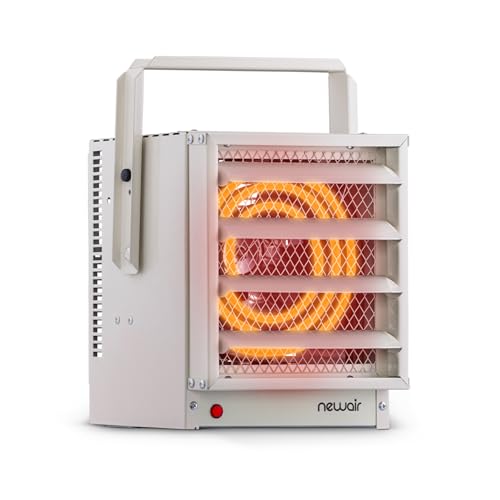
The Newair 4800W delivers controlled, fan-forced heat to a typical one- or two-car garage when you have the 240V circuit it requires and don’t mind blower noise. Buy it if you want a thermostat, a remote, and the flexibility to mount it on the ceiling or set it on the floor. It won’t work miracles in an uninsulated space or compete with a 7,500W unit for raw output, but it’s a solid middle-ground pick for finished garages up to 500 sq ft.
Buy it if
Garage and workshop owners with a 240V circuit who want adjustable fan heat, a thermostat, and the option to mount overhead or use freestanding.
Skip it if
You only have a 120V outlet, need silent radiant heat, want to warm more than 500 sq ft, or work in an uninsulated space where 4,800 watts won’t keep up.
Main review
Newair 4800W Electric Garage Heater
Best for Garages up to 500 sq ft with a 240V 30-amp outlet and a need for remote control
The 4800W output heats a two-car garage or shop fast enough to take the edge off in 15 minutes, and the digital thermostat with remote lets you dial in temperature and fan speed without walking over. It plugs into a 240V 30-amp outlet—no hardwiring—so installation is simpler if you already have the circuit. The mounting bracket and freestanding option give you flexibility, though the fan is loud enough to hear over hand tools.
Power 4,800WVoltage 240VCoverage 500 sq ftInstallation Freestanding or ceiling/wall mount with bracketControls Remote control and digital thermostatSafety UL-certified, automatic overheat shut-off, 30-amp 3-prong pl
Why it made the cut
Plugs into a 240V 30-amp outlet; no hardwiring required
Remote control adjusts temperature, fan speed and timer from across the garage
Freestanding or ceiling mount with included bracket
UL-certified with automatic overheat shut-off
Heats 500 sq ft, suitable for most two-car garages
Good to know
Fan noise is noticeable during operation
Requires a dedicated 240V 30-amp circuit, not a standard 120V outlet
Plug-in design limits placement to within cord reach of the outlet
Skip it if You’ll want something quieter if you’re podcasting or taking calls in the shop, and you’ll need a hardwired unit if your outlet is in the wrong spot.
The number on the box matters less than the circuit behind the wall. A 4,800W heater pulls about 20A at 240V, so the wiring, breaker, and outlet have to match the unit before it can do its job.
For many garages, the real cost of a bad choice is simple: cold hands, a tripped breaker, or a heater that never quite keeps up. The Newair can be a good fit, but only if your space and electrical setup are in the right range.
Key takeaways
It makes sense for a 240V garage or workshop that needs about 4,800W of fan heat.
A 120V outlet is a nonstarter; this is a dedicated 240V heater with a 30A plug.
The 500 sq ft claim is plausible for a fairly tight space, not an uninsulated barn in January.
Thermostat and remote control help with comfort, but they do not reduce the wiring load.
Noise from the fan and the need for hard mounting are the main trade-offs.
The Newair 4800W is a 240V fan-forced electric heater built for garages, workshops, and job sites where you want heat fast and don’t mind the sound of a blower. The maker rates it for spaces up to 500 sq ft, a figure that holds up in a well-sealed attached garage but feels optimistic in a drafty detached shop with a metal door and a concrete slab pulling heat away. You get a digital thermostat, a remote control, a timer, and a mounting bracket that lets you set it on the floor, hang it on a wall, or bolt it to the ceiling joists.
It suits people who work in the space for a few hours at a time and want directional warmth where they’re standing. The fan pushes heated air across the room instead of waiting for natural convection, so you feel the difference in minutes rather than half an hour. That makes it a practical pick for cold mornings in the garage or afternoon projects in the shed, where silent operation matters less than getting the chill off your hands.
The 4,800W output puts it in a different category than the plug-in heaters most people try first. Standard 120V models top out around 1,500W because a household outlet can’t safely supply more than about 12.5 amps continuously. That’s enough for a small bedroom but not a two-car garage. The Newair pulls roughly 20 amps at 240V, so it needs a dedicated circuit and a matching outlet—the same setup an electric dryer or water heater uses.
In short
The Newair 4800W delivers fan-forced heat for garages and shops up to 500 sq ft, with a thermostat and remote. It runs on 240V, not a standard outlet, and works best where quick directional warmth matters more than quiet.
Myth
A 120V garage heater can match a 240V unit if you buy a higher-end model.
Fact
Physics sets the limit. A 120V circuit maxes out around 1,500W; a 240V circuit at 20 amps delivers 4,800W. No amount of marketing changes the wattage a standard outlet can supply.
Comparing wattage
The InoKraft 7,500W electric garage heater pulls 31 amps at 240V and needs a larger breaker and heavier wire. The Newair’s 20-amp draw fits more garage circuits without an electrician visit.
Measure Your Garage Before You Buy
A 20 by 25 ft garage comes to 500 sq ft, right at the maker’s rating, but that figure alone won’t tell you whether the heater will keep up. Ceiling height, insulation, and air leaks decide whether 4,800W feels generous or barely adequate. An eight-foot ceiling, insulated door, and weatherstripped jambs let the heater work the way the spec sheet suggests. A ten-foot ceiling, uninsulated walls, and gaps around the garage door mean the heater runs longer and struggles to hold temperature on cold nights.
The common mistake is buying by square footage and ignoring everything else. A well-insulated attached garage shares a wall with the house and loses heat slowly. A detached garage with a concrete slab, metal door, and no drywall loses heat in every direction at once. The same 4,800W heater will keep the first space comfortable and leave the second one cold enough that you’re still wearing gloves.
Worked example
Say your garage is 22 by 24 ft with an eight-foot ceiling, insulated walls, and a garage door with no weatherstripping. That’s 528 sq ft on paper, but the door leaks cold air every time the wind picks up. The heater cycles on, warms the air, then watches it slip out through the gaps. You’ll spend more time at full power and may never reach the thermostat setpoint on the coldest nights.
Size22 × 24 ft, 528 sq ft
Ceiling8 ft
Weak pointUnweatherstripped door
ResultHeater runs constantly, may not hold tem
If you’re switching from oil to electric because you want simpler operation or you’re tired of filling a tank, understand that electric resistance heat costs more per BTU in most of the US. A 4,800W heater running eight hours a day at 17 cents per kWh costs about $52 a month. That’s manageable for a small, tight space you heat part-time, but it adds up fast in a leaky garage you’re trying to keep warm all winter.
Don’t guess on insulation
Buying a heater sized for 500 sq ft and then discovering your garage has no insulation leaves you with a unit that runs nonstop and a power bill that climbs every month. Seal the door, insulate what you can, then size the heater.
Check The Circuit And Running Cost
You’ll need a 240V circuit before you buy, because the Newair 4800W pulls about 20 amps and won’t work on the standard 120V outlet that powers your drill. Most garages built in the last fifteen years have a 240V line for tools or an old dryer, but not all. If you’re starting from scratch, budget for an electrician to run the wire and install the right outlet—usually a NEMA 14-30 or 14-50 depending on your panel and local code.
20 A
What 4,800W draws at 240V
It’s close to the limit of a 20-amp breaker, so a dedicated 30-amp circuit gives you headroom and meets the maker’s spec.
Electric resistance heat is straightforward: every watt you draw becomes a watt of heat, no combustion losses, no venting. Running cost depends entirely on how long the heater stays on. At 4,800W for eight hours you’re using 38.4 kWh per day; at 17 cents per kWh that’s about $6.53 a day, or $196 a month if it runs every night.
Heater
Watts
Per hour
Per day (8 h)
Per month (30 days)
Newair 4800W garage heater
4,800 W
82¢
$6.53
$195.84
Calculated at 17¢ per kWh. Assumes full power for the whole runtime. A thermostat will cycle the heater off once the set temperature is reached, cutting actual consumption.
If you’re only in the garage a couple of evenings a week to work on a project, the heater can be a practical choice: you get heat fast, no tank to maintain, and the bill stays manageable. Run it all winter in a drafty two-car garage with no insulation and you’ll feel it on the electric statement. Insulation and weatherstripping do more for long-term comfort than a bigger heater will.
In short
Budget for a dedicated 240V circuit if you don’t have one, and expect about $6.50 a day at full runtime. Occasional use keeps cost reasonable; all-day heat in a leaky space makes electric resistance expensive.
Safety Features And Installation Limits
Built-in overheat protection shuts the Newair down if the internal temperature climbs past a safe threshold, and an automatic shutoff kicks in if airflow gets blocked or the unit tips during installation. Both are standard on any heater worth plugging in, but they only work if you mount the unit correctly and keep the area around it clear.
No extension cords
Plug straight into a dedicated 240V outlet. Extension cords, power strips, and adapters can’t handle a 20-amp load safely, and the connection will overheat or trip the breaker at best, start a fire at worst.
Mount the heater securely if it’s going on a wall or ceiling bracket, and follow the spacing in the manual: usually at least 3 feet from combustibles in every direction, with nothing blocking the intake or the discharge grille. Garages collect cardboard boxes, paint cans, and lumber; a heater mounted too close to shelving or parked underneath a pile of tarps is a problem waiting to happen. It’s not a storage shelf with opinions.
Before you install
Confirm the circuit can handle 20 amps continuous and matches the plug type
Clear a 3-foot radius around the planned location
Check that the mounting surface can support the weight and won’t flex
Read the manual’s clearance specs and local electrical code
The UL-certified 30A plug is a good sign—it means the heater met third-party safety testing—but certification doesn’t replace proper installation. Match the circuit to the load, use the right outlet, and don’t improvise. If you’re not comfortable working with 240V, hire an electrician. Garages are often on the edge of the house’s electrical system, and a miswired circuit can trip breakers, damage the heater, or worse.
No 120V version
If you only have standard outlets, this heater won’t work. Look at plug-in 1,500W models instead, or budget to upgrade the circuit before you buy a high-wattage unit.
How It Compares With Bigger Garage Heaters
More wattage buys more heat, but it also pulls harder on your electrical panel and costs more to run. A 5,000W or 5,600W heater gives you about 17 to 19 BTU per square foot in a 300 sq ft space, enough for most attached garages with decent insulation. Step up to 7,500W or 10,000W and you’re covering 600 to 800 sq ft or making up for a drafty door, an uninsulated roof, or single-digit weather—but you’ll need a 30 or 40 amp breaker and a heavier wire run. The Newair 4800W sits in the middle: strong enough for a typical two-car garage, light enough that a 30 amp circuit handles it without pushing the limit, and cheaper to feed than the bigger models.
Choose a larger heater if your garage has a ten-foot ceiling, sits detached from the house, or sees regular use in a climate where January means teens or lower. The InoKraft 7,500W and similar units in that class deliver about 25,500 BTU, roughly 50 percent more output than the Newair. The Newair 5600W offers a smaller step up—about 19,100 BTU—without the circuit demand of the 7,500W models. Step down to a 1,500W plug-in heater if you have only 120V available, work in a well-insulated single-car bay, or heat the space for an hour at a time rather than all day. Propane and oil-fired models put out more BTU per dollar of equipment, but electric avoids the fuel run, the exhaust smell, and the carbon monoxide risk that comes with combustion.
In short
The 4,800W class makes sense for attached garages up to 500 sq ft with a 240V circuit already in place. Go bigger for cold climates and detached spaces, smaller for light use and standard outlets.
Ceiling-mount heaters free up wall and floor space, but the trade is a tougher install and less flexibility if you move the workbench. Electric garage heaters designed for ceiling mount cover the overhead options if that’s the placement you need.
The Newair 4800W And How It Stacks Up
Budget pick
VEVOR 4800W Electric Garage Heater
Best for Shops up to 500 sq ft where you want thermostat control and a long remote cord
VEVOR’s 4800W unit delivers the same wattage as the Newair with a 20-foot remote, so you can adjust it from farther away or a different corner of the shop. The cold-rolled steel shell and overheat protection handle daily workshop use, and the adjustable mounting arms let you aim heat at 45 or 90 degrees. It’s a capable alternative if the Newair is out of stock.
Why it made the cut
20-foot remote control for adjustment across larger spaces
Adjustable mounting arms direct airflow at 45 or 90 degrees
Good to know
No plug-in option listed; likely hardwired installation
Best for Garages up to 500 sq ft with a 240V circuit and space to hardwire a ceiling unit
The 5000W output gives you 200 more watts than the 4800W model—enough to warm a poorly insulated garage a little faster. The stainless steel housing and tilting head with adjustable louvers let you aim heat exactly where you work, and hardwiring keeps the unit out of the way permanently. You’ll need an electrician for installation, and you give up the remote.
Why it made the cut
5,000W output for faster heating in cold or drafty garages
Stainless steel housing stands up to shop dust and moisture
Good to know
Hardwired installation only; no plug-in option or remote control
Is the Newair 4800W garage heater enough for 500 square feet?
It will maintain warmth in an insulated 500 sq ft garage when outdoor temperatures stay above freezing, but struggles in poorly insulated spaces or when it’s below 20°F outside. The maker rates it to 500 sq ft under typical conditions, meaning finished walls, a ceiling, and a closed door. An uninsulated detached garage with single-pane windows needs more wattage or supplemental heat on the coldest nights.
Can I plug a 4800W garage heater into a regular 120V outlet?
No. The Newair 4800W requires a 240V circuit and uses a 30-amp, 3-prong plug that won’t fit a standard 120V outlet. Attempting an adapter or forcing the connection will trip your breaker immediately or, worse, overheat the wiring and create a fire hazard.
How much electricity does a 4800W garage heater use in a day?
Running continuously for one hour, it uses 4.8 kWh; at the US average of 17 cents per kWh, that’s about 82 cents an hour or $6.56 for eight hours. A thermostat cuts that figure in half or more once the space reaches temperature, because the heater cycles off between calls for heat instead of running nonstop.
Is a garage heater with a thermostat better than one without?
A thermostat saves electricity and keeps temperature steady without you walking over to adjust a dial every twenty minutes. Heaters without one run at full power until you shut them off manually, wasting energy once the garage warms up and risking an overly hot workspace. The convenience alone justifies the modest price difference for anyone who spends more than an hour at a time in the garage.
What size breaker do I need for a 4800W 240V heater?
The Newair 4800W pulls 20 amps at 240V, so you need a dedicated 30-amp double-pole breaker and 10-gauge wire to meet code and give the required safety margin. A 20-amp breaker will trip under load, and a 15-amp breaker won’t support the heater at all. If your panel doesn’t have a spare 240V slot or the wire isn’t already run, hire an electrician before you buy the heater.
Is it worth switching from oil heat to electric heat in a garage?
Electric heat costs more per BTU in most of the US—roughly two to three times as much as fuel oil or propane for the same warmth—but electric heaters need no venting, no fuel deliveries, and no annual service calls. The break-even depends on how many hours you heat the garage each winter and whether you already have the 240V circuit. For occasional weekend use, the convenience of electric often outweighs the higher running cost; for all-day, every-day heating, fuel wins on price.