The best emergency heater for a power outage for most people is the Mr. Heater 9,000 BTU Portable Buddy, because it’s approved for indoor use, runs on easy-to-store 1 lb propane cylinders, has low-oxygen and tip-over shutoff, and throws enough heat for a 150–225 sq ft room while the rest of the house cools down.
What to remember
For most indoor emergencies, a 4,000–9,000 BTU indoor-rated propane heater is the easiest, safest way to keep one 150–225 sq ft room livable.
Kerosene heater-stoves run much longer per fill than 1 lb propane cylinders and let you boil water or cook, but they demand careful fueling and ventilation.
Outdoor-only propane tank-top heaters belong in open garages or outdoors, never in a closed living room during a power outage.
Plan on heating a single room, not the whole house; close doors and hang blankets to shrink the space your heater has to cover.
Buy and store fuel before storm season, and pair any fuel-burning emergency heater with a battery-powered carbon monoxide alarm.
Say your 14 × 16 ft living room drops from 70°F to 50°F overnight after an ice storm kills the power. You don’t need to heat the whole house; you need one safe flame in one room that can actually keep up.
That’s what an emergency heater is for: a non-electric, fuel-burning unit you can light in the dark, that’s sized to a single space, and has the right safety systems so you’re warming your family, not gambling with carbon monoxide.
Best Emergency Heaters for Power Outages
#1Best Overall Pick
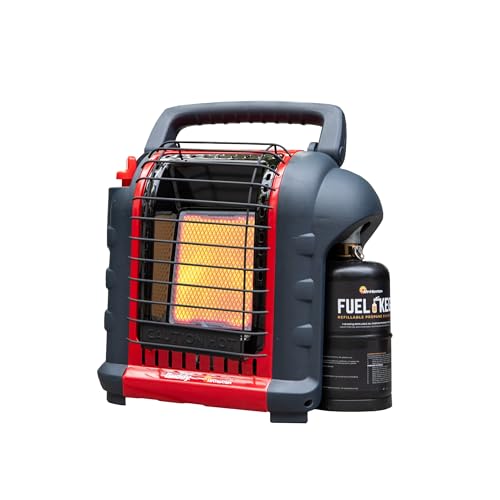
Mr. Heater Portable Buddy 9,000 BTU
Best for Most people heating one 150–225 sq ft room in an outage
This propane radiant heater is sized for one closed-off room, with 4,000 or 9,000 BTU settings that cover up to approximately 225 square feet. It runs 5.4 hours on low or 2.4 hours on high from a single 1 lb cylinder, so you can stretch stored fuel through a long outage. The built-in emergency low oxygen safety system and indoor/outdoor approval make it well suited to emergency use in living spaces.
Heat output 4,000 or 9,000 BTU/hrFuel 1 lb propane cylinderApprox. room size Heats up to approximately 225 square feetRun time 5.4 hours on low; 2.4 hours on highUse rating Designed and approved for indoor and outdoor use
Why it made the cut
4,000 or 9,000 BTU/hr settings for flexible heat output
Designed and approved for indoor and outdoor use
Runs 5.4 hours on low or 2.4 hours on high with a 1 lb cylinder
Emergency low oxygen safety system for added protection
Good to know
Shorter run time on high, so you need multiple spare cylinders ready
Propane cylinders must be stored and handled carefully
Skip it if Skip it if you are trying to back up whole-house heating instead of a single room.
Best for Fast heating in well-ventilated garages or workshops
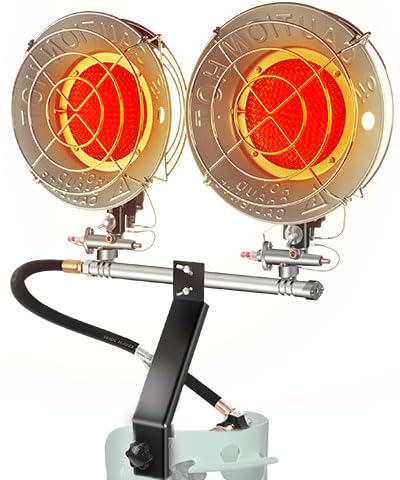
This high-output propane heater delivers 22K, 26K or 30K BTU, enough to warm roughly 500 square feet of garage or work area in a hurry. Dual burners and a wind resistant design keep it running steadily in cold, drafty spaces. The automatic safety shut-off valve, tipping protection and flame fault detection add layers of protection, but its outdoor rating keeps it in ventilated areas, not sealed bedrooms.
Heat output 22K/26K/30K BTU adjustableCoverage HIGH (30000 BTU) for 500 square feet of spaceFuel Propane tank heaterSafety Automatic safety shut-off valve, tipping protection, flame fSize and weight 11.8×16.5 in, 5.7 pounds
Why it made the cut
Adjustable 22K/26K/30K BTU output for large, cold spaces
Dual burner design with wind resistant burners
Automatic safety shut-off valve plus tipping protection
Compact 11.8×16.5 in body weighing 5.7 lb, easy to store
Good to know
Outdoor propane heater, so it is not suited to closed indoor living spaces
High heat output can be excessive for small areas
Skip it if Skip it if you need an indoor-rated heater for a bedroom or living room.
Best for Small rooms where you also want to boil water or heat food
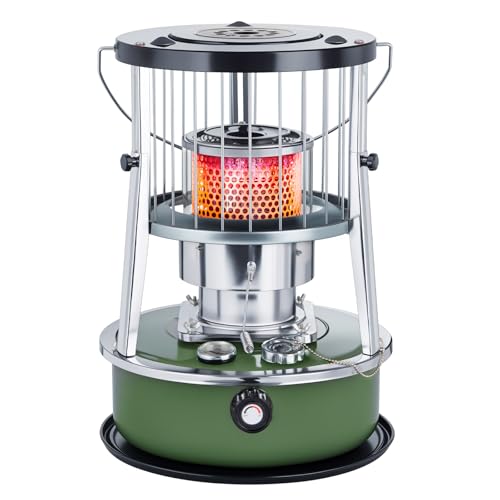
This non-electric kerosene model puts out 9,000 BTU of radiant heat, enough to warm rooms up to 15 m² while also serving as a cooking stove. The flat top surface lets you boil water, heat food or make coffee during an outage. A 4.5 L tank delivers 16–21 hours of continuous heat, and the carry handle plus adjustable height make it easy to move between indoor and outdoor spots.
Heat output 9,000 BTUFuel Kerosene, 4.5 L fuel tankRun time 16–21 hours of continuous heat on a single fillCoverage Warms rooms up to 15 m²Use Indoor and outdoor emergency heating and cooking
Why it made the cut
9,000 BTU radiant heat for compact spaces
2-in-1 heater and stove with a flat top for cooking
4.5 L tank provides 16–21 hours of continuous heat
Portable design with carry handle and adjustable height
Good to know
Kerosene needs careful storage and can smell during refueling or use
Hot top surface requires extra care around kids and pets
Skip it if Skip it if you want an enclosed heater and never plan to cook on top.
Best for Compact backup heat and cooking in smaller areas
This 9,000 BTU kerosene heater and stove is sized for roughly 107.64–161.46 ft² spaces such as small rooms, cabins or tents with proper ventilation. Its 1.22 Gal/4.6 L tank provides 15–17 hours of steady heat, so you can run it through a long winter night. The compact 12.4×13.98 in body, adjustable height and carry handle make it easy to stash and deploy, while the protective mesh, stable base and clear fuel gauge keep use straightforward.
Heat output 9000 BTUFuel tank 1.22 Gal/4.6L fuel tankRun time 15–17 hours of continuous heatingCoverage Designed to warm 107.64–161.46ft² areasSize Approx. 12.4×13.98 in with adjustable height
Why it made the cut
9,000 BTU output for 107.64–161.46 ft² areas
1.22 Gal/4.6 L tank runs about 15–17 hours per fill
Compact 12.4×13.98 in footprint with adjustable height
Protective mesh cover, stable base and clear fuel gauge
Good to know
Liquid-fuel refueling can be messy if you do not take your time
Like any unvented kerosene heater, it needs ventilation and a CO alarm
Skip it if Skip it if you want to heat a large open space without managing liquid fuel.
Best for Heating and light cooking in 200–500 sq ft rooms
This indoor kerosene heater puts out 9,000–10,000 BTU and is sized for spaces around 200–500 square feet, such as a living room, bedroom, apartment or garage. The 1.4 gallon tank can deliver up to 20 hours of heat, so a single fill can cover a long outage stretch. A flat top allows boiling water or cooking while it runs, and the included funnel, siphon pump, gloves and extra wicks simplify setup and maintenance.
Heat output 9,000–10,000 BTUFuel Kerosene with 1.4 gallon tankRun time Provides up to 20 hours of heatCoverage For spaces up to 200-500 square feetUse Indoor kerosene heater for garage, living room, bedroom, apa
Why it made the cut
9,000–10,000 BTU output sized for 200–500 sq ft spaces
1.4 gallon tank provides up to 20 hours of heating
Flat top surface can boil water or cook food
Includes funnel, siphon pump, gloves and extra wicks
Good to know
Larger heater and tank than 9,000 BTU models, so it takes more space
You will smell kerosene slightly during refills and operation
Skip it if Skip it if you only need to warm a small bedroom and want the smallest possible heater.
The right emergency heater for a power outage runs without the grid, burns a fuel you can store ahead of time, and is clearly approved for the room you want to heat.
If you are searching for emergency heaters for power outage, emergency heaters for power outages, or a safety hearter for emergency power outage, start by deciding on fuel, location, and safety features instead of chasing extra bells and whistles. An emergency heater here means propane or kerosene, with a manual ignition that still works when every light in the house is off.
Standard plug‑in electric space heaters stop the second the power fails unless you feed them from a generator or a separate battery or solar system. If you want that route, look at a reliable backup heater for power outages; for most people, a simple propane or kerosene unit is more practical and cheaper to keep fueled.
Propane emergency heaters burn gas from sealed cylinders, which store almost indefinitely if the tank and valve stay intact. A 1 lb bottle screws straight into a compact heater, and larger models like tank‑top units run off a common 20 lb grill tank with a hose. Kerosene heaters use liquid fuel poured into a tank from a can; the fuel has a long but finite shelf life, needs a dedicated blue kerosene container, and you handle more open fuel during refills, but you get a lot of heat per gallon and usually a built‑in cooktop.
91,500 BTU
Energy in a gallon of propane
That is enough fuel for roughly ten hours at 9,000 BTU per hour, which is why small cylinder heaters work well for short outages and larger tanks for storms that last overnight and longer.
For most living rooms and bedrooms, an indoor rated propane radiant heater like the Mr. Heater 9,000 BTU Portable Buddy is the most balanced choice. It runs at 4,000 or 9,000 BTU, is approved for indoor and outdoor use, has a low oxygen shutoff and tip‑over switch, and its protective front grill and chunky base make it stable around kids and pets. In a shut‑off room up to about 150–225 square feet, it is a very solid emergency indoor heater for power outage use.
High output tank‑top propane heaters, like the 30000 BTU Portable Propane Heaters for Outdoor Use, belong in open or semi‑open spaces only. They throw a lot of radiant heat into cold garages, workshops, and outdoor work areas and mount directly on a propane cylinder, but they are not built or approved for sealed living rooms or bedrooms.
Do not bring outdoor heaters indoors
Never run an outdoor only tank‑top, patio, or construction propane heater in a closed room, tent, or cabin. They lack the indoor safety systems and clearance requirements, and can quickly build up carbon monoxide as well as create a serious fire risk.
Kerosene heater stoves, like the Kerosene Heater for Indoor Use, the 2 in 1 Portable Kerosene Heater 9000 BTU Kerosene Stove, and the 10,000 BTU Kerosene Heater and Stove, work well when you need both heat and a simple cooking surface. They typically put out around 9,000 to 10,000 BTU for space heating, and the flat top lets you boil water or warm food when both the power and a gas range are down, at the cost of more refueling steps and a bit more odor.
No matter which fuel you choose, plan to heat one closed off room instead of the whole house; you move people, pets, and blankets into that space and keep it survivable while the rest of the house cools down. That choice of a single warm room is what drives how big a heater you need and whether a compact Buddy style unit or a larger heater stove makes more sense.
What to look for on the box or manual
Explicit indoor use approval for any heater you plan to run in a closed room
For propane, an oxygen depletion sensor (ODS) and automatic tip‑over shutoff
For kerosene, a stable, wide base and a guard over the hot surfaces
Protective grills you cannot easily touch through, especially with kids around
Controls that still work without house power (no plug‑in fans or electronics required)
A BTU rating that matches the size of the one room you will actually heat, not the whole house
What Size Emergency Heater You Need
Size an emergency indoor heater for a power outage to keep one or two rooms in the 50 to 65 degree range, not to hold the whole house at 72.
For quick sizing, figure on about 25 to 35 BTU per square foot for a reasonably insulated room with decent windows in cold weather. Drafty, leaky, or uninsulated spaces can need 35 to 45 BTU per square foot, because a lot of the heat you buy with fuel goes straight outside.
You can see this in the spec for the Mr. Heater 9,000 BTU Portable Buddy, which is rated for rooms up to about 225 square feet. Divide 9,000 BTU by 225 square feet and you get about 40 BTU per square foot, a strong number that gives some safety margin for real winter conditions instead of a mild fall day.
In practice, compact 4,000 to 9,000 BTU heaters are a good fit for bedrooms, living rooms, and small open areas roughly 100 to 225 square feet. That range includes the Portable Buddy on low or high, plus moderate output kerosene models like the Kerosene Heater for Indoor Use and the 2 in 1 Portable Kerosene Heater 9000 BTU Kerosene Stove.
Large, leaky, or partially open spaces take much more heat. A 30,000 BTU tank‑top propane heater like the 30000 BTU Portable Propane Heaters for Outdoor Use can cover roughly 400 to 500 square feet of garage or workshop, but only with plenty of ventilation from open doors or windows, and it still is not appropriate for finished living spaces.
Kerosene heater stoves around 9,000 to 10,000 BTU, such as the Kerosene Heater for Indoor Use and the 10,000 BTU Kerosene Heater and Stove, are best parked in one main room where they can both heat and cook. In a small bedroom they will feel overpowering; in a mid sized living room they give you breathing room if the weather turns worse overnight.
Worked example
Say your main refuge is a 12 by 15 foot room. Multiply 12 by 15 to get 180 square feet. At an emergency sizing rule of 30 BTU per square foot, that room needs about 5,400 BTU per hour (180 × 30). Any of the 9,000 to 10,000 BTU heaters, like the Mr. Heater 9,000 BTU Portable Buddy on high or the 10,000 BTU Kerosene Heater and Stove, gives you a comfortable buffer above that requirement.
Room12 × 15 ft
Area180 sq ft
Rule30 BTU/ft²
Result≈5,400 BTU needed
Room Size
Typical Space
Approx BTU Range
Good Matches From This List
100 sq ft
Small bedroom or office
2,500–4,000 BTU
Mr. Heater 9,000 BTU Portable Buddy on low; Kerosene Heater for Indoor Use turned down if adjustable
150 sq ft
Large bedroom or den
4,000–6,000 BTU
Mr. Heater 9,000 BTU Portable Buddy (low in milder cold, high in harsher cold); 2 in 1 Portable Kerosene Heater 9000 BTU Kerosene Stove
225 sq ft
Average living room
6,000–9,000 BTU
Mr. Heater 9,000 BTU Portable Buddy on high; 2 in 1 Portable Kerosene Heater 9000 BTU Kerosene Stove; 10,000 BTU Kerosene Heater and Stove
400–500 sq ft
Two car garage or workshop
15,000–30,000 BTU
30000 BTU Portable Propane Heaters for Outdoor Use in a well ventilated space only
Emergency sizing is approximate; err toward the higher end of the BTU range in very cold or drafty homes.
Fuel Use, Run Time and Storage in an Outage
Fuel planning for a power outage means turning heater specs into run time and fuel storage numbers you can trust for a couple of cold nights.
With the Mr. Heater 9,000 BTU Portable Buddy, a single 1 lb propane cylinder gives about 5.4 hours on low and 2.4 hours on high under typical indoor conditions. If you plan to run the heater 8 hours per night on low, 8 / 5.4 works out to roughly 1.5 cylinders for each night of use.
Running continuously on high at about 2.4 hours per cylinder, a full 24 hours of heat would take about 10 one pound cylinders, since 24 / 2.4 is about 10. Storing that many small bottles is bulky, which is why many people connect the Portable Buddy to a larger propane tank with the hose and fittings its manual allows, provided local rules permit that setup.
A standard 20 lb propane tank holds about twenty times as much fuel as a 1 lb cylinder, so you can multiply the Buddy’s runtimes by twenty for rough planning. On low that is a bit over 100 hours from a full 20 lb tank, and on high around 48 hours, assuming the heater and hose are installed as the manufacturer specifies. Keep 20 lb tanks stored upright outdoors in a shaded, ventilated spot rather than next to the heater in the living room.
For kerosene heaters, think in gallons per day. The Kerosene Heater for Indoor Use and the 2 in 1 Portable Kerosene Heater 9000 BTU Kerosene Stove each have roughly 4.5 to 4.6 L tanks, about 1.2 gallons, and advertise around 15 to 21 hours of heat per fill depending on the setting. The 10,000 BTU Kerosene Heater & Stove increases tank size to about 1.4 gallons and still claims up to 20 hours on a tank.
Worked example
Say your kerosene heater is rated for about 18 hours on a 1.2 gallon tank. That works out to roughly 15 hours of heat per gallon (18 / 1.2 = 15). If you want 36 hours of run time during an outage, divide 36 by 15 to get about 2.4 gallons, so you would plan to store around 2.5 gallons on hand, which in practice usually means three 1 gallon cans.
Heater tank1.2 gallons
Planned runtime36 hours
Fuel to store~2.5 gallons
Those advertised times match the fuel’s energy content: a gallon of kerosene contains about 135,000 BTU of heat, so a 9,000 to 10,000 BTU heater running flat out would empty 1 gallon in roughly 13 to 15 hours (135,000 / 10,000 is about 13.5). Turning the control down lowers the BTU burn rate per hour and stretches that run time.
Outage planning usually means intermittent use, not round the clock heat. A sensible target is 24 to 72 hours of potential runtime, for example 6 to 10 hours of operation per day for one to three days, then you can divide by your hours per cylinder or hours per gallon figure to see how many cylinders or cans to keep on the shelf.
Safe storage finishes the plan. Keep propane cylinders and 20 lb tanks upright, outdoors, away from grills, furnace exhausts, or other ignition sources, in a location that is sheltered from direct sun and heavy ice. Store kerosene in approved containers, also upright and outside living spaces, and label each can with the purchase date so you remember to use and replace older fuel.
Check your local limits
Local fire codes and landlords often cap how many gallons of kerosene or pounds of propane you can store and where you can keep them, so check the rules before you stack a season’s worth of fuel beside the shed.
Make a runtime cheat sheet
Before storm season, write down your heater’s hours per cylinder or gallon for low and high, and tape that note to the heater or fuel shelf so you are not doing math by flashlight at midnight.
Emergency Heater Safety and Indoor Use
Safe indoor use of an emergency heater starts from one fact: every propane or kerosene flame produces carbon monoxide, so you treat it with the same respect as a gas stove or fireplace. If you typed “safety hearter for emergency power outage” or “emergency indoor heater for power outage” into a search box, the safest starting point is an indoor rated heater with built in protections, used exactly the way the manual describes.
An indoor rated propane model like the Mr. Heater 9,000 BTU Portable Buddy is designed and approved for enclosed spaces, and it includes both a low oxygen shutoff system and a tip over sensor. Even with those features, you still need a bit of ventilation: crack a window or door slightly so fresh air can replace what the flame uses, and follow its manual on minimum room size.
For more choices that are specifically approved for indoor rooms, indoor heater for power outage picks focus on models with oxygen depletion sensors and shutoff features built in.
Clearance and placement matter just as much as the model you pick. Keep at least 3 feet of space clear in front of and around any heater, especially away from curtains, bedding, furniture, paperwork, and anything that can dangle into the hot zone. Set the heater on a flat, stable, nonflammable surface where kids, pets, and traffic will not bump it.
Tank top propane heaters such as the 30000 BTU Portable Propane Heaters for Outdoor Use are built around an exposed burner mounted on a cylinder, and they are meant for patios, job sites, or very open garages. They should not be used in small closed rooms or bedrooms, because they throw a lot of combustion products into the air and typically lack the indoor safety approvals you get with the Portable Buddy.
Kerosene heaters need the same respect. Use only clean 1 K kerosene recommended by the manufacturer, never gasoline or diesel, and fill the tank outdoors or in a well ventilated area with the heater turned off. Indoors, set the heater on a tray or tile to catch drips, and open a window or interior door a crack so there is a steady trickle of fresh air.
A battery operated carbon monoxide alarm is mandatory backup for any fuel burning heater during an outage, because your plug in units will be dead with the power. Put one alarm in the same room as the heater and another near sleeping areas, test them monthly, and swap in fresh batteries before storm season.
Supervision is the other big rule. Do not leave a propane or kerosene heater running unattended, and treat overnight use in a bedroom as risky unless the manual specifically says the model is suitable for that and you have both ventilation and working CO alarms in place. Even then, keep the heater on its lowest setting and well away from bedding, pillows, and clothing that could fall against it.
Refueling deserves its own routine. Shut the heater down, let it cool completely, carry it away from open flames or pilot lights, and only then top up the tank slowly, using a funnel to avoid spills; wipe any drips before you bring it back inside and relight according to the instructions.
Indoor safety checklist
Confirm your heater is clearly labeled for indoor use and has an oxygen depletion sensor and tip over shutoff.
Keep at least 3 feet of clearance around the heater in all directions.
Crack a window or door slightly whenever the heater is running.
Install and maintain battery operated carbon monoxide alarms in heater rooms and near bedrooms.
Turn the heater off before sleeping or leaving the room, unless the manual explicitly allows supervised overnight use.
Let the heater cool fully before moving or refueling it.
Never do these with an emergency heater
Do not run an outdoor only tank top, patio, or torpedo style heater inside a house, tent, or closed garage; they are not designed for that and can quickly build up carbon monoxide. Never burn gasoline in a kerosene heater, never store 20 lb propane cylinders in living spaces, and never block the heater’s air inlets or vents with clothes, foil, or improvised heat shields.
Practice on a calm day
Before storm season, unpack the heater, read the manual in good light, and do a full lighting, running, and shutdown test so everyone in the home knows how to operate it safely when the power actually goes out.
What To Do Today to Prepare for an Outage
Preparation that actually helps in a blackout means picking one “warm room”, one heater sized for it, and enough fuel for a couple of cold days before the forecast turns ugly. If you’re asking about the best indoor emergency heat source during power outage in Alabama today, a 9,000–10,000 BTU indoor-rated propane heater such as the Mr. Heater 9,000 BTU Portable Buddy Radiant Propane Heater is usually enough for a 120–220 sq ft bedroom or small living room. For anyone wondering about the best indoor emergency heat source during power outage in Alabama more generally, think in terms of keeping that one room livable, not the whole house toasty.
In short
Pick an interior room with a door, match it to a 9,000–10,000 BTU indoor-rated heater in mild climates (more in drafty northern homes), lay in 2–3 days of fuel, then practice lighting and shutting the heater off while the lights are still on.
1
Choose your warm room
Start by choosing a “warm room” where everyone can gather: ideally 120–220 sq ft, inside the house, with a door you can close (a bedroom or small living room works well). In a mild-winter state like Alabama, a 9,000–10,000 BTU indoor-rated heater is usually enough for that size room; in colder northern climates the same heater is a good minimum, and drafty or leaky spaces may need a higher-BTU model or some extra sealing first.
2
Pick a heater style
If you want something as close to plug-and-play as a flame can be, an indoor-rated propane heater such as the Mr. Heater 9,000 BTU Portable Buddy Radiant Propane Heater keeps maintenance simple and fuel easy to store. If being able to boil water and cook during outages matters more, a kerosene heater-stove like the Kerosene Heater for Indoor Use, 2 in 1 Portable Kerosene Heater 9000 BTU Kerosene Stove for…, or 10,000 BTU Kerosene Heater & Stove, Kerosene Heaters for In… gives you both heat and a basic cooktop.
3
Estimate runtime and fuel
Estimate how long you’ll actually run the heater. Be honest: many people end up using 6–10 hours per day (evenings, early mornings, maybe overnight on the coldest nights), so multiply your daily hours by 2–3 days to size your fuel reserve. Example: 8 hours x 3 days = 24 burner-hours; if your manual says about 2–3 hours from a 1 lb propane cylinder, you would want roughly 8–12 cylinders on hand, or the comparable amount of kerosene by the gallon.
4
Buy the outage kit in one trip
Plan one store run and get everything on your list at once—heater, fuel, CO alarm and small accessories, so you’re not driving icy roads later hunting for propane or wicks.
5
Test-fire while the power is on
Set the heater up and light it once on a calm day with power, a window cracked, and your battery CO alarm running. Practice start-up, turning it down, and full shutdown, and make sure everyone who might use it can do the same safely.
6
Pre-stage the warm room
Keep the heater, CO alarm, lighter, and room-sealing supplies in or near the warm room, and put blankets or sleeping bags where you can grab them in the dark. Bulk fuel stays in its safe storage spot; you only carry in what the manual allows while the heater is running.
One-Trip Outage Kit
Indoor-rated emergency heater (propane or kerosene, sized 9,000–10,000 BTU or more as needed)
Propane cylinders or kerosene for at least 24–72 hours of planned run time
Battery-powered carbon monoxide alarm for the warm room
Fresh batteries for the CO alarm and flashlights
Long matches or a long-neck lighter
Plastic or metal funnel and chemical-resistant gloves (for kerosene refueling)
Spare wicks for wick-style kerosene heaters
Thick blankets or quilts for people and for hanging over doorways
Draft stoppers or rolled towels for under doors and leaky window sills
Homeowners who would rather plan for permanent backup heat, such as vented gas heaters or battery systems driving part of an existing setup, can jump to best backup heat for power outages and map out a longer-term solution once the immediate kit is handled.
Questions People Ask
What is the safest indoor emergency heater for a power outage?
For most people, the safest indoor emergency heater is an indoor-rated propane model with oxygen-depletion and tip-over shutoff, such as a portable unit around 9,000 BTU. From a carbon-monoxide standpoint, an electric space heater powered from a properly sized generator is even safer, because there’s no flame in the room and the engine exhaust stays outside. Whatever you pick, pair it with a battery CO alarm and make sure the heater is UL, ETL or CSA listed for indoor use.
Can I use a propane heater indoors during a power outage?
Propane heat indoors is only acceptable if the heater is clearly rated for indoor use and the manual allows the way you plan to run it. Look for “indoor safe” language, a built-in oxygen-depletion sensor, and tip-over shutoff, then give it at least 3 feet of clearance and a cracked window for fresh air. A battery carbon-monoxide alarm in the same room is non-negotiable, and some jurisdictions restrict unvented heaters entirely, so check local code before you buy.
How long will a 20 lb propane tank run an emergency heater?
A standard 20 lb propane grill tank holds about 4.7 gallons of fuel, or roughly 430,000 BTU. With a 9,000 BTU emergency heater running on high the whole time, that’s about 430,000 ÷ 9,000 ≈ 47 hours of burner time; at a lower setting around half power, you’re closer to four days. Real-world run time is shorter because you never draw the tank completely empty and cold weather slows evaporation, so planning on 60–70% of that number is more realistic.
Are kerosene heaters safe to use inside during a power outage?
Indoor-rated kerosene heaters can be used safely, but they demand more discipline than small propane units. You must burn only 1-K kerosene, refuel and store the fuel cans outdoors, and give the heater the ventilation the manual calls for to control carbon monoxide and odor. Weekly or seasonal wick maintenance, plus a CO alarm in the room, are what separate a safe setup from a smoky, headache-inducing one.
What is the best emergency heat source for a power outage in a mild climate like Alabama?
In a mild climate, the best emergency heat source is usually something small and simple that will keep one bedroom or living room in the 50s, not a giant heater sized for a cabin in Montana. An indoor-rated propane heater around 9,000 BTU with a couple of 1 lb cylinders will usually carry you through the kind of short, rare outages Alabama sees. If your outages almost always end within a few hours, a heavy comforter, warm clothing and a way to boil water for hot drinks may matter more than stocking dozens of pounds of fuel.
Do candles or canned heat provide enough warmth as an emergency heater in a power outage?
Candles and canned heat barely move the needle on room temperature. A single candle gives off roughly 80 watts of heat, so you’d need on the order of 15–20 burning at once just to match one small 1,500 W space heater, which is an obvious fire hazard. Canned heat is better reserved for warming food or a small pot of water, with plenty of ventilation, rather than as your primary emergency heater.