Product 2 is the best reliable choice for most rooms because its 1,500-watt ceramic heater, thermostat, oscillation, timer and tip-over protection cover everyday heating needs. Choose product 5 for silent heat, product 1 for a desk or small room, and product 3 if Wi-Fi control matters more than simplicity.
What to remember
Choose a 1,500-watt model for a larger room, but confirm the outlet circuit can handle it.
Pick the oil-filled model when silent, fan-free heat matters more than fast warm-up.
A thermostat and timer can reduce runtime, but they don’t make electric heat cheaper per watt.
Plug the heater directly into a wall outlet, keep 3 feet of clearance, and stop using it if the plug or outlet gets hot.
Don’t use any of these room heaters as a substitute for a tankless water heater, furnace or outdoor-rated construction heater.
The products here are plug-in electric space heaters, not tankless water heaters or engine block heaters. They heat one occupied room, so the right choice depends on room size, outlet capacity, noise tolerance and how much control you want.
A 1,500-watt heater draws about 12.5 amps from a 120-volt outlet. That leaves little room for another large appliance on the same circuit, which is why placement and outlet checks matter as much as the heater’s feature list.
Reliable Electric Heaters Ranked By Use
#1Best Overall
PELONIS 30-Inch Ceramic Tower
Best for Bedrooms and living rooms needing wide heat coverage
The 1,500-watt ceramic heater combines 75° oscillation with a thermostat, remote and 12-hour timer, so you can spread heat around the room and set it without walking over. Tip-over and overheat protection cover the key built-in shutoffs; its listed coverage is up to 280 sq ft.
Power 1,500 WListed room coverage Up to 280 sq ftOscillation 75°Timer 12 hoursSafety Tip-over switch and overheat protection
Why it made the cut
75° oscillation spreads heat across the room
Remote, thermostat and 12-hour timer
Tip-over and overheat protection
Good to know
A fan moves the heat, so it isn’t silent
The 30-inch tower takes more floor space than a compact heater
Skip it if Skip it if you want silent, fan-free heat or only need to warm the space beside your desk.
Best for Large bedrooms and living rooms up to 220 sq ft
Its 1,500-watt ceramic heat and 75° oscillation suit rooms where warmth needs to reach beyond the spot directly in front of the heater. The remote, adjustable thermostat and 12-hour timer make it easier to manage from across the room.
Power 1,500 WListed room coverage Up to 220 sq ftOscillation 75°Timer 12 hoursSafety Tip-over switch and overheat protection
Why it made the cut
Listed coverage up to 220 sq ft
75° oscillation
Remote, adjustable thermostat and 12-hour timer
Good to know
Fan operation may bother you if you need silent heat
Doesn’t list the 30-inch model’s larger coverage
Skip it if Skip it if quiet, fan-free operation matters more than circulating warmth around a room.
Best for Quiet heating in small rooms up to 120 sq ft
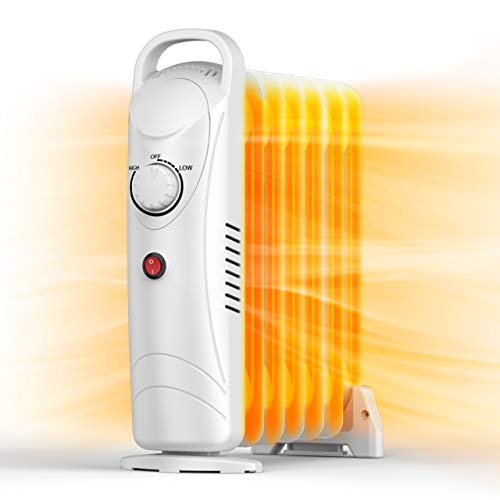
This 700-watt oil radiator heats by natural convection, with no fan to add noise or blow air around. Its rotary thermostat and two heat settings suit a small room where steady, quiet warmth matters more than quick heat circulation.
Power 700 WListed room coverage Up to 120 sq ftControls Rotary thermostat and two heat settingsHeating method Natural convection and oil circulationSafety Overheat protection
Why it made the cut
Silent, fan-free operation
Thermostat and two heat settings
No oil refills or replacements
Good to know
700 W is less output than the 1,500 W tower heaters
Coverage is limited to small rooms up to 120 sq ft
Skip it if Skip it if you need broad room coverage or fan-driven heat that spreads quickly.
Best for Rooms where Wi-Fi control and a child lock are useful
Wi-Fi and a remote let you adjust the thermostat, timer and modes without reaching the heater. A child lock, tip-over protection and overheat protection add useful controls for households with kids or pets; choose it when app access matters more than straightforward tower-style coverage.
Power 1,500 WControls Wi-Fi, remote, thermostat and 12-hour timerModes Power Heat, ECO and Fan OnlySafety Child lock, tip-over and overheat protectionDimensions 5.9 × 5.9 × 9.5 in
Why it made the cut
Wi-Fi app and remote control
Child lock, tip-over and overheat protection
Thermostat and ECO mode
Good to know
The data doesn’t give a room-coverage figure
App controls add complexity if you only want basic heat
Skip it if Skip it if you don’t need Wi-Fi control or want a heater with stated room coverage.
Best for A desk, office or other small area needing focused heat
At 500 watts, this compact PTC ceramic heater is suited to personal heating rather than warming a large room. Overheat protection and 45° tip-over protection are listed, and its small footprint fits where a tower heater would be in the way.
Power 500 WHeating element PTC ceramicSafety 45° tip-over and overheat protectionIndicator LED light
Why it made the cut
Compact design for desks and small spaces
45° tip-over and overheat protection
Quiet operation
Good to know
500 W is less output than a full-size space heater
No thermostat, timer or room-coverage figure is listed
Skip it if Skip it if you need to heat a whole bedroom or living room.
For everyday room heat, reliability means the right wattage, a thermostat that cycles the element, tip-over and overheat protection, steady placement, and controls you can operate without fuss. The PELONIS 30” Ceramic Tower Space Heater is the default pick because its 1,500 watts, thermostat, 75-degree oscillation, ECO mode, remote, and 12-hour timer cover the jobs most rooms ask of a heater.
In short
The most reliable oil filled heater here is the Air Choice 700W Small Oil Heater for a small room when silent, wind-free warmth matters more than fast heat movement. A convection heater gives reliable warmth by moving heated air naturally, while electric resistance is usually the simplest reliable method for heating one room; cooling requires separate air-conditioning equipment.
Myth
A small heater with a long feature list is reliable anywhere.
Fact
Reliability starts with a suitable heat output and safe placement. A control you never use, or a heater that struggles in a drafty room, doesn’t become dependable because it has more buttons.
Choose the Air Choice oil heater if you want quiet heat without a fan and can wait longer for warmth to spread. The Gaiatop Mini Space Heater fits a desk, dorm, or small office, but its 500-watt output isn’t a whole-room answer for a large or cold space. Pick the SereneLife Smart Space Heater if Wi-Fi control matters more than simple controls; it adds Wi-Fi, a remote, child lock, and ECO mode.
Pick the PELONIS 30” tower for general room heating and adjustable airflow.
Pick the Air Choice oil heater for silent, slower warmth in a small room.
Pick the Gaiatop for close-range desk heat, not large-room heating.
Pick the SereneLife when remote access and smart scheduling matter.
Keep the category straight
None of these products is a water heater, pellet stove, furnace, HVAC rooftop unit, or engine block heater. They heat room air from a household electrical outlet; they don’t provide domestic hot water or whole-home heating and cooling.
Match Heat Output To The Room
Match the heater’s wattage to the room’s heat loss, then treat the advertised coverage area as a starting point rather than a promise. The PELONIS 30” tower is listed for up to 280 square feet, the PELONIS 23” tower for up to 220 square feet, and the Air Choice oil heater is intended for small spaces up to 120 square feet.
A 280-square-foot claim can look optimistic in a room with poor insulation, high ceilings, drafts, an open doorway, or very low outdoor temperatures. Those conditions let heat escape faster, so a thermostat may run the heater longer without making the far side of the room comfortable.
Heater
Listed or practical fit
What to remember
PELONIS 30” ceramic tower
Up to 280 sq ft
1,500 W gives more reserve for ordinary room heating
PELONIS 23” ceramic tower
Up to 220 sq ft
Coverage still depends on drafts and room layout
Air Choice 700W oil heater
Small spaces up to 120 sq ft
Quiet heat, but slower circulation
Gaiatop 500W desk heater
Desk or small nearby area
Designed for close-range heat, not a large room
Coverage claims are guides, not guarantees.
Worked example
Say your room is 12 by 14 feet: 12 × 14 = 168 square feet. A 1,500-watt heater offers considerably more heat output and reserve than a 500-watt desk heater, especially if the room has a draft or an open door. The desk heater may warm your hands; it shouldn’t be expected to carry the room.
A space heater and a hot water heater solve different sizing problems. The most reliable hot water heater depends on demand, fuel, venting, and installation quality; a 40-gallon tank can be a lower-installation-cost choice when suitable connections already exist, while a gas water heater needs safe gas and flue work. A licensed plumber should handle gas connections and venting. For that separate decision, see the efficient and naturally reliable hot water heater guide.
Don’t multiply the load carelessly
Two 1,500-watt heaters draw 3,000 watts together, so they need separate suitable circuits. Never use a power strip or extension cord to solve a cold room; plug each heater directly into an appropriate wall outlet.
Calculate The Nightly Cost
A 1,500-watt space heater costs about $2.04 for an eight-hour night at 17 cents per kWh if it runs continuously. The formula is watts ÷ 1,000 × hours × electricity rate: 1,500 ÷ 1,000 × 8 × $0.17 = $2.04. This is a full-power estimate, not a promise about your bill.
Heater
Watts
Per hour
Per day (8 h)
Per month (1 days)
1,500 W heater
1,500 W
26¢
$2.04
$2.04
700 W heater
700 W
12¢
95¢
95¢
500 W heater
500 W
8.5¢
68¢
68¢
Calculated at 17¢ per kWh. Assumes 17 cents per kWh and eight hours at full power; actual use may be lower if the thermostat cycles the element off.
At the same rate, a 700-watt heater uses 5.6 kWh in eight hours and costs about 95 cents; a 500-watt model uses 4 kWh and costs 68 cents. A thermostat can reduce the real total by switching the element off when the room reaches its setting. A cold, drafty room may keep it running longer.
Myth
A ceramic element makes electric heat cheaper.
Fact
Electric resistance heaters convert electricity into heat in the room. Ceramic can warm quickly, but it doesn’t create cheaper heat by itself; lower bills come from lower wattage, less runtime or a room that holds heat better.
For whole-home heating and cooling, a properly sized heat pump is often an efficient choice; reliability depends on installation, maintenance and climate. A tankless water heater is a separate appliance, and its reliability depends on the model, water quality and maintenance, so there isn’t one dependable pick for every home. For buying options, see reliable heating air.
Use Controls That Earn Their Keep
For an eight-hour room-heating routine, choose controls that make operation easier without making the heater harder to manage. Hot water heaters can be reliable when correctly sized and maintained, but they’re separate from these room heaters. A thermostat override should let you change the setpoint temporarily; check the manual to see whether it resumes the schedule or holds the new setting.
Heater or model
How it heats and controls
Ceramic: products 2 and 4
A ceramic PTC element heats quickly, and a fan pushes air across it for fast warm-up; fan noise is the trade-off. Both models offer a remote, timer, ECO mode and oscillation.
Smart: product 3
Adds Wi-Fi control and a child lock. Wi-Fi is convenient, not a safety system; a lost connection shouldn’t leave you relying on an app to spot overheating or poor placement.
Oil-filled: product 5
Sealed thermal oil stores heat. Natural convection moves it quietly, and the metal case keeps releasing warmth after the element cycles off. Controls are a rotary thermostat and independent power switch.
Match the controls to the way you use the heater; more settings aren’t automatically more useful.
To check a smart thermostat with reliable support on Android, confirm the app supports your phone’s Android version, then test the connection and a temperature change while you’re home. Check the thermostat itself too; don’t rely on the phone to monitor a heater. Choose the simplest controls that fit your routine. More buttons mean more parts and more settings to check.
Check The Outlet Before The Heater
Check the outlet and the heater’s safety marks before you buy; a reliable space heater still becomes a hazard when its plug, placement or circuit is wrong. For the query “most reliable electric tankless water heater brand,” there isn’t one defensible answer here because tankless water heaters are a different product. The same applies to “most reliable gas water heaters” and “most reliable pellet stove brand”: installation, venting, maintenance and local service often matter as much as the badge.
12.5 A
What a 1,500 W heater draws at 120 V
The calculation is 1,500 ÷ 120 = 12.5 amps. Plug the heater directly into a wall outlet—never an extension cord or power strip—because those connections can overheat under a sustained load.
Give It Room
Keep at least 3 feet between the heater and bedding, curtains, furniture and clothing. Set it on a stable, level surface so the tip-over switch can work; a chair, bed or uneven rug is a poor substitute for a floor.
Look for tip-over shutoff, overheat protection and a recognized UL, ETL or CSA listing on the actual heater or its packaging. A seller’s vague phrase such as “安全 tested” or “safety certified” isn’t a certification you can verify. Don’t sleep with the heater running or leave it operating while you’re away unless the manufacturer specifically designs and permits that use.
Stop At The First Warning
A warm plug, loose receptacle, discoloration, burning smell or repeated breaker trip means stop using the heater. Have the circuit checked by a qualified electrician; don’t keep resetting the breaker or move the heater to a power strip.
Before Buying, Using, Or Calling
Confirm the heater’s listing mark, tip-over switch and overheat protection on the product or package.
Choose a level location with 3 feet of clearance and a nearby wall outlet.
Plug it directly into the wall; never use an extension cord or power strip.
Unplug it and stop use for a warm plug, loose outlet, discoloration, odor or repeated breaker trip.
Ask a qualified electrician to inspect the circuit if any warning sign appears.
Questions People Ask
What is the most reliable oil-filled heater?
No single brand is reliably best for every home. Choose an oil-filled radiator with a sealed oil circuit, adjustable thermostat, overheat protection, tip-over protection, and a UL, ETL, or CSA listing; its simple design has fewer moving parts than a fan heater. Keep it upright and plug it directly into the wall.
Are Rheem water heaters reliable?
Rheem water heaters can be reliable when the model fits the household and installation is done correctly. Lifespan and service needs depend heavily on water quality, anode-rod condition, temperature setting, and regular maintenance, so compare the specific tank or tankless model rather than judging the brand alone.
Are Noritz tankless water heaters reliable?
Noritz tankless water heaters can provide dependable service when sized for the required flow and maintained properly. A yearly flush helps control scale, especially with hard water, while a unit that is too small may struggle when several fixtures run at once; local service availability matters, too.
What is the most reliable pellet stove brand?
The most reliable pellet stove brand is usually the one with an authorized dealer, stocked parts, and service near you. Reliability also depends on dry, quality pellets, regular ash removal, annual vent cleaning, and installing the stove to its listing and local code; a well-supported midrange stove beats an orphaned premium model.