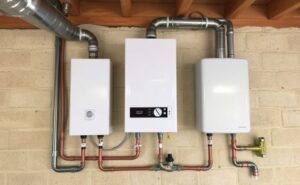
Navien Tankless Water Heaters: Save Up to 30% on Energy Costs
On this page 14 sections
- Who Makes Navien — and What They Build
- The Current Navien Lineup (NPE-2 Series)
- Where Navien Genuinely Excels
- The Complaints You Should Take Seriously
- Navien Pros & Cons at a Glance
- Navien vs Rinnai vs Rheem
- Do Plumbers Actually Recommend Navien?
- Sizing It Right (So You Don’t Overpay)
- Common Error Codes & What They Usually Mean
- Who Should Buy a Navien (and Who Shouldn’t)
- Annual Owner Maintenance Checklist
- Navien Tankless Gas Water Heaters Are All Gas-Fired
- Frequently Asked Questions
- The Bottom Line
Navien makes some of the most efficient and feature-rich gas tankless water heaters available, and for the right home they deliver exceptional long-term value. They are not flawless, however — the warranty has fine print most buyers miss, parts can be fussy in hard water, and their plumber-first support model frustrates homeowners. Here is the complete, honest picture.
Navien now outsells every other gas tankless brand in North America, ahead of Rinnai and Rheem. That market lead is built on real engineering. But popularity is not the same as “right for your house,” so this review breaks down the current lineup, the genuine strengths, the recurring complaints, the warranty mechanics, and exactly who should buy.

Quick Verdict
Buy Navien if you want top-tier efficiency, built-in recirculation, and will use a certified installer in a home with reasonable water hardness. Look elsewhere — or add a softener and a maintenance plan — if you are in a very hard-water area, want strong homeowner phone support, or expect a true DIY install.
Who Makes Navien — and What They Build
Navien is the North American arm of KyungDong Navien, a South Korean manufacturer founded in 1978 that built its reputation on condensing boilers and high-efficiency heating technology. The company entered the U.S. market in 2006 and scaled fast by focusing on one thing competitors were slow to commit to: high-efficiency condensing gas units.
One point that trips up many shoppers: every Navien tankless water heater is gas-fired (natural gas or field-convertible to propane). If you searched for a “Navien electric tankless water heater,” that product does not exist. Navien’s entire tankless range is built around condensing gas combustion and recirculation technology, which is exactly where its advantages come from.
The Current Navien Lineup (NPE-2 Series)
Navien’s residential tankless range is the NPE-2 series, split into two families. Knowing which one you need is the most important decision before buying.
| Family | What It Is | Models | Recirculation? |
|---|---|---|---|
| NPE-S2 | Standard condensing. Excellent efficiency, no built-in pump. | 150S2, 180S2, 210S2, 240S2 | Optional (external) |
| NPE-A2 | Advanced. Adds ComfortFlow® buffer tank + recirculation pump. | 180A2, 210A2, 240A2 | Built-in |
Expert Tip
The number (150/180/210/240) tracks BTU capacity and flow rate, not gallons stored. The flagship NPE-240A2 delivers up to 11.2 GPM at a 35°F rise and modulates from 19,900 to 199,900 BTU/hr. For most 2-bath homes, the 180A2 handles demand without paying for capacity you’ll never use.
Where Navien Genuinely Excels
1. Industry-Leading Efficiency
Navien’s condensing models reach up to a 0.96–0.97 UEF (Uniform Energy Factor). A condensing unit captures exhaust heat that non-condensing tankless units (around 0.82) and old tank heaters (near 0.60) simply vent to the outside. The U.S. Department of Energy notes that demand-type water heaters can be 24–34% more energy efficient than storage tanks for typical households — and Navien sits at the top of that band.
Real-World Savings Example
A household spending roughly $300/year heating water with an older 0.60-efficiency tank can expect to cut that bill significantly by moving to a 0.96-UEF Navien. Most homes see $100–$300 in annual gas savings on water heating. Over a 15-year heat-exchanger lifespan, that meaningfully offsets the higher purchase price. One caveat: running the recirculation pump 24/7 eats back some of those savings, so use the built-in timer to recirculate only during peak hours.
2. ComfortFlow® Kills the Cold Water Sandwich
The classic tankless frustration is the cold burst you get when you turn a tap off and quickly back on. Navien’s NPE-A2 models include a built-in 0.5-gallon buffer tank and recirculation pump that keep hot water staged and ready at all times. In practice this is the single feature owners notice and appreciate the most — near tank-style instant hot water, with tankless efficiency. The optional HotButton control lets you prime the line before you even open the faucet.
3. Dual Stainless Steel Heat Exchangers

Many competitors use copper exchangers. Navien uses dual stainless steel throughout the NPE-2 line, which resists corrosion and scale better over time. This is especially relevant in hard-water regions — with the maintenance caveat covered further below.
4. Cheaper, More Flexible Installs
Two underrated install advantages: NPE units run on a standard ½-inch gas line up to 24 feet (most high-BTU rivals demand a ¾-inch line, a costly upgrade on retrofits), and they vent with inexpensive 2-inch PVC pipe instead of stainless steel. On a retrofit that can save hundreds in materials and labour alone. For the full picture, see our tankless installation cost guide.
5. Cascading and Smart Control
The NPE-240A2 cascades up to 12 units for estate-sized or light-commercial demand. The EZNav control panel displays temperature, flow rate, and cascade status at a glance. Optional NaviLink Wi-Fi adds remote monitoring and push notification of error codes from your phone. If yours ever starts beeping, our guide on why a tankless heater beeps decodes the most common alerts.

Navien Owner Essentials
3 Products Every Navien Owner Needs
Navien units are sold through installers, not Amazon — but these three accessories and maintenance items are must-haves once you own one. They directly address the top issues owners face: scale buildup, smart control, and hard-water protection.
Chromex Tankless Descaling Flush Kit
Protect your heat exchanger every year.
Skipping annual descaling is the #1 cause of stuck check valves and error codes on Navien units. This kit has everything — pump, hoses, NSF-certified solution — and cleans in under 30 minutes. Explicitly compatible with Navien NPE series.
Check price on AmazonNaviLink Lite Wi-Fi Controller
Control and monitor your Navien from your phone.
Genuine Navien OEM accessory. Plugs directly into the unit — no external power needed. Adjust temperature, schedule recirculation, get diagnostic alerts, and activate the recirculation pump remotely. Compatible with NPE-2 series.
Check price on AmazonAquasana Salt-Free Conditioner for Tankless Heaters
Stop scale before it starts — no salt, no electricity.
Designed specifically for tankless water heaters. Transforms dissolved hard minerals into harmless particles so they pass through without coating your heat exchanger. No wastewater, no salt bags. Lasts 2 years and installs in minutes before the cold-water inlet.
Check price on Amazon Water Heater Owner's ToolkitFix the common faults yourself, keep it running for years, and know when a repair is money wasted.No-hot-water flowcharts, gas and electricFlush, anode, relief valve and descaling stepsRepair-or-replace calculator (Excel)
The Complaints You Should Take Seriously
This is where most review articles go quiet. Here are the recurring issues that show up across professional plumber assessments, owner forums, and complaint boards.
Heads-Up: Support Is Plumber-First
Navien runs a direct-to-installer model. They prefer to troubleshoot with licensed contractors, not homeowners directly. Owners regularly report long hold times and being redirected to call their installer. Navien’s Better Business Bureau customer rating sits near the bottom of the scale. If you want a brand that walks you through issues over the phone, this is a genuine strike against Navien.
Scale, Stuck Check Valves, and Seal Wear
Plumbers who service these units regularly note scale buildup that affects the check valve more than other components, along with gasket, seal, and O-ring wear over time. None of this is catastrophic — but it means annual descaling is not optional, especially in hard water. One published industry figure suggests a meaningful share of all tankless units develop some mechanical issue within their first decade, with leaks and control-board faults topping the list across the category.
The Warranty Has a Catch
Navien’s headline warranty is strong: 15 years on the heat exchanger, 5 years on parts, 1 year labor allowance (residential). But two conditions catch buyers off guard. First, the unit must be installed by a qualified installer — a DIY install can void coverage from day one. Second, full recirculation warranty terms apply only when the pump is controlled by the unit or an approved external control. Uncontrolled recirculation can reduce coverage. Keep your installer’s paperwork.
“Which Navien Is Best for Hard Water?”
There is no special hard-water model. The dual stainless steel heat exchanger across the entire NPE-2 line is already the hard-water advantage. What actually protects you long-term is a scale inhibiting filter or whole-house water conditioner installed before the cold-water inlet, combined with yearly descaling. In hard water, maintenance discipline matters more than model number selection.
Navien Pros & Cons at a Glance
✔ Pros
- Top-of-class efficiency (up to 0.96–0.97 UEF)
- Built-in recirculation on A2 models ends the cold water sandwich
- Dual stainless steel heat exchangers resist scale and corrosion
- ½” gas line + 2″ PVC venting = lower install costs
- Cascades up to 12 units; Wi-Fi via NaviLink
- Strong 15-year heat exchanger warranty
✘ Cons
- Homeowner customer service is widely criticized
- Warranty voids without a qualified professional installer
- Scale can stick check valves in hard-water areas
- Seals and gaskets may need service over the years
- Sold mainly through dealers, not retail stores
- Higher upfront cost than tank heaters and basic tankless
Navien vs Rinnai vs Rheem
The brands almost always cross-shopped against Navien are Rinnai and Rheem. Here is the honest comparison.
| Navien | Rinnai | Rheem | |
|---|---|---|---|
| Efficiency | Best-in-class condensing | Excellent | Very good |
| Built-in recirculation | Yes (A2 models) | Select models | Select models |
| Reliability rep. | Strong, but seal/scale service noted | Often cited as most trouble-free | Good; widely available parts |
| Homeowner support | Weak (plumber-first model) | Better regarded | Retail-backed support |
| Availability | Dealers/installers primarily | Dealers + some retail | Big-box retail nationwide |
For a deeper head-to-head, read our full Rinnai vs Navien comparison. For flow-rate sizing help, see our roundup of best 8 GPM gas tankless heaters. For smaller applications, the best compact on-demand heaters guide is a useful starting point.
Do Plumbers Actually Recommend Navien?
Mostly yes — with a specific caveat. Plumbers like the performance, the recirculation system, and how easily Navien units cascade on multi-bath jobs. The recurring professional gripe is not the hardware but rather the homeowner support experience and the seal/scale service calls that come back over the years. Several independent plumber reviews rank Navien a close second behind Rinnai specifically because Rinnai generates fewer gasket-and-seal callback visits. Translation: a Navien installed and maintained properly by a certified professional is a strong machine. A Navien self-installed and left unmaintained is asking for trouble.
Sizing It Right (So You Don’t Overpay)
Tankless sizing is about simultaneous flow and temperature rise, not gallons stored. Estimate the fixtures you would realistically run at the same time — a shower uses roughly 2.0–2.5 GPM, a kitchen faucet around 1.5 GPM — then check whether your target model meets that total at your local groundwater temperature rise. Colder incoming water in northern winters reduces usable GPM, which is why a 240-class unit makes sense in cold climates or very large homes, while a 180-class unit is plenty for a mild-climate 2-bath house.
| Household Size | Typical Simultaneous Use | Recommended Model Class |
|---|---|---|
| 1–2 people, 1 bath | 1 shower at a time | NPE-150S2 / 180S2 |
| Family, 2–3 baths | Shower + faucet/appliance | NPE-180A2 / 210A2 |
| Large/cold-climate, 3+ baths | Two showers simultaneously | NPE-240A2 |
Common Error Codes & What They Usually Mean
Navien’s EZNav panel self-diagnoses and displays error codes, which is genuinely helpful once you know the pattern. Most homeowner-reported faults trace back to maintenance or gas/venting rather than a failed unit:
- Ignition / flame faults often point to gas supply pressure or venting blockage, not a dead heater.
- Flow or temperature faults frequently indicate scale buildup — a descaling flush clears many of them.
- Repeated lockouts after install usually indicate an undersized gas line or venting that doesn’t meet spec.
Because the unit involves gas, water, and electricity together, Navien limits homeowner troubleshooting and routes you to a licensed installer or Navien Service Specialist. If yours is beeping or flashing, our tankless heater alert guide walks through the first steps before you call.
Who Should Buy a Navien (and Who Shouldn’t)
✔ Buy Navien if you:
- Want maximum efficiency and built-in recirculation
- Have a large or multi-bath home with overlapping hot water demand
- Will use a certified installer and commit to annual descaling
- Value smart monitoring and a compact wall-mounted footprint
✘ Think twice if you:
- Plan to self-install (immediate warranty risk)
- Have very hard water and won’t add a conditioner or softener
- Want strong, responsive homeowner-facing phone support
- Have modest demand that a simpler unit could handle comfortably
Annual Owner Maintenance Checklist
- ☑ Descale and flush the unit once per year (every 6–9 months in hard water)
- ☑ Clean the inlet cold-water filter screen
- ☑ Inspect and clean the air intake filter
- ☑ Check all venting for blockage, gaps, or misalignment
- ☑ Install a scale inhibitor or water conditioner in hard-water areas
- ☑ Keep written proof of professional installation for warranty claims
Navien Tankless Gas Water Heaters Are All Gas-Fired
Every Navien tankless water heater runs on gas, either natural gas or propane, with no electric tankless models offered. This focus on gas-fired, condensing technology is what gives Navien its efficiency edge and built-in recirculation features. If you are looking for a Navien electric tankless water heater, that product does not exist. Knowing this upfront helps avoid confusion and ensures you pick the right fuel type for your home.
Frequently Asked Questions
Is Navien a reliable tankless water heater?
Yes, when professionally installed and descaled annually. Its weak spots are homeowner support and hard-water scale on seals and check valves — not the core heating hardware itself.
Do Navien tankless heaters provide a steady flow of hot water?
Yes. Output modulates to match demand, and A2 models add a buffer tank that eliminates the cold water sandwich that most tankless units produce.
Does Navien make an electric tankless water heater?
No. Every Navien tankless model is gas-fired — natural gas or propane. For a whole-home electric tankless, look at EcoSmart, Rheem, or Stiebel Eltron instead.
How long does a Navien tankless water heater last?
Typically 15–20 years with annual descaling and a quality install — considerably longer than the 8–12 years most tank heaters achieve.
How often should I descale it?
Once a year as a baseline, and every 6–9 months in hard-water regions. Skipping this is the leading cause of error codes, stuck check valves, and premature part failure on Navien units.
Can I run a Navien on propane?
Yes. All NPE-2 units ship configured for natural gas and are field-convertible to propane using the included gas conversion kit.
Is a Navien tankless water heater worth the price?
For an efficiency-focused buyer with professional installation and a maintenance habit, yes — the energy savings and 15–20 year lifespan justify the premium. For casual DIY buyers in hard water with no maintenance plan, the experience can be frustrating.
The Bottom Line
Verdict: 4.3 / 5 — excellent unit, two known weak spots.
Navien earns its market lead on genuine efficiency, smart recirculation, and installer-friendly flexibility. The honest knocks are homeowner support quality and hard-water maintenance sensitivity — both manageable with a certified installer and a yearly descaling routine. Pair the right NPE-2 model with proper water treatment and professional service, and you will get 15+ years of efficient, truly endless hot water.
Related guides: Rinnai vs Navien | Tankless Installation Cost | Best Install Locations | Commercial Tankless Heaters | Why Is My Heater Beeping?