Skip to content

Expert home heating guides, reviews & repairs

Heater GuidesHeaterGuides
Gas Heaters

Freestanding Natural Gas Vented Heaters: Safe & Efficient Heating

Bottom line
Freestanding natural gas vented heaters send combustion exhaust outdoors, so they’re built for rooms that need real heat without indoor fumes. An infrared heater is a heater that warms objects and people directly rather than the air. The catch is that venting, clearances, and gas piping decide whether one is a good fit or a headache.

Most people searching this are really asking two things: will a vented natural gas heater keep a garage or room warm, and what does it cost to run compared with the furnace? The answer depends on the heater type, venting method, and whether the space is insulated enough to hold the heat.

The usual mistake is buying for BTU output alone and ignoring the vent path. That can leave you with a heater that is too small, too noisy, or too awkward to install, and the fix often costs more than the heater itself.

What to remember
Direct-vent natural gas heaters are for spaces that need sealed exhaust and steady room heat, not quick portable warmth.
A 17,000 BTU heater can cover up to 500 sq. ft. if the room is reasonably tight; drafty garages need more output or better insulation.
Running cost depends on BTU input and gas price, so a bigger heater is not automatically a much higher bill.
Ventless natural gas heaters belong in separate articles and separate safety decisions; this page is about vented units.
Bedroom or bathroom use needs a model that is listed for that space, not a guess and a prayer.

Freestanding Natural Gas Vented Heaters

A freestanding natural gas vented heater burns gas in a room heater, transfers the heat through a heat exchanger, and sends combustion exhaust outdoors through a listed vent. It suits garages, workshops, basements, and other rooms that need dedicated heat; the right model costs roughly its gas input divided by 100,000, multiplied by your gas price, and it must have indoor approval, proper clearances, a carbon monoxide alarm, and code-compliant gas and vent work.
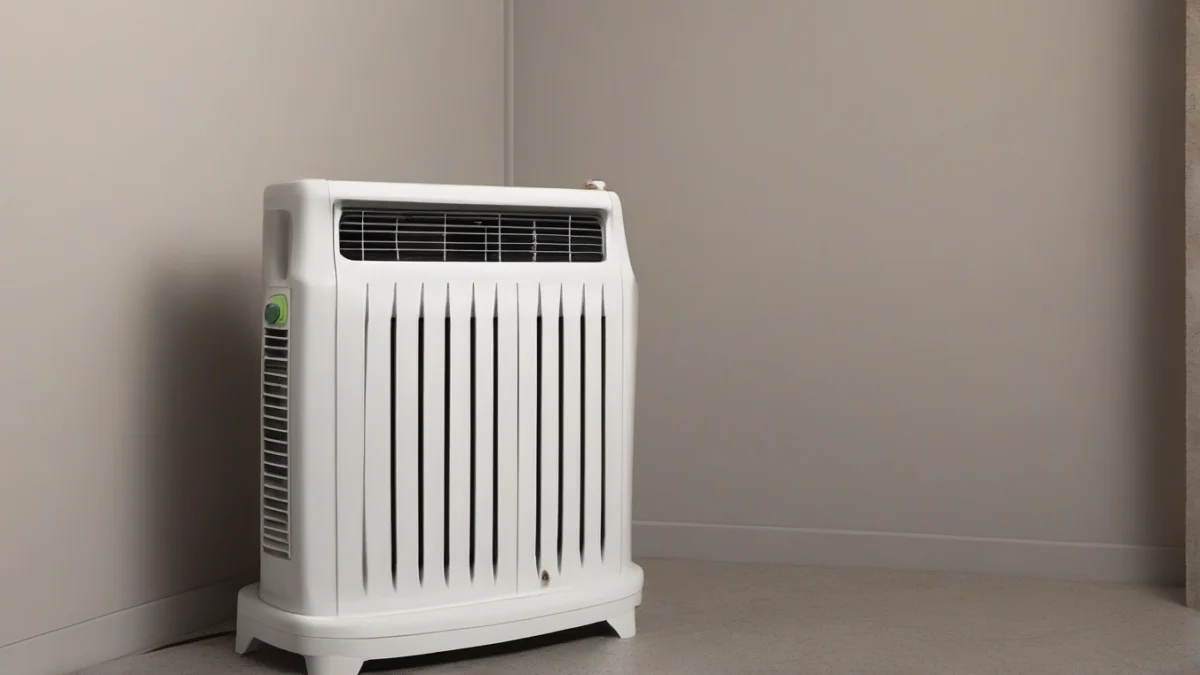
A freestanding natural gas vented heater installed in a garage.
This heater is ideal for heating garages and workshops.

Unlike a ventless heater, a vented unit gives exhaust a defined path out of the building. Unlike a furnace, it heats the room where it sits instead of sending warm air through ducts, so you get simpler zone heating but less whole-house distribution. That makes a natural gas garage heater sensible for a workshop or detached space, provided the model is listed for that location and the gas line and vent can be installed legally.

The burner mixes natural gas with air and produces heat inside the cabinet. A heat exchanger absorbs that heat while keeping combustion gases separate from the room air; a direct-vent model uses sealed combustion, drawing air from outdoors and returning exhaust outdoors through a wall termination. B-vent models generally draw combustion air from the room and use a vertical vent, while a power-vent model uses a fan to move exhaust through an approved vent path.

TypeFits bestPractical tradeoff
Direct ventRooms without a chimney; garages, basements, and living spacesSealed combustion and a wall termination, but the vent location and clearances limit placement
B-ventSpaces where a vertical gas vent route already existsUsually simpler than adding a powered exhaust system, but it uses room air and needs the right vertical venting
Power ventInstallations needing a fan-assisted route or a less conventional vent pathFlexible exhaust routing, but it adds electrical parts, noise, and installation requirements
The appliance listing and installation manual control the allowed vent materials, length, termination, and clearances.

The best vented natural gas heater is the one listed for your room, fuel, vent arrangement, and heat load—not the one with the largest BTU number. A natural gas wall heater can be safe when it is an indoor-rated, listed appliance installed to its manual; a wall location alone doesn’t make a heater safe. Bedrooms and bathrooms need a unit specifically approved for those uses, while garages need attention to vehicle clearance, ignition sources, and local rules.

Useful for choosing a direct-vent room h
Comfort Glow 17,000 BTU Direct Vent Natural Gas Wall Heater
Product 1 is a 17,000 BTU direct-vent natural gas wall heater with sealed combustion, electronic ignition, a safety pilot, thermostat control, and direct-through-wall venting; it suits a small room up to the stated 500 square feet when that installation is allowed.
See current price
Worked Gas-Cost Example
Say a heater has a 30,000 BTU-per-hour input and runs for 8 hours. That is 240,000 BTU, or 2.4 therms, because one therm equals 100,000 BTU. At an assumed gas price of $1.50 per therm, the fuel costs 2.4 × $1.50 = $3.60 for that night. Your bill may also include fixed charges and a different local gas rate.
Heat input30,000 BTU/h
Runtime8 hours
Gas used2.4 therms
Assumed fuel rateNatural gas typically costs about 1.50 p
Installation Rules
Use an indoor-rated heater only, keep every listed clearance from walls and combustibles, and install a working carbon monoxide alarm nearby. Have gas connections and venting checked or installed under local code requirements by the qualified professional your jurisdiction requires; never improvise a vent, cap an opening, or use an outdoor construction heater indoors.
In short
Vented natural gas heaters are room-sized appliances that keep combustion exhaust out of the room through direct, vertical, or fan-assisted venting. For detailed garage-specific clearance and venting questions, see this guide to natural gas garage heaters.

Where The Heat Actually Goes

A freestanding natural gas vented heater warms the room directly, while a furnace heats air in one place and sends that air through ducts. Natural gas furnaces use a burner and heat exchanger; the blower moves warmed air to registers, so the furnace room may feel hot while the far bedroom waits its turn.

Radiant heat travels from the hot front, cabinet, or exchanger to people and nearby surfaces. Convection heat warms air that rises, circulates, and eventually reaches the rest of the room. A freestanding unit can use both: radiant warmth feels immediate across the room, while natural convection keeps working after the burner cycles down.

A sealed-combustion heater draws combustion air from outdoors and sends its exhaust back outdoors through its vent, keeping the flame and flue gases out of the living space. That matters because combustion consumes oxygen and can add carbon monoxide and water vapor if exhaust enters the room. Follow the listed vent system and local gas code; a working carbon monoxide alarm still belongs nearby.

Myth
A natural gas ventless wall heater sends its combustion products outside through the wall.
Fact
A natural gas ventless wall heater burns gas in the room and releases its heat, water vapor, and combustion byproducts indoors. An oxygen-depletion sensor can shut the burner down if oxygen falls, but it doesn’t turn an unvented heater into a vented one; local rules also restrict or ban vent-free units in some places.

Natural gas vented heat is usually steadier in a small or medium room than an open-flame or unvented option because the appliance controls its burner and removes exhaust through a vent. A blower, if fitted, spreads heat faster and more evenly, but adds fan noise and a part that can fail. Electricity for the fan changes comfort and operation; it doesn’t cancel the combustion safety rules.

Read The Installation Manual
A vented heater may heat the room directly, but its clearances, vent route, combustion-air requirements, and gas connection still belong to the appliance listing. A small natural gas vented heater isn’t automatically suitable for a small room; output, ceiling height, insulation, and the approved vent path all matter.
A Direct-Vent Wall Heater To Consider
Pick a vented model only if you need sealed exhaust, wall mounting, and heat during outages.
Power-Outage Backup
Comfort Glow Direct-Vent Natural Gas Wall Heater
Product 1 suits a room where combustion exhaust must leave through the wall and the heater needs to keep working during a power outage. Its thermostatic control adjusts the heat, while the sealed burn system and safety pilot stop gas flow if the pilot goes out.
See current price

How To Compare Vented Types

The main types of natural gas heaters here are direct vent, B-vent, and power vent, and the vent path matters more than the word freestanding on the carton. These are installed gas appliances, not portable space heaters you can carry from the den to the garage.

TypeVent pathPower needsBest roomMain drawback
Direct ventSealed pipe through an exterior wall; combustion air comes from outdoorsMany models need no electricityLiving rooms, bedrooms, and small additions with an exterior wallWall location and termination clearances limit placement
B-ventListed vent, usually rising vertically through the roofOften works without a blower, depending on the modelRooms below a usable vertical roof routeMore vertical-routing, ceiling, and roof constraints
Power ventFan-assisted exhaust through an approved vent routeNeeds electricity for the fan and controlsSpaces where the approved route can’t rely on natural draftA power outage or failed fan can stop operation
Confirm the exact vent kit, termination rules, and power requirements in the heater’s installation manual.

Direct vent models can keep running during an outage when the specific unit uses no electricity, which is useful if winter weather has an enthusiasm for knocking out the grid. Power-vent models depend on electricity and on vent-fan parts, so a dead outlet, control board, or fan can stop heat even when the gas supply is fine.

Treat Installation As Part Of The Heater
Natural gas installation normally means sizing and connecting the gas line, setting clearances, fitting the listed vent, and checking for leaks and correct operation. Use a qualified gas professional and follow local code; never choose a vent route from a product photo alone.

A vented heater can be left on through winter only when its manual permits continuous or thermostat-controlled operation, the installation is code-compliant, the vent remains unobstructed, and the appliance is maintained. That answer does not make every model suitable for unattended use. A small natural gas vented heater still needs the right vent termination and enough heat output for its room, details covered by sizing rather than by the word small.

How Much Heat You Actually Need

For natural gas heaters for garages, start with floor area, then adjust for ceiling height, air leaks, insulation, and how often the garage door opens. A rough planning range is about 20 BTU per square foot for a reasonably insulated room and closer to 30 BTU per square foot for a drafty space; those figures are starting points, not a promise that every room will heat evenly.
A BTU calculator placed on a workbench for heating estimation.
Calculating BTUs helps determine the heater size needed.

Garage heaters natural gas installations need extra care because a tall, leaky garage loses heat quickly through the overhead door and roof. A garage wall heater natural gas model also has to be listed for that location, installed with its specified clearances, and connected according to local gas and venting rules. For a deeper look at the vent requirement, see garage heaters natural gas.

Worked Example
Say your garage is 24 by 24 feet, or 576 square feet, with moderate insulation and a standard-height ceiling. A rough 20 BTU-per-square-foot starting point gives 11,520 BTU, so a heater around the 17,000 BTU class gives useful reserve for door openings and colder weather. If the ceiling is tall, the overhead door leaks badly, or you want to raise the temperature quickly, stepping up may make sense; improve the air sealing first if you can.
Floor area24 × 24 = 576 sq. ft.
Rough starting load576 × 20 = 11,520 BTU
Practical classAround 17,000 BTU, then adjust

The best natural gas garage heaters aren’t automatically the largest ones. An undersized unit may run almost constantly while cold corners remain; an oversized unit can reach the thermostat quickly, shut off, and restart often, wasting fuel and making the room temperature swing.

Adjust The Starting Number
Add capacity or improve sealing for a tall ceiling, leaky overhead door, or frequent door openings.
Treat a 17,000 BTU class heater as a starting point for a moderate 576-square-foot garage, not a guarantee.
Check the heater’s listed room size and local rules before using any natural gas garage heaters vented in a garage.
Don’t assume a wall-mounted model is garage-approved just because it is a natural gas garage heater.
Useful for a smaller, fairly controlled
Comfort Glow 17,000 BTU Direct Vent Natural Gas Wall Heater
Product 1 is sized for up to 500 square feet and has thermostatic control, so it can reduce burner runtime after a room approaches the target temperature; for a 576-square-foot garage, treat it as borderline and verify the listing before choosing it.
See current price

What It Costs To Run

If you’re asking how much a safe natural gas wall heater costs to run, multiply its input BTU by burner hours, divide by 100,000 to get therms, then multiply by your local gas price. The thermostat matters because the heater’s rated input applies while the burner is firing, not during every hour the room is occupied.

Worked Example
Assume a 17,000 BTU-per-hour heater and a gas rate of $1.50 per therm. Eight hours of continuous burner operation uses 17,000 × 8 = 136,000 BTU, or 1.36 therms, costing about $2.04. A long cold night with 12 burner-hours uses 2.04 therms and costs about $3.06; intermittent use totaling four burner-hours uses 0.68 therm and costs about $1.02.
Burner timeGas usedCost at $1.50/therm
4 hours0.68 therm1.02
8 hours1.36 therms2.04
12 hours2.04 therms3.06
Example uses a 17,000 BTU input and a $1.50 per therm gas rate.

A natural gas wall heater with thermostat can cut those hours once the room reaches its set temperature: the burner shuts off, then fires again only as heat leaks away. Actual natural gas heaters cost efficiency depends on the vented design, its rated efficiency, installation quality, and how much warm air escapes around doors and windows. Gas used for the burner is still calculated from input BTU; efficiency changes how much of that heat reaches the room.

In short
Use input BTU × burner hours ÷ 100,000 × your gas price per therm. A thermostat lowers the bill by shortening burner time, while a leaky room can turn a reasonable heater into a frequent flyer for your gas meter.

What To Check Before You Buy

Can a natural gas heater be converted to propane? Sometimes, but only with the exact manufacturer conversion kit and a listed approval for that model. A wall-mount gas heater isn’t changed over safely by swapping a fitting or adjusting the burner by guesswork; the gas orifices, regulator, and instructions must match the fuel.

1
Confirm the fuel and gas supply
Read the rating plate before ordering. Confirm natural gas or propane, the required supply pressure, the gas pipe size, and the connection location. Ask a licensed pro to verify the supply can deliver the heater’s input without an unsafe pressure drop.
2
Map the vent path
For a direct-vent unit, check where the wall terminal will land outside, then compare the wall thickness with the listed vent kit. Keep the required clearances from windows, doors, soffits, combustibles, and property features; the installation manual and local code control the final locations.
3
Check the room approval
Look for explicit approval if the heater will serve a bedroom, bathroom, mobile home, modular home, or HUD housing. Those approvals aren’t interchangeable, and a unit approved for one space may not be approved for another.
4
Plan the installation
Gas connections, venting changes, and hard-piped installations belong with a licensed gas fitter, plumber, or other qualified professional where local code requires it. Don’t order the heater until that person has checked the vent route and connection point.
Useful for a no-power direct-vent setup
Comfort Glow 17,000 BTU Direct Vent Natural Gas Wall Heater
Product 1 suits readers who want a wall-mounted direct-vent natural gas heater with no electricity, electronic ignition, a thermostat, bedroom and bathroom approval, and a listed sealed burn system; confirm the wall thickness and clearances before ordering.
See current price
Before you click Buy
Fuel type matches the home’s supply.
Gas pipe size and connection location are confirmed.
The vent terminal has a code-compliant route outdoors.
Wall thickness matches the vent system.
Required clearance space is available.
The room approval matches your intended use.
Ventless is a different decision
If you’re searching for the best natural gas ventless wall heater, this is the wrong equipment category and the safety rules change. Vent-free gas heaters release combustion products into the room, may be restricted by state or local code, and require their own installation instructions and safety checks. Don’t substitute one for a vented model.

For names of direct-vent natural gas wall-hung heaters that are worth comparing, start with the listing and approval details rather than the carton’s BTU headline; the 2026 vented natural gas wall heater guide is the next useful stop.

Questions People Ask

Do natural gas heaters need to be vented?
Yes, a vented natural gas heater sends combustion gases outdoors through a listed vent system. Vent-free models release combustion byproducts and moisture into the room instead, and local rules may restrict or prohibit them. Never install a vented appliance with an improvised pipe or an unapproved termination.
How do ventless natural gas wall heaters work?
A ventless wall heater burns gas inside the room and releases its heat, water vapor, and combustion byproducts indoors. Many models use an oxygen-depletion sensor that shuts off the gas if room oxygen falls, but that safety device doesn’t remove carbon monoxide risk or local code restrictions. A working carbon monoxide alarm is still required protection.
Are natural gas wall heaters safe for bedrooms?
A bedroom heater is acceptable only when the specific model is listed for that location and local code permits it. Direct-vent models keep the combustion circuit sealed from the room, which is usually the safer design for sleeping areas. Follow the manual’s clearance and operating rules, and install a carbon monoxide alarm nearby.
Can a natural gas heater be converted to propane?
Only when the manufacturer provides an approved conversion kit for that exact model. The fuel change usually involves the burner orifice, regulator settings, and a leak and combustion check, so a qualified gas technician should do the work. Never swap fittings or adjust the gas valve by guesswork.
What size natural gas heater do I need for a garage?
Start with the garage’s floor area, then account for ceiling height, insulation, air leaks, and how often the overhead door opens. A sealed, insulated garage may need far less capacity than the same-size drafty shop. Choose a heater specifically listed for garage use and have the gas line and vent sized for the appliance.
What is the difference between a natural gas furnace and a vented wall heater?
A furnace heats air in one cabinet and distributes it through ducts, while a vented wall heater heats the room where it is installed. Furnaces can serve several rooms but need ductwork, return-air planning, and a larger installation. A wall heater is simpler for one zone, though its heat remains concentrated near that room.
Where to go next
Do natural gas heaters need to be ventedExplains venting requirements, safety risks, and efficiency tradeoffs.
Comfort Glow direct vent natural gas wall heaterExamines one direct-vent wall heater’s design and practical fit.
vented natural gas heatersHelps compare vented heater features before choosing a model.
vented gas heatersCovers safe installation and efficient operation for vented gas heaters.
natural gas heatersBreaks down fuel costs and the numbers behind running expenses.
Share
Written by Joye

I am a mechanical engineer and love doing research on different home and outdoor heating options. When I am not working, I love spending time with my family and friends. I also enjoy blogging about my findings and helping others to find the best heating options for their needs.

Keep reading

Related guides

Free newsletter

Heater deals and guides, worth opening

Price drops, new guides and safety recalls. One email, only when it matters.

No spam. Unsubscribe in one click. Privacy policy.