For most households comparing Rheem water heaters, product 5 is the practical starting point: it delivers 7.0 GPM at a 35°F temperature rise and includes leak detection. Choose product 1 instead if several water points may run together; product 3 offers the highest listed flow and built-in recirculation.
Key takeaways
Product 5 is rated for 7.0 GPM at a 35°F temperature rise; colder incoming water can reduce usable flow.
Product 3 has the highest listed flow, 11.2 GPM, and built-in recirculation with Wi-Fi controls.
Products 1, 2 and 5 are non-condensing; confirm the venting and gas requirements before buying.
A licensed professional should handle gas, venting and required electrical work.
A tankless heater can keep supplying hot water, but its flow rate still has a ceiling. The right pick depends on how many fixtures you use at once and how cold your incoming water gets.
One common belief is that a higher GPM rating always means a better heater. The useful half is that more flow can serve more fixtures; the missing half is that the rating depends on the stated temperature rise and your actual winter inlet temperature.
Five Rheem Gas Tankless Picks
#1Practical starting point
Rheem RTG 7.0 GPM Indoor
Best for Households with 2–3 water points running at once
This indoor model delivers 7.0 GPM at a 35°F rise, a useful fit for many households that don’t need the largest unit here. LeakGuard detects internal leaks and helps prevent water damage, while the wall-mounted design frees floor space.
Flow at 35°F rise 7.0 GPMOutput 160,000 BTU/hrInstallation Indoor, direct ventUniform Energy Factor 0.82
Why it made the cut
LeakGuard leak detection and prevention
Digital temperature control with ±1°F adjustments
Built-in freeze and flame failure protection
Good to know
Lower listed flow than the 8.4 and 11.2 GPM picks
Indoor installation requires a direct vent system
Skip it if Choose a higher-flow model if several showers and other hot-water uses commonly run together.
Best for Large families with 3–4 water points running together
The 8.4 GPM rating at a 35°F rise and 180,000 BTU/hr output make this a stronger fit when several showers may run at once. It has digital temperature control and built-in freeze protection, but you’ll need space for its indoor direct-vent installation.
Flow at 35°F rise 8.4 GPMOutput 180,000 BTU/hrInstallation Indoor, direct ventUniform Energy Factor 0.82
Why it made the cut
Listed for 3–4 simultaneous showers
Digital temperature control with ±1°F adjustments
Built-in freeze and flame failure protection
Good to know
Indoor installation needs a direct vent system
No built-in leak detection is listed
Skip it if Skip it if your household’s hot-water demand is modest; the 7.0 GPM option may be a better fit.
Best for Homes with high simultaneous demand and interest in built-in recirculation
At 11.2 GPM, this has the highest listed flow among these picks, and its built-in recirculation can reduce the wait for hot water at a tap. Wi-Fi controls let you adjust temperature and recirculation settings from a phone, which suits homeowners who want those controls without adding a separate recirculation system.
Best for Households seeking built-in recirculation and automatic water-use scheduling
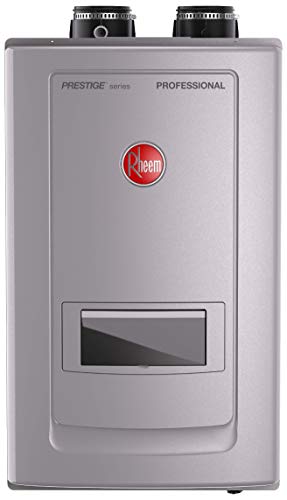
Built-in recirculation helps deliver hot water with less waiting, while Auto-Learn tracks usage and programs the unit around peak demand. Water and gas leak detection can shut the unit down and provide an error code, a practical feature for owners who want a clear alert if something goes wrong.
Flow 11.0 GPMInstallation IndoorStandout feature Built-in recirculationLeak protection Water and gas leak detection
Why it made the cut
Built-in recirculation
Auto-Learn programming
Water and gas leak detection with shutdown and error code
Good to know
No BTU/hr output is listed
No flow figure at a 35°F rise is provided
Skip it if Pick another model if you need a stated flow rate at a 35°F rise before comparing capacity.
Best for Homes with a suitable outdoor installation location
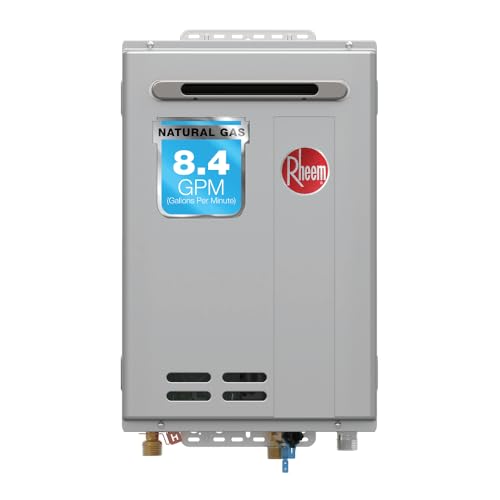
This outdoor version provides the same listed 8.4 GPM flow at a 35°F rise as the indoor RTG pick, while outdoor installation eliminates venting. Its metal cabinet is designed for outdoor installation, and the unit includes built-in freeze protection; confirm the location and installation details with a qualified installer.
Flow at 35°F rise 8.4 GPMOutput 180,000 BTU/hrInstallation OutdoorUniform Energy Factor 0.82
Why it made the cut
8.4 GPM at a 35°F rise
Outdoor installation eliminates venting
Built-in freeze and flame failure protection
Good to know
Requires an appropriate outdoor installation location
No built-in leak detection is listed
Skip it if Skip it if your climate, site or local requirements make outdoor installation unsuitable.
Rheem water heaters in this lineup are gas tankless models, not 40-gallon storage heaters; the right Rheem gas water heater depends on how much hot water you use at once and where the unit can be installed. For Rheem water heater reviews, compare listed flow, temperature rise, features and indoor or outdoor placement—not unsupported reliability rankings. Those details are a more useful way to judge whether Rheem water heaters are good for your home.
Model
Listed flow and output
Location and notable features
Rheem RTG Series 8.4 GPM (product 1)
8.4 GPM at 35°F rise; 180,000 BTU/hr
Indoor
Rheem RTG Series 8.4 GPM (product 2)
8.4 GPM at 35°F rise; 180,000 BTU/hr
Outdoor
Rheem IKONIC 11.2 GPM (product 3)
11.2 GPM; 199,900 BTU/hr
Indoor; Wi-Fi and recirculation
Rheem Prestige Condensing (product 4)
11.0 GPM
Indoor; built-in recirculation; supplied data doesn’t state BTU output or efficiency
Rheem RTG Series 7.0 GPM (product 5)
7.0 GPM at 35°F rise; 160,000 BTU/hr
Indoor; leak detection
Compare listed Rheem water heater models by the specs provided; a missing spec isn’t evidence of a particular performance level.
A temperature rise is the difference between incoming cold water and the hot water the heater delivers. The 35°F figures are ratings at that rise, not a promise of the same flow in every season. Products 1 and 2 share listed flow and output, but product 2 is the outdoor option; products 3 and 4 are the higher-flow condensing choices, with the listed features shown above.
Myth
A tankless heater supplies unlimited hot water at any flow.
Fact
It heats water as it passes through, but its available flow depends on the temperature rise and the unit’s capacity. Ask an installer to match the model to your demand and installation location.
Choose by the spec that matters
Pick an indoor or outdoor model that suits the planned installation.
Compare the listed flow with the fixtures you may run together.
Treat missing output or efficiency data as unknown, not as a reason to assume better performance.
From HeaterGuides · our own guidePages 9 to 13 are the fault flowcharts: no hot water, noises, smells and leaks, in order.Water Heater Owner's ToolkitFix the common faults yourself, keep it running for years, and know when a repair is money wasted.No-hot-water flowcharts, gas and electricFlush, anode, relief valve and descaling stepsRepair-or-replace calculator (Excel)$14.99$9.99Get it for $9.99See what's inside and watch the 2-minute video →18-page printable PDF + Excel calculator · instant download · 30-day refund
Size Flow for a Cold Winter Morning
For a Rheem 40 gallon gas water heater search, first check whether you want a storage tank: the five products here are tankless, so compare simultaneous flow in GPM, not tank capacity. A Rheem 40 gallon water heater is a different product type, and the listed tankless GPM ratings are measured at a 35°F temperature rise—not guaranteed flow under every winter condition.
Product type
What to compare
40-gallon storage heater
Tank capacity in gallons
Tankless heater in this lineup
Flow in GPM at the stated temperature rise
A comparison chart should compare like with like; tank capacity and tankless flow describe different things.
Add the fixtures you’ll use together
Say the shower and another hot-water fixture may run at the same time. Find each fixture’s flow in its own specifications, add those figures, then compare the total with the heater’s rated flow. For example, if the two listed fixture rates are A and B, the combined demand is A + B GPM; use your actual fixture specs rather than guessed values.
Heater ratingCompare at the listed 35°F rise
Fixture demandAdd the flow rates for fixtures running
Colder incoming water needs more heating to reach the same outlet temperature, so the required temperature rise increases and available flow can fall. Have an installer check your local winter inlet temperature and the household’s simultaneous demand before choosing a model; the product data doesn’t establish a fixed number of showers any one unit can serve.
A Rheem 40 gallon gas water heater cost search won’t answer what a tankless installation costs; tank capacity is not a comparable flow rating. For a tankless comparison, ask for the expected winter flow at your incoming-water temperature and the fixtures you plan to run together.
Budget for Gas, Venting and Installation
The listed data gives no purchase prices, household gas rates or installation costs, so there’s no reliable price list for Rheem water heaters here. That applies to searches for a Rheem gas water heater 40 gallon cost, a Rheem 40 gallon gas water heater price, a Rheem professional water heater price, a Rheem water heater installation cost or a Rheem electric water heater; the five picks above are gas tankless models, not 40-gallon tanks or electric heaters.
Your gas use depends on how much hot water you draw, the incoming-water temperature, your set temperature and your local gas rate. Compare annual operating-cost estimates only when they use the same household demand, incoming temperature, setpoint and gas price. A UEF rating alone won’t tell you what your bill will be.
Products 1, 2 and 5 list a 0.82 UEF; the supplied data gives no UEF for products 3 and 4. Don’t assume those two are more or less efficient, or compare gas and electric bills from UEF alone.
Indoor models need the venting specified for that unit. Product 2 is designed for outdoor installation, so it avoids indoor venting, but still needs correct placement and installation. A licensed plumber or other qualified professional should handle gas connections and venting; local code and the exact installation manual govern clearances and materials.
Before You Approve a Quote
Confirm the exact model and indoor or outdoor configuration.
Ask which vent materials, route and clearances the installation requires.
Get labor, materials and any required gas or vent changes itemized.
Check that the installer will follow the manual and local code.
Plan for Recirculation and Freeze Protection
A Rheem hot water heater with recirculation can shorten the wait at a distant tap, but the system’s controls and schedule affect how often it runs and how much water and energy it uses. Check how the recirculation setup works before paying for a feature you may not need.
Myth
Built-in recirculation guarantees a fixed amount of water savings.
Fact
Product 3 claims an average saving of 11,000 gallons of water per year, but your result depends on your household and how the system is controlled. Product 4 lists built-in recirculation and auto-learn programming; product 3’s Wi-Fi and water-savings claims don’t apply to product 4.
Products 1 and 2 list built-in freeze protection, but that doesn’t make every outdoor installation safe during a power outage or severe cold. Follow the exact manual and your installer’s guidance for freeze protection and any steps needed during an outage.
Confirm Product 3’s Configuration
Product 3 is listed as an indoor model, yet its supplied information says outdoor installation requires an outdoor conversion kit. Ask the seller or installer to confirm the exact model and kit configuration before purchase; don’t assume the indoor listing means it can go outside as supplied.
Frequently Asked Questions
How do you light the pilot on a Rheem gas water heater?
Most Rheem gas tankless models use electronic ignition and don’t have a standing pilot to light. If your model has a pilot, follow its lighting label exactly; if you smell gas, leave the area and call your gas utility or emergency services from outside.
Why is my Rheem water heater beeping?
A beep can signal an error or a leak-detection alert, depending on the model. Read the display code and check the manual before resetting the unit; if you see water near the heater or smell gas, shut it down only as the manual directs and call a qualified technician.
Is a Rheem 40-gallon gas water heater tankless?
No. A 40-gallon model is a storage water heater with a tank; tankless models heat water as it flows and are sized by flow rate and temperature rise. Check the model number or rating plate before comparing replacement options.
How often should you replace a Rheem water heater anode rod?
A tank-style heater’s anode rod should be inspected on the schedule in its manual, since water chemistry and use affect how quickly it wears. Tankless models generally don’t have the same storage-tank anode rod; don’t order one without checking the exact model.
How does a Rheem gas water heater compare with an A. O. Smith?
Compare specific models rather than brand names: check flow at the temperature rise you need, venting requirements, ignition and recirculation features, warranty terms, and local service availability. Two heaters with similar headline GPM can deliver different flow in cold incoming water.
Before you go · a welcome giftGet the Water Heater Owner's Toolkit for $4.99Fix the common faults yourself, keep it running for years, and know when a repair is money wasted. Normally $14.99; your welcome price saves $10.00. We'll email your link right now.or buy it now for $9.99 without the gift →One email with your link now. We never share your address.



 Water Heater Owner's ToolkitFix the common faults yourself, keep it running for years, and know when a repair is money wasted.No-hot-water flowcharts, gas and electricFlush, anode, relief valve and descaling stepsRepair-or-replace calculator (Excel)