

It’s 6 AM, the bedroom floor is freezing, and your toes refuse to touch it. You drag the space heater out from the closet, plug it in, and wonder: can I just leave this thing on the carpet? Most people do. Most people also don’t know that space heaters cause over 1,700 house fires each year in the US, and carpet is a primary ignition source.
This guide moves past the generic don’t do it warning. You’ll learn exactly why carpet burns, which carpet types are less risky, how to measure safe clearance, and a DIY base plate method that lets you use a heater on carpet without turning your bedroom into a tinderbox. You’ll leave with a clear yes or no for your specific setup.

Woo Warmer
Hot Carpet Woo Warmer Under Rug Radiant…
- HEATED WARM FLOORS-Now you can create a warm zone on your floor anywhere. Your central heat will warm your air but not warm your f…
- CREATE UNDER DESK WARM ZONE - Finding personal warmth for your feet when central heat is far from your work space just place it un…
- UNDER RUG HEATER - Your Woo Warmer plugs into any standard wall outlet and includes an AUTO SHUT OFF after 6 hours. Our heater off…
If you’re dealing with a permanently cold floor rather than a portable heater, a different tool exists. A Woo Warmer under-rug radiant mat sits beneath your existing rug and warms the surface directly, which sidesteps the air-circulation hazards of a standing heater altogether.
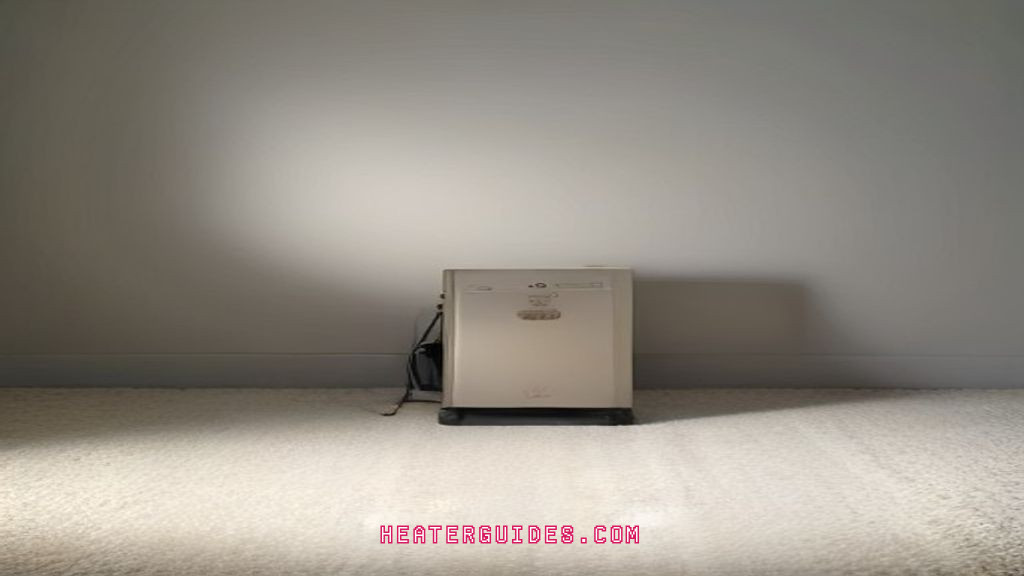
The Short Answer: Yes, But Only Under Strict Conditions
You can safely put a space heater on carpet, but only if the heater passes a simple test: the bottom surface must stay cool enough to touch after running for 30 minutes. Most modern convection heaters with ceramic elements and cool-touch bases pass this test. Radiant heaters with exposed glowing coils fail it instantly.
The risk isn’t the heater itself. It’s the heat that builds up underneath and around it. Carpet traps heat far better than hardwood or tile, so the temperature at the base of the heater climbs much higher on carpet than on a hard floor. If that temperature exceeds roughly 200°F (93°C), carpet fibers begin to soften and melt. At 300°F (149°C), they ignite.
Here’s the rule of thumb: if you can hold your palm flat on the bottom of the heater after it’s been running for an hour, it’s probably safe for low-pile carpet. If you can’t, it needs a hard barrier.
Why Carpet is a Fire Risk: The Science of Heat and Fibers
Most people think a heater catches fire when it tips over or gets covered. That’s true, but the more common failure is slower and less dramatic. It’s heat accumulation.
Carpet is a dense insulator. Nylon and polyester fibers have low thermal conductivity, meaning they don’t move heat away from the source. When a heater sits on carpet, the heat that should dissipate into the floor stays trapped in the fiber layer. The temperature under the heater rises continuously over 30 to 60 minutes until it reaches equilibrium. On a hard floor, that equilibrium might be 120°F. On carpet, it could be 250°F or higher.
Radiant heaters are the worst offenders. They emit infrared radiation that heats objects directly, not the air. The grille on a radiant heater can reach 400°F, and if that grille faces down toward the carpet, the fibers absorb that radiation and heat up rapidly. Convection heaters, which pull cool air from the bottom and push warm air out the top, have a much cooler bottom surface because the airflow constantly cools the base.
One more factor: the pile height. High-pile carpet (like shag) has more air gaps between fibers, which means more trapped heat and more surface area to ignite. Low-pile carpet (like berber) is denser and conducts heat slightly better, making it the safer option. But safer isn’t safe — it still needs the clearance rules below.
Which Carpet Types Are Safer (and Which Are a Hard No)
Not all carpet is created equal. Here’s the practical breakdown:
- Low-pile synthetic (nylon, polyester, olefin): Safest option. Dense fibers, low heat retention. Still requires a cool-touch base and 3-foot clearance.
- Berber: A low-pile loop carpet, usually wool or nylon. Wool is naturally flame-resistant, which helps, but the loops can snag and pull, creating uneven surfaces that concentrate heat.
- High-pile (shag, frieze): Hard no for any heater that isn’t specifically rated for floor contact. Long fibers trap heat and provide abundant fuel.
- Wool (any pile): Wool doesn’t ignite easily — it chars instead. But it still melts synthetic backing and padding underneath. Don’t assume wool makes it safe.
- Synthetic padding and backing: This is the hidden danger. Even if the top fibers survive, the foam or rubber padding beneath the carpet can melt and smolder. Smoldering is what actually starts most fires.
The takeaway: no carpet is truly safe with a radiant heater. Low-pile synthetic with a convection heater and a cool-touch base is the only combination I’d trust on carpet without a barrier.
The 3-Foot Rule: How to Measure Clearance Correctly
You’ve heard the 3-foot rule. Here’s what it actually means and how to apply it in a real room.
The rule states that the heater must maintain 36 inches of clearance from any combustible material — curtains, bedding, furniture, and yes, carpet. But carpet is the floor, so the rule applies to the perimeter of the heater, not the floor beneath it. The heater needs 3 feet of open space in every horizontal direction.
Measure it practically. Take a tape measure from the heater’s edge and mark 36 inches on the floor. That’s the boundary. Anything flammable — a bed skirt, a pile of laundry, a curtain that hangs low — must stay outside that circle. This includes the cord. The cord should never run under a rug or behind furniture where it can’t shed heat.
In a small bedroom, this is often impossible. A typical bedroom is 10×10 feet, and a heater placed in a corner instantly violates the rule for two walls. If you can’t achieve 3 feet of clearance on all sides, the heater doesn’t belong in that room on the floor. That’s a hard rule, not a suggestion.
The Only Safe Way to Use a Heater on Carpet (The Base Plate Method)
If you have no hard floor and no way to achieve the 3-foot rule, you have one remaining option: create a non-flammable base.
The base plate method is simple. You place a rigid, non-combustible barrier between the heater and the carpet. The barrier must be larger than the heater’s footprint by at least 6 inches on every side. Materials that work:
- Ceramic or porcelain tile (12×12 inch or larger)
- A sheet of 1/4-inch plywood covered with sheet metal
- A large metal baking sheet (the kind used for roasting)
- A concrete paver from a hardware store
For a standard heater with a 12-inch square base, you need at least a 24-inch square barrier. Place the barrier flat on the carpet, set the heater on top, and ensure the barrier doesn’t rock or tilt. The barrier spreads the heat across a larger area, keeping the carpet underneath below the ignition threshold.
This method isn’t perfect. It doesn’t fix the 3-foot rule for surrounding materials, and it adds a trip hazard. But it’s the difference between a heater that could ignite your carpet and one that won’t. If you use this method, check the barrier’s temperature after 30 minutes. If it’s too hot to hold your hand on it, the barrier is too small.
Heater Features That Make Carpet Use Safer (Look for These)
Not all heaters are equally risky on carpet. Before you buy, check for these four features:
- UL or ETL certification: This isn’t a marketing badge. It means an independent lab tested the heater for internal overheating and tip-over risks. Look for the mark on the bottom or back of the unit.
- Tip-over switch: If the heater falls, this cuts power instantly. On carpet, a tipped heater is a direct fire risk. This feature is non-negotiable.
- Overheat sensor: This shuts the unit off if the internal temperature exceeds a safe limit. It’s the last line of defense against heat buildup on carpet.
- Cool-touch housing and base: The exterior should stay below 100°F during operation. If the manufacturer lists this as a feature, it’s a good sign. If they don’t, assume the base gets hot.
Also check the wattage. A 1,500-watt heater is the max for a standard 15-amp household circuit. Anything higher will trip the breaker. Lower wattage (750W) heaters run cooler and are safer on carpet, but they also heat a smaller area. For a bedroom, 750W is usually enough if the room is well-insulated.
One more thing: avoid extension cords and power strips entirely. The heater’s cord should plug directly into a wall outlet. If the cord feels warm at the plug, the outlet is overloaded or the connection is loose. Both are fire hazards. Use a GFCI outlet in bathrooms or kitchens, but in a bedroom, a standard outlet is fine.
Absolute No-Nos: What You Should Never Do on Carpet
Don’t Hide the Cord
Running the cord under a rug or carpet to keep it out of the way traps heat inside the fiber layer. The cord can overheat and melt its insulation, exposing live wires. The same goes for tucking the cord under furniture or behind a curtain. Keep the entire cord visible and in open air.
Don’t Use a Timer or Leave it Unattended
Some people set a timer so the heater runs all night. That’s a mistake. Even with a tip-over switch and overheat sensor, a heater on carpet is a risk that compounds over time. If you’re asleep, you can’t smell the smoldering padding until it’s too late. Run the heater only while you’re awake and in the same room. Turn it off when you leave the room or go to bed.
Final Verdict: Is It Worth the Risk?
Here’s my honest take. A space heater on carpet is never ideal, but it’s not automatically a death sentence. If you have a UL-listed convection heater with a cool-touch base, low-pile carpet, 3 feet of clearance, and you’re awake and present, the risk is manageable. If any of those conditions fail, use the base plate method or skip the heater entirely.
The bigger issue is that most people don’t check these conditions. They plug in whatever heater they own and forget about it. That’s how fires start. The heater itself isn’t the villain — the complacency is.
If you’re comparing heater types, check out this breakdown of propane vs. portable electric heaters to see which fits your space. And if you’re considering placing a heater on furniture, read the table placement guide — the clearance rules are different and just as strict.
Quick Safety Checklist for Your Home
- Check the heater’s base temperature after 30 minutes. If you can’t hold your palm on it, it needs a barrier.
- Confirm the heater has UL/ETL certification, a tip-over switch, and an overheat sensor.
- Measure 3 feet of clearance in every direction. Move anything flammable outside that circle.
- Never use an extension cord or power strip. Plug directly into the wall.
- Keep the cord visible and off the carpet surface.
- For high-pile or wool carpet, use the base plate method or don’t use the heater.
- Turn the heater off when you leave the room or go to sleep. No timers, no overnight runs.

I am a mechanical engineer and love doing research on different home and outdoor heating options. When I am not working, I love spending time with my family and friends. I also enjoy blogging about my findings and helping others to find the best heating options for their needs.
Related guides

Space Heater Replacement Parts: When Repair Makes Sense
What's the secret to a warm winter? Find the right space heater replacement parts with our expert buying…
Space Heaters for Kids’ Rooms: Quiet, Cool-Touch & Stable Picks
What's the safest way to warm your child's room? Our essential guide to choosing the perfect kids’ room…
Space Heater Electricity Cost: Calculate & Save Money
The average cost to run a space heater is about $0.14 to $0.20 per hour, depending on wattage…
