Bradford White Water Heaters: Run Time, Costs, And Repairs
On this page 7 sections
Bradford White makes residential storage water heaters, most often gas or electric units with a tank. The practical questions are simple: what type do you have, how much hot water can it supply, and what fails first when it stops keeping up?
For most readers, the answer turns on recovery rate, tank size, venting, and the age of the parts inside the heater. Those details decide comfort, repair cost, and whether you should replace a part or the whole tank.
Bradford White Hot Water Tank: What It Is And How It Works
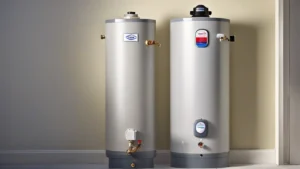
A Bradford White hot water tank is a storage water heater that heats and holds water in an insulated tank, usually 30 to 80 gallons, so hot water is ready when you turn on the tap. Unlike tankless models that heat on demand, a storage heater keeps a full tank at temperature around the clock, and the size of that tank plus how fast it can reheat—the recovery rate—determine whether you run out during back-to-back showers or a load of laundry.
Gas models burn natural gas or propane in a burner chamber beneath the tank, and exhaust gases vent through a flue that runs up the center and out the top or power-vented out a side wall. Electric models use one or two resistive heating elements threaded into the side of the tank, no flame and no vent. Both wrap the steel tank in foam insulation and sheet metal, but gas units recover faster—a typical 50-gallon gas heater with a 40,000 BTU burner recovers about 41 gallons per hour at a 90°F rise, while a 50-gallon electric unit with dual 4,500 W elements recovers around 21 gallons per hour on a 240 V circuit.
Tank size and recovery rate together dictate how long hot water lasts when multiple fixtures draw at once. A shower pulls roughly 2 gallons per minute, a dishwasher about 1.5 gpm, and a washing machine up to 3 gpm on the hot-water fill. Say your teenager showers for ten minutes while the dishwasher runs—that’s 20 gallons for the shower and 10 for the dishes, 30 gallons gone in ten minutes. A 40-gallon tank starts with 40 gallons ready, so you’d have 10 left, but if the heater recovers 20 gallons in that same ten minutes, you’re back up to 30 gallons available. A slower electric recovery means the tank stays depleted longer.
| Feature | Gas storage | Electric storage |
|---|---|---|
| Fuel | Natural gas or propane | 240 V circuit, about 4,500 W per element |
| Venting | Atmospheric or power vent to outside | None |
| Recovery rate | 38 to 50+ gph, depending on burner | 18 to 23 gph, depending on wattage |
| Best for | Larger households, high simultaneous demand | Smaller households, no gas line available |
Bradford White builds both residential and commercial models, with the Defender line adding a flame arrestor and tighter combustion chamber to meet flammable-vapor-ignition-resistant standards for garage installs. The core mechanics—burn fuel or run elements, store hot water, replace what you use—stay the same across the range, and choosing the right capacity and fuel type matters more than any feature badge.
Gas, Electric, And Defender Models
Bradford White makes gas and electric storage tank water heaters, and the fuel you choose shapes recovery speed, install complexity, and where the tank can live. Gas models heat water faster—usually 40 to 50 gallons per hour at the burner—so a family that drains the tank in the morning gets hot water back sooner. Electric units are simpler where 240 V wiring already runs to the utility room: no flue, no combustion air, no gas line. They heat more slowly, closer to 20 gallons per hour with dual 4,500 W elements, but they’ll sit in a closet or interior hallway where venting a gas unit isn’t practical.
The Bradford White Defender line is a gas water heater built with sealed combustion and a flammable vapor ignition-resistant chamber, so it meets stricter garage and utility-space codes. Defender models pull combustion air from outside through a dedicated inlet and resist flashback if gasoline fumes settle near the base. You’ll see them in garages where lawn equipment, paint cans, or stored fuel share the room. Standard atmospheric gas models vent through a metal flue that drafts naturally; power-vent models add a blower to push exhaust horizontally through a wall. Both need makeup air—a louvered vent or open door—so the burner gets enough oxygen.
Electric Bradford White tanks need a 30 A double-pole breaker and 10/2 wire for most residential sizes. Gas units need a B-vent chimney or direct-vent kit, a sediment trap on the gas supply, and clearance to combustibles spelled out in the install manual. Basement and garage installs are common for gas; closet and utility-room installs lean electric unless a flue already exists.
| Type | Venting | Typical location | Annual upkeep |
|---|---|---|---|
| Gas atmospheric | Metal flue to roof or chimney | Basement, garage, utility room with flue access | Flush tank yearly, check flue draft |
| Gas Defender | Sealed intake and exhaust, or power vent | Garage, utility space near flammables | Flush tank yearly, clean intake screen |
| Electric | None | Closet, hallway, basement, anywhere 240 V reaches | Flush tank yearly, test elements |
What It Costs To Run
Running cost hinges on fuel price, tank size, thermostat setting, insulation quality, and how much hot water leaves the tank each day. Bradford White reviews often ask whether the brand saves money; the brand itself changes cost less than those five factors. An electric tank’s monthly cost is standby loss plus the energy to heat incoming cold water: watts of the elements, hours they run, and your utility’s rate per kWh. Gas tanks burn therms; one therm is 100,000 BTU, and a 40,000 BTU burner running fifteen minutes uses a tenth of a therm.
Say a family of three uses 50 gallons of hot water a day. Incoming water is 55°F, the tank holds 120°F, so each gallon needs 65°F × 8.34 lb × 1 BTU/lb = 542 BTU, and 50 gallons need 27,100 BTU. An electric tank at 90 percent efficient needs about 8 kWh (27,100 BTU ÷ 3,412 BTU per kWh ÷ 0.9); at 16 cents per kWh that’s $1.28 a day, plus standby loss of maybe 50 W running all day, another 19 cents. Total is close to $44 a month. A gas tank at 60 percent efficient burns about 0.45 therms a day (27,100 BTU ÷ 100,000 ÷ 0.6); at $1.50 per therm that’s 68 cents, plus pilot-light gas of 5 to 10 cents, so around $23 a month. Double the daily draw and both costs nearly double.
| Heater | Watts | Per hour | Per day (24 h) | Per month (30 days) |
|---|---|---|---|---|
| Electric water heater, 50 gal/day | 333 W | 5.3¢ | $1.28 | $38.36 |
| Electric water heater, 80 gal/day | 533 W | 8.5¢ | $2.05 | $61.40 |
The biggest cost traps are thermostat cranked to 140°F when 120°F is enough, twenty-minute showers that drain the tank twice a day, and a failing lower element or gas control that cycles too often. A tank losing insulation or sitting in a cold crawlspace bleeds heat around the clock. Check hot water tank blanket efficiency if the jacket feels warm to the touch; newer tanks rarely need it, but an older unit in an unheated space might.
 Water Heater Owner's ToolkitFix the common faults yourself, keep it running for years, and know when a repair is money wasted.No-hot-water flowcharts, gas and electricFlush, anode, relief valve and descaling stepsRepair-or-replace calculator (Excel)
Warranty, Registration, And Serial Numbers
Coverage questions start with the serial number and model number on the rating plate, usually stuck to the side of the tank near the top or the gas valve. Bradford White warranties vary by model line and fuel type, and most run six years on the tank and one year on parts, though some Defender models carry longer coverage. Check what you’ve got before you buy a part or schedule a service call, because some claims hinge on when the unit was installed and whether a licensed pro did the work.
Registration extends certain coverage terms, but the serial number tells you the manufacture date and model details, and that’s what the warranty department will ask for first. Don’t guess the age from a sticker on the front; those labels fade and get replaced. The serial number follows a date code format Bradford White publishes, and you’ll need it to confirm eligibility.
Troubleshooting When The Tank Stops Keeping Up
When a Bradford White stops delivering hot water, the cause usually sits in one of six places: the heating source quit, the thermostat setting dropped or the high-limit tripped, sediment is choking flow, a vent or draft fault shut the burner down, an element burned out, or the pilot or ignition system isn’t lighting the gas. Start with the safe checks you can do without tools—breaker position, thermostat dial, gas valve setting, pilot flame—and escalate to a service call when the fault involves the gas valve, combustion chamber, elements under voltage, or the vent system.
No hot water at all means either no power to an electric unit (tripped breaker, blown fuse at the disconnect, or a tripped high-limit button under the upper access panel) or no flame on a gas model (pilot out, gas valve closed, or an ignition lockout). Lukewarm water that runs out fast points to a failed lower element on electric tanks or low gas pressure and a fouled burner on gas units. If you hear the burner fire but the water stays cold, suspect a draft problem: a blocked vent, a failed draft inducer motor, or a pressure switch that won’t close because airflow is wrong.
Bradford White power-vent and direct-vent gas models use a draft inducer blower to pull combustion air through the burner and push exhaust out the vent pipe. When that motor fails—bearings seize, the impeller cracks, or the windings short—the pressure switch won’t signal safe venting, and the control board locks out ignition to prevent exhaust from spilling into the room.

Error codes and hot water tank lights flash patterns are model-specific: three flashes might mean one fault on a 2015 model and something different on a 2023 Defender unit, so pull the manual or check the legend printed inside the burner-access door. Count the flashes with the gas valve in the On position and the thermostat calling for heat, then cross-reference the code. Common patterns include blocked vent, failed thermopile, or a high-limit trip from overheating.
Where To Buy And Who Installs It
Bradford White sells through plumbing supply houses and authorized dealers, not big-box home centers, so you won’t find one next to a Rheem on the shelf at Lowe’s. Call a local plumbing wholesaler or search the Bradford White dealer locator on their website to find a distributor near you. Many dealers sell only to licensed contractors, but some will sell directly to homeowners who are arranging their own install.
Installation is a job for a licensed plumber in most places. Gas connections, proper venting, T&P valve discharge lines, and 240 V wiring for electric models all fall under code requirements that vary by state and municipality. A plumber also confirms the new tank fits the same footprint, vent diameter, and supply-line positions as the old one. DIY replacement of an existing electric tank is legal in some areas if you’re comfortable with 240 V work and local permitting, but gas units almost always require a licensed professional.
Choosing by capacity, fuel type, vent compatibility, and physical dimensions matters more than sticking with the same brand. Bradford White electric water heater models and gas Defender units both have loyal followings, but if your old 50-gallon atmospheric-vent gas tank is being replaced, any brand’s 50-gallon atmospheric unit with similar first-hour rating will do the same work. Bringing the serial number speeds up warranty lookups and helps the dealer confirm which replacement parts fit if you’re fixing rather than replacing.