For most people searching for the Best Safe Room Heater, the DREO 1500W oscillating heater is the strongest fit: it has ETL certification, tip-over and overheat protection, and runs at a listed 34 dB. Its 70° oscillation helps spread heat, but it’s a 1,500W supplemental heater, not a whole-home system.
Key takeaways
Pick a heater with a recognized safety listing, tip-over shutoff and overheat protection.
A 1,500W plug-in heater draws about 12.5 A; plug it directly into a wall outlet.
For a bathroom, use only a heater specifically rated for that damp location.
Electric resistance heaters turn nearly all their electricity into heat at the point of use; ECO mode saves by reducing power or run time.
Keep electric heaters at least 3 feet from bedding, curtains and other combustibles.
A heater with tip-over shutoff is safer than one without it, but that feature can’t make a bad setup safe. The other half is choosing the right location and using the heater exactly as its manual allows.
Five Safe Room Heaters, Ranked by Use
#1Best Overall
DREO Quiet Oscillating Space Heater
Best for General room heating where quiet operation and broad airflow matter
This 1500W ceramic heater has ETL certification, tip-over and overheat protection, and a 24-hour timer. Its 70° oscillation moves heat across the room rather than concentrating it beside one chair. Choose it for a bedroom, office, basement, or living room that needs supplemental heat.
Best for Larger rooms needing wider airflow and a listed 250 sq. ft. coverage area
Dual DC motors, a 25% larger heating plate, and airflow up to 10ft/s give this tower more coverage than the compact picks. The 70° oscillation, cool-touch housing, child lock, and ETL listing suit family rooms and bedrooms where the heater will run near people. ECO mode and three heat levels add control.
Listed coverage Up to 250 sq. ft.Heat output Heats in 2 secondsNoise 34dbOscillation 70°Controls ECO mode, 3 heat levels, fan mode, 12-hour timer
Why it made the cut
Listed for rooms up to 250 sq. ft.
70° oscillation and dual DC motors
Child lock, cool-touch housing, tip-over and overheat protection
Good to know
Taller 24-inch design takes more floor space
The larger format is unnecessary for a small desk or office
Skip it if Skip it if you want the smallest portable heater for a desk, bathroom, or tight corner.
Best for Bedrooms and offices needing compact oscillating heat with precise controls
Atom One pairs 1500W heating with a 70° sweep, so it distributes warmth without taking up the role of a permanent heating system. Its ETL-listed Shield360° protection includes tip-over and overheat protection, while the thermostat adjusts from 41 to 95°F in 1°F increments. The 37.5dB rating makes it a sensible bedroom or office choice.
Heat output Up to 1500WNoise Up to 37.5dBOscillation 70°Temperature range 41 to 95°F in 1°F incrementsSafety ETL-listed; tip-over and overheat protection
Why it made the cut
70° wide-angle oscillation
Thermostat adjusts from 41 to 95°F
ETL-listed tip-over and overheat protection
Good to know
No listed room-size coverage
37.5dB is louder than the 34dB DREO picks
Skip it if Skip it if the room is larger than the product’s stated coverage or you want a larger tower design.
Best for Bedrooms, living rooms, and apartments needing wall-mounted heat and fireplace decor
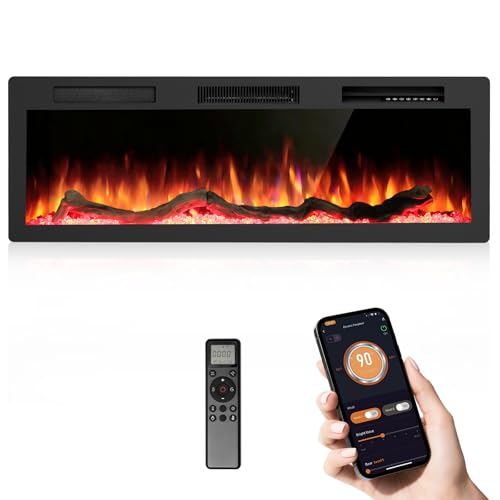
This 50-inch electric fireplace offers 750W and 1500W heating modes, temperature settings from 59 to 95°F, and supplemental heating for up to 400 sq. ft. Wall-mounted or recessed installation keeps the heater in a fixed location, while remote, touch, smartphone, and Alexa controls handle daily adjustments. Choose it for a room where the fireplace look matters as much as the heat.
Heat output 750W or 1500WListed coverage Up to 400 sq. ft.Temperature range 59 to 95°FSize 50L x 17.32H x 5.71WControls Remote, touch screen, smartphone, and Alexa
Why it made the cut
Listed for up to 400 sq. ft.
750W and 1500W heating modes
Wall-mounted and recessed installation options
Good to know
Requires installation rather than simple carry-and-place use
No safety listing or protection features are stated in the product data
Skip it if Skip it if you need a portable heater or don’t want to install a fixed wall or recessed unit.
The DREO Space Heater, Portable Electric Heaters for Indoor Use is the Best Safe Room Heater for most rooms: it’s a 1,500W ceramic heater with ETL certification, tip-over and overheat protection, 70° oscillation and listed 34 dB operation. For a safe electric space heater for a bedroom, it’s a strong pick; the safest electric heater for a large room depends on the room, but product 5 is listed for up to 250 sq ft. A safest small room space heater can be product 1, listed for up to 200 sq ft. There isn’t one safest room heater for every setup.
Pick
Best for
Supplied details
3. DREO 1,500W ceramic heater
Best overall
ETL; tip-over and overheat protection; 70° oscillation; 34 dB; remote, 12-hour timer and 24-hour automatic shutoff
5. DREO 24-inch heater
Best for large rooms
Coverage up to 250 sq ft; 34 dB; child lock; cool-touch housing
4. DREO portable heater
Quietest
ETL; 70° oscillation; 41–95°F thermostat; 37.5 dB
1. R.W.FLAME Small Space Heaters
Best budget
Compact 1,500W; listed for up to 200 sq ft; thermostat; child lock; ETL
2. R.W.FLAME Smart Electric Fireplace
Best smart controls
Recessed or wall-mounted; 750W/1,500W settings
Badges reflect the listed features, not independent safety testing.
Choose product 3 for a portable room heater with useful basic protections; choose product 5 if you want its stated larger coverage and cool-touch housing. Product 4 has a higher listed sound level than product 3, so “quietest” here means among the other portable picks, not quieter than the main pick. Product 2 suits a fixed fireplace installation with two heat settings. For more portable 1,500W options, see space heaters indoor.
Check the Safety Features and Listing
A bathroom safe space heater must be specifically designed and rated for that location; none of these portable heaters is identified as bathroom-rated. An infrared heater isn’t automatically safe for a bathroom either: don’t use a standard room heater near a shower or in a damp area. See bathroom-safe space heaters built for moisture and steam for heaters intended for that setting.
Check Before You Plug In
Look for a UL, ETL or CSA listing, plus tip-over and overheat protection. Those are specific safety features; a “flame-retardant” housing claim doesn’t replace them.
Plug an electric heater directly into a wall outlet, never an extension cord or power strip.
Keep at least 3 feet of clearance from bedding, curtains, furniture and anything else that can burn.
Set the heater on a stable, level surface and follow the manual’s placement and operating instructions.
Keep It Out of the Bathroom and Clear of Bedding
Don’t use a standard room heater in a bathroom or shower area. Don’t run a portable heater while you’re asleep or away unless the manufacturer says that specific model is designed for unattended operation.
For a toddler safe room heater, a child lock can stop changes to the controls, but it won’t make a hot heater safe to touch. Keep the heater and cord out of a child’s or pet’s reach, and preserve the full clearance around it. Oil-filled space heaters can be used in a bedroom when installed and operated as the manual directs, but the same clearance and unattended-use rules apply. A personal heater in your room is safe only when its listing, placement and use meet those instructions.
Match the Heater to the Room
A safe electric heater for a 16 × 24 ft room can add warmth near you, but don’t count on a 1,500W plug-in model to heat all 384 sq ft comfortably. Small room heaters for indoor use are best treated as supplemental zone heat; the most reliable way to heat a large room as its primary source is a properly sized permanent system.
The efficient way to heat a garage is to limit the space you’re heating and address drafts; a portable indoor electric heater may help a small occupied work area. A large or uninsulated garage can lose heat faster than a plug-in heater supplies it. Never use an outdoor or construction heater indoors. For any fuel-burning heater rated for indoor use, follow the manual’s ventilation requirements and use a working carbon monoxide alarm.
Product
Listed coverage
R.W.FLAME Small Space Heaters for Indoor Use
Up to 200 sq ft
R.W.FLAME Smart Electric Fireplace
Up to 400 sq ft for supplemental zone heating
DREO Space Heater for Large Room, 24-inch
Up to 250 sq ft
Coverage figures are estimates, not guarantees.
Insulation, ceiling height, drafts, outdoor temperature and your existing heat all affect how a room feels. A tower’s oscillation moves warm air around; it doesn’t increase the heater’s electrical output. The best safest whole room heaters still need a room with realistic heat loss and coverage expectations.
A 16 × 24 ft Room
At 384 sq ft, the room is larger than the listed coverage for the 200 sq ft and 250 sq ft models. Even the fireplace’s up-to-400-sq-ft claim is for supplemental zone heating, not a promise of comfortable primary heat in every 384 sq ft room. Use a portable heater to warm the area you occupy, reduce drafts, and use a properly sized permanent system for primary heat.
Room16 × 24 ft
Floor area384 sq ft
ApproachSupplemental zone heat
Read Coverage as a Guide
Treat square-foot claims as a starting point. A drafty room with high ceilings may feel colder than a smaller, better-insulated room.
Know the Running Cost and Efficiency
Electric resistance heaters, including ceramic and oil-filled models, convert nearly all the electricity they use into heat where they operate. At the same wattage, no plug-in resistance heater makes the same heat with less energy; your thermostat settings and run time affect the bill.
How efficient are oil-filled electric heaters? They use electricity to heat oil and metal, which continue releasing warmth after the thermostat switches the element off. That stored heat came from electricity already used, so oil-filled space heaters aren’t inherently more efficient than ceramic heaters.
Safe, efficient electric space heaters rely on sensible operation and the protections in the heater, not a special heating method. ECO mode can reduce power or cycle the heater off when the thermostat reaches its target; don’t treat advertised savings as guaranteed.
Heater
Watts
Per hour
Per day (8 h)
Per month (30 days)
1,500 W heater
1,500 W
26¢
$2.04
$61.20
Calculated at 17¢ per kWh. Assumes $0.17 per kWh. Calculation: 1.5 kW × 8 hours per day × 30 days × $0.17 per kWh.
Heater type
How it uses electricity
Ceramic
Resistance heat; thermostat cycling can reduce run time.
Oil-filled
Resistance heat warms oil and metal, which release stored heat after switching off.
Electric fireplace
Resistance heat; check its wattage and controls, then calculate cost the same way.
An electric heater efficiency chart is simple: at equal wattage and run time, resistance models use the same electricity.
For an affordable electric heater for winter, compare wattage, thermostat, timer and safety listing, then calculate cost at your local electricity rate. Walmart space heaters aren’t inherently more energy efficient than similar-wattage models elsewhere; the same math applies to electric heaters sold by any retailer.
Frequently Asked Questions
Are oil-filled space heaters safe to use in a bedroom?
They can be used in a bedroom if the model has tip-over and overheat protection, sits on a stable surface, and stays at least 3 feet from bedding and curtains. Plug it directly into a wall outlet, and don’t leave it running while you sleep unless the manufacturer says the model is designed for that use.
Are infrared heaters safe to use in a bathroom?
Only use an infrared heater in a bathroom if its manufacturer specifically rates it for that location and the model’s instructions allow the placement. A standard indoor heater can be unsafe around moisture, even if it has tip-over protection; check the bathroom-safe rating rather than relying on the heater type.
Is an oil-filled room heater safe to use around babies?
An oil-filled heater still has hot surfaces, a cord and a tip-over risk, so keep it well out of a baby’s reach and away from the crib. Choose a model with tip-over and overheat protection, place it on a level floor with 3 feet of clearance, and never use it as a substitute for safe infant sleep clothing or bedding.
What type of non-electric heater can be used safely in a closed room?
Don’t use a fuel-burning heater in a closed room unless it’s specifically rated for indoor use and operated with the ventilation required by its manual. Propane models need an oxygen depletion sensor, and any indoor fuel-burning heater needs a working carbon monoxide alarm; outdoor, patio and construction heaters aren’t safe substitutes.
Are freestanding room heaters with a thermostat safe to leave on all the time?
A thermostat controls temperature; it doesn’t make a heater safe to leave unattended. Follow the manual’s rules, keep 3 feet of clearance, and don’t leave a portable heater running while you’re asleep or away unless its manufacturer explicitly says that model is designed for it.