When your RV water line is frozen, a Camco 50′ Heated Drinking Water Hose does more for comfort than any heated shawl: it’s freeze-rated to -20°F, safe for drinking water, and thermostat-controlled so it only draws power when it needs to.
Key takeaways
Pick by freeze rating and water safety first: down to -20°F is fine for most campgrounds; -45°F makes sense only for true arctic camping.
If you drink from it, choose a hose that’s specifically rated as a drinking-water hose, not just “food-grade” plastic.
Match hose length to the distance from spigot to RV plus a small slack loop; a 30 ft hose covers most sites, 50 ft is for awkward hydrants and back-in angles.
Heated hoses use a thermostat or self-regulating cable; both cycle power, so the hose is not drawing full wattage 24/7 in milder weather.
Always plug a heated hose directly into a GFCI outlet, keep connections off the ground, and unhook and drain the hose in extreme cold snaps if you’re unsure.
Say your RV is parked for a month where nights sit around 5°F and the park’s hydrant is 30 feet from your inlet; one cheap vinyl hose and a heat lamp later, you wake up to no water and an ice-filled line. A good heated hose prevents that exact morning.
You’re here to fix a problem fast, not sort through a dozen similar blue hoses. We’ll start with the best pick for most RVers, then walk through the few specs that actually matter so you can match hose length, freeze rating and power draw to the way you camp.
Best RV Heated Hoses for Frozen-Camping Season
#1Best all-around pick
Camco Heated Drinking Water Hose 50 ft
Best for Most RVers who want a 50 ft, certified drinking-water hose down to -20°F.
If you want a hose that behaves like part of your plumbing, this Camco is the one to beat. The NSF/ANSI 61 hose and CSA lead-free certification mean your drinking water line is as safe as a home supply, while the thermostat-controlled heating cable protects down to -20°F without running constantly. At 50 ft long with a 5/8 in inner diameter, it reaches most campground hydrants without choking flow. The 120V LED indicator plug and 6 ft power cord also make it easy to see at a glance that it has power.
Length 50 ftInner diameter 5/8 inFreeze protection rating Down to -20°F (-28°C)Water safety NSF/ANSI 61 hose, CSA lead-free certified to NSF/ANSI 372Power and control 120VAC thermostat-controlled heating cable with 18AWG 6 ft c
Why it made the cut
NSF/ANSI 61 certified hose and CSA 372 lead-free, plus lead-, BPA- and phthalate-free construction.
Freeze protection rated to -20°F (-28°C) with thermostat-controlled heating cable.
Full 50 ft length with 5/8 in inner diameter for good flow at typical RV hookups.
Made in the USA with an 18AWG 6 ft power cord and LED indicator plug.
Good to know
Freeze rating only to -20°F, so very deep-winter or high-wind sites may need extra protection.
Only offered in a 50 ft length in this model, which can be more hose than you need on short runs.
Skip it if Skip it if you regularly camp below -20°F and want a hose tested for deeper subzero use.
Best for Shorter runs in very cold parks where you see temps down to -45°F.
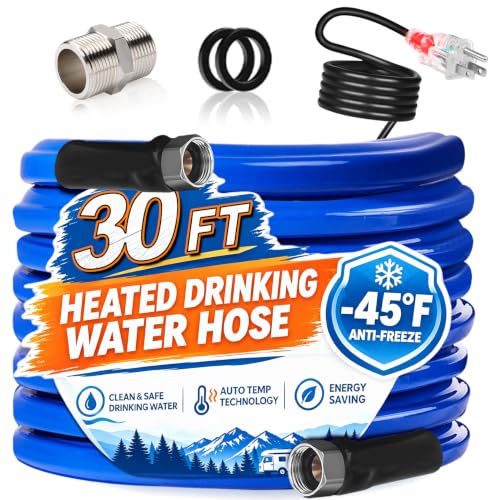
Nottia’s 30 ft heated hose is built for serious cold, with a smart self-regulating external thermostat rated down to -45°F (-42.7℃). The hose uses food-grade material that is lead- and BPA-free with no peculiar smell, so it’s safe for everyday RV use. A leak-focused design and years of lab development aim to keep connections dry through long winters. Backed by 24/7 support and 3 years of service, it suits seasonal or full-time campers who sit through real winter but park close to the hydrant.
Length 30 ftFreeze protection rating Down to -45°F (-42.7℃)Thermostat Smart self-regulating external thermostatWater safety Food-grade, lead- and BPA-free hoseService 24/7 support with 3 years service
Why it made the cut
Freeze protection down to -45°F (-42.7℃) for harsher winter conditions.
Smart self-regulating external thermostat to keep water flowing without manual adjustment.
Food-grade, lead- and BPA-free hose material with no peculiar smell.
Engineered for leak resistance and backed by 24/7 support with 3 years of service.
Good to know
30 ft length may be too short at parks where the hydrant is farther from your RV.
Does not list formal NSF/ANSI drinking-water certifications.
Skip it if Skip it if your sites often need a full 50 ft run more than extreme cold performance.
Best for Shorter RV sites that need a -45°F-rated hose marketed for drinking water.
This 30 ft REHOSEUP hose is marketed as an RV drinking heated hose and built for freeze protection down to -45°F. The smart self-regulating heat system is designed to keep water flowing in extreme cold by thawing ice gradually as needed. A durable exterior jacket shields both the hose and the heating system, and the materials are described as safe and won’t leave your water tasting like plastic or leaching harmful elements. It’s a good fit if most of your winter spots are within about 30 ft of the park spigot.
Length 30 ftFreeze protection rating Down to -45°FHeat control Smart self-regulating heat systemWater safety RV drinking heated hose; materials won’t affect tasteApplications RV, camping, garden, farm and livestock
Why it made the cut
Rated to prevent freezing down to -45°F for serious cold-weather use.
Smart self-regulating heat system to keep water moving in extreme winter conditions.
Marketed specifically as an RV drinking heated hose, with materials that avoid plastic taste or leaching.
Durable exterior jacket protects the hose and internal smart system from damage or exposure.
Good to know
Only 30 ft long, so it may not reach distant hydrants without relocating the RV.
Does not specify NSF/ANSI drinking-water certifications.
Skip it if Skip it if you usually need closer to 50 ft of hose to reach campground water posts.
Best for Cold-climate campers needing a full 50 ft run with -45°F protection.
If your usual site layout really does need a full 50 ft run, this REHOSEUP hose gives you that reach plus deep-freeze protection down to -45°F. Its smart temperature system is designed to keep water flowing by gradually thawing ice while handling extreme cold. A durable exterior jacket and leak-prevention design with double washers at both ends are helpful if you connect and disconnect often or leave the hose pressurized. It’s a practical long-run option for winter camping where distance to the hydrant is your main concern.
Length 50 ftFreeze protection rating Down to -45°FHeat control Smart self-regulating temperature systemLeak protection Double washers at both endsApplications RV, camping, chicken coops, garden
Why it made the cut
Full 50 ft length for longer reaches between park hydrant and RV inlet.
Freeze protection rated down to -45°F with a smart temperature system.
Leak-prevention design with double washers at both ends.
Durable exterior jacket to protect the hose and heating system.
Good to know
Does not specify NSF/ANSI drinking-water certifications, only that it won’t affect taste.
No LED indicator plug or power-status light mentioned.
Skip it if Skip it if you want a certified drinking-water hose for full-time RV living.
Best for RVers who want a food-grade hose with -45°F protection and many length choices.
Bipeoo’s heated hose line stands out if you care about sizing, with versions from 15 ft up to 100 ft and this model at 30 ft. The intelligent temperature adjustment function is designed to prevent freezing down to -45°F while helping save on electricity bills by heating only as needed. A five-layer tough water tube, robust stainless steel fittings, and a durable outer jacket protect against bursts and physical damage. The food-grade hose is lead- and BPA-free with no odor, so it works for RVs, home use, gardens, or livestock.
Length 30 ft (other lengths from 15 ft to 100 ft available)Freeze protection rating Down to -45°FHeat control Intelligent temperature adjustment functionWater safety Food-grade, lead- and BPA-free, no odorConstruction Five-layer tough water tube with durable outer jacket and st
Why it made the cut
Freeze protection down to -45°F with intelligent temperature adjustment.
Available in multiple lengths from 15 ft to 100 ft; this unit is the 30 ft version.
Food-grade hose that’s lead- and BPA-free with no odor.
Five-layer tough tube, durable outer jacket, and stainless steel fittings for durability.
Good to know
Does not list specific drinking-water certifications beyond food-grade and lead/BPA-free claims.
30 ft length can still come up short at some full-hookup sites.
Skip it if Skip it if you prioritize formal NSF/ANSI drinking-water certifications and indicator lights over length options.
Picking a heated hose for RV use comes down to three things: freeze rating, drinking-water safety, and how the heating cable is built.
If you searched for the “best tankless water heater hose” for winter, you still want the same thing: a heated drinking-water hose that keeps the line from freezing between the campground spigot and your RV, so water keeps flowing and the fittings don’t split.
For most RVers, the Camco 50′ Heated Drinking Water Hose is the right default choice because it balances real-world cold protection with verified safety certifications. It has a -20°F freeze rating, uses NSF/ANSI 61 and CSA 372 certified materials for drinking water, and runs on a standard 120 V plug with an LED indicator so you can see at a glance that it has power. The thermostat in the cable switches the heat on only when the temperature drops, which cuts unnecessary power draw.
A heated RV water hose simply warms the water and the hose wall enough that ice never locks the line between the hydrant and your city-water inlet. That same hose works fine feeding a standard or tankless RV water heater, filling your fresh tank, or even supplying a garden spigot or livestock trough, as long as the fittings match.
Spec
What to look for
Who it suits
Freeze rating
-20°F covers most winter camping; -45°F is for serious deep-freeze parks
-20°F: typical winter trips; -45°F: extended stays in very cold mountain or northern plains RV parks
Drinking-water safety
NSF/ANSI 61 and CSA 372 listed, not just “food-grade” marketing
Anyone drinking or cooking with the water
Heat control
Thermostat-controlled or self-regulating cable, not always-on
Thermostat: simple and proven; self-regulating: helps avoid hot spots
Jacket & fittings
Tough outer jacket over the cable, brass or stainless fittings, strain relief at ends
Full-time or frequent winter use where flexing and dragging the hose is common
Key choices when you pick a heated RV hose.
Camco’s -20°F rating is plenty if your nights flirt with zero and occasionally dip a bit below. A -45°F hose, like the 30 ft and 50 ft -45°F-rated hoses in the list above, makes sense only if you sit through long runs of subzero weather in high-elevation or far northern parks where -20°F is a realistic forecast, not an outlier.
For drinking-water safety, certifications matter more than buzzwords. NSF/ANSI 61 covers contact materials so the hose doesn’t leach excessive chemicals into the water, and CSA 372 addresses lead-free metal parts like fittings and crimps; that’s a different standard than vague “lead- and BPA-free” claims.
“Food-grade” vs certified
Many generic heated hoses advertise “food-grade” PVC and “lead-free” brass but don’t actually list NSF/ANSI 61 or CSA 372. If you’ll drink the water regularly, prefer a hose that names those standards explicitly.
Both thermostat-controlled and self-regulating heated hoses cycle on and off as it gets colder; neither runs full blast all the time. Self-regulating cable can run a bit cooler where the hose is warmer, which helps reduce hot spots along its length, while thermostat-driven designs like Camco’s stay simpler and have a long track record in RV use.
Durability comes from the outer jacket and the fittings, not just the heating wire. Look for a full-length abrasion-resistant jacket that shields the cable, brass or stainless fittings with visible strain relief where the hose meets the end, and good kink resistance so you’re not fighting flat spots every time you hook up. Doubling up washers at the faucet end is a small touch that often stops slow leaks in cold weather.
Cold body vs frozen pipe
If you’re choosing between a heated shawl and a heated hose, fix the water first. Extra layers can warm you, but only a heated hose keeps your RV toilet flushing and your “indoor” tankless water heater supplied with liquid water instead of ice; you can compare more hose options in our best heated water hose picks or pair yours with one of the best rv water heaters if hot showers are also a struggle.
How Long of a Heated Hose Your RV Really Needs
Most sites only need a 30 ft heated hose for RV hookups; a 50 ft hose is for pads where the hydrant sits awkwardly far from your water inlet or around an obstacle.
A “non heated” white RV hose can work in shoulder seasons if you’re willing to disconnect and drain it overnight, but once nights settle below freezing you want all your length in a heated hose, not a heated-to-unheated chain.
1
Find the spigot and inlet
Stand at the campground hydrant you’ll connect to, then spot your RV’s city-water inlet; imagine the route the hose will actually take rather than drawing a straight line through picnic tables or slide-outs.
2
Measure the real path
Use a tape measure or pace it off from the hydrant, along the ground, to the inlet. Count the turns you’ll make around posts, trees or the back of the RV.
3
Add slack for gentle loops
Add 2–3 ft at each end so the hose can make a relaxed loop without pulling on the fittings, and so it doesn’t hang with its own weight off the spigot.
4
Compare to 30 ft and 50 ft
If your total is under about 24–25 ft, a 30 ft heated hose is plenty; if you’re brushing past 30 ft or sometimes park differently, a 50 ft hose gives breathing room.
Worked example
Say your RV is backed into a typical pad and the hydrant sits near the front corner of the site. You pace from the spigot, around the power pedestal, along the side of the rig, to the city-water port and get about 18 ft. Add 2 ft at the spigot for a gentle loop and strain relief, plus 2 ft at the RV end so the hose doesn’t kink at the inlet, for 22 ft total. In that case a 30 ft heated hose easily covers the run with a little extra to play with, while a 50 ft model just adds weight and bulk you’ll coil and store every time without any real benefit.
Measured distance18 ft
Slack at each end2 + 2 ft
Needed hose length22 ft (30 ft is plenty)
A 30 ft hose fits most back-in and pull-through sites where the hydrant is near the pad corner or utility post, including many long-term sites with standard layouts. It’s lighter to wrestle in cold weather and takes less space in the storage bay, which matters if your wet bay is already tight.
A 50 ft hose earns its keep at parks where the pedestal is way at the rear of the pad, older campgrounds with oddball site geometry, or spots where you sometimes have to route the hose around another obstacle. If you’ve ever needed a second unheated hose just to reach the spigot, that’s a hint that the longer heated version would be useful.
Don’t mix heated and unheated hoses
Avoid daisy-chaining a heated hose to a regular RV hose in freezing weather. The unheated section will be the first to freeze and can still split or burst, even though the main heated hose is doing its job.
Longer hoses are also heavier and bulkier. A 50 ft heated hose is noticeably more awkward to coil, especially in below-freezing temps when the jacket stiffens, and it can fill a small storage compartment by itself, while a 30 ft version leaves room for filters and a pressure regulator.
If you mostly boondock and only hook up to water briefly at a fill station, you may only ever use the heated hose to fill the fresh tank on truly cold days. In that case, a shorter hose that comfortably reaches the most awkward fill you expect is usually enough, since you’ll disconnect and drain it after each use anyway.
Choose for your worst-case site
Think about the coldest and most awkward campground you actually visit, measure or estimate that run, then buy the shortest heated hose that comfortably covers it. Extra length is just more weight to coil and more cable to power, while a correctly sized hose stays easier to handle and less likely to kink.
How Much Power a Heated RV Hose Uses
A heated hose for RV use usually pulls only a few hundred watts, and only kicks on when the hose is cold enough to freeze. The heating cable runs along the hose and is controlled by a thermostat or self-regulating element, so once the water line is above its setpoint, power draw drops to almost nothing.
Find your hose’s watt rating
Actual wattage depends on brand and length. Many 30 ft hoses sit in the 100–200 W range, and 50 ft hoses are higher, but the only number that matters is the one on your label or manual. Look near the plug or tag for something like “120 V, 1.5 A” (about 180 W) and use that for your load planning.
Power cost is just watts, hours and your kWh rate multiplied together. Say your heated hose averages 200 W over a cold day: 200 ÷ 1,000 × 24 hours = 4.8 kWh. At $0.17 per kWh, that’s about $0.82 per day, or around $25 for a 30‑day month of continuous use.
Heater
Watts
Per hour
Per day (24 h)
Per month (30 days)
Heated RV hose (about 200 W)
200 W
3.4¢
82¢
$24.48
1,500 W space heater
1,500 W
26¢
$6.12
$183.60
Calculated at 17¢ per kWh. How a modest heated hose load compares with running a small space heater nonstop at $0.17 per kWh.
On a 30 A RV electrical service, you get about 3,600 W to work with (30 A × 120 V). A 200 W heated hose uses around 6% of that, but it stacks on top of an electric water heater, a 1,500 W space heater and the microwave. If breakers are tripping, you may need to stagger big loads or downsize the indoor electric heat best heater for an rv you run at the same time.
Thermostat-controlled or self-regulating hoses usually use less power than constant-on heat tape. As the hose warms up in the sun or temps climb above freezing during the day, they cycle off or reduce output instead of wasting full wattage for no benefit.
Campground power is often included in the nightly rate, but long-term or metered sites may bill by the kWh, so understanding your hose’s draw helps you avoid surprises. If you’re on generator or limited solar, you can also skip a continuous city-water hookup and fill the onboard fresh tank during warmer hours; then shut off and drain the hose so it isn’t burning watts around the clock.
RV Heated Hose Safety and Drinking Water Standards
A heated hose for RV hookups is still an electrical appliance, so treating it like one is how you stay safe and keep the water drinkable. Plug the hose directly into a properly grounded, outdoor-rated 120 V GFCI outlet—never into a power strip or light-duty extension cord dangling from the pedestal.
Skip that orange cord
A household orange extension cord buried in snow is a recipe for voltage drop, overheating and shock risk. The insulation isn’t designed to sit in slush all winter, and light-gauge wire can overheat on continuous loads. If the pedestal outlet is too far away for the hose’s factory cord, ask for a closer site or another solution instead of adding more cord.
Keep the plug and any connection off the ground and out of puddles or snow. Rest the plug on a short stand, cinder block or the pedestal shelf so meltwater can’t sit around the blades and creep into the plug body.
Route the hose so it’s safe mechanically as well as thermally. Avoid sharp bends right at the fittings, don’t pinch the hose under slide-outs or compartment doors, and keep it away from tire paths. In high-traffic spots, a short section of split foam pipe insulation or a protective sleeve helps prevent abrasion.
Resist the urge to wrap extra heat tape or another heated cable around a heated hose. Doubling up can trap heat, cook the hose jacket, and damage the built-in electrical insulation, which risks leaks and shorts.
For water quality, look for hoses that say they meet NSF/ANSI 61 for drinking-water contact and use lead-free components certified to NSF/ANSI 372 (often shown as CSA lead-free). Labels like lead-free, BPA-free and phthalate-free mean the plastics and brass are formulated so they don’t leach as much into water you’re using every day.
Hoses explicitly sold as “drinking water” or “potable” are the right choice for feeding your RV’s fresh-water system. Multipurpose or “utility” heated hoses can be fine for tank flushing or washing gear, but they’re not what you want between the campground spigot and your kitchen faucet.
Confirm it’s really drinking-water safe
Check both the packaging and the printing on the hose jacket for “NSF/ANSI 61” or a clear “drinking water safe” statement before you cut off tags and throw the box away.
Before each winter season, inspect the entire hose for nicks, flattened spots, chewed sections and any sign of exposed conductors at the ends or along the cord. If the jacket is damaged, the plug is cracked, or the GFCI trips repeatedly, retire that hose and replace it—heated hoses are cheaper than dealing with a shock or a midwinter leak.
Winter RV Water Setup Details People Forget
Winterizing a heated hose for RV use means protecting everything around it, not just the hose itself; the park riser, your pressure regulator, any filters, and the RV plumbing can all still freeze.
1
Cover the spigot and regulator
Foam faucet covers and split pipe insulation help keep the campground spigot and your pressure regulator from freezing. Wrap only what you own, and leave any park shutoff valves or backflow devices visible and operable so staff can still service the pedestal.
2
Keep filters close and warm
Mount any external water filter as close to the RV as you reasonably can, ideally inside a heated bay where the furnace or an electric heater keeps temps above freezing. If the filter has to stay outside, stand it upright, wrap it with insulation, and keep it under a weatherproof tote or box that still lets the hose exit without sharp bends.
3
Use the fresh tank in brutal cold
In severe cold spells, some RVers disconnect and drain the heated hose overnight and run on the onboard fresh tank instead. Refilling during the warmer part of the day reduces freeze risk along the whole run and gives you a backup if the park spigot ices over.
4
Baby the fittings on long stays
On monthly or seasonal sites, check both hose ends every few days for slow drips or damp insulation. Tighten fittings by hand only, swap out worn rubber washers if you see leaks, and avoid pliers that can crack plastic or deform brass ends.
5
Store the hose like an electrical cord
When you move or pack up for the season, disconnect and fully drain the heated hose, then coil it loosely without kinks. Stow it where the jacket will not rub on screw points, drill bits, or other sharp tools that can nick the insulation and expose the heating cable.
Cold air inside the RV can still freeze P-traps and under-floor lines even with a perfect hose, so many owners add or upgrade an efficient space heater to keep interior plumbing bays above freezing; the top rv electric heaters guide compares good options for that job.
If the bigger headache is running out of hot water rather than losing the supply line, a heated hose for RV duty will not change that; a best RV water heater is what increases shower length and recovery time.
Small parts that save big headaches
Keep spare hose washers, a couple of spare regulator washers, and a foam faucet cover in the same bin as your heated hose so a slow drip or unprotected spigot does not leave you scrambling in a hard freeze.
Quick RV Heated Hose Checklist Before You Buy
A short checklist makes choosing a heated hose for RV camping faster and a lot less stressful.
Before You Click Buy
Match the hose’s freeze rating to your weather, aiming for at least 5–10°F colder than your typical worst night.
Measure from campground spigot to your RV’s city water inlet on a usual site, then pick the shortest hose that comfortably reaches with a bit of slack.
Decide if the line must be drinking-water safe; if anyone might drink from the tap, insist on a hose clearly labeled for potable water.
Think about how you camp: quick overnights can prioritize flexibility and easy handling, while long seasonal stays benefit from tougher outer jackets and strain relief at the ends.
Check how often you see sub-zero temperatures; frequent deep cold justifies paying for a lower freeze rating and better insulation.
Plan the power path so the hose plug reaches a 120 V GFCI outlet at the pedestal or in a bay without using any extension cord or power strip.
Confirm where the hose will live in transit and storage so you are not wrestling a stiff 50 ft coil into a tight, shallow bay.
If you mostly boondock and only rarely hook to city water in winter, decide whether a heated hose for RV use is necessary, or if filling the fresh tank during milder hours covers your needs.
Before first use, read the manufacturer’s instructions for installation, minimum bend radius, and off-season storage so you do not damage the heating cable.
Do I really need a heated hose for my RV, or will a regular hose work in freezing weather?
For a full-time hookup in freezing weather, you do need a heated hose. A regular hose will freeze solid and can split even if the air only dips below 32°F for a few hours overnight. A plain hose is fine only if you hook up briefly to fill your fresh tank, then disconnect and drain it every time.
What type of hose should I use with an RV tankless water heater during winter?
With a tankless RV water heater, the hose mainly has to provide steady flow and avoid freezing. Use a drinking-water-safe heated hose (typically 1/2″–5/8″ ID) rated to the coldest temperature you expect, and avoid skinny garden hoses or multiple restrictive filters that can drop the flow below what the tankless needs to fire. Keeping the inlet pressure moderate and stable with a good regulator also helps the tankless stay lit and avoid temperature swings.
Are RV heated hoses safe to drink from all winter long?
Heated RV hoses that are labeled “drinking water safe” are designed for continuous use, not just weekend trips. Look for wording like lead-free and NSF/ANSI 61 compliance; that means the materials in contact with the water meet drinking-water standards. It’s smart to flush the hose for 15–30 seconds after long sits and to sanitize your RV’s fresh system once or twice a season so biofilm doesn’t build up anywhere in the line.
Can a heated RV water hose keep my water flowing at -30°F or colder?
Most RV heated hoses are only rated to about -20°F, and that’s the number to trust. Below that, even if the cable keeps parts of the hose warm, the fittings, spigot, and the park riser are likely to freeze first, stopping flow or cracking parts. In that kind of cold, many RVers switch to filling the fresh tank, insulating the riser as much as rules allow, and keeping a slow indoor drip only while temperatures are brutal.
How is my RV’s water system heated compared with how homes are heated?
An RV’s water system usually stays unfrozen because it shares space with your heated interior or enclosed underbelly, not because the pipes themselves are insulated as well as a house’s. In a house, most water lines are buried below the frost line or run inside thick insulated walls, and the whole structure is warmed by a much larger furnace or boiler. An RV might rely on your propane furnace, small duct runs, tank heater pads, and a heated hose outside, so there’s far less margin if any part is exposed.
Can I just fill my RV’s fresh tank and disconnect instead of using a heated hose in winter?
Filling the fresh tank and unhooking is a solid cold-weather strategy. You connect during the warmest part of the day, fill the tank, disconnect, and drain or blow out the hose so nothing outside can freeze. The tradeoff is you have to watch tank levels and schedule refills; a 40-gallon tank, for example, might last two people about three to four days at 8–12 gallons per day. Remember your sewer hose can’t stay hooked up in deep cold either—you’ll be doing batch dumps once the weather allows.