Skip to content

Expert home heating guides, reviews & repairs

Heater GuidesHeaterGuides
Tankless Water Heaters

Top Picks for Non-Condensing Tankless Water Heaters That Impress

Straight answer
Rheem RTG Series 9.5 GPM Natural Gas Tankless Water Heater is the best pick for most buyers seeking reliable, energy-efficient continuous hot water with a 15-year heat exchanger warranty and precise temperature control.
The essentials
Choose a unit with a flow rate matching your household’s peak simultaneous use to avoid cold water delays.
Non-condensing models are simpler and usually cheaper to install but have lower efficiency than condensing types.
Professional installation is essential for safety, warranty, and optimal performance, especially with gas models.
Look for a digital temperature control panel and built-in freeze protection to maintain comfort and prevent damage.
Outdoor models eliminate venting needs but require weatherproofing; indoor units need direct venting and safety sensors.
Top picks, ranked
1
Best for Most HomesRheem RTG Series 9.5 GPM Natural Gas Tankless Water Heater
Large families or multi-bathroom homes needing 3-4 simultaneous showers
Check today’s price
2
Best for Propane UsersRinnai RE180iP Non-Condensing Propane Tankless Water Heater
Homes on propane needing up to 8.5 GPM for multiple fixtures
Check today’s price
3
Best for Propane, IndoorRheem RTG Series 8.4 GPM Liquid Propane Tankless Water Heater
Large propane households needing steady hot water for 3-4 simultaneous showers
Check today’s price
4
Best Compact PropaneRinnai RE160iP Non-Condensing Propane Tankless Water Heater
Smaller propane homes needing up to 6.1 GPM for 5 fixtures
Check today’s price
5
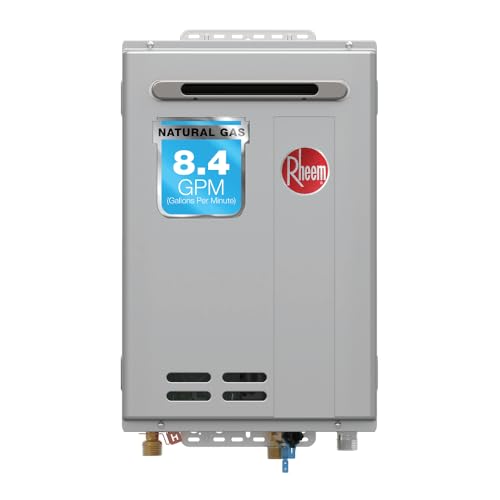
Best Outdoor Natural GasRheem RTG Series 8.4 GPM Natural Gas Tankless Water Heater Outdoor
Homes preferring outdoor natural gas installation without venting
Check today’s price

Non-condensing tankless water heaters offer dependable hot water on demand without the complexity and cost of condensing models. They suit large families and homes with multiple simultaneous water uses, delivering up to 9.5 gallons per minute with energy savings around 34% compared to electric tanks.

Choosing the right model means balancing flow rate, fuel type, installation location, and efficiency. This guide highlights top options and what specs matter most to help you avoid costly mistakes in comfort and utility bills.

Comparison of Top Non-Condensing Tankless Water Heaters

ModelBest forFlow Rate (GPM)Fuel TypeInstallation LocationWarranty LengthPrice
Rheem RTG Series 9.5 GPM Natural Gas Tankless Water HeaterBest for Most Homes9.5Natural GasIndoor15 years heat exchangerCheck today’s price
Rinnai RE180iP Non-Condensing Propane Tankless Water HeaterBest for Propane Users8.5PropaneIndoor15 years heat exchangerCheck today’s price
Rheem RTG Series 8.4 GPM Liquid Propane Tankless Water HeaterBest for Propane, Indoor8.4Liquid PropaneIndoor15 years heat exchangerCheck today’s price
Rinnai RE160iP Non-Condensing Propane Tankless Water HeaterBest Compact Propane6.1PropaneIndoor15 years heat exchangerCheck today’s price
Rheem RTG Series 8.4 GPM Natural Gas Tankless Water Heater OutdoorBest Outdoor Natural Gas8.4Natural GasOutdoor15 years heat exchangerCheck today’s price

Top Non-Condensing Tankless Water Heaters for Reliable Hot Water

#1Best for Most Homes

Rheem RTG Series 9.5 GPM Natural Gas Tankless Water Heater

Best for Large families or multi-bathroom homes needing 3-4 simultaneous showers
This Rheem model delivers up to 9.5 GPM at a 35°F rise, enough for 3-4 showers running at once. Its 199,900 BTU output and 0.82 UEF offer efficient, continuous hot water with up to 34% energy savings versus electric tanks. The digital control panel lets you adjust temperature within ±1°F for steady comfort. The 15-year heat exchanger warranty adds peace of mind for long-term use.
Flow Rate (GPM) 9.5Fuel Type Natural GasInstallation Location IndoorBTU Output 199,900Uniform Energy Factor 0.82
Why it made the cut
High 9.5 GPM flow rate suits big households
Energy efficient with 0.82 UEF saves on gas bills
Precise digital temperature control ±1°F
15-year heat exchanger warranty and 5-year parts warranty
Good to know
Indoor installation requires direct venting and professional setup
Higher BTU output means larger gas line and venting needs
Skip it if Skip this if you need propane fuel or outdoor installation options.
Check today’s pricePaid link · live price on Amazon
#2Best for Propane Users

Rinnai RE180iP Non-Condensing Propane Tankless Water Heater

Best for Homes on propane needing up to 8.5 GPM for multiple fixtures
The Rinnai RE160iP is a compact propane tankless water heater designed to heat water only when you need it, saving fuel. It features a cleaner internal layout that speeds installation and service, plus an LED screen for error codes and service reminders. A 15-year warranty on the heat exchanger adds peace of mind. This model suits propane users who want efficient hot water in a smaller footprint.
Flow Rate (GPM) 8.5Fuel Type PropaneInstallation Location IndoorWarranty 15-year heat exchanger
Why it made the cut
Compact design fits tight spaces with efficient propane heating
Compact size fits small indoor spaces
LED screen aids maintenance with service alerts
15-year heat exchanger warranty
Good to know
Requires professional installation and propane fuel supply
WiFi control module sold separately
Skip it if Skip if you prefer natural gas or outdoor mounting options.
Check today’s pricePaid link · live price on Amazon
#3Best for Propane, Indoor

Rheem RTG Series 8.4 GPM Liquid Propane Tankless Water Heater

Best for Large propane households needing steady hot water for 3-4 simultaneous showers
This Rheem propane model produces 8.4 GPM at 35°F rise with 180,000 BTU output, enough for busy homes. It shares the same 0.82 UEF energy efficiency as the natural gas Rheem, lowering fuel costs. The digital panel offers ±1°F temperature precision and built-in safety features. A 15-year heat exchanger warranty supports long-term reliability.
Flow Rate (GPM) 8.4Fuel Type Liquid PropaneInstallation Location IndoorBTU Output 180,000Uniform Energy Factor 0.82
Why it made the cut
Strong 8.4 GPM flow rate for multi-point use
Energy efficient with 0.82 UEF
Precise digital temperature control
Built-in freeze and flame failure protection
Good to know
Indoor use only with direct venting required
Professional installation needed
Skip it if Skip this if you want natural gas fuel or outdoor installation.
Check today’s pricePaid link · live price on Amazon
#4Best Compact Propane

Rinnai RE160iP Non-Condensing Propane Tankless Water Heater

Best for Smaller propane homes needing up to 6.1 GPM for 5 fixtures
Rinnai’s RE180iP offers a smart, non-condensing propane water heater with a clean internal design that simplifies installation and maintenance. It heats water on demand to save fuel and includes an LED display for diagnostics. Backed by a 15-year heat exchanger warranty, it’s well suited for homes needing reliable propane hot water in limited space.
Flow Rate (GPM) 6.1Fuel Type PropaneInstallation Location IndoorWarranty 15-year heat exchanger
Why it made the cut
Compact size fits tight spaces
Efficient propane heating with a compact footprint
LED screen with service reminders and error codes
15-year heat exchanger warranty
Good to know
Lower flow rate limits simultaneous use
Professional installation required
Skip it if Skip if your household needs higher flow or natural gas fuel.
Check today’s pricePaid link · live price on Amazon
#5Best Outdoor Natural Gas

Rheem RTG Series 8.4 GPM Natural Gas Tankless Water Heater Outdoor

Best for Homes preferring outdoor natural gas installation without venting
This Rheem outdoor model delivers 8.4 GPM and 180,000 BTU for whole-house hot water. Its outdoor placement removes venting requirements, simplifying installation in some homes. The 0.82 UEF energy factor keeps gas bills low. It includes the same digital temperature control and safety features as indoor Rheem models, plus a 15-year heat exchanger warranty.
Flow Rate (GPM) 8.4Fuel Type Natural GasInstallation Location OutdoorBTU Output 180,000Uniform Energy Factor 0.82
Why it made the cut
Outdoor installation eliminates venting complexity
8.4 GPM flow rate for multiple showers
Energy efficient with 0.82 UEF
15-year heat exchanger warranty
Good to know
Outdoor location may expose unit to weather extremes
Requires professional installation
Skip it if Skip if you need indoor installation or propane fuel.
Check today’s pricePaid link · live price on Amazon

Match Flow Rate to Your Household’s Hot Water Demand

You size a tankless water heater by gallons per minute (GPM), which measures how much hot water it can provide at once. Running multiple showers or fixtures simultaneously adds their flow rates together. For example, three to four showers need about 8 to 10 GPM, while a small home with one or two bathrooms might only require 5 to 6 GPM.

Undersizing a heater leads to cold water bursts when demand exceeds supply. If your 1.5 GPM kitchen faucet and 2.5 GPM shower run together on a unit rated for 4 GPM, expect a noticeable temperature drop. It’s safer to choose a unit with a slightly higher flow rate than you think you need.

Temperature rise—the difference between your incoming water and desired hot water temperature—also affects flow rate. Cold climates require a larger heater or lower flow to reach 120°F. Say your groundwater is 50°F and you want 120°F at the tap, that’s a 70°F rise. Higher rise means reduced flow capacity at that temperature.

Worked example
A family of four typically uses two showers, a kitchen sink, and a dishwasher simultaneously during busy mornings. Showers draw about 2.5 GPM each, kitchen sink 1.5 GPM, and dishwasher 1.5 GPM, totaling 8 GPM. Add 20% headroom to avoid cold bursts, so look for a heater rated around 9.5 to 10 GPM.
Showers2 × 2.5 GPM = 5 GPM
Kitchen sink1.5 GPM
Dishwasher1.5 GPM
Total8 GPM
Right-size your heater
Calculate your peak simultaneous demand by adding flow rates of fixtures you’ll use together, then add 15–20% for headroom. This avoids running out of hot water and overspending on capacity you don’t need.
Before you buy
List all fixtures you expect to run simultaneously
Check each fixture’s flow rate (usually on manufacturer specs or use 1.5–2.5 GPM for showers)
Estimate temperature rise based on your groundwater temperature
Choose a heater with GPM rating above your peak demand plus headroom
Plan for professional installation to handle gas and venting requirements

Tankless water heater cost varies mainly by flow rate and fuel type, typically $800 to $1,500 for residential models. Installation costs depend on existing plumbing and venting, usually $1,000 to $2,000. Professional installation ensures safety and code compliance.

Understand Efficiency and What Non-Condensing Means for Costs

Non-condensing tankless water heaters lose more heat through exhaust because their flue gases exit at about 300°F, unlike condensing models that cool exhaust to capture extra heat. This results in lower efficiency, with typical Uniform Energy Factors (UEF) around 0.82, while condensing units can reach 0.90 or higher.

UEF measures how efficiently a heater converts fuel to usable hot water over a typical day. A UEF of 0.82 means 82% of the fuel’s energy heats water; the rest is lost—mostly through hot exhaust gases. Higher UEF means lower fuel costs.

Running cost depends on fuel price and consumption. For example, a non-condensing gas heater with a 199,900 BTU/hr input running 1 hour daily at $1.50 per therm costs about $3.00 a day (199,900 ÷ 100,000 × $1.50). By contrast, an electric storage water heater using 4,500 watts for 3 hours consumes 13.5 kWh; at 17 cents per kWh, that’s about $2.30 per day.

Non-condensing units avoid standby losses by heating water only when you need it, which cuts energy use compared to storage tanks that keep water hot all day.

Non-condensing water heater meaning
Non-condensing means the unit does not cool exhaust gases below their dew point, so it vents hotter gases and loses more heat. This simplifies the heater design and lowers upfront cost but increases fuel use over time.
Maintenance difference
Non-condensing heaters need regular vent inspections because hotter exhaust can degrade vent materials faster. They have simpler internal parts than condensing units, which require condensate drainage and more complex heat exchangers.

If you’re comparing condensing vs non-condensing tankless heaters, consider upfront cost against fuel savings. Non-condensing models cost less initially and are simpler, but condensing units save more in fuel over years. For moderate to high use, condensing models generally pay off.

Learn more about the efficiency and maintenance trade-offs from our guide on condensing vs non-condensing water heaters.

Choose Installation Location and Venting with Safety in Mind

Tankless water heaters go where they can get enough air and vent safely—usually near your main water line and a gas connection if applicable.

Indoor non-condensing models require direct venting to the outside using sealed combustion pipes. These vent pipes must be metal and rated to handle exhaust temperatures around 300°F, since non-condensing units produce hotter gases that plastic or lower-grade vents can’t handle.

Outdoor models don’t need venting but must be protected from weather exposure. That means placing them under an eave or in a weatherproof enclosure that doesn’t block airflow.

Clearance to combustibles is crucial. Local codes and the unit’s manual specify minimum distances—often several inches from walls and ceilings—to prevent fire hazards. Never enclose an indoor unit tightly without proper ventilation. Doing so risks carbon monoxide buildup and voids the warranty.

Installation Safety
Gas tankless heaters must be installed by a licensed professional. This ensures venting meets code, gas lines are secure, and safety devices function properly. Improper installation is a leading cause of leaks, carbon monoxide risk, and system failure.
Tankless Water Heater Installation Checklist
Choose an installation spot near water and gas lines
For indoor units, use direct venting with metal pipes rated for 300°F exhaust
Ensure clearances per local code and manufacturer’s instructions
Protect outdoor units from rain, snow, and freezing
Never enclose indoor units without proper ventilation
Hire a licensed plumber or HVAC technician for installation

Look for Features That Improve Comfort and Reliability

The best tankless water heater brands offer digital temperature controls accurate to ±1°F. This precision avoids the hot and cold swings that spoil a shower.

Freeze protection is a must if your heater’s in a cold area. It prevents expensive damage by automatically heating internal pipes when temperatures drop near freezing.

Built-in safety features like flame failure protection and multiple sensors monitor combustion and water flow, shutting off the unit if anything goes wrong. These reduce breakdown risks and increase reliability.

Some models add WiFi modules as an option. They let you adjust temperature remotely, get maintenance alerts, and track performance—handy for busy households or second homes.

Look For Longer Warranties
A 10- to 15-year heat exchanger warranty signals the manufacturer’s confidence in durability. It also lowers your long-term risk and repair costs.
Good for Comfort and Reliability
Precise temperature control for consistent hot water
Freeze protection guards against pipe damage
Safety sensors increase reliability and peace of mind
Optional WiFi control for remote monitoring
Not for All Buyers
WiFi features add cost and may require app setup
Advanced safety and freeze features mainly benefit colder climates
Digital controls might be more than needed for simple setups

If you want a tankless water heater with recirculation for instant hot water at your tap, check for models designed to support it or compatible with add-on pumps. This feature improves comfort but usually comes at a higher upfront cost.

Fuel Type and Model Variants Matter More Than You Think

Natural gas tankless water heaters usually deliver higher BTU ratings and flow rates but need a reliable natural gas supply and proper venting. That makes them a strong choice for homes connected to a gas line but less practical where natural gas isn’t available.

Propane tankless water heaters perform similarly to natural gas models, often matching BTU output and flow capacity. However, they require propane tanks and may have venting or clearance requirements that differ from natural gas units, so check your model’s manual closely.

Outdoor tankless water heaters sidestep venting concerns since their exhaust goes directly outside into open air. They need built-in freeze protection and robust weatherproofing to handle winter and rain, which adds to upfront cost but simplifies installation.

TypeFuel SourceVenting NeedsInstallation Notes
Natural GasNatural gas lineRequires venting through wall or chimneyHigher flow, needs gas line access
PropanePropane tankVenting varies by modelPortable but needs safe propane storage
Outdoor ModelsNatural gas or propaneNo venting neededFreeze protection and weatherproofing required
Fuel Type and Model Variant Trade-Offs

Model variants affect installation complexity and price. Indoor models often cost more to install because of venting and clearance requirements. Outdoor variants save on venting but demand extra protection against cold and moisture.

Lower-cost tankless models tend to compromise on maximum flow rate or warranty length. It pays to balance the upfront price against potential long-term savings from higher flow and better reliability.

For the best affordable tankless water heater, look for a unit that fits your fuel source, meets your household’s flow needs, and has solid warranty coverage. Skipping on venting or fuel compatibility may cost more in the long run.

Fuel and Installation
Never install a propane unit indoors unless it’s specifically rated for indoor use and has an oxygen depletion sensor. Outdoor models require freeze protection even if they use natural gas.

More Questions, Answered

What is a non-condensing tankless water heater and how does it differ from condensing?
Non-condensing tankless water heaters vent exhaust gases at about 300°F without capturing additional heat, which means they have lower efficiency than condensing models. Condensing units cool exhaust to reclaim heat, reaching efficiencies around 90%, while non-condensing typically hover near 80%. This difference affects fuel use and venting requirements.
How do I calculate the correct flow rate (GPM) for my home?
Add up the flow rates of fixtures you expect to run at the same time, like showers, faucets, and appliances. For example, two showers at 2.5 GPM each plus a dishwasher at 1.5 GPM means 6.5 GPM total. Choose a heater rated at or above that combined flow to avoid running out of hot water.
Can I install a non-condensing tankless water heater myself?
Installation involves gas lines, venting, and sometimes electrical connections, which typically require permits and must meet local codes. Unless you’re a licensed plumber or HVAC technician, hiring a pro is safest to ensure proper venting and prevent carbon monoxide risks. Incorrect installation can void warranties and pose hazards.
Are non-condensing tankless water heaters suitable for cold climates?
They work well in cold climates but may need higher BTU ratings to heat incoming water from lower temperatures. Also, proper freeze protection or installation in heated spaces is essential to avoid damage. Their simpler venting compared to condensing models can be an advantage in some cold-weather installations.
What maintenance is required to keep my tankless water heater running efficiently?
Flush the system annually to remove scale buildup, especially in hard water areas, which can reduce heat transfer and flow rate. Check and clean the air intake and exhaust vents to avoid blockages. Inspect the burner and replace any worn parts as recommended by the manufacturer.
Related guides
effortless hot waterNon-condensing propane tankless heater options
condensing vs non-condensing tankless heatersClear differences in efficiency and venting
condensing vs non-condensing water heatersEfficiency and maintenance comparison
under sink tankless water heater 120VCompact electric tankless water heaters
Share
Written by Joye

I am a mechanical engineer and love doing research on different home and outdoor heating options. When I am not working, I love spending time with my family and friends. I also enjoy blogging about my findings and helping others to find the best heating options for their needs.

Keep reading

Related guides

Free newsletter

Heater deals and guides, worth opening

Price drops, new guides and safety recalls. One email, only when it matters.

No spam. Unsubscribe in one click. Privacy policy.