Moist Heating Pads: What To Check Before You Buy
On this page 9 sections
- Top Moist Heating Pads For Different Uses
- Top Moist Heating Pads For Different Uses
- The Best Moist Heating Pad For Most People
- Specs That Define A Good Moist Heat Pad
- Safe Moist Heat Use Duration
- Choosing The Right Pad For Back, Cramps, Feet, Or Travel
- Differences Between Electric, Microwavable, And Infrared Pads
- Safety And Cleaning Details Often Overlooked
- Frequently Asked Questions
Top Moist Heating Pads For Different Uses
| Rank | Model | Best for | Size | Heat method | Timer | Price |
|---|---|---|---|---|---|---|
| 1 | Thermophore MaxHEAT Model 155Best for most | Anyone who wants true automatic moist heat without spray bottles or refills | 14″ x 27″ | Automatic moist heat, no water | 25 minutes | See current price |
| 2 | Pure Enrichment PureRelief XL (Charcoal)Easiest controls | Households that want a straightforward LCD controller and fast heat | 12″ x 24″ | Spray bottle for moist heat | 2 hours | See current price |
| 3 | Chattanooga Theratherm StandardMost programmable | Clinics or home users who need precise temperature and time settings | — | Flannel cover draws moisture | 1 to 60 minutes | See current price |
| 4 | TheraTherm Digital Large 14″ x 27″Clinical-grade option | Physical therapy use or home users who want professional-level heat control | 14″ x 27″ | Flannel cover draws moisture | — | See current price |
| 5 | Pure Enrichment PureRelief XL (Blue)Budget-friendly pick | Anyone who wants the same features as the charcoal model in a different color | 12″ x 24″ | Spray bottle for moist heat | 2 hours | See current price |
Buy the wrong pad and you usually pay in two ways: weak heat that barely reaches sore muscle, or a model that runs too hot, dries your skin, and sits in a drawer after two uses. Neither is a bargain.
The useful question is which pad matches your pain pattern, your patience for setup, and how long you actually want to sit still with it. The last part matters more than the packaging does, which is rude of the body but there we are.
Top Moist Heating Pads For Different Uses
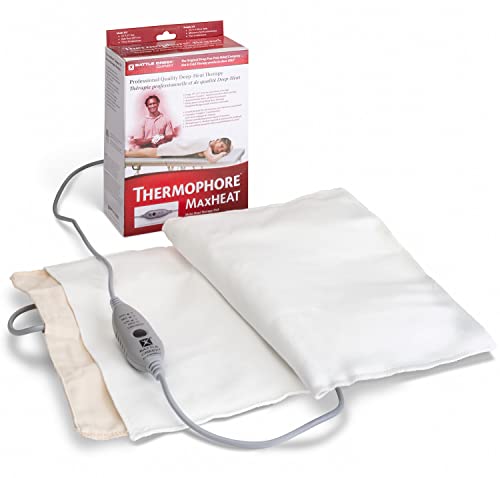
Thermophore MaxHEAT Model 155

Pure Enrichment PureRelief XL (Charcoal)

Chattanooga Theratherm Standard

TheraTherm Digital Large 14″ x 27″

Pure Enrichment PureRelief XL (Blue)
The Best Moist Heating Pad For Most People

The Thermophore MaxHEAT Model 155 is the best moist heating pad for most people because it delivers automatic moist heat across a 14″ × 27″ surface without dampening a sponge or spraying water first. The pad weighs about 4 pounds, which keeps it pressed against your back, hips, shoulders, or abdomen while you lie on it or drape it over a joint. A 25-minute auto shutoff keeps you from falling asleep with it running, and the moist heat mechanism works by drawing humidity from the air through its cotton flannel cover, so there’s no spray bottle to refill.
If you want simpler controls and a lighter pad, the Pure Enrichment PureRelief XL is the easier pick. It measures 12″ × 24″, runs a 9-foot cord, and offers six heat settings from 105°F to 140°F on a detachable LCD controller. You dampen the cover with a spray bottle for moist heat, then toss it in the washing machine after use. The pad shuts off after two hours and comes with a five-year warranty.
The MaxHEAT’s weight and size mean it stays put when you shift position, but that same heft makes it less convenient to move from room to room or pack for travel. The fleece cover isn’t machine-washable, so you’ll wipe it down with a damp cloth instead. Skip it if you want exact temperature readouts or a pad light enough to hold against your neck while sitting upright.
The PureRelief XL gives you more control over heat intensity, which matters if you’re sensitive to temperature or switching between a sore shoulder and menstrual cramps that need different settings. The spray-bottle approach to moist heat is an extra step, but it also means you decide how damp the cover gets. The two-hour shutoff is longer than the MaxHEAT’s 25 minutes, so you can use it through a movie or a long stretch of desk work without restarting it.
| Feature | Thermophore MaxHEAT 155 | PureRelief XL |
|---|---|---|
| Size | 14″ × 27″ | 12″ × 24″ |
| Weight | ~4 lb | ~1.5 lb |
| Heat settings | Single intensity | 6 settings (105–140°F) |
| Moist heat method | Automatic from air | Spray dampened cover |
| Auto shutoff | 25 minutes | 2 hours |
| Cord length | Standard | 9 feet |
| Cover care | Spot clean | Machine washable |
| Warranty | 1 year | 5 years |
Both pads plug into a standard 120 V outlet and should go straight into the wall, never into an extension cord or power strip. Keep the cord away from the heated surface so it doesn’t kink or melt the insulation. If you need a weighted heating pad for a different body area or a cordless option for travel, those designs trade off coverage or heat consistency.
Specs That Define A Good Moist Heat Pad
A moist heating pad delivers heat combined with water vapor to ease muscles and joints. How it creates moisture varies: some require dampening a cloth before use, while others generate moisture automatically. For example, the Thermophore MaxHEAT uses a special fleece cover to pull moisture from the air, so you don’t need to add water. Spray-and-dampen pads need a misted cover or a damp cloth tucked inside before heating. Microwavable pads are fabric pouches filled with grain, beads, or gel that release moisture when warmed and can be used anywhere without cords. Moist heat penetrates tissue more deeply than dry heat, making it effective for tight muscles, arthritis discomfort, and cramps.
Size matters as much as moisture. A 12″ × 24″ pad covers one shoulder, a hip, or wraps around a knee. Pads measuring 14″ × 27″ blanket your whole back or drape across both shoulders at once. Smaller 9″ × 12″ pads suit an ankle, elbow, or cramping lower abdomen, and they’re lighter to pack for travel. Match the pad to the pain: too small and you’ll reposition it every five minutes; too large and it flops off a joint or wastes heat on areas that don’t hurt.
| Feature | Basic | Mid-Range | Digital |
|---|---|---|---|
| Heat settings | 3 (low, medium, high) | 6 numbered levels | 1–60 minute timer, temp display |
| Moisture method | Dampen cover manually | Automatic from fleece | Automatic or manual |
| Shutoff timer | 20–30 minutes fixed | 25–90 minutes fixed | Custom 1–120 minutes |
| Weight | Unweighted | Weighted (2–3 lb) | Weighted or unweighted |
| Typical size | 12″ × 24″ | 14″ × 27″ | 14″ × 27″ or larger |
Heat settings and timers give you control over intensity and session length. Basic pads offer three settings—low around 110°F, medium near 125°F, high up to 140°F—and a fixed 20- or 25-minute shutoff. Six-setting pads let you dial in half-steps between low and high, which helps if you’re heat-sensitive or easing into therapy after an injury. Digital models like the Chattanooga TheraTherm Digital let you set any timer from 1 to 60 minutes and display the current temperature on an LCD screen. You’ll pay more for digital precision, but it’s worth it if you need longer sessions or want to see exactly what temperature you’re using.
Weighted pads press gently against your body, keeping the heating surface flush with sore muscles instead of sagging away. That contact matters: a 2- to 3-pound pad won’t slide off a rounded shoulder or lower back curve the way a floppy unweighted one does, and the pressure itself can feel soothing. Non-weighted pads work fine when you’re lying flat and gravity does the work, or when you want something lighter to drape over a knee or forearm. Weighted heating pads suit back pain and broad areas; unweighted pads suit joints and travel.
- Automatic moisture beats manual dampening if you use the pad daily.
- A 14″ × 27″ pad covers a full back; a 12″ × 24″ pad targets one area.
- Six heat settings offer more precise temperature control compared to three settings, improving comfort and adaptability.
- Weighted pads stay put on curves; unweighted pads weigh less for travel.
- Digital timers let you set sessions longer than the usual 25-minute fixed shutoff.
Safe Moist Heat Use Duration
About 20 minutes per session is the standard target for moist heat therapy, though some pads allow longer if their manual says so. That’s long enough to relax muscle fibers and increase blood flow without overheating skin. Sessions beyond 20 or 30 minutes raise the risk of irritation, redness, or—in worst cases—a low-temperature burn where prolonged contact slowly cooks tissue that can’t signal pain fast enough.
Heat builds in the skin faster than you feel it. Thin skin over bony areas—ankles, wrists, the front of the shin—absorbs heat quickly, and anyone with poor circulation or numbness may not notice discomfort until damage starts. Even healthy skin on the lower back or abdomen can redden or blister if a pad stays in place too long on a high setting. The 20-minute rule buys a margin.
Auto shutoff timers enforce that limit, though the span varies. The Thermophore MaxHEAT clicks off at 25 minutes, close to the clinical standard. Pure Enrichment’s XL runs for two hours unless you stop it sooner, which suits people who prefer control but demands attention. Most pads fall somewhere between 20 and 120 minutes; check the spec sheet and set a phone alarm if the shutoff window stretches past half an hour.
Repeated daily sessions are usually fine—physical therapists often recommend moist heat two or three times a day for acute strains—but each session starts fresh. Leaving a pad on continuously, even at low heat, traps moisture and warmth against skin that needs time to breathe and cool. Redness that doesn’t fade within an hour, blisters, or pain that worsens after heat are signs to stop and call a doctor.
Choosing The Right Pad For Back, Cramps, Feet, Or Travel
Large pads measuring 14″ × 27″ cover your lower back, shoulders, hips, and abdomen in one session, which makes them the right choice for sciatica, widespread soreness, or menstrual cramps that radiate across your torso. A 12″ × 24″ pad fits smaller areas—one shoulder, mid-back between the shoulder blades, or cramps that stay below the navel—and weighs less if you’re moving it from couch to bed. Both the Thermophore MaxHEAT Model 155 and the Pure Enrichment PureRelief XL sit in the large camp, so they handle back and abdominal pain without leaving cold edges.
Feet and ankles tolerate a standard flat pad draped over the top, but a smaller flexible design or a wrap with a strap holds heat against curved surfaces without sliding off. Standard rectangular pads work when you’re propped on the couch; wraps suit anyone pacing between the kettle and the chair. Shoulders respond to moist heat the same way backs do, though a moist heat massager that vibrates adds another layer if muscle knots are the problem—just confirm it offers actual moisture, not only warmth and vibration.
Microwavable pads give you moist heat without a cord trailing to the outlet, which suits travel, office desks with scarce plugs, or anyone who dislikes being tethered during a session. Heat one for two to three minutes, wrap it in the cover it ships with, and you’ll get fifteen to twenty minutes of warmth before it cools. Cordless electric models running on rechargeable batteries exist, but they trade plug-free convenience for shorter heat duration and a smaller surface; a microwavable heating pad stays hot longer per session and costs less up front.
Match the pad’s footprint to the span of pain, not the body part’s name. Lower-back sciatica that shoots into one hip wants the full 14″ × 27″ spread; a tight knot under one shoulder blade fits a 9″ × 12″ square. Buying the largest pad available sounds safe until you’re folding half of it under itself to fit your neck, trapping moisture against the cover and shortening its life.
Differences Between Electric, Microwavable, And Infrared Pads
Electric and microwavable moist heating pads both deliver effective moist heat, but they suit different needs. An electric pad plugs into the wall and maintains steady warmth for as long as you want, which makes it the better pick for extended home use on the couch or in bed. Microwavable pads heat up in two to three minutes, stay warm for 20 to 30 minutes, and need no cord, so they’re the practical choice when you’re traveling, moving around the house, or want moist heat without an outlet nearby.
Both types generate moisture differently. Electric models like the Thermophore MaxHEAT pull water vapor from the air automatically—no reservoir, no sponge, no spray bottle. You unwrap it and switch it on. Microwavable pads use filling materials such as rice, flaxseed, or clay that release stored moisture when heated. A few electric pads still ask you to dampen a sponge or mist the surface with a spray bottle before each session, but the automatic models in this guide skip that step entirely.
Infrared heating pads are an alternative technology, not a replacement for traditional moist heat. They emit infrared wavelengths that manufacturers claim penetrate deeper into tissue, and some users prefer the sensation. Clinical evidence comparing infrared to conventional moist heat for muscle relaxation remains limited, and infrared pads typically cost more. If you’re looking for the deep, familiar warmth that physical therapists recommend for sore muscles and stiff joints, a traditional moist heat pad is the safer default. Infrared is worth considering if dry heat hasn’t worked and you want to try something different.
Weighted electric pads combine moist heat with even contact across the treated area. The extra pounds—usually one to three—keep the pad pressed against your back, shoulder, or abdomen without shifting, which improves heat transfer and lets you relax without holding it in place. If you plan to use moist heat regularly at home and want something that stays put on a couch or bed, a weighted electric pad is the simpler buy.
Safety And Cleaning Details Often Overlooked
Look for a UL or cUL listing on any electric moist heating pad you’re considering, and check that it includes automatic shutoff—typically 20 to 30 minutes for models like the Thermophore MaxHEAT, up to two hours on digital pads such as the weighted heating pad Theratherm Digital. Digital controllers often add a lockout mode to prevent accidental temperature changes mid-session, useful for arthritis patients whose grip strength makes button presses unpredictable. Medical-grade moist heating pads such as the Chattanooga Theratherm models carry these certifications and are built to physical therapy clinic standards, though home-use pads from Pure Enrichment and Thermophore meet the same UL safety benchmarks.
Machine-washable covers and detachable controllers make daily cleaning practical. Most covers unzip or unhook from the heating element; wash them on gentle with mild detergent, air dry or tumble on low, and reattach only when fully dry. Spot-clean the heating element itself with a damp cloth—never submerge it or run it through the washer. Let the pad cool completely before folding it for storage, and use the storage bag if one came in the box; folding a warm pad can crack internal wires over time.
Warranty length signals how long the manufacturer expects the pad to last under regular use. Pure Enrichment backs its PureRelief XL with a five-year warranty, the longest in this group. Chattanooga’s Theratherm models carry a one-year warranty, standard for clinical-grade equipment that sees heavy rotation in therapy offices. Thermophore’s MaxHEAT comes with two years of coverage. Register the product within 30 days of purchase to activate the warranty; most claims hinge on a dated receipt and proof of registration.
| Model | Warranty | UL Listed | Shutoff |
|---|---|---|---|
| Thermophore MaxHEAT 155 | 2 years | Yes | 25 min |
| Pure Enrichment PureRelief XL | 5 years | Yes | 120 min |
| Chattanooga Theratherm | 1 year | Yes | Varies |
Store the pad flat or loosely rolled in a cool, dry place away from sharp objects. Folding it tightly along the same crease every time stresses the internal wiring and shortens its life. Check the cord and plug for fraying or scorch marks before each use; replace the pad if you see damage. Don’t pin, clip, or bunch the pad while it’s on—trapped heat can burn fabric and skin.