The best time to buy a water heater is before the old one fails, ideally during a slower replacement season when installers and retailers may offer promotions. Buy immediately if the tank is leaking or hot water has stopped; a seasonal discount isn’t worth water damage or a cold shower.
Buying by the calendar alone can cost you an emergency installation, damaged flooring, or a unit that doesn’t fit your venting and electrical setup. A planned replacement gives you time to compare the tank, fuel type, efficiency, installation requirements, and current rebates.
The safest bargain is the one that fits your home and gets installed correctly. A cheap water heater with the wrong vent, circuit, or discharge setup is simply an expensive problem wearing a sale sticker.
The essentials
Late winter and early spring can be good times to request quotes because replacement demand may be slower, but no season guarantees a lower price.
Replace a leaking tank promptly instead of waiting for a holiday sale; water damage costs more than a missed promotion.
Check utility and federal incentive rules before buying an efficient or heat pump water heater because eligibility and installation requirements change.
A water heater installation includes connections, venting or electrical work, the T&P discharge line, and sometimes an expansion tank—not just setting a tank in place.
Get the model, fuel type, dimensions, venting, electrical requirements, permit needs, and installation price in writing before you schedule the work.
Best Time to Buy a Water Heater
The best time to buy a water heater is before failure, with late winter and early spring reasonable windows for comparing prices and installer availability. Off-peak demand may bring a discount, but there’s no universal sale season, guaranteed markdown, or fixed model-release calendar.
In short
Plan the replacement after getting at least two properly scoped quotes; an emergency purchase leaves less time to compare models, prices, and installers. Buy promptly if the tank is leaking or the water is already cold.
A slower local season can make scheduling easier and give you room to negotiate, but “off-peak” varies by area and contractor. Ask whether the quote includes removal, permits, venting or electrical changes, delivery, and startup; a low sticker price can grow legs.
Situation
Best timing
What changes
Planned replacement
Before failure
Compare two complete quotes and several suitable units.
Active leak
Now
Protect the floor and arrange prompt replacement; waiting can cost more than a sale saves.
Failed heating
Now
Choose from available, correctly sized models rather than waiting for a promotion.
Rebate deadline
Before the deadline
Confirm the unit, installer, paperwork, and installation date qualify.
Clearance stock
When verified
Check that the model fits your fuel type, capacity, venting, and local code.
The calendar matters less than the heater’s condition and the program rules.
Worked example
Say a planned quote gives you two weeks to compare a 50-gallon replacement, while an emergency failure leaves one available model and a rushed installation. The planned purchase may save through better model choice or scheduling, even if the emergency seller advertises a small discount. The exact dollar difference depends on the quotes, installation work, and eligible incentives—not a guaranteed seasonal percentage.
Planned purchaseTwo properly scoped quotes
Emergency purchaseLimited model and scheduling choice
Rebates and tax incentives depend on the unit, installation, location, income, and current program year. The search phrase “water heater IRS lifetime” doesn’t point to one universal lifetime benefit; verify the current eligibility rules before ordering, and keep the required invoice and certification records.
A water heater timer wifi setup or simple timer can reduce operating cost only with a suitable electric heater and a utility rate that rewards shifting use. The heater still needs enough recovery time to make hot water safely, so don’t install a timer based on a generic schedule alone.
Myth
Buying during summer guarantees a discount or free installation.
Fact
Retailers and installers set their own promotions, and clearance or free-installation claims need checking line by line. There’s also no universal summer launch date for new water-heater models.
Before you order
Compare the full written scope, then verify the model’s fuel type, capacity, dimensions, energy requirements, venting, permit needs, and incentive eligibility. If you’re ready to compare units, start with these best gas water heaters for your home.
When the Calendar Stops Mattering
A leak from the tank, water near burner or electrical controls, repeated safety shutdowns, or no hot water calls for prompt diagnosis—not waiting for a sale. Comfort matters, but water damage and gas-appliance hazards can make delay costly.
A status light may stay on, blink, or go dark depending on the model; there’s no universal rule that it should be on all the time. The same goes for beeps and flash codes: a Rheem water heater beeping three times or a Bradford White power-vent model flashing seven times and then three times needs its exact model number and manual checked. Record the pattern. Don’t treat a number of beeps or flashes as a diagnosis by itself.
Symptom
What to do
Water at a fitting or valve
A connection leak may be repairable; check whether the water is coming from a pipe joint or valve rather than the tank.
Water from the tank body
Treat it as a likely failed tank and arrange prompt replacement; don’t wait for a seasonal promotion.
Lukewarm water, pilot won’t stay lit, or flame starts only on the second attempt
Arrange service soon. These are symptoms to diagnose, not reasons to wait for a sale.
Unusual hum or seasonal hammering sounds
Have sediment, moving pipes, valves, and expansion pressure checked before assuming the heater needs replacement.
The location and pattern of the problem matter more than the calendar.
A softener can contribute to plumbing or water-quality problems, but it doesn’t prove the heater is at fault. Test the water system and heater separately; intermittent hot water can have more than one cause.
1
Stop water and energy safely
If a leak is active, shut off the heater’s water supply. Turn off gas or electricity only if you can reach the control safely and the area is dry; don’t touch wet electrical equipment.
2
Get help when the source is unclear
Call a qualified professional if you can’t tell whether water is from a fitting, valve, or tank, or if a safety control keeps shutting the unit down.
Treat these as urgent
If you smell gas, leave the area and contact your gas utility or emergency services from outside; don’t operate switches. Water near electrical controls can cause shock. A CO alarm or symptoms such as headache or dizziness near a gas appliance call for leaving the building and seeking emergency help. Don’t keep resetting a unit that trips a safety control.
Codes are clues, not buying advice
A light, beep, or flash pattern helps identify what to investigate; it doesn’t by itself tell you to replace the heater. Check the model-specific manual and have recurring faults diagnosed.
Plan the Installation Before You Buy
A water heater installation guide starts with the site, not the sale: a straightforward replacement may finish in one visit, while solar, tankless, indirect, relocation, new venting, permits, or electrical changes can take longer. Have the installer inspect the space before promising a purchase date.
For an electric instant or tankless heater, installation time depends on the available circuit and service capacity. A larger unit may need a different circuit or service upgrade. A time-delay fuse isn’t a universal water-heater requirement; an electrician should match overcurrent protection to the nameplate and local code.
First-time venting a gas water heater needs more than attaching a pipe. The installer must select approved vent material, confirm draft, maintain clearances, and meet local code. Gas connections, venting, and 240-volt electrical work generally belong to a licensed plumber or electrician under local rules.
1
Inspect the site
Check the heater’s location, fuel or electrical supply, vent route, drain, shutoff valve, floor condition, access path, and required clearances.
2
Confirm the replacement
Match fuel type, tank size or recovery needs, dimensions, connections, and the manual’s installation requirements before ordering.
3
Ask about permits
Have the installer confirm local permit, inspection, seismic restraint, drain-pan, venting, and combustion-air requirements before work begins.
4
Book the right trades
Schedule a licensed plumber, electrician, or both when the replacement changes gas, venting, wiring, controls, or the heater’s location.
Heater type
What can change the schedule
Tank
A like-for-like replacement is usually the simplest installation; access, permits, venting, and a drain pan can add work.
Tankless
Gas venting, larger gas supply, electrical needs, condensate drainage, or water-line changes may be required.
Heat pump
The installer needs suitable space, condensate drainage, electrical capacity, and a way to handle cooler exhaust air.
Indirect
Recovery depends on the boiler and its controls, so compatibility and control wiring matter as much as tank size.
Solar
Collector, storage, roof or ground work, controls, plumbing, permits, and backup planning make solar installation longer and less predictable than a tank swap.
An expansion tank belongs on a closed plumbing system because heated water expands and has nowhere else to go. The tank must be correctly sized and supported, and its air charge is checked against house water pressure before service; there isn’t a universal adjustment time for a new tank.
For a safe water-heater drainage guide, shut off the energy source, let the water cool, close the cold-water supply, connect a hose to a suitable drain, open a hot faucet, and follow the unit manual. A hose that ends in a bucket or across a walkway is a small project trying to become a larger one.
Leave the safety parts alone
The temperature-and-pressure relief valve and its discharge line must remain correctly installed, unobstructed, and directed as required. Never cap, plug, or block the line. Gas, venting, 240-volt wiring, and unfamiliar drainage work deserve a licensed professional.
Before ordering
Installer has inspected the location
Fuel, voltage, dimensions, and connections match
Manual clearances and drain requirements are available
Permit and inspection needs are confirmed
Expansion tank, venting, controls, or service upgrades are included in the quote
Myth
A new heater is a simple appliance swap, so any model with the right gallons will fit.
Fact
The connection layout, vent, electrical service, clearances, drain, expansion control, and local code can decide the real installation. Gallons are only one line on the order.
From HeaterGuides · our own guidePages 9 to 13 are the fault flowcharts: no hot water, noises, smells and leaks, in order.Water Heater Owner's ToolkitFix the common faults yourself, keep it running for years, and know when a repair is money wasted.No-hot-water flowcharts, gas and electricFlush, anode, relief valve and descaling stepsRepair-or-replace calculator (Excel)$14.99$9.99Get it for $9.99See what's inside and watch the 2-minute video →18-page printable PDF + Excel calculator · instant download · 30-day refund
Make the Replacement Decision in Order
Your first action depends on the heater’s condition: plan ahead for an old but working unit, arrange service for warning symptoms, and treat a leak or total failure as an immediate repair or replacement job. Shorter showers can reduce demand and postpone a capacity problem, but they can’t fix a bad thermostat, heating element, burner, or tank.
For a vacation, use the manual’s vacation or low setting. Shut off fuel or electrical power only by the manufacturer’s procedure, and protect the home from freezing conditions; a Canadian winter is a poor time to discover that a “temporary” setting froze a pipe.
1
Working but old
Photograph the data plate, measure the tank area and door clearance, note the fuel type and vent arrangement, and gather the last utility bill and repair records. Request installed quotes before failure forces a rushed choice. If the heater is only a year old but needs repeated toggling of the ignite button, don’t treat that as normal aging—check the manual and arrange model-specific service, especially if warranty coverage may apply.
2
Warning symptoms
Arrange qualified service for recurring shutdowns, temperature problems, pilot trouble, ignition faults, or flash codes. A Bradford White Echo-Defender Ultra Low NOx heater flashing twice while the pilot won’t stay lit needs the exact model’s diagnostic procedure; stop repeated resets and call for service. Gas odor, soot, or a carbon monoxide alarm means stop using the heater and leave the area as appropriate for the emergency.
3
Leaking or failed
Turn off the water supply to the heater and the fuel or electrical source only if you can do so safely, then call a qualified professional. A leaking tank generally needs replacement, while a failed control or heating part may be repairable; water damage doesn’t wait for the next sale.
Give every quote the same information
Photograph the data plate and record the model, fuel type, capacity, and vent arrangement.
Measure the tank space, doorway, access route, and door clearance.
Collect recent utility information and repair records.
Ask for separate prices for equipment, labor, permits, disposal, venting or electrical changes, expansion tank, shutoff valve, drain pan, and required code work.
Ask who handles permits, inspections, and final testing.
Compare the installed totals rather than the tank price alone. A quote that omits a vent change, expansion tank, permit, or disposal fee is incomplete. Readers sorting out warning signs can use this water heater replacement signs guide before requesting those quotes.
After choosing a qualified installer, verify available incentives, confirm code and permit needs, schedule the work, and test hot-water delivery afterward. Check that the temperature is suitable, connections are dry, and the temperature-and-pressure relief valve discharge setup is present and unobstructed—never cap or plug that valve.
More Questions, Answered
Are lights on a water heater supposed to be on all the time?
Not usually; indicator lights show different things depending on the model. A status light may blink to signal normal operation or a fault, so check the label on the heater or its manual before treating a blinking light as a problem.
Why does my water heater make a hammer sound only in fall and winter?
Seasonal temperature changes can make hot-water pipes expand and contract, while changes in water use can make pressure shocks more noticeable. If the sound happens when a valve closes, a plumber can check for loose pipes, high water pressure, or a missing or failed water-hammer arrestor.
Why does my water heater hum sometimes?
A low hum can come from vibration in the tank, pipes, or a component such as an electric heating element. Note whether it starts during heating or when another fixture runs; shut the unit off and arrange service if the noise is new, loud, or paired with leaking, burning smells, or a breaker that trips.
Should an electric water heater circuit use a time-delay fuse?
Use only the fuse type and rating specified on the water heater label and installation instructions. A time-delay fuse may be appropriate for some circuits, but replacing a fuse with a larger rating to stop nuisance trips can create a fire hazard; have an electrician check repeated trips.
Can a bad water softener cause a water heater to stop working?
A malfunctioning softener can reduce water flow or affect water chemistry, but it typically won’t directly switch off a water heater. If the heater stopped after a softener problem, check for a tripped breaker or fault code and have a plumber assess the water supply and heater.
How should a water heater be handled during a vacation in Canada?
For a short trip, you can usually lower the thermostat rather than shut off the whole system; follow the heater manual and keep the home warm enough to protect plumbing from freezing. For a longer absence, ask a local plumber how to set the heater and protect the pipes, especially if the home will be unheated.
Before you go · a welcome giftGet the Water Heater Owner's Toolkit for $4.99Fix the common faults yourself, keep it running for years, and know when a repair is money wasted. Normally $14.99; your welcome price saves $10.00. We'll email your link right now.or buy it now for $9.99 without the gift →One email with your link now. We never share your address.

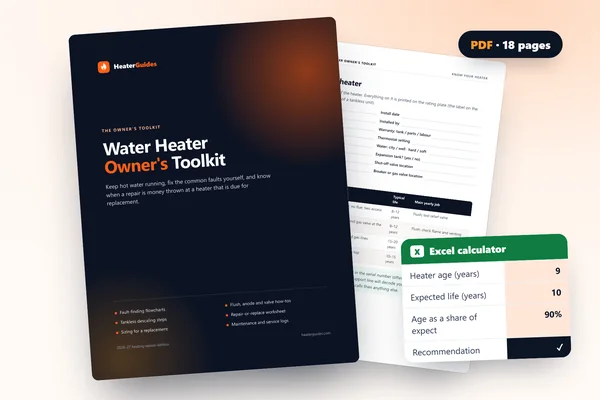 Water Heater Owner's ToolkitFix the common faults yourself, keep it running for years, and know when a repair is money wasted.No-hot-water flowcharts, gas and electricFlush, anode, relief valve and descaling stepsRepair-or-replace calculator (Excel)