For most people searching for the Best In-Wall Heater, product 3 is the strongest fit when you want a recessed electric heater with a fan and front thermostat. Its listed specifications conflict on wattage, though, so confirm the exact model and nameplate before buying; choose a surface-mounted or fireplace-style pick if that better matches your wall and wiring.
Key takeaways
Confirm whether the heater is recessed, surface-mounted or a wall-mounted portable unit.
Check the heater’s nameplate and your circuit before choosing a hardwired model.
A 1,500 W heater running eight hours uses 12 kWh; at 17 cents per kWh, that is about $2.04.
Use only an indoor-rated fuel-burning heater indoors, with the manual-required ventilation and a working CO alarm.
Getting the fit wrong can mean paying for a heater that cannot warm the room or hiring an electrician to correct a wiring mismatch. A poorly placed or improperly installed heater can also put nearby materials at risk.
These picks cover different kinds of wall heating, not five interchangeable units: some are recessed, some surface-mount, and one is a decorative electric fireplace. Match the installation style and circuit to your room before comparing app controls or flame colors.
The Best In-Wall Heaters by Use
#1Best Built-In Pick
Broan-NuTone Wall Heater With Grille
Best for A permanently installed room heater with a front thermostat
The front-mounted adjustable thermostat keeps the control on the grille, and the blower sends heat through downflow louvers. The listing conflicts on wattage: it names 750/1500W, but also describes 2000W at 240V and conversion to 1000W. Confirm the model and heater nameplate before you buy.
Listed wattage 750/1500W; description also says 2000W at 240V and conversioVoltage 120/240V ACThermostat Adjustable, front-mountedHousing size 10 1/4″ x 7 3/4″ x 3 3/4″Cover size 12 in x 9 1/4 in
Why it made the cut
Front-mounted adjustable thermostat
Blower and downflow louvers
Manual-reset thermal overload protector
Good to know
Wattage details in the listing conflict
Professional installation is recommended
Skip it if Skip it if you need a clearly specified wattage before purchase or want a surface-mounted heater.
Best for A small room up to 50 sq ft where fan noise is unwelcome
This 500W convector uses natural airflow instead of a fan, so it heats quietly. Its built-in electronic thermostat includes an automatic night temperature reduction and a security mode that limits the maximum setpoint. Choose it for a small room with a 240V circuit, not as a plug-in heater.
Heat output 500W at 240V; about 375W at 208VCoverage Up to 50 sq ftMounting Surface mountThermostat Built-in electronic thermostatClearance Mounted at least 4 inches from the floor
Why it made the cut
Quiet convection with no fan noise
Built-in electronic thermostat with backlit LCD
Concealed mounting bracket and cable clamps included
Good to know
Covers up to 50 sq ft
240V hardwired installation; not plug-in
Skip it if Skip it if you need a fan-forced heater, a larger listed coverage area or a plug-in model.
Best for A living room or bedroom needing supplemental heat and a fireplace look
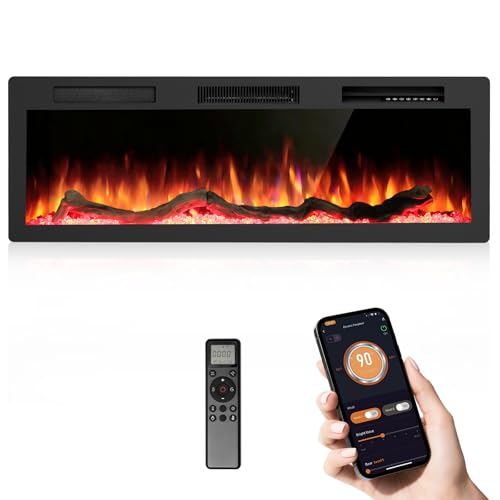
This fireplace can be recessed or wall-mounted, and its two heat settings give you 750W or 1500W. You can adjust the temperature from 59–95°F and control the unit by remote, touch panel, smartphone or Alexa. Pick it when flame effects and flexible mounting matter as much as supplemental heat.
Heat output 750W or 1500WDimensions 50″L x 17.32″H x 5.71″WOpening size 48″ x 16.9″ x 6.1″Listed coverage Up to 400 square feetTemperature range 59–95°F
Why it made the cut
Recessed or wall-mounted installation
Two heat settings and adjustable temperature
Remote, touch, smartphone and Alexa controls
Good to know
A 50-inch unit needs substantial wall space
Listed as supplemental zone heating
Skip it if Skip it if you want a compact built-in grille heater rather than a fireplace-style unit.
Best for A bedroom or office where app control and oscillation are useful
The 120° oscillation moves warm air across a wider area than a fixed outlet, while the app, voice controls and 24-hour timer let you schedule operation. Its thermostat adjusts from 41–95°F, and the LED panel dims in low light. This is a wall-mounted heater, not a recessed in-wall unit.
Heat output 1500WMounting Wall-mountedThermostat range 41–95°FOscillation 120°Timer 24H
Why it made the cut
120° oscillation
App and Alexa or Google Home control
24-hour timer and adjustable thermostat
Good to know
Wall-mounted rather than recessed
Listing gives no room coverage figure
Skip it if Skip it if you need a hardwired recessed heater or a stated coverage area before choosing.
Best for A room needing a 240V in-wall heater with a built-in thermostat
The listing specifies 2000W at 240V and a built-in thermostat that adjusts heating automatically. It also claims quiet operation at 30 decibels, a detail worth confirming against the exact model documentation. Consider it only after checking that the heater and your wiring match.
Heat output 2000WVoltage 240 VoltThermostat Built-inNoise As low as 30 decibelsWarranty One year
Why it made the cut
2000W output listed at 240V
Built-in thermostat
Compact profile
Good to know
Listing provides few installation details
Warranty is listed as one year
Skip it if Skip it if you need clear mounting instructions or independently stated room coverage before buying.
The best in-wall heater depends first on how it mounts: recessed models need a compatible wall opening, surface-mounted heaters attach to the wall, and wall-mounted portable heaters aren’t necessarily true in-wall units. If you searched “walmart wall heaters” or “wall heaters from Walmart,” retailer inventory can change; check the model’s mounting instructions rather than assuming a wall-mounted listing is recessed.
Product
What the listing tells you
Check before choosing
R.W.FLAME Smart Electric Fireplace 50 Inch
Fireplace-style; listed as recessed and wall mounted
It’s a fireplace-style unit, not a conventional in-wall heater.
Stelpro Wall Heater
Wall heater
Confirm mounting style, voltage and output for the exact model.
Broan-NuTone Wall Heater
Conflicting wattage and voltage details
Title says 750/1500 W and 120/240 V; description says 2000 W at 240 V, convertible to 1000 W.
DREO Smart Wall Heater, 1500W
Wall-mounted; title lists 1500 W
Check whether it’s portable or intended for permanent installation.
CSC202TW In Wall Heater
Title lists 2000 W and 240 V
Confirm the nameplate and circuit requirements.
Product titles alone don’t establish every installation detail.
Compare listed heat output and voltage with your room’s needs and available circuit. Treat any square-foot coverage as guidance, not a promise for a cold, drafty or poorly insulated room. For the Broan-NuTone, verify the exact model nameplate and installation instructions before buying; the supplied listing details disagree.
Skip unsupported claims
Don’t rely on old claims about materials, dishwasher-safe parts, warranties, stability or precise room coverage unless the exact product documentation confirms them. For another electric wall-heater comparison, see Best Electric Wall Heater.
Choosing the Right Size Wall Heater
Choose an in-wall heater size using the manufacturer’s sizing guidance, then account for insulation, ceiling height, drafts, local climate and whether the heater is supplemental. A fixed square-foot figure can’t capture those differences.
Worked Example
At an assumed electricity rate of $0.17 per kWh, a 1,500 W heater running eight hours daily for 30 days uses 360 kWh. The arithmetic is 1.5 kW × 8 hours × 30 days; estimated cost is $61.20 before thermostat cycling.
Heater1,500 W
Use8 hours daily for 30 days
Assumed rate$0.17/kWh
Estimated costVaries by retailer
Heater
Watts
Per hour
Per day (8 h)
Per month (30 days)
1,500 W wall heater
1,500 W
26¢
$2.04
$61.20
Calculated at 17¢ per kWh. Estimate assumes the heater runs continuously for eight hours each day; actual use depends on thermostat cycling.
A thermostat can cut consumption by switching the heater off once the room reaches its set temperature. A cold or leaky room may keep it running longer, so the estimate isn’t a guaranteed bill.
Check voltage before sizing
A standard 120 V outlet circuit doesn’t make every heater compatible with a plug-in connection. Check the listed voltage and installation requirements; a hardwired 240 V unit needs the right circuit. For more electric wall-heater options, see electric wall heaters.
Wall Heater Installation and Safety Checks
For wall heater installation, follow the exact model’s instructions and hire a licensed electrician for hardwiring or changes to a 240 V circuit; for a gas wall heater, contact a licensed gas fitter or HVAC contractor. A product seller can help identify a model, but shouldn’t be your substitute for someone qualified to connect it.
Keep combustibles the distance specified in the manual, and don’t cover the grille or air outlet. Plug-in electric space heaters and electric fireplaces need a direct wall outlet—never an extension cord or power strip—and 3 feet of clearance from nearby objects. Don’t run one while you’re asleep or away unless the manufacturer says that specific model is designed for it.
Check Before Installation
Confirm the heater’s voltage, mounting type and electrical requirements match your wall and circuit.
Check the manual for clearances and whether the model is designed for a recessed opening or surface mounting.
Look for tip-over and overheat protection and a UL, ETL or CSA listing on portable electric heaters and plug-in electric fireplaces.
Use only claims listed for the exact model. The Broan-NuTone Wall Heater product data lists a UL listing and a manual-reset thermal overload protector; don’t assume the other picks have those features.
Don’t Guess at Wiring
A 240 V heater needs a compatible circuit, and hardwired installation can involve work inside the electrical panel. Have a licensed electrician confirm the circuit and make the connection in line with local requirements.
Gas Wall Heaters and Other Heater Names
This ranked list covers electric wall-heating products; it doesn’t confirm current Walmart stock or identify a Mission or Thermador model. For gas wall heaters for homes, first confirm the fuel, venting type and exact model before comparing products.
Searching for a Mission natural gas wall heater or a Thermador heater wall appliance? Find the full model number on the rating plate, then check the manufacturer’s documentation or contact the manufacturer or a licensed gas/HVAC technician for identification, installation requirements and compatible parts. A brand name alone isn’t enough to establish what the appliance needs.
For Walmart wall heaters or wall heaters from Walmart, check the retailer’s current listing for the exact model number, voltage, mounting type, return terms and installation instructions. Stock and product names can change, so confirm those details on the listing for the specific heater you’re considering.
Gas Heaters Need Model-Specific Checks
Gas wall heaters may be vented or vent-free. Vent-free models are banned or restricted in some states and cities, so check local code before buying. Any fuel-burning heater used indoors must be rated for indoor use, installed and ventilated as its manual requires, and used with a working carbon monoxide alarm. Propane models need an oxygen depletion sensor.
Before you buy, match the heater to the room, wall and electrical circuit—not just the product name.
Buying and installation check
Room use: confirm the heater suits the room where you’ll use it.
Mounting type: check whether it’s recessed, surface-mounted or a wall-mounted portable unit, and whether your wall can accommodate it.
Exact model number: verify the model on the listing and the heater’s nameplate; the Broan-NuTone listing has conflicting wattage details.
Voltage and wattage: match the heater’s nameplate to the available supply and circuit; don’t assume similar-looking models have the same requirements.
Circuit compatibility: have an electrician check the circuit before hardwiring or changing a 240 V supply.
Clearances and certification: follow the exact model’s required clearances and confirm a UL, ETL or CSA listing where stated.
Installation: decide who’ll do the hardwired work; use a licensed electrician for hardwiring or 240 V changes.
Gas alternative: confirm local code allows the model, verify it’s rated for indoor use, follow its ventilation instructions and keep a working CO alarm in the space.
Frequently Asked Questions
Where can I get a gas wall heater serviced?
Start with the heater’s manufacturer or its authorized service network, using the model and serial number on the rating plate. If the manufacturer no longer supports it, contact a licensed HVAC or gas-appliance technician who services that fuel type; stop using the heater if you smell gas or the flame looks abnormal.
Does Walmart sell in-wall heaters?
Walmart may list wall heaters, but listings and local stock change, and “wall heater” can mean recessed, surface-mounted, or portable. Check the exact model’s installation instructions and electrical requirements before ordering; a product labeled wall-mounted isn’t necessarily designed to fit inside a wall.
Where can I find a manual for a Mission natural gas wall heater?
Look for the manufacturer name, full model number, and serial number on the heater’s rating plate, then ask the manufacturer or a licensed gas-appliance technician for the matching manual. Don’t rely on a manual for a similar-looking model, since venting, clearances, and parts can differ.
What should I check on a Thermador wall heater before replacing it?
Read the rating plate for the model number, fuel type, input rating, and venting details, then check whether the existing vent and wall opening match the replacement instructions. Have a licensed technician assess gas connections and venting; brand name alone doesn’t establish that a newer heater is a compatible replacement.
Are gas wall heaters suitable for homes?
They can heat a home or a specific room if the unit is approved for indoor use, correctly sized, and installed with the required venting and clearances. Use a working carbon monoxide alarm and follow the manual’s ventilation instructions; check local code before choosing a vent-free model, which is restricted in some areas.