The best 40-gallon gas water heater for most homes in 2026 is a high-recovery, 40,000+ BTU tank model from a major brand, but tankless models offer endless hot water and higher efficiency for the right household. Choose based on your usage, venting, and local gas type—see our detailed picks and comparison table below.
Key takeaways
A 40-gallon gas water heater can serve 2–4 people if the first hour rating is high enough.
Tankless models suit homes with high, staggered demand and can cut standby losses.
Look for a BTU input of at least 40,000 for quick recovery in colder climates.
Direct vent models are safer for tight spaces; check venting before you buy.
Annual flushing and checking the anode rod can double the life of your heater.
Say you have a family of four, two showers running back to back, and everyone wants hot water before work. Your water heater’s recovery rate and first hour delivery decide whether you get a warm rinse or a cold surprise.
The right 40-gallon gas water heater balances upfront cost, speed, and reliability. Below, you’ll find the top tank and tankless picks for 2026, with plain-English advice on picking the right one for your home.
The Best 40-Gallon Gas Water Heaters and Tankless Alternatives
#1Best Outdoor Upgrade
Rinnai Outdoor Natural Gas Tankless
Best for Homes wanting an outdoor natural-gas replacement for a storage tank
The Rinnai RE180eN supplies up to 6.9 GPM and can serve up to 5 fixtures at once, so it offers more flow headroom than a small tankless unit. Its outdoor, non-condensing design heats water only when needed, and the LED screen shows service reminders and error codes. Choose it when outdoor installation suits your home and you want Rinnai’s long residential heat-exchanger coverage.
Fuel Natural gasBTU input —Flow rate Up to 6.9 GPMInstallation Outdoor, non-condensingWarranty 15-year heat exchanger, 5-year parts, 5-year labor; registra
Why it made the cut
Up to 6.9 GPM and 5 fixtures at once
Outdoor installation saves indoor space
LED service reminders and error codes
15-year heat-exchanger warranty when registered within 90 days
Good to know
Natural gas only
Outdoor installation limits where it can go
WiFi control requires the Controlr module, which is not included
Skip it if Skip it if you need an indoor heater or use propane instead of natural gas.
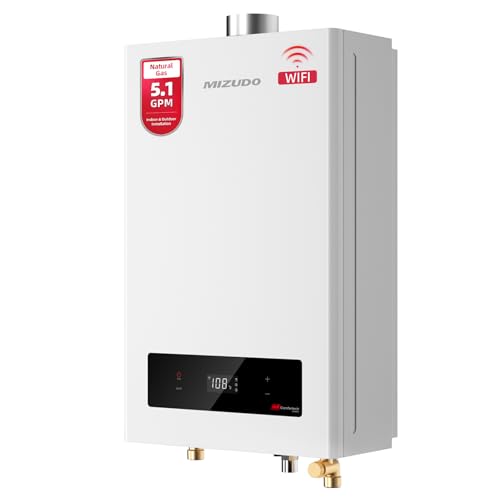
Best for Natural-gas homes needing flexible installation and app controls
MIZUDO’s 120,000 BTU output and 5.1 GPM flow rate are aimed at supplying multiple bathrooms, while gas modulation and flow monitoring help hold the output temperature within 1°F. Indoor installation can convert to outdoor use with an accessory kit, giving you more placement choices. WiFi and app controls add remote temperature adjustment, energy monitoring and maintenance notifications.
Fuel Natural gasBTU output 120,000 BTUFlow rate Max 5.1 GPMControls WiFi and app controlCertification CSA certified
Why it made the cut
Indoor or outdoor installation with an accessory kit
WiFi and app control
5.1 GPM flow rate
CSA certified with freeze and flame-failure protection
Good to know
Outdoor conversion requires an accessory kit purchased separately
Natural gas only
Warranty information is not provided in the product data
Skip it if Skip it if your home uses propane or you want a higher-flow commercial-capacity unit.
Best for Indoor natural-gas installation serving two showers at once
The ThermoMate CZ422NG is rated for up to 5 GPM and 113,000 BTU, with the product data specifying two simultaneous showers at a 105°F output based on 65°F inlet water. Its compact 21-inch by 13-inch by 7-inch cabinet takes less space than a traditional tank. A 3.5-inch LED display shows flow, fan and flame status, while the CSA-listed safety system covers flame-out, freeze, overheat and other faults.
Fuel Natural gasBTU input 113,000 BTUFlow rate Up to 5 GPMDimensions 21 H × 13 W × 7 D in.Efficiency Up to 98% thermal efficiency; UEF 0.81
Why it made the cut
Rated for two simultaneous showers
Compact indoor cabinet
Temperature range of 90–140°F
CSA certified with multiple safety protections
Good to know
Natural gas only
The stated 105°F performance is based on 65°F inlet water
Indoor installation requires venting and suitable exhaust routing
Skip it if Skip it if your household regularly runs more than two showers or several high-flow fixtures together.
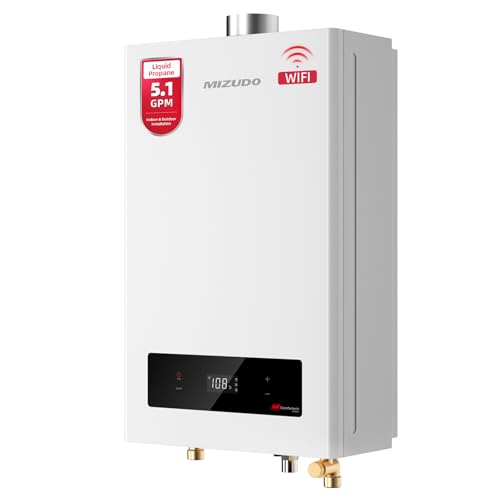
Best for Propane homes wanting app control and indoor or outdoor flexibility
This MIZUDO version uses propane and delivers 120,000 BTU with a maximum 5.1 GPM flow rate for multiple-bathroom use. Its flow monitoring and gas modulation are designed to keep temperature within 1°F, and the app can adjust settings, monitor energy use and send maintenance notifications. Indoor installation can be converted to outdoor use with the required accessory kit.
Fuel PropaneBTU output 120,000 BTUFlow rate Max 5.1 GPMControls WiFi and app controlCertification CSA certified
Why it made the cut
Designed for propane homes
Indoor or outdoor installation with an accessory kit
WiFi and app control
CSA certified with freeze, dry-burn and flame-failure protection
Good to know
Outdoor conversion requires an accessory kit purchased separately
Maximum flow is 5.1 GPM
Warranty information is not provided in the product data
Skip it if Skip it if your property has natural gas service or you need more than 5.1 GPM of flow.
Best for Large homes or commercial spaces with many fixtures running together
The Rinnai CX199iN reaches 199,000 BTU and up to 11.1 GPM, with capacity listed for 7 fixtures at once. Its condensing design has a UEF of .98, and Smart-Circ recirculation uses an internal pump to learn usage patterns and schedule circulation. Versa Vent allows indoor or outdoor installation, while Smart Sense gas control supports propane or natural gas.
Fuel Propane or natural gasBTU input 199,000 BTUFlow rate Up to 11.1 GPMEfficiency UEF .98Warranty 8-year or 12,000 hrs. heat exchanger, 5-year parts, 1-year l
Why it made the cut
Up to 11.1 GPM and 7 fixtures at once
Propane or natural gas operation
UEF .98 condensing design
Internal pump with Smart-Circ recirculation
Good to know
Commercial model is more capacity than many 40-gallon replacements need
Controlr module is required for WiFi control and is not included
Professional installation is recommended
Skip it if Skip it if you need a straightforward residential replacement for moderate hot-water demand.
How to Choose the Right 40-Gallon Gas Water Heater for Your Home
The best 40 gallon gas water heaters are the ones whose first hour rating, BTU input, venting and warranty fit your household—not simply the tank with the largest number on the label. That is the useful way to read 40 gallon gas water heater reviews and choose the best 40 gallon gas water heater for your home.
A 40 gallon gas hot water heater stores 40 gallons, but the burner keeps making hot water as the tank is used. Gas models generally recover faster than electric tanks, so a well-matched 40-gallon unit can serve a small or mid-size household without running dry after one shower.
Start With First Hour Rating
First hour rating (FHR) tells you how many gallons of hot water the heater can supply during the first hour, starting with a full tank. The number combines stored water with the burner’s recovery, so it often predicts real morning performance better than tank size alone.
Spec
What It Tells You
Example
Tank capacity
Hot water stored before heavy use
40 gallons
BTU input
How quickly the burner can replace used heat
40,000 or 48,000 BTU
FHR
Hot water available over the first hour
90 or 102 gallons
Warranty
How long the manufacturer covers specified parts
6 or 12 years
Compare these figures on the manufacturer’s specification sheet, not only on the front of the box.
Worked Example
Suppose two 40-gallon tanks serve the same house. A Rheem PROG40-40N lists 40,000 BTU and a 90-gallon FHR, while a Bradford White RG24076N lists 48,000 BTU and a 102-gallon FHR. The Bradford White has 12 more gallons of stated first-hour delivery, which gives a household more room for back-to-back showers or a shower followed by laundry.
Use BTU Input as a Recovery Clue
BTU input is the burner’s heat input, so a higher figure usually means faster recovery when the tank is being emptied. The 40,000-BTU Rheem is a reasonable reference point; the 48,000-BTU Bradford White gives more recovery capacity, which can matter in a cold climate where incoming water is colder or when several showers happen close together.
Read the Whole Spec Sheet
Don’t choose BTU input alone. Check FHR beside it, then confirm that your gas line, vent arrangement and fuel type—natural gas or propane—match the heater.
Tank or Tankless Depends on Use
Choose a tank when your household has predictable usage, wants a simpler replacement, or already has compatible tank venting. Choose tankless when long showers or sustained hot-water demand matter more than stored capacity, and your gas supply, venting and required flow rate can support the installation.
A tankless unit has no 40-gallon reserve; its limit is flow rate in gallons per minute (GPM). Gas tankless models commonly range from about 3.6 to 7.6 GPM, and simultaneous showers can push a smaller unit past its comfortable output. The MIZUDO tankless models, Rinnai CX199iN SENSEI CX and ThermoMate CZ422NG suit readers comparing continuous flow rather than tank capacity.
Match Venting to the House
Atmospheric venting uses warm exhaust rising through an approved chimney or flue, while direct venting uses a dedicated intake-and-exhaust path through an exterior wall or another listed route. Your existing vent, chimney condition, room layout and local code determine what the house can support; a direct-vent replacement isn’t automatically a drop-in swap for an atmospheric tank.
Treat the Warranty as a Build Clue
A 12-year warranty is a useful signal of stronger internal components and build quality, though you still need to read what it covers and which parts are excluded. For comparison, the Rheem PROG40-40N and Bradford White RG24076N facts listed above each carry a 6-year warranty, so warranty length can separate otherwise similar tanks.
Before You Pick
Compare FHR before tank capacity alone.
Use BTU input to judge recovery demand.
Confirm natural gas or propane compatibility.
Identify atmospheric or direct venting before ordering.
Read the warranty’s tank and parts coverage.
From HeaterGuides · our own guidePage 15 sizes your next heater for your household and flow rate.Water Heater Owner's ToolkitFix the common faults yourself, keep it running for years, and know when a repair is money wasted.No-hot-water flowcharts, gas and electricFlush, anode, relief valve and descaling stepsRepair-or-replace calculator (Excel)$14.99$9.99Get it for $9.99See what's inside and watch the 2-minute video →18-page printable PDF + Excel calculator · instant download · 30-day refund
Sizing and Recovery for 40-Gallon Gas Water Heaters
A 40-gallon gas water heater can serve a family of four if showers and appliances aren’t all drawing hot water at once; judge the fit by first hour rating (FHR), BTU input and your busiest hour, not tank capacity alone. For an upright 40-gallon unit, that is the useful way to guess hot water needs for your home.
The recovery rate tells you how quickly the burner replaces hot water after the tank starts giving it away. There isn’t one recovery rate for every 40-gallon gas heater: a 40,000 BTU model and a 48,000 BTU model can refill usable hot water at different speeds, and incoming water temperature changes the result. Gas models generally recover faster than electric tanks, but the specification you can compare directly is FHR.
Start With Your Busiest Hour
FHR measures how many gallons of hot water the heater can supply during one hour, including the water already stored and the water heated while you use it. Add the hot-water gallons your household may need during its busiest 60 minutes, then choose a unit whose FHR meets that total with some room left over.
Use during the busiest hour
Example planning amount
Four showers
40 gallons
Dishwasher cycle
6 gallons
Hand washing and kitchen use
8 gallons
Estimated peak demand
54 gallons
These are planning assumptions for the worked example, not fixed amounts for every fixture. Check your appliance labels and shower habits.
Worked Example: A Family Morning
Say two adults and two children each take a shower before school and work. If you plan on 10 gallons of hot water per shower, then add 6 gallons for the dishwasher and 8 gallons for kitchen and hand-washing use: 40 + 6 + 8 = 54 gallons during the peak hour. A 40-gallon tank with a 90-gallon FHR, such as the Rheem PROG40-40N specification, has ample rated first-hour capacity for that pattern. The rating still assumes proper installation and operating conditions; long showers or overlapping baths can change the answer.
Showers4 × 10 = 40 gallons
Dishwasher6 gallons
Kitchen and hand washing8 gallons
Peak-hour estimate54 gallons
1
List simultaneous uses
Write down showers, baths, laundry, dishwashing and kitchen use that can occur in the same 60-minute period.
2
Estimate each draw
Use the appliance’s stated water use when available. For showers, measure your actual flow and time rather than trusting a guess.
3
Compare the FHR
Add the peak-hour amounts and compare that total with the yellow EnergyGuide label or product specification.
4
Check the burner input
Use BTU input as a recovery clue: higher input can replace hot water faster, but it doesn’t override venting, gas type or the FHR rating.
Myth
A 40-gallon tank is automatically too small for four people.
Fact
Usage timing matters more than the headcount alone. A 40-gallon heater with strong recovery and a high FHR can handle four moderate showers, while a larger tank may still run short during back-to-back baths and laundry.
Tankless models solve the storage problem differently. They don’t recover a 40-gallon reserve; the burner heats water as it passes through the heat exchanger. A tankless unit’s flow rate, measured in GPM, must cover the fixtures running together, and cold winter inlet water can reduce the usable flow. Gas tankless models commonly span about 3.6 to 7.6 GPM, so an endless supply is only useful if the selected flow rate matches your peak demand.
Before Calling 40 Gallons Enough
Peak-hour demand is below the heater’s FHR
The BTU input suits the recovery you need
Two showers and a major appliance won’t routinely overlap beyond the rating
A tankless alternative lists enough GPM for simultaneous fixtures
In short
Choose a 40-gallon tank by FHR and BTU input, then compare that capacity with your busiest hour. Pick tankless only after checking its GPM at your coldest incoming-water conditions.
Real-World Efficiency and Running Costs: What You’ll Actually Pay
A Rheem 40-gallon water heater cost has no single useful answer because the installed total depends on the model, venting, gas type, permit and local labor; compare the heater price with a written replacement quote that includes removal, connections and startup. For a 50-gallon water heater, choose the highest first-hour rating and recovery rate that fits your household, while the highest-efficiency electric water heater is generally a heat-pump model rather than a standard resistance tank.
Gas usually costs less to run than electric resistance heating when gas service is already in place, and gas tanks recover faster. A 40,000 BTU burner uses 0.4 therm for every hour it fires, so a simple estimate is 0.4 × firing hours × gas price per therm. The burner won’t run continuously; hot-water demand, incoming water temperature, tank insulation and thermostat settings decide how often it fires.
Heater type
Illustrative calculation
What changes the result
40,000 BTU gas tank
0.4 therm × firing hours × gas price
Gas rate, demand, incoming water temperature
4,500 W electric tank
4.5 kW × heating hours × electric rate
Electric rate, demand, standby losses
Gas tankless
Burner input × actual firing time
Flow rate, incoming water temperature, simultaneous use
These are estimating formulas, not a utility bill. Use your local fuel rates and the heater’s nameplate data.
Heater
Watts
Per hour
Per day (2 h)
Per month (30 days)
4,500 W electric tank during active heating
4,500 W
77¢
$1.53
$45.90
Calculated at 17¢ per kWh. Illustration using 2 hours of active heating per day and electricity at $0.17 per kWh. A 4,500 W element uses 4.5 kWh in one hour.
Worked Gas Example
Say a 40,000 BTU gas tank fires for 1.5 hours per day, and your gas rate is $1.50 per therm. The estimate is 0.4 therm × 1.5 hours × 30 days × $1.50, or $27 for the month before standby losses and service charges. A real bill can differ substantially.
Burner input40,000 BTU
Assumed firing time1.5 hours per day
Assumed gas rateTypical natural gas prices vary by regio
Tankless gas heaters can waste less energy during light or intermittent use because they don’t keep 40 or 50 gallons hot between draws. Heavy demand changes the math: a unit firing for long periods has little standby saving, and its flow rate in GPM can limit how many showers or fixtures run together. The MIZUDO tankless models list flow rates up to about 5.1 GPM, while gas tankless units in this category can range from about 3.6 to 7.6 GPM.
The efficiency catch
Tankless doesn’t automatically mean lowest energy use. A household that uses hot water throughout the day may gain less from standby-loss savings than a household with short, widely spaced draws.
Insulation helps a storage tank hold heat between uses, especially in a cool garage or basement. Factory insulation is preferable; an approved water-heater blanket and pipe wrap can reduce standby and first-foot-of-pipe losses, but keep insulation away from the burner, flue, controls and temperature-and-pressure valve. Never cover a gas water heater’s draft hood.
Separate the quote lines
Ask for separate lines for the replacement heater, removal, permit, gas connector, venting, drain pan, expansion tank and labor. A swap using the existing approved vent may be straightforward; changing atmospheric venting to direct venting, moving the unit or converting natural gas to propane adds work and may require a licensed professional.
The highest-efficiency hot-water setup depends on the fuel and usage: a tankless gas heater can suit low-standby, intermittent demand, while a high-efficiency electric heat-pump unit usually beats standard electric resistance heating when the home can accommodate it. For a 50-gallon electric choice, check the unit’s UEF, recovery behavior and available electrical service instead of judging by tank size alone.
For a closer look at the equipment side of a Rheem purchase, compare the model, warranty and installation variables in this gallon Rheem water heater cost buying guide. A higher-efficiency label can’t erase a poor venting plan or an undersized gas supply; those details belong in the installed quote.
Safety, Certification, and What to Check Before You Buy
Most homeowners shouldn’t install a 40-gallon gas water heater themselves; gas piping, combustion venting, water connections, and sometimes 120-volt wiring all have to meet local code. A permit is commonly required for replacement, but the exact rule belongs to your city or county, so call the building department or ask the licensed installer before buying the heater.
Look for a recognized safety listing, such as CSA or UL, on the appliance and its installation instructions. CSA certification means the product was evaluated against applicable safety standards by the Canadian Standards Association or an accredited certification program; a UL listing serves the same basic purpose through Underwriters Laboratories. Neither mark makes a poor installation safe, and neither replaces the required gas type, venting, clearances, or local inspection.
Prioritize These Safety Features
Before you choose a model
A flame-out or flame-failure system that stops the gas supply if the burner flame goes out.
An ignition system that doesn’t require you to hold a match near the burner; many current units use electronic or spark ignition.
A temperature and pressure relief valve, with an unobstructed discharge line installed as the manufacturer and local code require.
Low-NOx emissions if required by your jurisdiction or preferred for reduced combustion emissions.
A listing and installation manual that match your fuel: natural gas or propane. The two aren’t interchangeable without an approved conversion.
Oxygen-depletion protection deserves a careful explanation. An oxygen depletion sensor can shut off certain gas appliances if oxygen falls too low, while flame-out protection closes the gas valve when combustion stops; those controls are useful backup devices, not permission to operate a water heater with poor combustion air or blocked venting. Check the exact feature in the manual, because a conventional storage water heater may not use the same ODS system found on some vent-free gas appliances.
Venting Is Non-Negotiable
Combustion produces exhaust that must leave the building through the vent system specified for that heater. Atmospheric venting relies on warm exhaust rising through an approved flue, while direct-vent equipment uses a sealed system for combustion air and exhaust; mixing vent parts or reusing an incompatible flue can spill carbon monoxide into the home. Keep a working carbon monoxide alarm near sleeping areas, but never treat it as a substitute for correct venting.
1
Confirm the fuel and vent
Match natural gas or propane, vent type, pipe material, termination, and available clearance to the product manual and existing installation.
2
Check the local rules
Ask whether a replacement permit, inspection, seismic restraint, drain pan, or updated shutoff arrangement is required in your area.
3
Hire the right trade
Use a licensed plumber for gas, water, venting, and relief-valve work; an electrician should handle any required 120- or 240-volt circuit work.
One useful comparison
The MIZUDO and Rinnai tankless models in this guide need more than a tank swap: confirm gas capacity, vent routing, condensate requirements where applicable, and the household’s flow-rate demand before ordering.
Maintenance and Lifespan: Getting the Most from Your Water Heater
A 40-gallon gas water heater typically lasts 6 to 12 years, while a maintained tankless gas model commonly lasts about 15 to 20 years; flush a tank annually, inspect its anode rod annually, and service a tankless unit according to its manual and local water conditions. Hard water is especially rough on heat exchangers and dip tubes.
The storage tank holds water against a glass-lined steel shell, so corrosion protection matters more than a shiny control panel. A sacrificial anode rod corrodes in the tank’s place. Once that rod is mostly consumed, the tank itself becomes the volunteer.
1
Flush the storage tank
Once a year, or more often if your water leaves heavy mineral scale, have the tank flushed through its drain valve. The work involves shutting down the burner safely, cooling the water, connecting a hose to a suitable drain, and restoring the tank completely before relighting it. If the drain valve is stuck or the discharge water is scalding, use a licensed plumber rather than forcing the job.
2
Check the anode rod
At the annual service, ask for the anode rod to be inspected. Replace it when the core wire is exposed or most of the sacrificial material has disappeared. The correct rod depends on the tank and water chemistry, so match the manufacturer’s parts information instead of treating every 40-gallon rod as interchangeable.
3
Service a tankless heater
Follow the manual for descaling and filter cleaning. Mineral buildup can narrow the water passages and reduce the flow rate (GPM), which makes a unit shut down or deliver lukewarm water during a shower. Some homes need annual descaling; cleaner water may allow a longer interval specified by the manufacturer.
Myth
A glass-lined tank never needs anode-rod maintenance.
Fact
The glass lining protects most of the steel, but it isn’t a lifetime shield. The anode rod still handles corrosion at exposed metal, fittings and small flaws in the lining; ignoring it can turn a replaceable maintenance part into a leaking tank.
Bradford White 40-gallon gas water heaters may be listed with a zinc anode rod, but the exact rod depends on the model and replacement parts list. Zinc-alloy rods can suit some water conditions, while magnesium or aluminum-alloy rods may be specified for others. Check the rating plate and installation manual before ordering; a rod with the wrong length, thread or material can be useless—or impossible to install.
A longer-life rod can be worth it
Some models use proprietary or longer-life anode rods designed around that tank’s water-contact parts. That can delay tank corrosion, but it doesn’t cancel annual inspection. If the original rod is hard to find, a plumber can identify the approved replacement or discuss a powered anode rod; see our guide to powered anode rods for how that option differs.
Replace instead of repair when
Water is leaking from the tank body or bottom seam, rather than from a serviceable valve or fitting.
The tank repeatedly trips its safety controls, has severe rust around the burner area, or cannot maintain temperature after proper service.
Repair parts and labor approach the cost of a new, code-compliant unit, especially once the tank is beyond its 6-to-12-year planning range.
Leave these parts alone
Don’t cap the T&P relief valve, block its discharge pipe, or bypass a gas safety control. Gas connections, venting and burner repairs belong to a licensed plumber or qualified gas technician in most locations.
Frequently Asked Questions
How does first hour rating (FHR) affect daily hot water supply?
First hour rating tells you how many gallons the heater can deliver during the busiest one-hour period, including the tank’s stored water and fresh recovery. A model rated at 102 gallons can handle more concentrated demand than one rated at 90 gallons, assuming the rest of the installation matches. Compare FHR with your busiest morning rather than choosing by tank size alone.
Can an electric water heater effectively replace a gas model for 40 gallons?
Yes, a 40-gallon electric water heater can replace a gas model when your electrical service, circuit and recovery needs fit the change. Gas usually recovers faster, while electric models may make sense where gas venting is costly or unavailable. A 240-volt installation and any panel changes should be handled by a licensed electrician.
Do I need a permit to replace my 40-gallon gas water heater?
Most jurisdictions require a permit for a gas water-heater replacement, but the exact rule belongs to your city or county building department. Ask before work starts because the inspector may check the gas shutoff, venting, seismic restraint, drain pan, T&P discharge line and combustion-air arrangement. A licensed plumber should handle gas connections and venting.
What BTU input should I look for in a 40-gallon gas water heater?
Look for an input that delivers the FHR your household needs while matching your gas line and venting. Current 40-gallon examples range from 40,000 BTU to 48,000 BTU, with listed first-hour ratings of 90 and 102 gallons respectively. Higher BTU input can improve recovery, but it may also require different venting or gas-supply capacity; the installer must verify both.
Before you go · a welcome giftGet the Water Heater Owner's Toolkit for $4.99Fix the common faults yourself, keep it running for years, and know when a repair is money wasted. Normally $14.99; your welcome price saves $10.00. We'll email your link right now.or buy it now for $9.99 without the gift →One email with your link now. We never share your address.




 Water Heater Owner's ToolkitFix the common faults yourself, keep it running for years, and know when a repair is money wasted.No-hot-water flowcharts, gas and electricFlush, anode, relief valve and descaling stepsRepair-or-replace calculator (Excel)