The best gas wall heater for most homes is a direct-vent natural gas model, because it exhausts outside, handles airtight rooms better, and gives steadier heat than vent-free units. For bigger spaces, 21,500 to 30,000 BTU is the range to watch; for smaller rooms, match the heater to the square footage and venting first.
What to remember
Pick direct vent if you want the safest fit for tighter indoor rooms and better indoor air handling.
Pick vent-free only if you have the right fuel, the right room, and local code allows it.
For roughly 350 to 500 sq. ft., 10,000 BTU is a common starting point; 20,000 BTU reaches about 700 sq. ft. in a typical setup.
Natural gas usually costs less to run than propane, but the heater has to match the fuel you actually have.
Do not buy based on BTU alone; venting type, noise, and installation cost matter just as much.
Gas wall heaters split into three practical choices: direct vent, vent-free, and fuel type. The right pick depends on whether you have a gas line, how tight the room is, and whether you want heat that works during a power outage.
The wall heater that looks strongest on paper can still be the wrong one for your house if the venting, clearances, or local code do not fit. A good buying guide should help you avoid that mistake before the box lands on your porch.
Best Gas Wall Heater Picks
#1Best Overall
Rinnai Direct Vent Wall Furnace
Best for Homes needing steady, controlled heat from natural gas
Product 2 is the strongest fit for most homes because its direct-vent design and 21,500 BTU output suit a permanent indoor installation. Advanced modulating technology adjusts heat levels to reduce cold spots, while the programmable thermostat can connect with Wi-Fi-enabled systems.
Heat output 21,500 BTUFuel Natural gasControls Programmable thermostat; Wi-Fi-enabled systemsWarranty 10-year heat exchanger; 5 years parts; 2 years labor
Why it made the cut
Direct vent design
Modulating heat output
Cool-to-the-touch cabinet
Self-diagnostic electronics
Good to know
Natural gas only
Professional installation is needed for the vent and gas connection
Skip it if Skip it if you need a heater that works without electricity during an outage.
Best for Smaller rooms up to 500 sq. ft. that need quiet backup heat
Product 3 gives you direct-vent natural gas heat without electricity, so it can keep working during a power outage. Its 17,000 BTU output, thermostat, electronic ignition, and safety pilot fit smaller rooms where a 30,000 BTU heater would be excessive.
Heat output 17,000 BTURoom coverage Up to 500 sq. ft.Fuel Natural gasIgnition Electronic ignitionDimensions 20 H × 27.3 W × 6.5 D
Why it made the cut
Works without electricity
Direct vent through the wall
Thermostatic heat control
Quiet stainless steel burner
Good to know
Smaller 17,000 BTU output
Room coverage is limited to up to 500 sq. ft.
Skip it if Skip it if you need heat for a larger open area or want smart controls.
Best for Large rooms needing up to 30,000 BTU without a flue
Product 4 delivers up to 30,000 BTU and is listed for spaces up to 1,400 sq. ft., making it the larger-room choice among the vent-free options. Its thermostat, blue-flame convection, ODS safety shut-off, and no-electricity operation cover the main convenience features.
Heat output 30,000 BTURoom coverage Up to 1,400 sq. ft.Fuel Natural gasVenting Vent-freeSafety Oxygen Depletion Sensor safety shut-off
Why it made the cut
Up to 30,000 BTU
Thermostatic control
ODS safety shut-off
Works without electricity
Good to know
Vent-free design needs local code approval
No external vent or chimney removes combustion exhaust from the room
Skip it if Skip it if your local code restricts vent-free heaters or you prefer combustion gases vented outdoors.
Best for Large rooms needing basic natural gas heat during outages
Product 5 offers the same 30,000 BTU class and up to 1,400 sq. ft. coverage as the other large vent-free pick, with wall mounting and base feet for flexible placement. The thermostat, blue-flame convection, ODS shut-off, and no-electricity operation make sense for straightforward backup heating.
Heat output 30,000 BTURoom coverage Up to 1,400 sq. ft.Fuel Natural gasVenting Vent-freeIgnition Piezo ignition
Why it made the cut
Up to 30,000 BTU
Wall mount and base feet
Thermostatic control
Works without electricity
Good to know
Vent-free design needs local code approval
No smart controls are listed
Skip it if Skip it if you want a direct-vent heater or need a model with listed smart control integration.
Best for Apartments and rooms up to 400 sq. ft. where gas isn’t practical
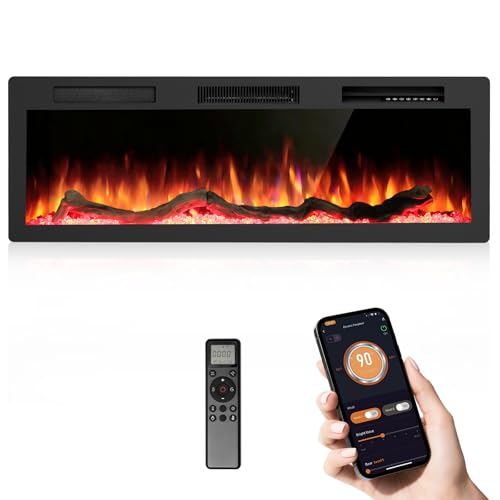
Product 1 isn’t a gas heater, but it’s a useful alternative when you want wall-mounted heat without a gas line or vent. Its 750 W and 1,500 W modes cover supplemental heating up to 400 sq. ft., with remote, touch, smartphone, and Alexa controls.
Heat output 750 W or 1,500 WRoom coverage Up to 400 sq. ft.Installation Wall-mounted or recessedTemperature range 59–95 °FControls Remote, touch screen, smartphone, Alexa/Wi-Fi
Why it made the cut
Wall-mounted or recessed installation
750 W and 1,500 W heat modes
Remote, touch, smartphone, and Alexa controls
Low-noise operation
Good to know
Electric rather than gas-powered
Supplemental heat is limited to up to 400 sq. ft.
Requires an electrical outlet
Skip it if Skip it if you specifically need natural gas heat or operation during a power outage.
For most homes, the best gas wall heater is a direct-vent natural gas model because its sealed combustion system draws air from outside and sends exhaust outside. That makes it the sensible indoor gas wall heater for an airtight room, provided your home has natural gas and the installation meets local code.
In short
The best wall gas heaters are chosen in this order: venting, fuel availability, room size, then controls and heating style. A search for the best gas wall furnace 2025 may lead you to older advice, but the same rule still applies in 2026: match the heater to the room and the venting allowed in your home.
Choice
Best fit
Main trade-off
Direct-vent natural gas
Homes with a gas line and an approved exterior wall
Needs vent installation and professional gas work
Direct-vent propane
Rooms without a natural gas connection
Uses propane tanks and still needs exterior venting
Vent-free natural gas or propane
Spaces where local code permits them and ventilation is adequate
Adds water vapor and trace combustion byproducts to the room
Electric wall fireplace
Homes without gas service or venting access
Usually costs more to run for long heating periods
Venting and fuel narrow the field before BTU becomes the deciding number.
Natural gas connects to the home line and usually has lower fuel costs, while propane suits a house without natural gas service. Buy the fuel type you need; conversion kits are rarely available, and assuming any heater can switch between natural gas and propane is an expensive way to end up with the wrong appliance.
A 21,500 to 30,000 BTU wall heater covers the common larger-room range, while smaller rooms need less output. The number is a ceiling, not a target to chase: a 10,000-BTU heater covers roughly 350 to 500 square feet, and a 20,000-BTU heater handles up to about 700 square feet under typical assumptions. The next section works through the sizing math.
Good reasons to choose direct vent
Combustion air comes from outdoors
Exhaust leaves through the wall
Better suited to tighter, more airtight rooms
Natural gas models can provide steady whole-room heat
Reasons to choose something else
Requires an approved vent route
Natural gas installation usually needs professional help
Placement is limited by the exterior wall and local code
Bedrooms are a venting and code question before they’re a BTU question. A direct-vent model may be allowed where a vent-free heater isn’t, but local rules and the heater’s listing control the answer; check both before buying. Bathrooms are generally a poor location for natural gas wall heaters because moisture, combustion, clearances and local restrictions make the room a bad match.
For a drafty room, infrared heating warms people and objects directly, while blue flame technology mainly warms the room air by convection. Those labels matter after you have chosen legal venting and the right fuel. The Rinnai EX22DTWN is the strongest example here for shoppers who want a direct-vent natural gas wall furnace with a modulating burner and smart-home integration; the Comfort Glow 17,000 BTU Direct Vent Natural Gas Wall Heater is the simpler route for a smaller installation.
Don’t treat vent-free as harmless
Vent-free heaters have no external flue, so their water vapor and trace combustion byproducts remain indoors. An oxygen depletion sensor and automatic shutoff are useful safeguards, but they don’t erase ventilation needs or local code limits. Never use an outdoor, patio or construction heater indoors.
How To Size BTUs For Your Room
Match the heater to the room’s square footage first: a 10,000-BTU unit suits roughly 350 to 500 square feet, while 20,000 BTU handles up to about 700 square feet. A 12 × 14 room is 168 square feet, so choose the smallest output listed for that room by the manufacturer rather than jumping to a 20,000-BTU heater.
Room dimensions
Area
Starting point
12 × 14 ft
168 sq. ft.
Smallest listed output
15 × 20 ft
300 sq. ft.
Smallest listed output
20 × 25 ft
500 sq. ft.
About 10,000 BTU
20 × 30 ft
600 sq. ft.
Up to about 20,000 BTU
These are starting points, not a substitute for the heater’s sizing chart or local code.
Drafts, high ceilings and poor insulation push you toward the higher end of a range because more heat escapes before the room reaches the thermostat setting. A 500-square-foot room with leaky windows may need more output than a tight, insulated room of the same size; don’t solve a cold floor or open doorway by blindly buying the biggest burner.
Worked Example
Say your den is 20 × 25 feet, or 500 square feet. A 10,000-BTU heater sits at the stated range’s upper edge. If that den has high ceilings and noticeable drafts, compare a larger listed output, then confirm the manufacturer allows it for the room and installation. Oversizing can cause short heating cycles and uneven comfort.
Room20 × 25 ft
Area500 sq. ft.
Reference outputAbout 10,000 BTU
Heating method changes how that output feels. Infrared heating warms people and nearby objects directly, so it gives faster spot heat in a drafty area. Blue flame technology warms the room’s air by convection and usually spreads heat more evenly through the space. Pick infrared for quick comfort near the heater; pick blue flame when the goal is steadier room-wide air temperature.
Myth
A vent-free heater is automatically safe because it has an oxygen depletion sensor.
Fact
The sensor can shut the burner down when oxygen falls too low, but a vent-free heater still releases water vapor and trace combustion byproducts indoors and needs the ventilation required by its manual. A direct-vent heater uses sealed combustion: it draws air from outside and sends exhaust outside, making it the better gas wall heater with a flue when the room needs sealed combustion or local code requires venting.
Before You Choose The Output
Measure length × width and include only the space the heater will actually warm.
Check ceiling height, window drafts and insulation before choosing the high end of the range.
Confirm the heater’s listed BTU range matches the room and fuel type.
Choose a flue or direct-vent model when sealed combustion is needed or required by code.
One Room, One Calculation
A heater rated for 700 square feet won’t heat two closed bedrooms like one open 700-square-foot room. Doors, walls and air movement matter; size each enclosed space separately unless the manufacturer’s instructions say the layout qualifies as one heating area.
Fuel, Venting, And Code Come First
Gas heater safety starts with the correct fuel, approved venting, and a working carbon monoxide alarm; maintenance then keeps the burner, air openings, and vent path clear. Check the manual before installation, keep the heater away from anything combustible, and have gas connections and venting handled by a qualified professional.
Direct-vent and vent-free heaters manage combustion in very different ways. A direct-vent heater uses a sealed combustion system: it draws combustion air from outside and sends exhaust outside through its wall termination, making it the better choice for an airtight room. A vent-free heater has no external flue or chimney, so it releases water vapor and trace combustion byproducts into the room and needs the ventilation required by its manual.
Feature
Direct Vent
Vent Free
Combustion air
Drawn from outside
Taken from the room
Exhaust
Sent outdoors
Released into the room
Room air impact
Lower indoor-air impact
Adds water vapor and trace byproducts
Key safety language
Sealed combustion
Oxygen depletion sensor and automatic shutoff
The venting method matters more than a glossy control panel.
Natural gas and propane also need to match the heater from the start. Natural gas units connect to a home’s gas line, while propane models use liquid propane; conversion kits are rarely available, so buy the exact fuel type you have instead of assuming a dual-fuel conversion will be simple. The Rinnai EX22DTWN is a direct-vent natural gas example; readers without a natural-gas connection should look at a purpose-built propane model or another heat source.
Check Local Code First
Vent-free heaters can be restricted or prohibited in some states and cities, and bathroom installation needs a local-code check; bathrooms aren’t a room I’d recommend for a gas wall heater because moisture, small room volume, and combustion safety leave little margin. Never install an outdoor, patio, or construction heater indoors.
Gas wall heaters can be safe in bedrooms only when the specific appliance is approved for that location and the manufacturer and local code allow it. A direct-vent model is the safer direction for an enclosed bedroom because combustion air and exhaust stay outside; follow the required clearances and place a working CO alarm nearby, but outside the immediate appliance area so the alarm can sense the room properly.
Before You Buy Or Light It
Confirm natural gas or propane on the rating plate; don’t rely on a conversion claim.
Look for the required safety listing and an installation manual for your location.
Confirm an oxygen depletion sensor and automatic shutoff on a vent-free model.
Keep the vent termination and combustion-air openings clear of snow, leaves, and nesting material.
Install and test a working carbon monoxide alarm in any home with a fuel-burning heater.
Arrange professional installation for the gas connection, regulator, and venting when required by local code.
Maintenance That Prevents Trouble
With the heater off and cool, keep dust from collecting around the burner and air openings, and watch for yellow flames, soot, unusual odor, or a pilot that repeatedly goes out. Don’t drill, cap, extend, or modify a vent, and don’t use a heater that shows combustion damage; shut it down and call a qualified technician. For more model-specific venting choices, see the best direct-vent gas heaters for small spaces.
What Running Costs And Noise Really Tell You
A gas heater’s operating cost depends on its fuel burn rate and your local gas price, not the BTU number alone. For natural gas, divide the heater’s input BTU per hour by 100,000 to estimate therms per hour, then multiply by running hours and your utility’s price per therm. For propane, divide hourly BTUs by 91,500 to estimate gallons per hour, then multiply by hours and your tank price per gallon.
Say a 30,000-BTU propane heater runs for 6 hours: 30,000 ÷ 91,500 is about 0.33 gallons per hour, or roughly 2 gallons for that night. Your actual cost is those 2 gallons multiplied by the price you pay. A natural-gas model may cost less to run where a home gas line is available, while propane makes more sense when extending a gas service line would be impractical.
Feature
Blue Flame
Infrared
How it heats
Warms room air by convection
Warms people and objects directly with radiant heat
Best fit
Rooms that need the air temperature raised evenly
Drafty areas or spaces where you want fast nearby warmth
Trade-off
Feels slower near a cold floor or open doorway
Comfort drops as you move away from the heater
Both types still need the correct fuel, approved installation, and the safety controls specified for the model.
Blue flame technology heats the air first, so it suits an enclosed room with reasonably even insulation. Infrared heating warms furniture and people directly, which can feel quicker in a drafty spot. Neither label replaces sizing; an oversized heater can cycle more often and make the room swing between too warm and too cool.
Power outages don’t automatically rule out gas heat. Some direct-vent and vent-free heaters use a standing pilot or electronic ignition with battery backup and can operate without household electricity, but the exact model decides. A blower, display, remote, or smart control may still stop working, so check the manual for outage operation before treating that feature as a guarantee.
Modulating burners and thermostatic control improve comfort by changing output or cycling the burner around a set temperature instead of running full blast until the room overshoots. The Rinnai EX22DTWN combines a modulating burner with smart home integration; that connectivity is useful if you want remote scheduling, but a reliable wall thermostat is enough for basic heating.
Noise comes from the burner, ignition, blower, and cabinet—not from the BTU rating by itself. Fanless models avoid blower noise, and a well-built stainless burner can keep combustion quieter; a light cabinet buzz or clicking during ignition may still occur. Direct-vent units are often among the quieter choices, while a fan-equipped heater will make its presence known whenever the blower starts.
Listen Before You Buy
Check the manual for blower and ignition details, then read reviews for cabinet buzz or repeated clicking rather than vague claims about quiet operation. Smart home integration is a nice extra; it won’t fix poor sizing, noisy hardware, or an unsuitable vent arrangement.
Installation, Maintenance, And Lifespan
Professional installation is the safe default for a gas wall heater: gas connections, venting, and wall penetrations usually require a licensed technician. DIY work is limited to tasks your manual and local code explicitly allow, such as mounting preparation or final trim. A properly installed heater can last many years, but burner condition, corrosion, vent damage, and neglected service decide when it is done. Routine care means dusting the cabinet, keeping the intake and exhaust clear, checking the flame pattern, and inspecting the pilot or igniter.
Installation cost depends on the wall and the heater, not only the BTU rating. A direct-vent model may need a vent kit, an exterior wall opening, wall-mounting hardware, approved clearances, and a gas-line connection. The technician also needs room to route the vent correctly and keep its termination away from obstructions. Those details can make a simple replacement far less involved than fitting a heater where no gas line or vent opening exists.
1
Confirm the fuel
Check the data plate and manual for natural gas or propane before anything is connected. Don’t assume a conversion kit exists; buy the exact fuel type specified for your home.
2
Plan the wall location
Mark the mounting height, clearances to combustibles, gas-line route, and direct-vent termination. The listed clearances and local code control the layout.
3
Have the pro connect it
A licensed technician should install the gas shutoff, make the gas connection, fit the vent, seal the wall penetration, and test for safe operation.
4
Check the first burn
Watch the startup and flame through the viewing area. The pattern should match the manual; yellowing, soot, delayed ignition, or a flame that lifts from the burner needs service.
5
Schedule yearly service
Have a qualified technician inspect fuel-burning equipment annually, especially before the heating season. Venting must remain unobstructed all year.
Routine Checks
Dust the cabinet and accessible air openings with the heater off and cool.
Keep furniture, curtains, storage, snow, and leaves away from the combustion-air intake and exhaust.
Inspect the pilot or electronic igniter for reliable startup and unusual clicking.
Confirm the carbon monoxide alarm works and is installed as required by local guidance.
Stop If Something Changes
Smell gas, repeated shutdowns, or see soot around the heater? Turn it off, leave the area if you smell gas, and contact the gas utility or a qualified technician. Don’t relight it or keep resetting the control until the cause is checked.
Questions People Ask
How Do Vent-Free And Direct-Vent Gas Wall Heaters Differ In Safety?
A direct-vent heater uses sealed combustion: it draws air from outdoors and sends exhaust outdoors. A vent-free unit releases water vapor and trace combustion byproducts indoors, so ventilation and a working carbon monoxide alarm matter; an oxygen depletion sensor is useful but doesn’t replace those requirements.
Can A Natural Gas Wall Heater Be Converted To Propane?
Only convert a heater when the manufacturer lists an approved conversion kit for that exact model. Kits are uncommon, and the work changes gas pressure and burner setup, so buying the correct fuel version and using a licensed technician is the safer path.
Are Gas Wall Heaters Safe To Use In Bedrooms?
A direct-vent model may be allowed in a bedroom when its installation manual and local code permit it, with the required clearances and a working CO alarm. Avoid sleeping with a vent-free heater running, and don’t install a gas heater in a bathroom unless local rules and the manual specifically allow it.
How Much Does It Cost To Operate A Gas Wall Heater?
Use the heater’s input rating, runtime, and your gas rate. For example, a 30,000-BTU unit running at full input uses about 0.3 therm per hour; eight hours at $1.50 per therm costs about $3.60, before cycling reduces the actual total.
Is Professional Installation Mandatory For A Gas Wall Heater?
Local law decides, but gas connections, venting, permits, and wall penetrations usually belong to a licensed technician. Even where DIY mounting is allowed, have the finished installation inspected and leak-tested before operating the heater.