



Basements fight you with concrete, damp air and heat loss through the slab and rim joists. That changes the shortlist fast. A good pick for a finished basement can be a poor fit for an unfinished one.
If you want the quick rule: use a mini-split for whole-basement comfort, radiant floor heat for a remodel with tile, and a portable space heater only for one small zone or a backup.
Basement Heating Picks Compared
| Model | Best for | Heat output | Voltage | Coverage | Price |
|---|---|---|---|---|---|
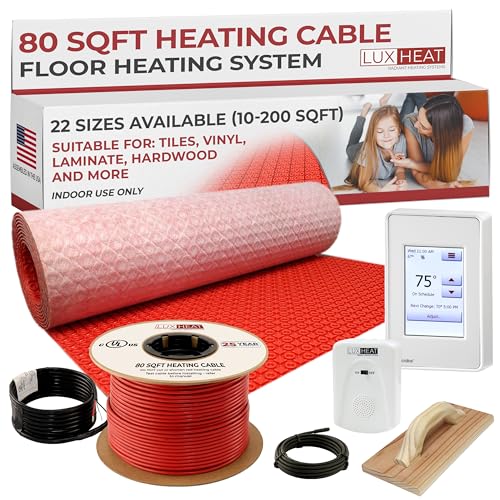
| LuxHeat 80 Sq Ft Radiant Floor Heating Kit | Best for full remodels | 960 W | 120 V | 80 sq ft at 3 in spacing | See current price |
| LuxHeat 50 Sq Ft Radiant Floor Heating Kit | Best for small zones | 600 W | 120 V | 50 sq ft at 3 in spacing | See current price |
| SunTouch WarmWire 120V 30 Sq Ft Cable | Best for odd layouts | — | 120 V or 240 V | 30 sq ft | See current price |
| ELIAS Infrared Wall Heater for Mold | Best for damp walls | — | — | Wall and ceiling surfaces | See current price |
Picks For Basement Heating Projects
LuxHeat 80 Sq Ft Radiant Floor Heating Kit
LuxHeat 50 Sq Ft Radiant Floor Heating Kit
SunTouch WarmWire 120V 30 Sq Ft Cable
ELIAS Infrared Wall Heater for Mold
How To Choose A Basement Heater
Start with what the basement is for, because that one answer rules out half the options. A whole floor you’ll actually live in wants a ductless mini-split heat pump: it’s the most energy-efficient way to heat a basement and it cools the same space in July. One finished room points to a baseboard heater or radiant floor mats. A damp, unfinished storage space needs the cheapest thing that keeps pipes from freezing and moves air off wet concrete — not a system you’ll be paying for all winter.
Cost-effective heating for a basement almost never means the lowest sticker price. It means the lowest cost per delivered BTU in a room that runs 5–15°F colder than the floor above, so you’re asking every heater to work harder than it would upstairs. A mini-split delivers roughly three units of heat per unit of electricity; a plug-in resistance heater delivers one. That gap is the whole ballgame on a January bill.
| Option | Installation | Humidity | Coverage |
|---|---|---|---|
| Ductless mini-split | Pro install, refrigerant lines, condensate drain | Dehumidifies while it heats | Whole basement, zoned |
| Electric radiant floor | Mats or cable, thermostat, floor tear-up | Dries floor, no air movement | One room or slab area |
| Hydronic baseboard | Plumbing to boiler, or 240 V circuit | Neutral | Along walls, quiet |
| Portable space heater | Plug in | Can stir damp air, no drying | One spot, 150–200 sq ft |
| Extended ductwork | Duct run, return path, balancing | None | Uneven, thermostat fights you |
Installation complexity is where budgets quietly break. A ductless mini-split needs a licensed installer, a wall penetration for the line set, and a condensate path — a few thousand dollars of work before the first warm afternoon. Electric radiant floor heat like the LuxHeat 80sqft Electric Radiant Floor Heating System is a middle path: you lay mats or cable under the finished floor, wire a thermostat, and you’re done, but you’re doing it during a renovation, not after. The SunTouch WarmWire 120030WD-BST cable works the same way where mats won’t fit around a toilet or a floor drain. Portable heaters and baseboard units need a circuit and a cleared wall. That’s it.
Damp basements change the answer. Every heater warms air, but a wet room needs one that doesn’t just push that warm, humid air in circles — that’s how you get condensation on cold concrete and a musty smell by February. A mini-split pulls moisture out of the air as it runs. Radiant floor heat dries the slab from below, which is why it feels so good on bare feet. If the space smells like a cellar, deal with the water first: a dehumidifier and something like ELIAS Mold killer on the affected surfaces, then heat.
Controls matter more in a basement than anywhere else in the house. A smart thermostat lets you schedule heat around actual use instead of heating an empty room all day, and freeze protection mode on a ductless heat pump keeps pipes from bursting when you’re away — a feature that pays for itself the first hard freeze. If you extend existing ductwork instead, know the trade: long runs lose heat to the cold space they pass through, and a thermostat upstairs will happily let the basement sit at 55°F because the hallway reads fine.
If you want the shortlist rather than the theory, start with the best basement heating options and work backwards to the one that matches your space.
Where The Heat Actually Goes
Cheap home heating solutions start with stopping loss, not adding watts. A basement sitting 5–15°F below the rooms above it is losing heat through concrete, air gaps and duct runs before any heater gets a chance.
The sizing bridge is simple. A finished room up to roughly 150 sq ft can work with electric radiant floor heat or a compact unit. An open basement — say 24 by 24 feet with a stairwell and no interior doors — needs a whole-space system, because one portable unit can’t reach the far corner.
| Basement type | What it needs first | Likely system |
|---|---|---|
| Finished, under 150 sq ft | Rim joist and band sealing | Radiant floor heat or compact unit |
| Finished, 300–600 sq ft | Insulated walls, sealed gaps | Ductless mini-split or baseboard |
| Open, unfinished | Rim joist sealing, wall insulation | Whole-space system |
| With exposed ductwork | Insulated supply runs | Sealed ducts plus one heat source |
Unfinished basements leak through the rim joist — the band where the floor framing meets the foundation. Sealing and insulating that band before buying another heater is the highest-return move you can make, and it’s the step ENERGY STAR’s basement air sealing and insulation guidance covers in detail. Contractors often find the biggest gaps there, not in the concrete itself.
Ducts matter too. If your furnace supply lines run through the basement uninsulated, you’re paying to heat the joist cavity. Sealing and insulating those runs can recover heat that never reaches the rooms above — or the basement floor you’re trying to warm.
A ‘cheap’ heater gets expensive fast. A 1,500 W portable unit running 8 hours a night draws 12 kWh. At 17 cents per kWh, that’s about $2.04 a night, or roughly $61 a month, for one room. Two units in an open basement doubles it.
| Heater | Watts | Per hour | Per day (8 h) | Per month (30 days) |
|---|---|---|---|---|
| 1,500 W portable space heater | 1,500 W | 26¢ | $2.04 | $61.20 |
| Ductless mini-split heat pump (typical draw) | 700 W | 12¢ | 95¢ | $28.56 |
| Electric radiant floor heat, 80 sq ft | 960 W | 16¢ | $1.31 | $39.17 |
Portable space heaters alone are a poor fit for whole-basement heating. They heat the air around them, not the concrete, and they run long enough in a basement to show up on the bill. For a hall with no insulation, a single 1,500 W unit can take the chill off a pass-through, but it won’t hold a 600 sq ft open floor. If that’s your layout, heating large basements with a properly sized system is the better route.
For small houses, the math favors a mini-split or baseboard over multiple portables. A ductless mini-split heat pump draws roughly 700 W to deliver heat a 1,500 W resistance heater struggles to match, and it can cool the space in summer. That efficiency difference is why it wins for most basements — but only after the envelope is sealed.
Radiant floor heat suits finished rooms where you want even warmth underfoot. The LuxHeat 80sqft and 50sqft systems and the SunTouch WarmWire 120030WD-BST cable are sized to specific square footages, so measure the finished floor area before choosing. They’re quiet and invisible, but they run on resistance electricity, which is the most expensive way to heat a large open space.
If your basement has had moisture problems, fix those before adding heat. A wet floor or musty smell means the ELIAS Mold killer and a dehumidifier belong in the plan first — heat plus trapped moisture is a recipe for a damp, uncomfortable room.
Finished Versus Unfinished Basements
The basement you have decides the answer more than your budget does. Finished space with drywall, carpet and a couch wants a quiet, controlled heat source you can live with. Bare concrete and exposed joists want something that shrugs off damp and doesn’t care about dust.
Finished Basements: Comfort First
A ductless mini-split heat pump is the top pick in finished space. It heats and cools, runs at low noise, and dehumidifies in summer, which matters in a room that already smells like a cellar in July. A single indoor head covers most finished basements up to about 500 sq ft.
If you’re already pulling up flooring, electric radiant floor heat is the quietest option there is. Warm boards at 80°F mean no fan noise, no dust movement, and even warmth from the slab up. The LuxHeat 80sqft Electric Radiant Floor Heating System suits a mid-size finished room; the 50sqft kit fits a smaller nook or bathroom. SunTouch WarmWire 120030WD-BST Radiant Floor Heating Cable is the mat-free route when the room has an odd shape.
Hydronic baseboard heaters fed from your existing boiler are the third path, and they’re the quietest of the three. Water at 160–180°F moves through fin-tube, and you get the same even warmth as a radiator without the electric bill spike.
Unfinished Basements: Toughness First
Unfinished space is a different job. Concrete sweats, dust collects, and anything with a fan will pull that grit through its own bearings. A mini-split still works if you mount the head high and keep the filter clean. Otherwise, a baseboard heater or a single portable unit in one zone is the honest answer.
Baseboard heaters are cheap to install, silent, and tolerate a damp room better than most electronics. A 1,500 W unit draws 12.5 A, so it needs its own 15 A circuit or a 20 A circuit shared with nothing else. For one corner — a workbench, a laundry area — a portable heater with tip-over and overheat protection is fine as long as you keep 3 feet of clearance and never run it on an extension cord.
Radiant Floor: Electric Versus Hydronic
Electric radiant is the retrofit play. You lay mats or cable over the slab, pour self-leveling compound, and set the new floor on top. It works when you’re already replacing flooring, and it’s a bad idea if you’re not.
Hydronic radiant is the bigger renovation. You’re running PEX in a slab or over a subfloor with plates, plus a manifold and a boiler or heat pump to feed it. It costs more up front and pays back over many winters. If you’re finishing a basement from scratch, it’s worth pricing. If the floor is staying, it isn’t.
Different Rooms, Different Answers
A laundry room is cold, damp and often has a dryer venting moisture into it. Heat it with a small wall-mounted baseboard or a dedicated mini-split head, not a portable unit sitting on a wet floor. A game room with a TV and people in it needs quiet heat and a smart thermostat so you’re not heating an empty room all day. A workshop corner needs directed heat that recovers fast when the garage door opens — a PTC ceramic portable with oscillation beats a slow radiant panel there.
If you want to compare the specific units side by side, the best space heater for basement guide breaks down wattage, noise and coverage for the models that actually fit these rooms.
Safety, Moisture And Controls
Every plug-in heater in a basement follows the same three rules: a wall outlet that can carry it, 3 feet of clearance on all sides, and a listing mark from UL, ETL or CSA on the label. A 1,500 W unit pulls about 12.5 A, which is most of a 15 A circuit. Never run one on an extension cord or power strip, and never tuck it against a curtain, a box of holiday decorations or the back of a couch.
Heating solutions that work when the power is out are a different animal. A wood or pellet stove with a properly listed chimney is the only common option that keeps producing heat through an outage, and it needs clearance to combustibles per its listing plus a working CO alarm nearby. Kerosene and propane heaters can run without grid power, but only indoor-rated models with an oxygen depletion sensor, only with the ventilation the manual specifies, and never while you sleep unless the manufacturer says so.
Low-cost infrared heating solutions are safe when they’re electric and listed, and they warm people and objects rather than air, which suits a cold corner or a workbench. Radiant floor heating and electric radiant floor heating sit in the same family and carry no combustion risk at all. The catch is that none of them fix damp air, and damp air is what makes a basement feel colder than its thermostat reading suggests.
Humidity slows comfort because moist air takes more energy to warm, and it feeds mold on joists, drywall and stored cardboard. Keep the basement between 30% and 50% relative humidity with a dehumidifier or the mini-split’s dry mode, and deal with any existing growth before you heat the space. The _ELIAS Mold killer_ is worth having on hand for surface mold on joists and framing while you sort out the moisture source.
For controls, the best thermostat options for basement heating are ones you can schedule and check remotely, because basements get forgotten. A smart thermostat with freeze protection mode holds the space around 45–50°F so pipes in the rim joist don’t burst, then ramps up before you use the room. Pair it with a separate humidity reading if your thermostat doesn’t measure it.
One more piece of the missing piece: air quality. Sealing and insulating the rim joist and band area cuts both heat loss and the moist outside air that feeds mold, and it’s the cheapest comfort upgrade in most basements. ENERGY STAR’s basement air sealing and insulating guidance walks through the materials and where they go. Get that done before you spend money on watts you’ll lose anyway.
What Competitors Leave Out
Yes, electric radiant floor heating retrofits into existing basements more easily than most people expect. Mats and cables like the LuxHeat 80sqft system or the SunTouch WarmWire 120030WD-BST roll out over a concrete slab and get buried in thinset or a self-leveling pour, which adds roughly 3/8 to 1/2 inch of floor height. Hydronic radiant floor heating is a different animal: it belongs in new builds or gut renovations, where tubing goes into a fresh slab or subfloor before anything covers it.
Portable space heaters are safe for continuous use in a basement if the unit is listed by UL, ETL or CSA, plugged directly into a wall outlet, and given 3 feet of clearance on all sides. What they aren’t safe for is unsupervised overnight operation in a room where kids or pets can knock one over, unless the maker explicitly rates the model for it. Tip-over and overheat shutoffs are the two switches to confirm before you trust one.
Duct losses are the quiet thief. Basement ducts running through cold, uninsulated space can shed a meaningful share of their heat before it reaches the register, and a thermostat on the first floor never sees the basement at all. Insulate the duct runs, seal the joints with mastic rather than tape, and close the rim joist with rigid foam or spray foam — that last step is where basement air sealing and insulation work pays back fastest. The register heater trick rarely fixes a supply problem; it usually just moves the shortfall around.
Wood and pellet stoves can work in a basement, but only with a dedicated chimney or listed vent that meets clearance to combustibles and local code, plus combustion air the stove can actually pull. A wood-burning fireplace is the trap: it typically pulls more heated room air up the flue than it radiates back, so it can make the basement colder, not warmer. Pellet stoves with a sealed vent and an outside air kit are the more defensible choice where code allows them.
| System | Routine upkeep | Service interval |
|---|---|---|
| Ductless mini-split heat pump | Rinse or vacuum the filter; keep the outdoor unit clear of leaves and snow | Filter monthly in season, professional service every 1–2 years |
| Electric radiant floor heat | Almost none — no filters, no moving parts | Verify the thermostat and GFCI once a year |
| Hydronic baseboard or radiant | Bleed air, check for leaks, keep fins dust-free | Annual boiler service by a technician |
| Portable or baseboard electric | Vacuum the intake and element area | None required beyond inspection |
Long-term math flips the sticker price. A mini-split costs more upfront but runs at roughly two to three units of heat per unit of electricity, so several winters of use can erase the gap against resistance heat that converts every watt into one unit of heat. Cheap portable heaters do the opposite: low price, high running cost, and they rarely heat a whole basement on their own. If you’re still deciding what to buy, the best mini-split heat pumps and electric radiant floor heating guides cover the two systems that hold up over years, not weeks.
More Questions, Answered
Which heating method is best for unfinished basements?
How does basement humidity affect heater choice and safety?
What size heater do I need for my basement square footage?
Are portable space heaters safe for continuous use in basements?
Can radiant floor heating be retrofitted in an existing basement?
What thermostat works best for basement heating?

I am a mechanical engineer and love doing research on different home and outdoor heating options. When I am not working, I love spending time with my family and friends. I also enjoy blogging about my findings and helping others to find the best heating options for their needs.
Related guides

Electric Heaters: The Smart Choice for Energy Efficiency
You come home, the house is cold, and every degree you add to the thermostat feels like burning…

How Solar-Powered Heating Units Actually Work—and Where They Make Sense
A solar-powered heating unit turns sunlight into heat for small rooms, sheds or animal shelters. Find out how…
Smart Heater Settings to Slash Energy Bills by 10%
To save energy, set your heater to 68°F (20°C) during the day and lower it at night or…