Product 4 is the best gas fireplace log set for most readers who need real heat: it runs on liquid propane, produces up to 34,000 BTU, includes a remote and has an oxygen-depletion sensor. Choose product 3 for decorative vented logs, or product 1 for an electric fireplace with no gas venting.
Key takeaways
Use product 4 only with liquid propane, its stated firebox dimensions and the ventilation required by its manual.
Product 3 is decorative ceramic log material for compatible vented gas fireplaces; it is not a burner or complete heating appliance.
A vent-free gas log set still burns fuel indoors and needs an oxygen-depletion sensor, the required ventilation and a working carbon-monoxide alarm.
Product 1 or 2 avoids gas and flue work, but each draws up to 1,500 W from a wall outlet and supplies electric supplemental heat.
Never assume an old wood fireplace, gas insert or firebox accepts a new log set without checking its listing and local code.
Gas logs aren’t interchangeable decorations. A vented ceramic log set needs a compatible burner and working flue; a vent-free set has different firebox, fuel and local-code requirements. The wrong match can produce soot, unsafe combustion or a set that simply won’t operate.
One useful number puts the choice in perspective: product 4’s 34,000 BTU output is heating equipment, while product 3 adds appearance only. Decide first whether you need heat, a flame display or a safer electric replacement.
The Best Gas Fireplace Log Sets and Alternatives
#1Best For Real Heat
BETISEF Ventless LP Log Set
Best for LP fireplace heating with remote control
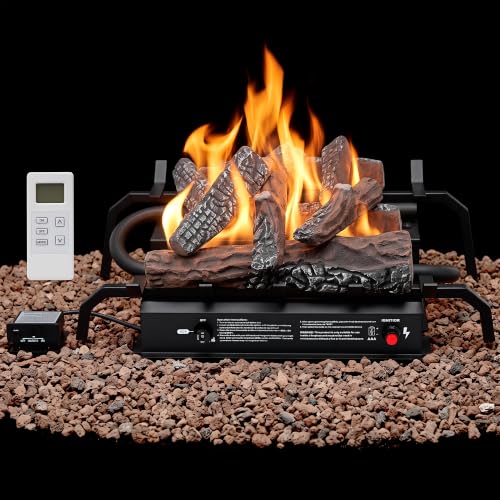
Product 4 is the strongest choice if you want a gas log set that produces real heat. It runs on liquid propane, delivers up to 34,000 BTU, includes a remote with manual and thermostat modes, and has an oxygen-depletion sensor. The listed firebox minimum is 14 inches deep by 32 inches wide and 24 inches high.
Fuel Liquid propaneHeat output Up to 34,000 BTUCoverage Up to 1,100 sq. ft.Firebox minimum 14″ D x 32″ W x 24″ HLog count 9 hand-painted ceramic logs
Why it made the cut
Up to 34,000 BTU of heat
Remote includes manual and thermostat modes
Oxygen-depletion sensor shuts off gas if oxygen gets too low
Good to know
Designed for liquid propane only
Requires the listed minimum firebox size and ventilation
Skip it if Skip it if you have natural gas, need a decorative vented set, or don’t meet the firebox requirements.
Best for Vented fireplaces that need a realistic wood-look display
Product 3 suits a vented gas fireplace where appearance matters more than added heat output. Its 10 ceramic logs have bark textures and natural shapes, and each piece can be stacked or repositioned to fit the firebox. The same set can also dress compatible fireplace inserts and outdoor gas fire pits.
Construction Heat-resistant ceramicLog count 10 individual logsUse Vented gas fireplaces, fireplace inserts, and outdoor gas fiDesign Realistic wood-look with bark textures
Why it made the cut
10 individual ceramic logs
Stackable and repositionable arrangement
Heat-resistant ceramic construction
Good to know
Designed for compatible vented fireplaces
The data does not list a heat output or burner
Skip it if Skip it if you need a complete heating burner, remote control, or a vent-free propane log set.
Best for Adding glowing-coal detail around compatible gas burners
Product 5 is the finishing material for a gas fireplace that already has a compatible burner. Pinch small clumps near the gas ports so the flame makes them glow like coals; the mineral fiber works with natural gas and propane appliances. Follow the appliance manual for vent-free use, since placement rules can differ.
Material Asbestos-free mineral fiberBag size 6 ozFuel compatibility Natural gas and propaneUse Vented and unvented gas appliances
Why it made the cut
Works with natural gas and propane appliances
Asbestos-free mineral fiber
One 6 oz bag can dress a full-size burner pan
Good to know
Adds ember effect but does not provide a burner or heat output
Must not be packed tightly around gas ports
Skip it if Skip it if you need a complete log set, burner, ignition system, or remote.
Best for A gas-free fireplace effect with optional electric heat
Product 1 is the better gas-free alternative when you want flame and log effects without gas equipment. It offers separate flame and heater operation, four flame colors, adjustable flame speed, and 500W or 1500W heating modes. Three-sided clear viewing gives you a wider view of the effect.
Best for Smaller spaces that need a freestanding electric flame effect
Product 2 keeps the electric alternative compact while retaining separate flame and heater operation. You can choose from four flame colors, four wood-log colors, and five flame-speed levels, then use the remote to adjust the effect or select 500W or 1500W heat. Its three-sided clear glass works well when the fireplace is viewed from more than one angle.
Gas fireplace venting requirements start with one rule: vented gas logs need a listed, functioning chimney or vent path, while vent-free logs skip the external flue but still need the room conditions and ventilation stated in their manual. A log set can’t make an unsuitable firebox safe.
Appliance
How it vents
What you must confirm
Vented gas logs
Uses the existing chimney or listed vent
The chimney is open, functional and approved for the appliance
Vent-free gas logs
No external flue
Indoor-rated listing, room size, ventilation and oxygen-depletion protection
Direct-vent fireplace
Sealed combustion; air comes from outdoors and exhaust goes outdoors
The complete fireplace and its vent termination follow the listing
Electric fireplace
No combustion and no gas vent
A suitable electrical outlet and the manufacturer’s clearances
These are different appliance systems, not interchangeable labels.
Local building code, fuel-gas rules and fireplace code control clearances, hearth construction, gas-line work and venting. The appliance listing and installation manual control the model-specific details. Ask your authority having jurisdiction—the local building or fire official—and use a licensed gas professional for gas connections or changes. For installing a gas fireplace in a finished home in Pennsylvania, start with that local official and the listed appliance requirements; state and local rules can differ.
Vent-Free Still Burns Gas
Vent-free doesn’t mean risk-free. Combustion still happens inside the room, so carbon monoxide remains a hazard. Use only an indoor-rated model, install a working CO alarm, provide the ventilation the manual requires and follow local restrictions; some states and cities limit or prohibit vent-free gas appliances.
Myth
A vented gas fireplace only needs a decorative chimney opening.
Fact
Vented logs depend on an open, functioning and listed vent path that carries combustion products outdoors. Have a blocked, damaged or unused chimney inspected before installation. If sealed-combustion performance is your priority, compare the direct vent gas fireplace venting requirements for complete direct-vent units instead.
The 24″ Ventless Gas Fireplace Logs Set with Remote and Burner is LP-only. Its listed minimum firebox is 14 inches deep, 32 inches wide at the front, 22 inches wide at the rear and 24 inches high; every dimension must fit before you buy. The Barton 10-Piece Ceramic Gas Fireplace Logs listing mentions outdoor fire-pit use, but that does not make the product suitable for an indoor room.
Check Before Ordering
Match the fuel, appliance type, vent path, firebox listing and local approval first. A remote or realistic log shape can’t correct a missing chimney, wrong fuel connection or prohibited installation.
Measure the Firebox Before Choosing Logs
For best gas fireplace logs vented models, match the set to your firebox and venting type; a nominal 18- or 24-inch label isn’t a fit measurement. You can put a gas fireplace in a traditional fireplace only if the appliance is approved for that installation and the fireplace, venting and local code allow it. Product 4 is LP-compatible only, and it’s the only listed option here with complete minimum firebox dimensions.
1
Measure the opening
At the narrowest points, measure front width, rear width, height and depth. Check for grates, lintels or other obstructions that reduce usable space.
2
Compare every dimension
Use the product manual’s minimum and clearance requirements, not the size printed in the product name. Product 4 requires a minimum front width of 29 inches, rear width of 24 inches, height of 17 inches and depth of 13 inches.
3
Confirm fuel and appliance type
Product 4 is for liquid propane (LP), not natural gas. Don’t connect it to a natural-gas line, and don’t assume a 20-pound cylinder is an approved permanent fireplace supply.
Part or detail
What it tells you
Ceramic logs
Product 3 is a decorative log set; logs alone don’t provide a burner or gas controls.
Ember material
Product 5 adds rock wool embers; it doesn’t replace a burner or fireplace components.
Complete gas appliance
A gas log set needs the specified burner, gas valve, ignition and approved firebox. Confirm what the set includes in its manual.
A log set, ember material and complete gas appliance aren’t interchangeable.
A gas fireplace gas tank is not a universal solution: the appliance must be listed for its fuel and supply arrangement. There isn’t one common home fireplace gas valve size that fits every installation; valve and gas-line sizing depend on the appliance specifications and supply. A licensed professional should handle gas-line sizing, shutoff valves, regulator questions and installation.
Before You Buy
Identify whether your supply is natural gas or LP.
Check that the firebox and venting are approved for the appliance.
Compare all four measured dimensions with the manual.
Confirm which burner, valve and ignition parts are included.
Compare Gas Heat With Electric Flame Effects
Replacing gas with electric is usually an appliance replacement, not a gas-log conversion. To replace a gas fireplace with electric, have a qualified professional shut off and disconnect the gas, then choose an electric appliance made for the space; don’t assume a freestanding heater fits the old firebox.
Products 1 and 2, the R.W.FLAME 25-inch and 17-inch models, are freestanding electric fireplace heaters, not inserts shown to fit an existing gas firebox. Both can display flame effects without heat, so you can get the look without running the heater. For electric logs designed to sit in a fireplace, see electric log sets with built-in heaters; check that product’s fit requirements separately.
What One Hour Costs
At full output, a 1,500 W heater uses 1,500 W ÷ 1,000 × 1 hour = 1.5 kWh. At an assumed electricity rate of $0.17 per kWh, 1.5 × $0.17 is about $0.26 for an hour before the thermostat cycles the heater off and on.
Power1,500 W
Assumed rate$0.17/kWh
Cost at full outputAbout $0.26 per hour
Use the Wall Outlet
Plug an electric fireplace heater directly into a wall outlet, never an extension cord or power strip. Keep combustibles at least 3 feet away, and follow the manual’s operating instructions.
Electric Flame Effects
Products 1 and 2 can show flames without heat.
No gas combustion or gas supply is needed to run their flame effects.
What to Check
These freestanding models aren’t proven to fit an existing gas firebox.
Electric heat adds to your bill while the heater runs.
If you’re switching a gas fireplace to electric, the practical route is to disconnect the gas professionally and install an electric appliance that fits the intended location. A gas fireplace can be replaced by an electric one, but that doesn’t make a freestanding model an insert or establish that it fits the old opening.
Set Up Glowing Embers Without Blocking the Burner
For gas fireplace glowing embers, use only ember material approved by your appliance manual, and keep it clear of burner ports. Rock wool glows where flames touch it; ceramic logs shape the flame picture. Neither should be packed tightly or arranged to cover burner openings.
The best embers for a gas fireplace are the type and amount specified for that exact appliance, not whichever material looks most realistic. Midwest Hearth Rock Wool for Gas Fireplace Embers, Made in… is one accessory example, but use it only if your manual approves it for your vented or vent-free setup.
1
Confirm the appliance type
Check the rating plate and manual before adding anything. A gas unit has a fuel valve and burner, plus venting or combustion-air provisions; an electric unit has a cord and heating outlet. Those clues can help you look, but the rating plate is the reliable identification.
2
Let the fireplace cool
Turn the appliance off and wait until the logs, burner and ember material are cool. Arrange them using the supplied placement diagram exactly; don’t improvise to change the flame shape.
3
Clean glass only as directed
For the best gas fireplace glass cleaner, use only the cleaner and cleaning procedure named by the manufacturer. The wrong product or method can damage the glass. Never alter logs or burner ports to improve the appearance.
Stop if the flame or glass looks wrong
Soot, yellow flames where the manual expects blue, a damaged glass panel, an unusual odor or a CO alarm means stop using the appliance. Have a qualified technician inspect it before you run it again; don’t try to correct the flame by shifting logs or clearing ports yourself.
Myth
More ember material makes a better-looking fire.
Fact
Too much material can obstruct burner ports and disrupt the flame. Use only the approved amount and placement in the appliance manual; appearance isn’t a reason to pack or rearrange it.
Frequently Asked Questions
Does a gas fireplace need electricity?
Many gas fireplaces can heat during a power outage because a standing pilot or millivolt valve doesn’t need household electricity. Electronic ignition, a blower, or a remote may need batteries or an outlet, so check the appliance manual before relying on it for backup heat.
How do you start a gas fireplace?
Follow the control sequence in the fireplace manual, which usually involves opening the gas control, selecting Pilot, and using the igniter. If you smell gas, don’t ignite anything; leave the area and contact your gas supplier or fire department from outside. Never bypass the pilot safety system.
Can I put a gas fireplace in a traditional fireplace?
You can install a listed gas log set in some traditional masonry fireplaces, but the firebox dimensions, chimney, gas supply, damper position, and local code must all match the appliance. Have the chimney inspected before using vented logs, and don’t assume an old wood-burning fireplace is automatically suitable.
Can propane be used with a gas fireplace?
Propane works only with a fireplace or log set listed for liquid propane, or with the manufacturer-approved conversion parts installed correctly. Natural-gas and propane orifices, regulators, and pressures differ, so a qualified gas technician should make the conversion and connection.
Can gas fireplace logs be used outdoors?
Indoor gas logs shouldn’t be used outdoors because their listing, burner, controls, and ventilation assumptions are different. Choose an outdoor-rated set installed in its approved enclosure, and protect the gas connection and controls as the manual requires.
How do gas fireplace glowing embers work?
Approved ember material catches the burner flame and spreads the glow so it resembles hot coals; it doesn’t create extra fuel or replace the burner. Arrange it only as shown in the manual, keeping burner ports and the pilot opening clear, because misplaced fibers can change the flame pattern or cause soot.