For a 50-gallon electric water heater, choose a standard tank only after checking its first-hour rating, physical fit and electrical requirements against your household and existing setup. The supplied product options are space heaters and an electric fireplace, not water heaters, so no responsible product pick or ranked comparison can be made from this data.
A 50-gallon tank is a common replacement size, but the gallon label alone won’t tell you how well it handles a morning shower rush. Match the tank’s first-hour rating and recovery time to your actual hot-water use.
The belief that every 50-gallon electric tank performs about the same is only half true: capacity may match, while recovery, dimensions and installation requirements differ.
Choosing a 50-Gallon Electric Water Heater
#1Room Heat Only
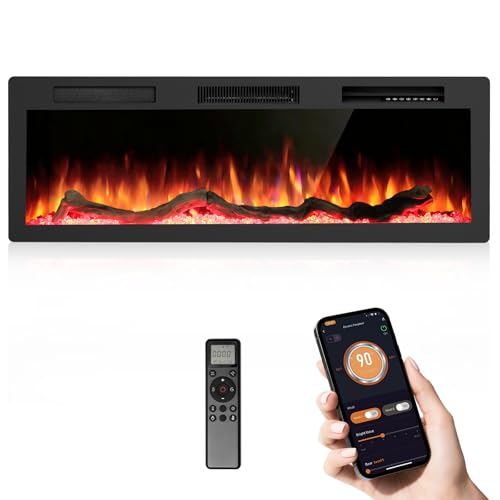
R.W.FLAME 50-Inch Electric Fireplace
Best for Supplemental heat and fireplace effects in a room
This wall-mounted or recessed fireplace offers 750W and 1,500W heating modes and adjustable flame effects. Its listed dimensions are for the fireplace, not a water heater tank, so it won’t supply household hot water.
Heating modes 750W and 1,500WDimensions 50″L x 17.32″H x 5.71″WTemperature range 59-95°FListed heating area Up to 400 square feet
Why it made the cut
Two heating modes: 750W and 1,500W
Wall-mounted or recessed installation
Remote, touch, smartphone and voice controls
Good to know
Not a water heater
Requires an appropriately sized wall opening for recessed installation
Skip it if Skip it if you need a tank to supply showers, sinks or appliances.
Best for Supplemental heat at a home or office desk
The compact ceramic heater has low and high settings of 950W and 1,500W, plus tip-over and overheat shutoffs. Those features suit supplemental room heat; they don’t heat water for your plumbing.
Heating settings 950W and 1,500WDimensions 6.22 x 6.22 x 8.78 inchesWeight 3.53 poundsPower cord 6 feet
Why it made the cut
Low and high heating settings
Tip-over and overheat protection
ETL certified
Good to know
Not a water heater
The listed heating area is 108-130 square feet
Skip it if Skip it if you’re replacing a household hot-water tank.
Best for Supplemental heat in a small room or office
This portable heater lists a 1,500W setting, a thermostat and a 24-hour timer, with remote and touch controls. It is for room heating, not for storing or delivering domestic hot water.
Power 1,500WListed heating area Up to 200 square feetTimer 24 hoursNoise level 35dB
Why it made the cut
1,500W heating setting
24-hour timer and ECO mode
Tip-over and overheat protection
Good to know
Not a water heater
The listed heating area is up to 200 square feet
Skip it if Skip it if you need a replacement for a 50-gallon water heater tank.
Best for Supplemental heat in an office or bedroom
The DREO uses a 1,500W PTC ceramic system and lists a 34dB noise level, with a thermostat adjustable from 41-95°F. Those are room-heater features, not tank capacity or water-heating specifications.
Power 1,500WThermostat range 41-95°FNoise level 34dBHeating technology PTC ceramic
Why it made the cut
1,500W PTC ceramic heating system
Thermostat range of 41-95°F
34dB listed noise level
Good to know
Not a water heater
No tank capacity or first-hour rating is provided
Skip it if Skip it if your search is for a household hot-water tank.
This is a kerosene stove for cooking, not an electric water heater. Its listing mentions indoor use, but kerosene combustion can produce carbon monoxide; don’t use it indoors unless it is specifically indoor-rated and the manual’s ventilation requirements are met, with a working CO alarm.
Wick count 8Fuel KeroseneListed burn time Up to 5-6 hoursListed boil time 7-8 minutes
Why it made the cut
Adjustable flame
Listed burn time of up to 5-6 hours per full tank
Portable construction
Good to know
Uses kerosene rather than electricity
Not a water heater
Indoor combustion carries carbon monoxide risk
Skip it if Skip it for water heating, and don’t use it indoors unless its indoor rating and required ventilation are confirmed.
What to Check in a 50-Gallon Electric Water Heater
A 50 gallon electric water heater is a domestic storage tank, not an aquarium heater; the right replacement depends on its first-hour rating, recovery rate, element wattage and dimensions. Searches such as “electric water heater 50 gallon,” “best electric hot water heater 50 gallon tank” and “50 gallon hot water heater electric” point to the same category. The supplied products—an electric fireplace, portable space heaters and a kerosene stove—don’t heat household tank water, so they can’t be ranked as water heaters.
For the best 50 gallon electric water heater for your home, compare the label and installation requirements of actual tank models against your household’s demand and the space and wiring you have. A 50-gallon capacity is a starting point, not a promise of a set number of shower minutes: incoming water temperature, shower flow and reheating all affect the usable supply.
Specification
What to check
First-hour rating
How much hot water the heater can supply during a busy first hour; compare this with your household’s peak demand.
Recovery rate
How quickly the tank reheats water after hot water is used. Compare model data using the same stated conditions.
Element wattage
Whether the model’s electrical requirements match the existing circuit. Confirm the product label and installation instructions.
Tank dimensions
Whether the tank fits the available space, including room for connections and service access.
Compare verified model specifications; gallon capacity alone doesn’t show how quickly a tank can meet demand.
Myth
Two 50-gallon electric water heaters perform the same because they hold the same amount.
Fact
Equal capacity doesn’t mean equal first-hour performance or recovery. Element wattage and the model’s published ratings affect how quickly a tank can supply and reheat hot water.
The phrase “50 gallon electric hot water heater” can lead to products with different dimensions and performance, so check the specific model documentation before choosing. If you’re comparing actual tank options, start with the best 50-gallon water heaters and verify each model’s ratings and fit.
50 gal
Nominal tank capacity
That number describes the tank, not the amount of hot water you can draw before it reheats. Check the first-hour rating and household demand when comparing models.
A 50-Gallon Tank Can Keep Up With Many Households
There’s no fixed number of hot-water minutes from a 50-gallon tank: incoming water temperature, thermostat setting, fixture flow and reheating during use all change the result. For a best 50 gallon residential water heater—or a best rated 50 gallon water heater—compare first-hour ratings, not gallons alone.
The first-hour rating is the amount of hot water a unit can supply during a busy first hour, counting the hot water already stored and the water it reheats as demand continues. It’s a more useful comparison for peak use than tank size by itself.
Read the rating on the unit label
Compare the first-hour rating on each candidate’s label with your household’s busiest hour. For frequent back-to-back showers or laundry running while someone bathes, prioritize that rating over a small difference in tank capacity.
Why shower minutes vary
Suppose a hypothetical household draws 20 gallons of hot water from a 50-gallon tank during showers. That leaves 30 gallons of stored hot water before accounting for incoming cold water or reheating. The example assumes a 20-gallon draw; it doesn’t predict shower time, because fixture flow and water temperature weren’t specified.
Tank capacity50 gallons
Assumed shower draw20 gallons
Stored amount left before othe30 gallons
A best residential 50 gallon water heater is one whose verified first-hour rating fits your peak use and whose electrical and physical requirements match your home. For another buying comparison, see the best 50 gallon water heater options and check the rating for each specific model.
Check Replacement Fit, Cost and Installation
A 50 gallon water heater replacement has to fit the space and the home’s electrical and plumbing setup; a listing at Costco, Home Depot or Lowe’s doesn’t confirm either. Compare the exact model number, specifications, included components, delivery and installation arrangements. That applies to a home depot electric 50 gallon hot water tank and lowe’s electrical hot water tanks 50 gallon just as much as any other listing.
Measure Before You Order
Measure the old tank’s height and diameter, and check the route through doors and hallways for access clearance.
Note the locations and sizes of plumbing connections, then compare them with the replacement’s specifications.
Read the old unit’s nameplate for voltage and element requirements; check the new unit’s specifications and confirm the breaker and wiring are suitable.
If you’re comparing 50 gallon water heater costs or water heater prices 50 gallon, get a quote for the full job, not only the tank. Delivery, removal, installation and any needed code updates can change the total. For model comparisons, see the gallon electric water heater buying guide.
Switching to tankless isn’t a gallon-for-gallon replacement: a qualified professional needs to check peak hot-water flow and whether the home’s electrical service can support the unit. An expansion tank may also be required if the plumbing system is closed; local code and system design decide, not the heater’s 50-gallon capacity. Ask a licensed plumber to determine whether one is needed and how it should be installed.
Leave the Connections to a Pro
Gas connections, venting, 240 V electrical work and T&P valve discharge piping are jobs for a licensed plumber or electrician in most places. Never cap or plug a T&P valve; it needs a safe, unobstructed discharge path.
What a 50-Gallon Electric Water Heater Costs to Run
A 50 gallon water heater costs what its hot-water use and local electricity rate make it cost; tank capacity alone can’t predict the bill. Incoming water temperature, insulation and thermostat setting also affect how much energy the heater uses. For 2026 best hot water heaters, electric 50 gallon, compare verified energy data where available rather than assuming every 50-gallon model costs the same to operate.
For a known electrical load, estimate energy cost as kilowatts × hours energized × price per kilowatt-hour. Say a 4,500 W element runs for one hypothetical hour and electricity costs 17 cents per kWh: 4.5 kW × 1 hour × $0.17 = about $0.77. That’s an example, not an annual-cost estimate; use the actual operating time and your utility rate to calculate your own figure.
Element Rating Isn’t Run Time
A 4,500 W element draws 4.5 kW while it’s energized, but that rating doesn’t mean it runs continuously. The thermostat switches the element on as the water cools, so an annual-cost estimate needs verified energy-use data and a stated utility rate.
Water Heater Safety and the Final Fit Check
A 50 gallon water heater needs a safe temperature setting and an installation that matches its instructions and local code. The same checks apply to a Rheem 50 gallon electric model; the brand name alone doesn’t confirm that a particular tank fits your home or wiring.
Scalding and T&P Valve Safety
Scald risk rises above 120°F at the tap, so check the delivered water temperature rather than relying only on the thermostat dial. Never cap or plug the temperature-and-pressure relief valve. Its discharge line must follow the manufacturer’s instructions and local code.
Follow the exact model’s instructions and local requirements for clearances, electrical connections and T&P discharge routing. In most places, a licensed electrician should handle 240 V work, and a licensed plumber should handle water-heater plumbing. Don’t assume safety features or certifications from another model’s listing.
Photograph the existing unit’s nameplate, including electrical details and model information.
Measure the tank and the available space, including the path needed to bring it in.
Note household hot-water demand and when multiple fixtures run together.
Record the existing circuit and connection details; have an electrician verify any changes.
Check whether the plumbing system has an expansion tank and whether the replacement setup requires one.
Confirm local installation requirements and the new tank’s manufacturer instructions.
More Questions, Answered
How many minutes of hot water does a 50-gallon tank provide?
There isn’t a reliable minutes-per-tank figure: usable hot water depends on the incoming water temperature, how hot the tank is set, and the flow rate of your fixtures. A low-flow showerhead uses less hot water per minute than a high-flow one, and the tank may recover while you’re using it.
What instant water heater can replace a 50-gallon, 4,500-watt tank?
A tankless unit isn’t a direct watt-for-watt replacement for a 4,500-watt tank. Its required capacity depends on how much water you need flowing at once and the temperature rise it must provide; have a qualified professional check the electrical service and plumbing before choosing a model.
Does a 50-gallon water heater need an expansion tank?
It depends on the plumbing system, not the tank’s 50-gallon capacity. A closed system, such as one with a check valve or pressure-reducing valve, may need an expansion tank under local code; have a plumber confirm the setup and size it correctly.
Can I use a 50-gallon electric water heater with my existing breaker?
Only if the heater’s nameplate requirements match the circuit, wiring and disconnect already in place. Check the new unit’s installation manual and have an electrician verify the circuit; don’t assume an existing 4,500-watt heater means every replacement has the same electrical requirements.
Is a Rheem 50-gallon electric water heater a good replacement?
It can be, but the brand name alone doesn’t establish fit or performance. Compare the specific model’s first-hour rating, dimensions, element requirements and warranty with your household’s needs and existing installation before buying.