For most UK homes, choose a convector heater rated for the room, with a thermostat and overheat protection. The listed picks include models specified for 120V US supply, so don’t plug those into UK mains. Confirm the heater is rated for 230V and has a UK-compatible plug before buying.
The essentials
Check the heater’s rating label for 220–240V or 230V before using it in the UK.
Match wattage to the room and insulation; a small panel won’t quickly heat a draughty large room.
A thermostat can reduce wasted run time, but it doesn’t make resistance heating more efficient per unit of heat.
Plug an electric heater directly into a wall outlet, keep 3 feet of clearance and choose a listed model with tip-over and overheat protection.
If the label or instructions don’t confirm UK compatibility, don’t use a plug adapter to make it fit.
A convector warms air as it passes over an element; the warmed air rises and cooler air moves in to take its place. That gives you quiet, gradual room heat, rather than the immediate directional warmth of an infrared heater.
The product specs below don’t establish UK voltage compatibility for most models. Treat them as feature comparisons, not UK-ready recommendations: verify the rating label and manufacturer instructions before purchase.
Convector Heater Picks by Use
#1Best for Larger Rooms
Amaze Classic Convection Heater
Best for Rooms up to 350 sq ft where wall mounting or freestanding use suits
The built-in thermostat regulates temperature, and fan-free convection runs quietly without recirculating dust. It can be wall-mounted or used freestanding, so it suits a room where you want either installation option; check its voltage and plug before buying.
Room coverage Up to 350 sq ftMounting Wall-mounted or freestandingControls Built-in thermostatSafety Thermal cutoff and tip-over switch
Why it made the cut
Built-in thermostat
Wall-mounted or freestanding
Overheat cutoff and tip-over switch
Good to know
Wattage and voltage aren’t stated in the supplied specifications
Skip it if Skip it if you need a confirmed UK-voltage specification before purchase.
Best for Small spaces where you want 1,300W or 1,500W settings
Two heat settings let you choose 1,300W or 1,500W, with a fan-only mode when you don’t need heat. The tip-over shutoff and overheat protection are useful safeguards, but the supplied details don’t confirm voltage or UK-plug compatibility.
Heat output 1,300W and 1,500WModes Fan-only and anti-freezeControls ThermostatSafety Tip-over shutoff and overheat protection
Why it made the cut
1,300W and 1,500W heat settings
Fan-only mode and anti-freeze setting
Tip-over shutoff and overheat protection
Good to know
Room coverage and voltage aren’t stated in the supplied specifications
Skip it if Skip it if you need confirmed UK voltage or a stated room-size rating before buying.
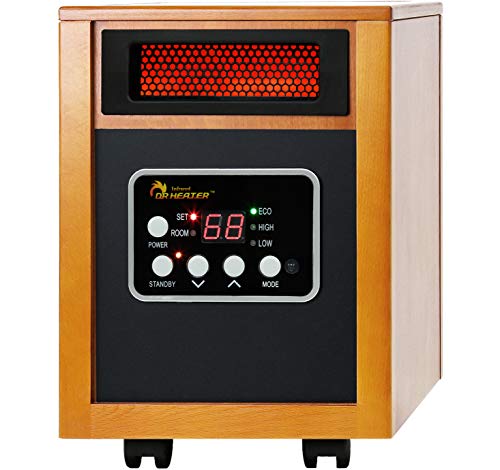
Best for Larger rooms where a portable heater with a remote is useful
Its infrared quartz and PTC dual heating system combines two heat sources, while caster wheels make the 19 lb unit easier to move. The electronic thermostat runs from 50 to 85 degrees, and the 12-hour shutoff timer adds a set-and-stop option; confirm UK voltage and plug compatibility first.
Heat output 1500WCurrent 12.5 ampsThermostat range 50 to 85 degreesWeight 19 lbs
Why it made the cut
Infrared quartz and PTC dual heating system
Electronic thermostat with 50–85 degree range
Caster wheels and 12-hour shutoff timer
Good to know
The 1500W rating draws 12.5 amps
Room coverage isn’t quantified in the supplied specifications
Skip it if Skip it if you need a confirmed UK-voltage model or a stated room-coverage figure.
Best for Small rooms where a remote and timer are useful
The thermostat, remote and 24-hour timer give you several ways to control a 1500W ceramic heater. Its stated coverage is up to 200 sq ft, with tip-over shutoff and overheat protection; the supplied details don’t confirm UK voltage or plug compatibility.
Heat output 1500WRoom coverage Up to 200 sq ftControls Thermostat, remote and 24-hour timerSafety Tip-over shutoff and overheat protection
Why it made the cut
1500W ceramic PTC heat
Thermostat and remote control
24-hour timer, tip-over shutoff and overheat protection
Good to know
The 1500W rating is a substantial load
UK voltage and plug compatibility aren’t stated
Skip it if Skip it if you need a model confirmed for UK mains or a fan-free convector.
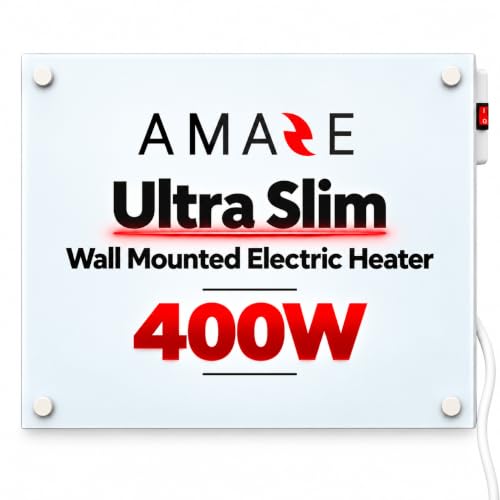
Best for Small rooms up to 120 sq ft with a fixed wall-mounted heater
This 400W panel mounts on the wall and heats without a fan, so it suits a small room where quiet operation matters. Its product data specifies 120V; check the voltage against your supply before buying, since it may not be suitable for UK mains.
Heat output 400WRoom coverage Up to 120 sq ftVoltage 120VMounting Wall-mounted with kit
Why it made the cut
400W output
Wall-mount kit included
Silent, fan-free convection
Good to know
Specified for 120V, not UK 230V mains
Thermostat is compatible equipment, not listed as built in
Skip it if Skip it for a UK home unless the manufacturer confirms a suitable, safe UK configuration.
A convector heater is a sensible pick for quiet, gradual room heating, but check its wattage, controls and electrical compatibility before buying. The best convector heaters UK shoppers can use depend on the room and supply: a model made for 120V must not be connected directly to UK 230V mains.
The supplied product details don’t confirm any listed model is compatible with UK mains. The Amaze Ultraslim Electric Wall Heater (product 3) explicitly lists 120V. The Dr Infrared Heater DR-968 (product 2) lists 12.5A at 1,500W, consistent with 120V supply. Voltage isn’t provided for the R.W.FLAME Small Space Heaters for Indoor Use (product 1) or the BEYOND HEAT 1500W Milkhouse Space Heater (product 5), and product 4 also has no voltage stated. Check the actual rating label and manufacturer’s UK specifications before buying.
Myth
A plug adapter or transformer makes a 120V heater suitable for UK mains.
Fact
It doesn’t establish that the heater is designed or approved for UK use. Don’t rely on an adapter or transformer to make an unsuitable model safe; choose a heater explicitly rated for 230V with a UK-compatible plug.
Check Before You Buy
Look for a 230V rating and a UK-compatible plug in the manufacturer’s specifications.
Match the heater’s output to the room and check that it has a thermostat and stated safety protections.
Treat wattage and claimed room area as clues, not proof of performance in your particular UK room.
A good convector electric heater guide weighs room fit and confirmed supply ahead of a large coverage claim. The pros are quiet, gradual air circulation and even background warmth in an enclosed room; the trade-off is that it won’t give the same immediate, direct warmth as infrared. For more models to compare, see glass convector heater picks.
Match Output to the Room
Convection heaters work well for gradual background warmth in an enclosed room, but they’re slower to warm you directly than an infrared heater. A convector heater works by drawing cool air in low down, warming it at the element and letting it rise; cooler air then moves in to replace it. That circulation is the answer to “what is a convector heater?” in practical terms.
Room size alone can’t tell you how much output you need: ceiling height, draughts, insulation and outdoor temperature all change the heat a room loses. Treat area claims as the maker’s estimate under unspecified conditions, not a universal sizing rule. The Amaze Ultraslim Electric Wall Heater (product 3) is listed at 400W with a claim of up to 120 sq ft; that’s the maker’s claim, not a guarantee, and its modest output is better suited to supplemental heat than quickly recovering a cold room.
A Room That Starts Cold
Say your enclosed spare room is 10 × 12 ft, or 120 sq ft, with a high ceiling and a draughty window. The product 3 claim reaches that floor area, but the draught and ceiling height may increase the heat needed. Use the claim as a starting point, then compare the heater’s output with the room’s conditions; don’t assume it will bring the room to a particular temperature or warm it quickly.
Floor area10 × 12 ft = 120 sq ft
Product 3 output400W
Use the claim asA maker’s estimate, not a guarantee
So, is a convection heater any good? Yes, if you want steady whole-room background heat and can allow time for the air to warm; less so if you need instant warmth on a person or fast recovery from a cold start. How well do convection heaters work in your room depends on heat loss as much as the heater’s area claim. For the difference in airflow, see fan heater vs convector heater.
Compare Running Costs and Heat Types
A fan heater vs convector heater choice is mainly about how heat reaches you, not which type automatically costs less to run. A 1,500 W resistive heater running at full power for one hour uses 1.5 kWh; at other settings or with a thermostat cycling the heater on and off, actual use is lower.
Convector radiators aren’t inherently more efficient than fan heaters or oil-filled electric radiators: all turn electricity into heat at broadly similar efficiency where they’re used. Your bill depends more on power setting, thermostat control and run time. So what uses more electricity, an oil-filled radiator or a convector heater? The one that draws more power for longer; stored heat from an oil-filled radiator comes from electricity it has already used.
Type
How it feels
Trade-off
Fan heater
Moves warm air around quickly
The airflow makes noise.
Convector heater
Warms circulating room air quietly
Takes time to bring the room air up to temperature.
Infrared heater
Warms people and surfaces more directly
Does less to warm the air across the whole room.
That’s also the difference between a convection heater and an infrared heater: convection heats room air, while infrared transfers heat more directly to people and surfaces. A fan heater can feel quicker than a convector, but neither is automatically more efficient; the right pick depends on whether you want fast, moving air or quieter background warmth.
Heater
Watts
Per hour
Per day (8 h)
Per month (30 days)
1,500 W heater
1,500 W
45¢
$3.60
$108.00
400 W heater
400 W
12¢
96¢
$28.80
Calculated at 30¢ per kWh. Assumes each heater runs at its stated power for 8 hours daily, for 30 days, at £0.30 per kWh. Thermostat cycling and lower power settings reduce actual use.
Check Safety, Plug and Cleaning
How to clean a convection heater: switch it off, unplug it and let it cool, then follow the manual to remove dust from accessible grilles; don’t open the casing or wet electrical parts. For routine convector heating maintenance, keep the air openings clear and check the plug and cable before use.
Plug a portable electric heater straight into a wall outlet and leave 3 feet of clearance around it. Skip extension cords and power strips; choose a model with tip-over and overheat protection. Check that its electrical rating matches your supply, since a UL, ETL or CSA listing alone doesn’t confirm UK mains compatibility.
Check the heater’s supply rating and plug before connecting it. A UK plug adapter changes the plug shape, not the voltage; never use a heater whose supply rating is incompatible with your mains. Don’t leave a portable heater running unattended or while you sleep unless the manufacturer says that model is designed for it.
Stop if a connection looks or smells wrong
A burnt smell, discoloured plug, hot or loose socket, crackling, or repeated breaker trips can signal a fault. Switch off and unplug the heater if you can do so safely; don’t use it again until a qualified electrician has checked the heater and outlet.
For convector heater contact concerns, treat burning smells or marks near the plug or socket as possible electrical faults, not as a cleaning problem. Keep the heater out of service until it has been checked.
Convector heater pros and cons are simple: natural convection gives quiet, steady room warmth, but it’s slower for fast spot heating. Convection heater energy saving isn’t guaranteed by the heater type; a claimed room area or percentage saving doesn’t prove a lower bill. Most convectors make little operating noise because they don’t need a fan, though controls may click.
Check the product page and rating label
Match the stated heat output to your room and insulation; treat coverage claims as a guide, not a guarantee.
Confirm the rating says 220–240V or 230V, the plug is UK-compatible, and the manufacturer’s instructions cover your intended use. A 120V model isn’t suitable for UK mains.
Look for a thermostat and useful controls such as a timer or adjustable heat settings; check that overheat protection is stated.
Confirm the heater can sit safely in your chosen spot, following the manual’s clearance requirements and keeping it away from curtains, bedding and furniture.
Check what the specifications actually verify. A claimed room area or energy-saving percentage is marketing unless backed by clear, relevant evidence.
If you need warmth across an enclosed room without fan noise, a convector is a sensible fit. For quick heat on one person or one small area, a different heat type may suit you better. Choose by the job, not the boldest number on the box.
More Questions, Answered
How does a convector heater work?
A convector heater warms air that passes over its heating element; the warmed air rises, and cooler air moves in to replace it. That circulation gradually raises the room temperature, so placement and an unobstructed airflow matter.
What is the difference between a convector heater and an infrared heater?
Infrared heaters warm people and objects directly, while convector heaters warm the air around you. Infrared can feel quicker if you’re sitting in its path; a convector suits gradual warmth across an enclosed room.
Which uses more electricity, an oil-filled radiator or a convector heater?
Neither type automatically uses more electricity: compare their wattage and how long each runs. At the same wattage and run time, both use the same energy; thermostat cycling and room heat loss affect the actual total.
Do convector heaters make noise?
Most natural-convection models run quietly because they have no fan, though you may hear a thermostat click as it switches. A fan-assisted model will make some airflow noise, so check the product details if quiet operation matters.
How do you clean a convection heater?
Switch it off at the socket, unplug it and let it cool fully before cleaning. Follow the manual for removing dust from accessible grilles; don’t spray liquid into the heater or open its casing.
What should you do if a convection heater plug or connection looks burnt?
Stop using the heater and switch off the socket; don’t plug it back in to test it. If the plug is hot, damaged or difficult to remove, leave it alone and contact a qualified electrician to inspect the socket and connection.