For most bathrooms, the Broan-NuTone BHFLED110 is the best bathroom heater fan combo: it pairs a 1,500-watt heater with 110 CFM of exhaust airflow and lets you run the fan, heat, and light separately. Check your ceiling opening, duct, and electrical circuit before choosing it; those constraints can rule out a good-looking spec sheet.
Key takeaways
Choose airflow for the room and duct, not by chasing the highest CFM number.
Confirm the ceiling housing, cutout, duct diameter, and wiring before ordering.
A 1,500-watt unit draws about 12.5 amps at 120 volts; check the circuit requirements in its manual.
Fan, heat, and light controls vary: some models let you run each function independently.
Use an indoor-rated bathroom unit, follow its clearance and installation instructions, and have a licensed electrician handle wiring if needed.
A ceiling combo can warm you while it clears shower moisture, but the right pick depends on more than the room’s square footage. Duct size, ceiling framing, circuit capacity, and whether you need a light all matter.
One useful number to keep in view: a 1,500-watt heater draws about 12.5 amps at 120 volts. That leaves little spare capacity on a typical 15-amp branch circuit, especially if other bathroom loads share it.
Bathroom Heater Fan Combo Picks
#1Dry-room alternative
R.W.FLAME Small Ceramic Space Heater
Best for Supplemental heat in a small, dry indoor room
The 950W and 1,500W settings and adjustable thermostat let you choose between lower and higher heat. It’s compact and has tip-over and overheat shutoffs, but the listed data does not establish that it’s suitable for bathroom use.
Heat settings 950W / 1500WListed heating area 108-130Dimensions 6.22 x 6.22 x 8.78 inchesSafety listing ETL certified
Why it made the cut
Two heat settings and adjustable thermostat
Tip-over and overheat shutoffs
Compact, with a built-in handle
Good to know
No exhaust fan or airflow rating
No bathroom-use rating or installation details
Skip it if Skip it if you need a bathroom heater, exhaust fan, or permanent ceiling installation.
Best for Personal heat at a desk in a dry indoor room
Manual controls switch between fan-only, 750W, and 1,500W heat, with an adjustable thermostat for personal comfort. Its tip-over and overheat shutoffs are useful features, but it has no bathroom exhaust function or stated bathroom-use rating.
Settings Fan only / 750 Watts / 1500 WattsControls Manual controls; adjustable thermostatWeight Not specifiedSafety features Automatic tip-over shutoff and overheat shutoff protection
Why it made the cut
Fan-only, 750W, and 1,500W settings
Adjustable thermostat
Tip-over and overheat shutoffs
Good to know
No exhaust fan or airflow rating
No bathroom-use rating or installation details
Skip it if Choose a listed bathroom unit instead if you need heat and ventilation in the same fixture.
Best for Supplemental heat in a dry room where a timer helps
This model has 1,500W PTC ceramic heat and a 70° oscillation range. Those features suit a dry indoor room, but the supplied specifications say nothing about bathroom use, exhaust airflow, or ceiling installation.
Heat output 1500WOscillation 70°Timer Not specifiedSafety listing ETL-Certified
Why it made the cut
1,500W PTC ceramic heating
70° oscillation
Automatic power-off feature
Good to know
No exhaust fan or airflow rating
No bathroom-use rating or installation details
Skip it if Skip it if you’re shopping for a ceiling-mounted heater and exhaust fan in one unit.
Best for Quiet supplemental heat in a dry bedroom or office
The listed noise level is as low as 34dB, and its 70° oscillation spreads warm air across a wider area. An adjustable thermostat and 12-hour timer add control; none of that provides bathroom ventilation or confirms bathroom suitability.
Heat output 1500WNoise level As low as 34dBOscillation 70°Timer 12H
Why it made the cut
Noise level as low as 34dB
70° oscillation
Adjustable thermostat and 12-hour timer
Good to know
No exhaust fan or airflow rating
No bathroom-use rating or installation details
Skip it if Skip it if your priority is removing bathroom moisture rather than warming a dry room.
Best for Supplemental zone heat in a living room or bedroom
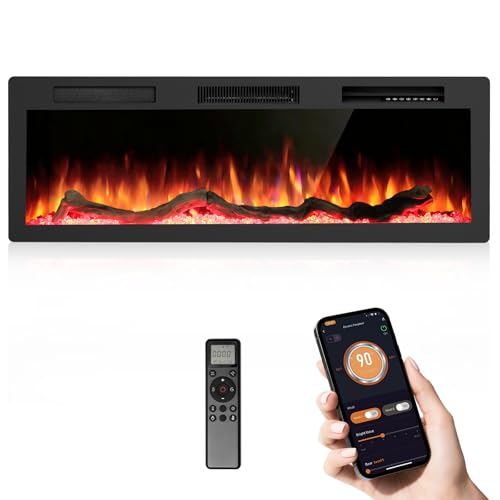
This recessed or wall-mounted fireplace offers remote, touch, smartphone, and voice controls. It’s designed for rooms such as bedrooms and living rooms, not bathroom ventilation or bathroom-heater installation.
Dimensions Not specifiedOpening size Not specifiedHeat modes Not specifiedTemperature range 59-95 ℉
Why it made the cut
Remote, touch, smartphone, and voice controls
Remote, touch, smartphone, and voice controls
Recessed or wall-mounted installation options
Good to know
No exhaust fan or airflow rating
Specified opening is for a fireplace installation, not a bathroom heater combo
Skip it if Skip it if you need a bathroom-rated fixture that exhausts humid air.
The best bathroom heater fan combo for your bathroom depends on three measurements: the airflow your room needs, the ceiling opening, and the duct connection. Match those before comparing heat, noise, lighting, and controls; a unit that doesn’t fit the duct or wiring can turn a simple upgrade into a larger job.
50, 80, or 110 CFM; 0.8 sone; heater wattage not confirmed
Air King AK55L
Smaller bathrooms, if airflow and ducting suit
70 CFM; 1,350 W ceramic heater
These are the verified ceiling-mounted options; no model is a substitute for checking the room, duct, and electrical requirements.
Which One Fits Your Bathroom?
Pick the BHFLED110 if you want heat, ventilation, and an integrated light in one ceiling unit, with separate controls for each function.
Choose the BHF110 if you need the same verified airflow, heater wattage, and noise rating but don’t need a built-in light.
Consider the WhisperWarm DC if lower stated fan noise matters most or you want selectable airflow. Its heater wattage isn’t confirmed here, so compare the manufacturer’s current specification before choosing it for heat output.
Consider the AK55L for a smaller bathroom only after checking that 70 CFM suits the room and the existing duct. Its ceramic heater is rated at 1,350 W.
The Broan-NuTone 80 CFM model isn’t ranked here: its airflow, 1.5-sone rating, three LED color temperatures, and independent operation are documented, but the required heater and electrical specifications aren’t confirmed. An 80 CFM label alone doesn’t establish that it’s the right heater combo.
A bathroom wall heater is a different product: it heats the room but doesn’t exhaust moisture. Don’t treat a portable space heater as a substitute for a bathroom heater fan combo, either. The supplied product cards are portable heaters and an electric fireplace, not verified bathroom ceiling combos; none belongs in this recommendation list. For more bathroom-specific choices, see our bathroom fan heater picks.
Don’t improvise the installation
A bathroom combo needs ducting that exhausts outdoors, and its electrical requirements must match the installation. Check the unit’s instructions and local requirements before replacing or wiring one.
Bathroom Airflow Needs
A bathroom exhaust fan with heater needs enough airflow to remove shower moisture; a wall-mounted bathroom heater warms the room but doesn’t replace the exhaust fan. For bathrooms up to 100 square feet, about 1 CFM per square foot is a common starting point, subject to local code and the fan manufacturer’s sizing guidance. The best bathroom fan with light and heater still has to match your room and duct.
If you’re searching for golf course bathroom wall heaters, check whether you need room heat, moisture removal, or both: a wall heater supplies heat, while a ceiling fan-heater combo can exhaust damp air through ducting. Choose a combo when you need both jobs done, and make sure its exhaust ducts outdoors.
Bathroom area
Starting airflow guidance
Up to 70 sq ft
About 70 CFM
About 80 sq ft
About 80 CFM
About 100 sq ft
About 100 CFM
Larger than 100 sq ft
Size for the room layout, fixtures, ceiling height, duct run, local code, and manufacturer guidance
The 1 CFM per square foot guideline is a starting point for bathrooms up to 100 square feet, not a universal sizing rule.
Verified bathroom combo examples include the Air King AK55L at 70 CFM, a Broan-NuTone 80 CFM model, and the Broan-NuTone BHFLED110 at 110 CFM. Panasonic WhisperWarm DC offers selectable airflow of 50, 80, or 110 CFM, so you can choose a setting rather than run maximum airflow all the time. A higher rating isn’t automatically better.
Duct resistance matters
A long run, bends, or a restrictive duct can cut the air that reaches the outdoors. Pushing a high-CFM fan through a poorly matched duct may add noise without delivering its rated flow; check the unit’s duct requirements and your existing run before choosing.
Too little airflow can leave moisture behind, which can mean lingering steam and damp surfaces. For a larger bathroom, several fixtures, a high ceiling, or a long duct run, room area alone won’t settle the choice; follow the manufacturer’s sizing guidance and local code, and account for the layout and duct resistance.
A quick sizing check
Say your bathroom is 8 by 10 feet. That’s 80 square feet, so about 80 CFM is a reasonable starting point. If the duct run is long or the room has a high ceiling, check the fan maker’s guidance before treating 80 CFM as the answer.
Room8 × 10 ft
Area80 sq ft
Starting airflowAbout 80 CFM
For the right number, use the area as a first check, then account for the duct and room details. If your current fan leaves the mirror fogged long after a shower, that’s a useful sign to reassess airflow and ducting, not a reason to buy the largest rating on the shelf.
Ceiling and Duct Fit
A bathroom heater fan combo fits only if its ceiling housing, wiring, and duct route work in your bathroom; measure those before ordering. The heater in the wall when you’re in the bathroom is a separate kind of appliance: bathroom wall heaters warm the room but don’t exhaust shower moisture.
A wall heater for a bathroom—or bathroom wall heaters, including electric bathroom wall heaters—must be specifically listed for bathroom use and installed according to its manual and local code. The same applies to the best wall unit heaters for new construction bathrooms. New construction can make framing and duct routing easier, but it doesn’t waive electrical, venting, or clearance requirements.
Measure Before You Buy
Ceiling cutout: measure the opening, not just the visible grille.
Housing depth: check the space above the ceiling and any obstructions.
Joist spacing: note the framing around the opening and whether the housing can fit between or attach to the joists.
Duct diameter and route: check the existing duct connection and whether it reaches an exterior vent.
Wiring: compare the existing wiring and controls with the new unit’s installation instructions.
Grille Size Isn’t Housing Size
A replacement grille that matches the old one doesn’t prove the ceiling housing will fit. Check the new unit’s housing dimensions, mounting method, duct connection, and wiring against the existing installation; a mismatch can turn a quick swap into ceiling and duct work.
Ceiling combos need a compatible housing and a duct that carries moist air outdoors. Recirculating air back into the bathroom doesn’t remove shower humidity from the building. If you’re checking or replacing ducting, ducting is a separate part of the fit decision; the unit’s outlet and the installed route must work together.
1
Inspect the existing setup
Turn off power at the breaker before inspecting wiring. Record the cutout, available housing depth, joist position, duct diameter, and route to the exterior.
2
Compare installation instructions
Check the candidate unit’s housing, duct connection, mounting requirements, and wiring against your measurements. Don’t assume an old duct or switch arrangement will carry over.
3
Decide whether it’s a replacement or a new opening
For a replacement, confirm the housing fits the opening and framing before removing the old unit. For new construction, plan the ceiling opening and outdoor duct route, then follow the unit manual and local code.
A wall-mounted bathroom heater won’t solve a missing exhaust duct, and a ceiling combo isn’t a wall heater. If you need both warmth and moisture removal, choose a ceiling unit with an outdoor duct route; if you want wall heat only, choose a bathroom-listed wall model and follow its installation requirements.
Bathroom Heater Fan Combo Running Costs
A 1,500-watt bathroom heater costs about 26 cents for one hour at an assumed electricity rate of $0.17 per kWh. The Broan-NuTone BHFLED110 is a best bathroom fan with light and heater option, and its fan, heat, and light can operate independently; a smart bathroom ceiling heater fan may also offer timer control or a humidity sensor, but check the model’s specifications. For a small bathroom in new construction, choose a listed ceiling combo or wall heater that suits the layout and electrical plan—don’t treat a wall heater as a replacement for exhaust ventilation.
One Hour Of Heat
The arithmetic is 1.5 kW × 1 hour × $0.17/kWh = $0.255, or about 26 cents. That’s heater-on time only; fan and light use are separate, and the total depends on your local electricity rate and how often the thermostat cycles the heater off.
Heater input1,500 W (1.5 kW)
Assumed rate$0.17/kWh
One-hour costAbout $0.26 per hour
Heater
Watts
Per hour
Per day (1 h)
Per month (30 days)
1,500 W heater
1,500 W
26¢
26¢
$7.65
Calculated at 17¢ per kWh. Illustration assumes the heater runs one hour daily for 30 days at $0.17/kWh; actual bills vary with your electricity rate and thermostat cycling.
At 120 volts, a 1,500-watt heater draws about 12.5 amps: 1,500 W ÷ 120 V = 12.5 A. That’s a calculation, not a circuit specification. Check the unit’s nameplate and installation manual for required circuit capacity, switching, and wiring; some models require a dedicated circuit or other arrangements under the manufacturer’s instructions and local code. Hire a licensed electrician where required, or if you’re not qualified to do the work.
Controls Change What Runs
Independent controls aren’t universal. The BHFLED110 and a Broan-NuTone 80 CFM model are listed with independently operable functions, but don’t assume every combo lets you run the heater, fan, and light separately. A timer can limit fan runtime, while a humidity sensor can switch ventilation based on moisture; confirm either feature is included before buying.
Heater Types and Bathroom Controls
For a smart bathroom ceiling heater fan, look for confirmed Wi-Fi or voice connectivity; a remote by itself doesn’t make a unit smart. The best bathroom fan with light and heater depends on whether you want warm air or direct radiant warmth, and bathroom wall heaters electric can add heat but don’t replace an exhaust fan.
Choose the Heating Style
Type
How it heats
What to consider
PTC or ceramic
An electric resistance element warms air that the unit moves into the room.
Choose this style if you want heated air; neither type is universally more efficient.
Infrared
Bulbs radiate heat to people and nearby surfaces rather than heating all the room’s air first.
Broan-NuTone 164 has two infrared-bulb sockets and a 70 CFM fan; bulbs are sold separately. Broan 162M has one 250-watt BR40 socket and 70 CFM ventilation; the bulb isn’t included.
Heating style changes how warmth reaches you, not the need to exhaust shower moisture.
Infrared can feel warm quickly when you’re in its line of sight, while PTC and ceramic units warm moving air. For a lower listed fan-noise rating, Panasonic WhisperWarm DC is 0.8 sone; the BHFLED110 is 2 sones. Lower listed sones generally mean quieter operation, but duct layout and installation affect what you hear.
Check Light and Control Claims
A bathroom heater fan combo doesn’t always include a light: the Broan-NuTone BHF110 has no integrated light. The Broan-NuTone 80 CFM model offers three LED color temperatures, but the available data doesn’t confirm dimming or brightness adjustment. BHFLED110 lets you operate its fan, heat, and light separately.
Before You Choose
Confirm whether the unit has an integrated light and independent controls.
Treat a remote as a remote, not proof of Wi-Fi or voice control; choose a smart model only when its product data confirms connectivity.
Compare listed sones, while allowing for duct routing and installation to affect perceived noise.
Look for a bathroom-rated, listed unit and follow its installation instructions and local code.
Keep Portable Heaters Out of the Bathroom
Don’t use a portable space heater in a bathroom; the damp location and nearby water make it a poor fit. Plug any portable electric heater directly into a wall outlet, never an extension cord or power strip, and keep it at least 3 feet from towels and other combustibles. Choose equipment listed for bathroom installation, and have a qualified electrician handle wiring beyond your ability.
Frequently Asked Questions
Can a bathroom wall heater replace a bathroom exhaust fan?
No. A wall heater warms the room but doesn’t remove shower moisture; you still need a bathroom exhaust fan ducted to the outdoors.
What kind of wall heater can I use in a bathroom?
Choose a heater specifically listed for bathroom use, and follow its required clearances and installation instructions. Keep plug-in heaters away from water, plug them directly into a wall outlet, and don’t run one unattended unless its manufacturer says it’s designed for that use.
How much airflow does my bathroom need?
Use the bathroom’s size and the fan manufacturer’s sizing guidance to choose CFM; a higher rating isn’t automatically better. Long or restrictive duct runs can reduce airflow, so match the fan to both the room and the existing duct route.
Will a bathroom heater fan fit my existing ceiling duct?
Check the unit’s duct outlet size and direction against your duct before ordering, along with the ceiling housing dimensions and available space. An adapter may connect mismatched duct sizes, but it won’t fix a cramped ceiling cavity or a poor duct route.
Can the fan, heater, and light run independently?
Some models allow independent controls, but don’t assume every function can run separately. The Broan-NuTone BHFLED110, for example, is listed with separately operable fan, heat, and light; check the wiring diagram and control requirements for the model you choose.
How loud is a bathroom exhaust fan with a heater?
Compare the fan’s sone rating: lower numbers indicate quieter operation. For reference, the Broan-NuTone BHFLED110 is rated at 2 sones, while the Panasonic WhisperWarm DC is listed at 0.8 sone.
Can I replace a Broan bathroom fan heater element myself?
Only replace a part if the model’s manual identifies it as user-serviceable and gives the procedure; disconnect power at the breaker first. If replacement involves fixed wiring or work inside the ceiling housing, use a qualified electrician rather than guessing at connections.