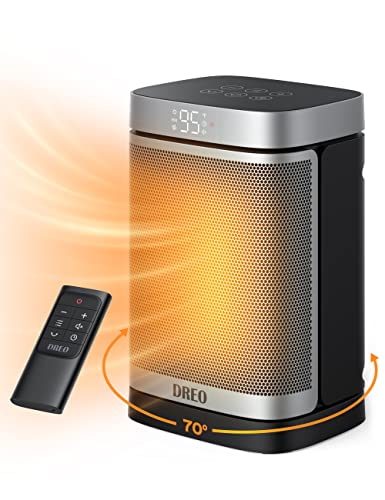
For most people, the DREO 70° oscillating heater is the best 1500 watt space heater: it combines a thermostat, remote, 12-hour timer and ETL-listed tip-over and overheat protection. Its 37.5 dB noise rating suits a bedroom or office, while oscillation spreads warmth beyond the spot directly in front of it.
What to remember
Choose the DREO oscillating heater for a mix of thermostat control, remote operation and wide airflow.
The DR-968 offers a thermostat range of 50°F to 85°F and a cool-touch cabinet, but its claimed 1,000-square-foot coverage should not be treated as a guaranteed heating size.
At 1,500 watts, eight hours of full-power use equals 12 kWh; multiply by your electricity rate to estimate the cost.
Plug an electric heater directly into a wall outlet, keep 3 feet of clearance and check what else shares its circuit.
A 1,500-watt heater draws about 12.5 amps at 120 volts, so a full-power model can use most of a standard 15-amp circuit. That matters if your room already has a computer, lights or other high-draw appliances running.
The picks below prioritize useful controls and documented safety features over broad room-coverage promises. A 1,500-watt plug-in heater has the same maximum heat output as other 1,500-watt electric models; the differences are how that heat reaches you and how conveniently you control it.
Five 1,500-Watt Heaters, Ranked by Use
#1Best Overall
DREO 70° Oscillating Space Heater
Best for Bedrooms and offices where warmth should reach beyond one spot
The 70° oscillation sweeps heat across a wider area, while the thermostat adjusts from 41 to 95°F in 1°F increments. At 37.5 dB, it’s a quiet fit for working or sleeping, and the remote and 12-hour timer make adjustments easy from your seat.
Power Up to 1500WOscillation 70°Thermostat 41 to 95°F, adjustable in 1°F incrementsNoise 37.5 dBTimer 12 hours
Why it made the cut
70° oscillation spreads warmth around the room
Thermostat, remote and 12-hour timer
ETL-listed tip-over and overheat protection
Good to know
No room-size coverage figure is provided
No heat-setting wattages are specified
Skip it if Skip it if you want a heater with a stated room-size limit or documented low and high wattages.
Best for Bedrooms and offices where low fan noise matters
Its 34 dB noise figure is the lowest listed among these five heaters, and 70° oscillation helps distribute warmth across a larger area. ECO mode can switch between 1000W and 1500W as it maintains your target temperature.
Power 1500WOscillation 70°Noise 34 dBHeat settings 1000W and 1500W in ECO modeTimer 12-hour timer
Why it made the cut
34 dB operation
70° oscillation
ECO mode uses 1000W or 1500W
Good to know
No thermostat temperature range is provided
No room-size coverage figure is provided
Skip it if Skip it if you need a heater with a documented thermostat range or a specified room coverage area.
Best for Living rooms where radiant warmth and a wood-look cabinet appeal
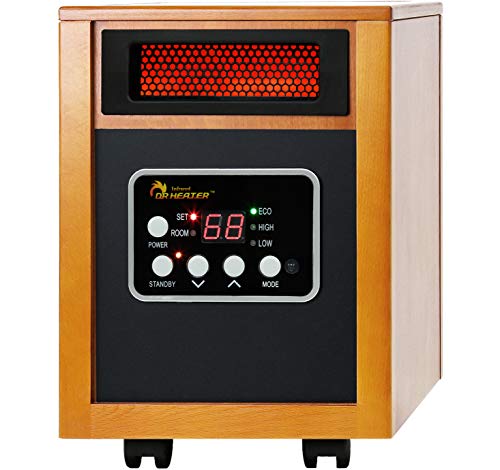
The DR-968 pairs infrared quartz radiant heat with PTC heated-air circulation, so it delivers both direct warmth and moving warm air. Its thermostat adjusts from 50°F to 85°F, and the remote and 12-hour timer suit everyday living-room use.
Power 1500WHeat output Up to 5,200 BTUThermostat 50°F to 85°FNoise 39 dBTimer 12 hours
Why it made the cut
Infrared quartz and PTC dual heating
50°F to 85°F electronic thermostat
Tip-over and overheat protection
Good to know
39 dB is louder than the listed DREO models
No low and high heat wattages are provided
Skip it if Skip it if the lowest listed noise level or wide-angle oscillation is your main priority.
Best for Small bedrooms and offices where remote control and a long timer help
A 24-hour timer gives you more scheduling range than the other listed models, and the remote lets you change among Low, High, Eco and Fan modes without walking over. The stated 35 dB noise level and child lock are useful in a bedroom or a home with curious hands or paws.
Power 1500WCoverage Up to 200 sq.ftNoise 35 dBTimer 24 hoursSafety ETL-certified; 45° tip-over shutoff and overheat protection
Why it made the cut
24-hour timer
Four modes: Low, High, Eco and Fan
Child lock, tip-over shutoff and overheat protection
Good to know
The stated coverage is limited to 200 sq ft
No thermostat temperature range is provided
Skip it if Skip it if you want a heater with wide-angle oscillation or a stated temperature range for its thermostat.
Best for Small offices and rooms with straightforward knob controls
Two knobs handle the thermostat and modes, including Low at 950W and High at 1500W. Its listed 108–130 coverage range and compact 6.22 × 6.22 × 8.78-inch body make it a practical fit when you want simple controls rather than a remote or timer.
The DREO 70° oscillating heater is the best 1500 watt space heater for most rooms because it pairs a thermostat and remote with a 12-hour timer, oscillation and ETL-listed tip-over and overheat protection. Its stated 37.5 dB noise rating also makes it a sensible pick for a bedroom or office.
For quieter operation, look at the DREO Space Heaters for Indoor Use with Thermostat; for radiant-plus-fan heat and a cool-touch cabinet, consider the Dr Infrared Heater DR-968. The R.W.FLAME Small Space Heaters for Indoor Use adds a remote and child lock, while the R.W.FLAME 1500W ceramic model keeps things simple with two-knob controls.
The 200- and 1,000-square-foot figures are manufacturer claims, not guarantees. Insulation, ceiling height, outdoor temperature and air leakage all affect what a heater can do.
A thermostat cycles the heating element to maintain a chosen temperature; a timer shuts the heater off after a set period. They solve different problems, so check which control you’ll actually use. For more detail on the DREO line, see this Dreo 1500W space heater review.
The search for a DREO 1500W space heater vs. a BLACK+DECKER heater, a DREO Atom 1, or the Lowe’s Lasko ceramic tower 1500W price, reviews and rating in 2025 needs model-specific comparison data. The details here don’t establish those rivals’ specs or performance, so compare each model’s noise, controls, safety features and warranty on its own listing rather than assuming they match.
From HeaterGuides · our own guidePage 4 shows what every heater costs per hour; the Excel sheet works out your own bill.Winter Heating Bill CutterSee what every heater in your home really costs, heat the rooms you use, and cut the waste in 30 days.Cost-per-hour tables for every heaterThermostat schedule and draft-proofing planRunning-cost and bill calculator (Excel)$14.99$9.99Get it for $9.99See what's inside and watch the 2-minute video →14-page printable PDF + Excel calculator · instant download · 30-day refund
How Much Room a 1,500-Watt Heater Can Warm
A 1,500-watt heater’s maximum heat rate is 1.5 kW; it doesn’t promise to warm a particular room size. A poorly insulated or very large room may lose heat faster than the heater can replace it, so the thermostat setting may stay out of reach.
A 12-by-14-foot room
A 1,500-watt heater may work as supplemental heat in this hypothetical 168-square-foot room, but the result depends on insulation, ceiling height and outdoor temperature. Treat the room size as an example, not a capacity guarantee.
Room12 × 14 ft
Heater output1,500 W maximum
Likely roleSupplemental heat, depending on conditio
A DeLonghi 1,500-watt oil radiator isn’t more electrically efficient than a baseboard heater: both resistance heaters turn electricity into heat in the room. Ceramic, infrared and oil-filled electric models also produce the same total heat per watt; where you feel the heat and how often the thermostat cycles can change comfort and energy use.
An oil-filled radiator releases stored heat for a while after its element cycles off, which smooths out the heating. That stored warmth doesn’t make the electricity cheaper than baseboard heat.
12.5 A
Current drawn by a 1,500 W heater at 120 V
That’s a substantial load for a plug-in appliance; the circuit question is covered in the next section.
At full power, the arithmetic is 1,500 ÷ 1,000 × 8 hours = 12 kWh. At an assumed electricity rate of $0.17 per kWh, that’s $2.04 for eight hours; thermostat cycling can reduce actual use.
Heater
Watts
Per hour
Per day (8 h)
Per month (30 days)
1,500 W space heater
1,500 W
26¢
$2.04
$61.20
Calculated at 17¢ per kWh. Assumes the heater runs at full power for 8 hours every day, 30 days, at $0.17 per kWh. A cycling thermostat can lower consumption.
Outlet Requirements for 1,500-Watt Space Heaters
A 1,500-watt space heater runs on a standard 120-volt household outlet and draws about 12.5 amps. Plug it directly into the wall—never use an extension cord or power strip. Two outlets may share a breaker, so separate receptacles don’t guarantee separate circuits.
12.5 A
Current drawn by a 1,500 W heater at 120 V
The calculation is 1,500 watts ÷ 120 volts = 12.5 amps. That leaves little capacity on a standard 15-amp circuit for other loads.
Check the breaker, not just the outlets
Two 1,500-watt heaters draw about 25 amps together, before a computer and monitors are added. Don’t run that setup on one standard 15-amp circuit, even if the heaters plug into separate outlets. Find the breaker serving those outlets and check the panel label; if the circuit is unclear, ask an electrician to identify it.
If a breaker trips, or a plug feels warm or an outlet looks discolored, stop using that setup and have it investigated. Don’t keep resetting the breaker or move the heater to another outlet without checking which circuit serves it.
Use a heater with tip-over and overheat protection and a UL, ETL or CSA listing. Keep it at least 3 feet from bedding, curtains, furniture and other combustibles; don’t leave it running unattended or while you sleep unless the manufacturer says that model is designed for it.
Understanding 440 Volts and 1,500 Watts
A 440-volt, 1,500-watt heater is commercial or industrial equipment, not a standard US household plug-in heater; it cannot run from a 120-volt wall outlet. The query mentioning an NGM Stufa El-Varme S21U15, serial 028010, 440 volts, 1,500 watts, IP44 and a 1,150 mm length describes a specific nameplate, not a household plug-in specification.
If you’re replacing that heater, match the nameplate and installation requirements rather than choosing by wattage alone. Supply voltage, frequency, wiring and physical dimensions all need to suit the equipment and site. Have a qualified electrician verify the circuit and connection.
Verify Before Replacing Equipment
Supply voltage and frequency on the nameplate
Wattage and required wiring or connection
Length and other installation dimensions
Required protection rating and certifications
The specified heat element, housing and tip-over shutoff
The listed products in this guide are portable indoor heaters. The supplied product data describes products 1, 2, 4 and 5 as ETL-listed or certified, and product 3 as UL certified; those claims aren’t interchangeable, and none confirms a non-glowing element or cool-to-the-touch housing unless its product data says so.
Check the exact specification
A requirement for a non-glowing heat element, cool-to-the-touch housing or automatic tip-over shutoff must be confirmed against that model’s documentation. Don’t assume a portable heater meets a procurement specification because it has a thermostat or a safety listing.
Questions People Ask
Is a 1,500-watt oil-filled radiator more efficient than an electric baseboard heater?
No—both convert nearly all the electricity they use into heat, so a 1,500-watt unit running for the same time uses about the same electricity. An oil-filled radiator can keep releasing stored heat after its element switches off, but that doesn’t make the heat cheaper; thermostat settings and how long each heater runs determine the bill.
Can I run two 1,500-watt heaters on separate outlets if they share a breaker?
No, not on a typical 15-amp circuit: each heater draws about 12.5 amps, so together they would draw roughly 25 amps. Separate outlets can still be on the same breaker; check the panel and use heaters on separate circuits instead.
Can I use an extension cord with a 1,500-watt space heater?
No. Plug the heater directly into a wall outlet because an extension cord or power strip can overheat under the heater’s sustained load.
Does a 1,500-watt heater need a 440-volt outlet?
No—a household 1,500-watt space heater is made for a standard 120-volt outlet. If the nameplate specifies 440 volts, it’s different equipment; don’t connect it to a household outlet or try to adapt it without qualified electrical guidance.
What safety features should a 1,500-watt space heater have?
Look for tip-over and overheat protection, plus a UL, ETL or CSA listing. Keep the heater at least 3 feet from anything that can burn, plug it directly into the wall, and follow the manual’s instructions about leaving it on or using it while you sleep.
Before you go · a welcome giftGet the Winter Heating Bill Cutter for $4.99See what every heater in your home really costs, heat the rooms you use, and cut the waste in 30 days. Normally $14.99; your welcome price saves $10.00. We'll email your link right now.or buy it now for $9.99 without the gift →One email with your link now. We never share your address.



 Winter Heating Bill CutterSee what every heater in your home really costs, heat the rooms you use, and cut the waste in 30 days.Cost-per-hour tables for every heaterThermostat schedule and draft-proofing planRunning-cost and bill calculator (Excel)