When the power goes out in the middle of winter, your electric heater becomes a useless hunk of plastic. You need a backup that works without plugging in. That is where non-electric indoor heaters come in.
These heaters run on kerosene or butane, producing steady warmth for hours or even days. They are built for emergencies, off-grid living, or just cutting your heating bill. Modern models include safety features like tip-over shutoff and automatic overpressure protection.
We researched five of the most interesting non-electric heaters on Amazon right now. From a compact camping cooker to a 23,800 BTU giant, there is an option for every home and budget. Here is what you need to know before buying.
Compare the key specifications of each heater at a glance.
| Features | Vikye Kerosene | Dyna-Glo WK24BK | sxvbdway 2-in-1 | Naturehike Butane | fosa Kerosene |
|---|---|---|---|---|---|
| Fuel Type | Kerosene | Kerosene | Kerosene | Butane | Kerosene |
| Max BTU | 12,000 | 23,800 | 9,000 | 3,750 | 12,000 |
| Runtime | 20 hours | Not specified | 16-21 hours | 4 hours | 30 hours |
| Safety Feature | Tipping protection | Not specified | Adjustable flame | Overpressure shutoff | Tipping protection |
| Best Use | Garage, camping | Large rooms up to 1,000 sq ft | Cooking + heating | Tents, small spaces | Home, basement |
Vikye Kerosene Heater

Vikye
Vikye Indoor Kerosene Heater, 12000 BTU Non…
- [POWERFUL HEATING PERFORMANCE] - Experience rapid warmth with this 12000 BTU kerosene heater. The high thermal efficiency design e…
- [NON ELECTRIC EMERGENCY SOLUTION] - Designed for versatility, this non electric space heater requires no external power source, ma…
- [6L LARGE CAPACITY & LONG RUNTIME] - Featuring a generous 6L fuel tank, this indoor kerosene heater supports up to 20 hours of sin…
This heater suits anyone who needs a reliable backup for power outages or a portable heat source for the garage. Its 12,000 BTU output warms a medium room without straining your fuel supply. The 6-liter tank runs up to 20 hours on a single fill, so you can sleep through a winter storm without refueling.
What stands out is the tipping protection. Many kerosene heaters leave this out, but Vikye includes a built-in mechanism that cuts fuel flow if the unit is knocked over. The smokeless combustion system also keeps the air fresher than older designs. At 11 pounds, it is light enough to carry from the shed to the tent.
On the downside, kerosene does produce a faint odor and requires careful ventilation. You will need to let the unit cool before refueling. The 12,000 BTU output is good for about 200-300 square feet, not whole-house heating.
- 12,000 BTU (equivalent to 2,800W electric)
- 6-liter fuel tank provides up to 20 hours of runtime
- Tipping protection device for safe operation
- Weighs 11 lbs with compact design
- No electricity needed; works in outages
Best for: Homeowners who want a mid-size emergency heater that balances runtime with portability.
Dyna-Glo WK24BK
If you need serious heat for a large space, this is the one. The Dyna-Glo WK24BK delivers 23,800 BTU and claims to heat up to 1,000 square feet. That makes it a strong candidate for basements, workshops, or open living areas. No electricity is needed, so it works during a blackout.
The real advantage is raw heat output. Most non-electric heaters top out around 12,000 BTU. This unit nearly doubles that, yet still runs on kerosene. It uses a convection design that circulates warm air naturally, reducing cold spots. It also helps lower utility bills when used as a supplement to central heating.
Trade-offs include a larger fuel consumption rate and a bigger footprint. You will need to refuel more often than smaller units. The product data does not list a tipping sensor, so you must place it on a stable, flat surface. And at this size, moving it around takes more effort.
- 23,800 BTU for spaces up to 1,000 sq ft
- Convection heating – no fan or electricity required
- Ideal for emergency use or daily supplemental heat
- Kerosene fuel, clean-burning design
- No built-in tipping protection specified
Best for: People with large garages, workshops, or open-concept homes who want maximum heat from a non-electric source.
sxvbdway 2-in-1 Kerosene
sxvbdway
Indoor & Outdoor Kerosene Heater, Radiant Heating,…
- 1. **Versatile 2-in-1 Kerosene Heater**: The non-electric 9000 BTU kerosene stove is designed for dual purposes, allowing you to c…
- 2. **Extended Heating Duration**: Enjoy up to 16 to 21 hours of continuous warmth with this kerosene heater after refueling. Its i…
- 3. **No Electricity Needed**: This portable indoor kerosene radiant heater operates without electricity, making it an ideal soluti…
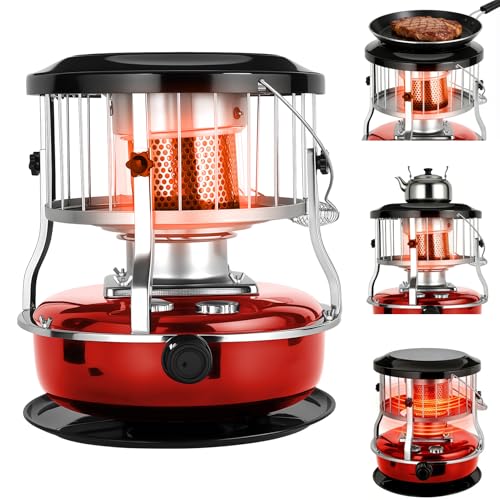
This heater does double duty: it warms the room and lets you cook on top. The 9,000 BTU output is modest, but the top surface can hold a pot or pan. That makes it a smart choice for campers, hunters, or anyone who wants to boil water while staying warm.
The adjustable height is a clever feature. You can raise or lower the unit to direct heat where you need it. The 4.5-liter tank runs 16 to 21 hours, so it keeps going overnight. The radiant heating method warms people and objects directly, not just the air.
The lower BTU means it only covers about 160 square feet. That is fine for a small cabin or tent, but not for a large living room. Cooking on top also means the surface gets hot; keep kids and pets away. Radiant heaters can be less effective in drafty spaces.
- 9,000 BTU radiant heater with cooking top
- 4.5-liter kerosene tank, 16-21 hours runtime
- Adjustable height for directional heat
- No electricity needed; portable handle
- Radiant heat – warms people directly
Best for: Campers, hunters, or cabin owners who want a compact heater that also serves as a stove.
Naturehike Camp Heater

Naturehike
Naturehike Camp Heater with Warming Shelf |…
- Efficient Warmth Anywhere: Experience rapid heating with high-performance technology that warms spaces from 54 to 108 sq ft in min…
- Convenient & Portable: Designed with a detachable insulated shelf and comfortable carry handle for effortless transport and versat…
- Extended Operation: Enjoy consistent warmth for up to 240 minutes on a single 8 oz butane canister gas-powered (180 minutes at max…
This butane-powered heater is the smallest option here. It delivers 3,750 BTU and warms 54 to 108 square feet – perfect for a tent, small room, or RV. The warming shelf on top lets you dry gloves or warm food. It runs on a standard 8 oz butane canister, which lasts up to 4 hours.
Safety is handled well. The magnetic butane connection seals tightly, and an automatic overpressure shutoff stops gas flow if something goes wrong. The detachable insulated shelf and carry handle make it easy to pack. It is quiet, with no fan noise.
Butane has lower energy density than kerosene, so runtime is shorter. You will need spare canisters for long evenings. The heat output is not enough for a large room or a cold basement. And butane can struggle in freezing temps – the gas does not vaporize well below 32°F.
- 3,750 BTU, heats 54-108 sq ft
- Runs on 8 oz butane canister, up to 4 hours
- Warming shelf and detachable insulated top
- Magnetic connection and overpressure shutoff
- Lightweight and portable with carry handle
Best for: Tent campers, van lifers, or anyone needing a small, safe heater for tight spaces.
fosa Portable Kerosene

FOSA
fosa Portable Kerosene Heater, 12000BTU Non Electric…
- Portable Kerosene Heater: This kerosene heater features a non electric design, eliminating the need for external power sources, ma…
- High Thermal Efficiency: Using kerosene as fuel, kerosene space heater features high thermal efficiency. It is quiet, energy savin…
- Easy to Carry: The portable kerosene heater is lightweight and comes with a convenient handle, allowing you to carry it effortless…
This model closely matches the Vikye in specs but offers a longer runtime. The 6-liter tank runs up to 30 hours, which is impressive for a 12,000 BTU heater. You can run it all night and into the next day without touching the fuel can. It also has tipping protection and a quiet, energy-saving burn.
The heat output covers a similar area – around 200-300 square feet. The handle and lightweight build make it easy to move between the garage, basement, and campsite. Fosa claims a no-fume operation, which suggests good combustion efficiency.
Long runtime is the main selling point, but it comes with the same kerosene trade-offs: odor, need for ventilation, and careful refueling. The 30-hour number likely assumes a low flame setting; on high you will get less. Also, no cooking top is included, so it is strictly a heater.
- 12,000 BTU with 6-liter tank, up to 30 hours runtime
- Tipping protection for safe indoor use
- Lightweight with convenient carry handle
- Quiet operation, no electricity needed
- Suitable for home, garage, basement, camping
Best for: Users who prioritize long runtime and want a dependable kerosene heater for extended off-grid use.
How We Chose These Products
We started by identifying the most important criteria for non-electric heaters: thermal output (BTU), fuel type, runtime, safety features, and portability. We then scoured Amazon for models that cover different use cases, from small camping units to whole-room heat sources. Each product had to have verifiable specs and genuinely helpful features, not just marketing claims.
We prioritized heaters with safety certifications or built-in protections like tipping sensors and overpressure shutoffs. We also looked for honest runtime numbers and realistic coverage areas. Finally, we considered value – not just price, but how well the heater solves a specific problem for a specific buyer.
Buying Guide: What Really Matters
BTU tells you how much heat the unit can produce. A rough rule: 10 BTUs per square foot for a well-insulated room, 20-30 for poor insulation. Do not overshoot – too much heat in a small space becomes uncomfortable and wastes fuel. Measure your room and match the BTU accordingly.
Fuel type affects runtime, cost, and portability. Kerosene is widely available, stores well, and gives long burn times. Butane is convenient for short trips but canisters cost more per hour of heat. Both produce carbon monoxide, so ventilation is non-negotiable. Never run any combustion heater in a sealed room.
Safety features matter. Tipping protection is a must for kerosene heaters. Overpressure shutoff is critical for butane units. Also consider noise: radiant heaters are silent, while forced-air units hum. Check whether you need a surface for cooking or just pure heating.
Our Top Recommendation
For most households, the Dyna-Glo WK24BK wins because it heats the largest area with the highest BTU output. It is ideal for emergency preparedness and daily use in big spaces. If you need a portable option for camping or smaller rooms, the Naturehike Camp Heater is the best butane choice due to its safety features and compact design. For long runtime and balanced output, the fosa Portable Kerosene offers 30 hours of operation and tipping protection.
Frequently Asked Questions
Are kerosene heaters safe to use indoors?
Yes, if you follow the manufacturer’s instructions. Always leave a window slightly open for ventilation. Models with tipping protection and a stable base reduce spill risks. Never refuel a hot heater.
How much fuel do these heaters consume?
Consumption varies by BTU and flame setting. A 12,000 BTU kerosene heater typically burns about 0.3 to 0.4 liters per hour. A 6-liter tank gives 15-20 hours on high, longer on low. Butane heaters use roughly one 8 oz canister per 2-4 hours at max output.
Do these heaters produce carbon monoxide?
Yes. Any fuel-burning heater produces carbon monoxide (CO). Use a CO detector in the same room. Never operate them in a tightly closed space. Proper ventilation and fresh air intake are mandatory.
Can I cook on top of these heaters?
Only those specifically designed for cooking, like the sxvbdway 2-in-1 model. Most kerosene heaters have a flat top but are not rated for food contact.

I am a mechanical engineer and love doing research on different home and outdoor heating options. When I am not working, I love spending time with my family and friends. I also enjoy blogging about my findings and helping others to find the best heating options for their needs.
Related guides
Why Do Space Heaters Blow Fuses? (And How to Fix It)
You plug in your space heater on a cold morning, and within five minutes the room goes dark.…

Why the 50-Inch Electric Fireplace Heater Transforms Home Heating
The 50-inch electric fireplace heater combines style, heat output, and flexible installation to upgrade your home's warmth and…
18 Genius Ways to Keep Heat in a Room Without a Door
To keep heat in a room without a door, use heavy curtains, draft stoppers, insulation, and space heaters…