For most Cozy Comfort searches, Product 5 is the best pick because an oil-filled radiator gives steady, quiet heat, useful thermostat control, and no fan blast. If you want warmth that lingers after the cycling stops, that’s the one to start with.
The common mistake is buying by wattage alone and then putting the heater in the wrong room. A 1,500 W unit can still feel weak in a drafty space, or too aggressive in a small one, and that usually means you pay for heat you never feel.
Quiet, efficient comfort comes from matching the heater style to the room: fan-forced for fast spot heat, infrared for direct warmth, and oil-filled for longer, steadier heat without much noise.
Best Cozy Comfort Picks
#1Best for steady warmth
DREO Oil-Filled Radiator
Best for Bedrooms and living rooms where quiet, even heat matters
The oil-filled design provides quiet, steady warmth, and the thermostat and ECO mode help maintain your chosen temperature. Choose it if you want adjustable output, room-to-room wheels, and no fan blast.
Maximum output 1500WHeat settings 600W/900W/1500WControls Digital thermostat, ECO mode, remote controlTimer 24-hour timerSafety ETL listed; overheat and tip-over protection
Why it made the cut
Three heat settings: 600W, 900W, and 1500W
Remote control, child lock, and 24-hour timer
ETL-listed with tip-over and overheat protection
Good to know
Heavier to move than a compact fan heater
Doesn’t offer the stated rapid air circulation of the ceramic models
Skip it if Skip it if you need warmth directed across a room in seconds; a ceramic heater is a better fit.
Best for Bedrooms, living rooms, and offices up to 250 sq ft
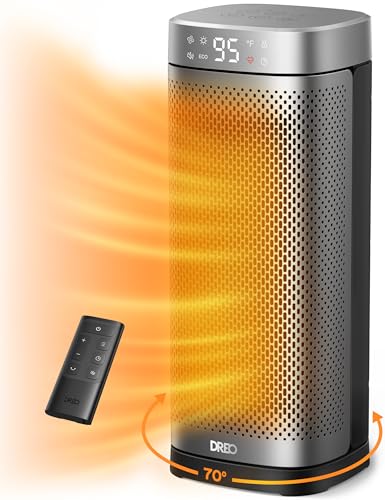
Its 1500W PTC ceramic element and 70° oscillation spread warmth quickly across a room. The digital thermostat adjusts in 1°F increments, while the stated 34dB noise level suits spaces where a loud fan would be distracting.
Maximum output 1500WStated coverage Up to 250 sq.ft.Thermostat range 41-95°F in ±1°F incrementsNoise As low as 34dBSafety ETL-listed; tip-over and overheat protection
Why it made the cut
Coverage stated up to 250 sq ft
Remote control, ECO mode, and 12-hour timer
ETL-listed with tip-over and overheat protection
Good to know
Uses a fan, unlike an oil-filled radiator
The 1500W setting draws substantial power on a standard household circuit
Skip it if Skip it if you want heat without moving air or fan noise; pick the oil-filled radiator instead.
Best for Rooms where wide oscillation and a child lock are useful
The 70° oscillation helps distribute heat, and its thermostat adjusts from 50°F to 95°F. A child lock, timer, and touch controls make it a practical choice for households that want straightforward settings.
Maximum output 1500WThermostat range 50°F to 95°FOscillation 70°Timer 12-hour timerSafety features Tip-over protection, overheat shut-off, child lock
Why it made the cut
1500W heating element
70° oscillation and 12-hour timer
Tip-over protection, overheat shut-off, and child lock
Good to know
No remote control is listed
No noise figure or independent safety listing is specified
Skip it if Skip it if you need a listed safety certification or want to control the heater from across the room.
This 1500W ceramic heater is described as warming within seconds, with a heat-funnel design intended to push warm air farther. Its handle, remote, and 41-95°F thermostat make it a flexible option when you want portable heat and precise temperature settings.
Maximum output 1500WStated coverage Up to 200 sq ftThermostat range 41-95°F in 1°F incrementsNoise 34dBControls Remote control; multiple heating levels and modes
Why it made the cut
Stated coverage up to 200 sq ft
Remote control and multiple heating modes
Stated 34dB noise level
Good to know
Uses a fan to circulate heat
The product data doesn’t state a safety listing
Skip it if Skip it if an ETL-listed heater is a requirement; the data for this model doesn’t identify a listing.
Best for Bedrooms, kitchens, and offices where floor space is limited
The wall-mounted design keeps the heater off the floor, and Wi-Fi control lets you adjust the temperature from your phone. It’s a sensible fit where a freestanding heater would get in the way.
Mounting Wall mountedVoltage 110 VoltsControls Wi-Fi, touch screen, remoteSafety features Tip-over safety shut offIncluded base Feet not included
Why it made the cut
Wall-mounted design saves floor space
Wi-Fi control and remote included
Touch screen with digital thermostat
Good to know
Wall-mounted version only; feet are not included
The product data doesn’t state wattage, coverage, or noise level
Skip it if Skip it if you want a portable heater you can move between rooms.
Home comfort solutions come down to how you want heat delivered: fast portable warmth, quieter bedroom heat, wall-mounted infrared warmth, or steady heat over several hours. For quiet, steady warmth, choose Product 5; for portable room heat, compare Products 1, 2 and 4; for wall-mounted infrared heat, look at Product 3.
A 1,500 W plug-in heater draws about 12.5 A on a standard 120 V circuit, near the practical ceiling for a typical household outlet. That means room shape, drafts and insulation often matter more than small wattage differences: a heater aimed across an open room may feel less effective than the same output in a compact, enclosed space.
What matters
How it changes comfort
Products to compare
Fan noise
Fan-driven heat moves air quickly, but you’ll hear the fan. Oil-filled heat works without a fan blast.
Products 1, 2, 4; Product 5
Heat direction
Oscillation or wide-angle output spreads warmth across more of the room; infrared heat is more localized.
Products 1, 2, 4; Product 3
Controls
Check the thermostat range, timer and remote if you want scheduled operation or fewer trips across the room.
Compare the controls listed for each model
Installation
A wall-mounted heater saves floor space; portable models can move between rooms.
Product 3; Products 1, 2, 4
Heat behavior
Ceramic heaters warm air quickly. An oil-filled radiator heats its oil and metal body, so it warms more gradually and continues releasing heat as it cycles.
Products 1, 2, 4; Product 5
Use these differences to narrow the field; confirm each model’s controls and mounting details in its product listing.
Searches for “comfort glow heater reviews,” “who makes Comfort Glow heaters,” or “De’Longhi Comfort” don’t identify any of the five products here. Check the exact brand and model on the heater’s label before applying a review or manufacturer claim to it; similar search wording isn’t proof that two heaters are the same.
In short
Pick Product 5 if quiet, steady heat matters most; choose Products 1, 2 or 4 for movable room heat, or Product 3 if you want wall-mounted infrared output. For more options focused on oil-filled radiators, see oil-filled radiator heaters.
From HeaterGuides · our own guidePage 6: heat only the rooms you use. Page 10 covers space-heater safety.Winter Heating Bill CutterSee what every heater in your home really costs, heat the rooms you use, and cut the waste in 30 days.Cost-per-hour tables for every heaterThermostat schedule and draft-proofing planRunning-cost and bill calculator (Excel)$14.99$9.99Get it for $9.99See what's inside and watch the 2-minute video →14-page printable PDF + Excel calculator · instant download · 30-day refund
Which Heater Style Fits Your Room
To heat a room with a space heater, put it near the coldest wall or window, close the door, and choose a style that suits how you use the room. For a bedroom or office, a quiet oil-filled radiator or low-noise ceramic heater is usually more comfortable; draftier living spaces often benefit from oscillation or wide-angle output, while a wall-mounted heater saves floor space.
The cheapest efficient electric heater is usually the one with a thermostat you can set low enough to avoid overheating the room. Plug-in resistance heaters turn nearly all the electricity they use into heat, so a more expensive style doesn’t automatically cost less to run. A thermostat helps by switching the heater off when the room reaches its set temperature.
Oil-filled electric heaters are efficient at turning electricity into heat, but they don’t make each unit of electricity produce more heat than another plug-in resistance heater. The oil and metal hold heat, so a radiator can keep warming the room briefly after its element shuts off; that steady output may feel more comfortable and can reduce cycling, depending on the room and thermostat.
Place Heat Where You Need It
Say your home office feels cold near a window. Set one heater near that cold wall, close the door to limit heat loss, and leave at least 3 feet of clearance around it. Plug it straight into a wall outlet, never an extension cord. A heater works best when its heat can circulate without being blocked by a desk or curtains.
HeatersOne
ClearanceAt least 3 ft
ConnectionWall outlet only
Myth
An oil-filled radiator is cheaper to run because it stays warm after shutting off.
Fact
The stored heat can make the output feel steadier, but the heater still has to replace that energy as it cools. Running cost depends on how much electricity it uses, how long it runs, and your rate—not the oil itself.
For an affordable electric heater for winter, a basic ceramic model with a thermostat can suit short bursts of warmth; choose an oil-filled radiator if quiet, even heat matters more. The DREO Oil Filled Radiator Heater fits that steady-heat preference, while the DREO Space Heater, Portable Electric Heaters for Indoor Use is a ceramic-style option for faster directed warmth. For most people asking for the best comfort portable heater, the right pick is the one that warms the occupied area without fan noise or heat blowing where you don’t need it.
Keep the Setup Clear
Keep electric heaters at least 3 feet from bedding, curtains, furniture, and other combustibles. Don’t run one through an extension cord or power strip.
Sizing And Running Cost Bridges
A comfortable home temperature is usually around 68–72°F, but the right heater size depends on the room, insulation, and how long you need heat. The search for a “strongest space heater 120V” usually points to a 1,500-watt model: that’s the upper limit for a typical plug-in heater, not proof it’s the best choice for your room.
Compact programmable space heaters suit bedrooms and offices when you want timer-based preheating and shutdown. A timer can control when the heater runs; the thermostat controls how often its heating element cycles to maintain the setting.
A small portable solar space heater usually won’t heat a room meaningfully unless it has stored power. Solar panels alone rarely provide enough steady electricity for indoor resistance heat, and a heater with a battery still has to store that energy somewhere.
Small space heaters at Walmart follow the same sizing rule as other plug-in models: check the wattage and safety features, not just the box’s room-size claim. A 1,500-watt heater draws about 12.5 amps at 120 volts, so it leaves little spare capacity on a standard 15-amp circuit.
Estimate The Monthly Cost
Use watts ÷ 1,000 × hours × price per kWh to estimate electricity cost. For a 1,500-watt heater running 8 hours a day for 30 days at $0.17 per kWh, the calculation is 1.5 × 8 × 30 × $0.17, or $61.20 if it runs continuously.
The thermostat usually cycles the heating element off once the room reaches its set temperature, so your actual monthly bill depends on how long the heater is on. Cold drafts, insulation, room size, and the temperature setting all affect that runtime.
Compare Runtime, Not Just Wattage
A lower setting may reduce the heater’s draw, while a thermostat can reduce total energy use by cycling the element. Check the manual for the heater’s wattage at each setting before estimating its cost.
Safety And Certification Checks
Plug an indoor electric heater straight into a wall outlet, keep it at least 3 feet from anything that can burn, and choose a model with tip-over and overheat protection plus a UL, ETL, or CSA listing. Never use a power strip or extension cord.
For a “best comfort portable heater” pick, those protections matter more than a remote or a display. The DREO Space Heaters and DREO Oil Filled Radiator Heater are product options from the cards above; check each model’s label and manual to confirm its listing and safety features before use.
Keep Electric Heaters Clear
Leave 3 feet of clearance on all sides, set the heater on a stable, level surface, and don’t leave it running while you sleep or leave home unless the manufacturer says that model is designed for it.
If The Heater Won’t Come On
If a “comfort furnace infrared heater not come on” search brought you here, check the outlet and breaker first, then the tip-over switch, thermostat setting, and thermal cutoff. Unplug the heater before checking it; don’t bypass a switch or open the casing to defeat a cutoff.
Before You Plug In
Use a wall outlet, not a power strip or extension cord.
Confirm tip-over and overheat protection and a UL, ETL, or CSA listing.
Keep the heater 3 feet from curtains, bedding, furniture, and other combustibles.
Check the manual for placement, operation, and cleaning instructions.
Propane Wall Furnaces Need The Right Setup
Searches for “cozy wall furnaces propane” point to fuel-burning appliances, not plug-in space heaters. Indoor use depends on the unit’s manufacturer listing, required venting, and local code; check local rules before buying or installing. Outdoor patio heaters aren’t suitable for indoor use.
What To Check Before You Buy
An affordable electric heater for winter should fit your room and routine, not just its price tag; comfort demand controlled means the heater adjusts its output around a thermostat setting so you’re not constantly fiddling with it. Before choosing, check these details against the room where you’ll use it.
Before You Buy
Room size: Match the heater’s stated coverage to the space; a drafty or poorly insulated room may need more help than its floor area suggests.
Outlet location: Make sure the heater can reach a wall outlet without an extension cord or power strip.
Noise tolerance: Fan heaters move warmth quickly but make airflow noise; an oil-filled radiator runs quietly.
Thermostat range: Check that its settings cover the temperature you actually want.
Timer: Decide whether scheduled shutoff or startup would be useful for your routine.
Remote: Handy if the controls will be hard to reach, but not a substitute for checking the heater in person.
Cord length: Measure the route to the outlet, and keep the cord clear of walkways and hot surfaces.
Safety listing: Look for a UL, ETL, or CSA listing, plus tip-over and overheat protection.
An eco or demand-controlled mode can reduce how often a heater runs at full output while maintaining a steadier room temperature. The exact behavior varies by model, so check the manual; the DREO Oil Filled Radiator is worth comparing if quiet, thermostat-controlled heat is your priority. For a fan-style alternative, see our indoor space heater picks.
Wood Stoves Are A Different Purchase
A home comfort wood stove belongs in a different decision tree from a plug-in heater. Its clearances, listed flue requirements, and chimney inspection and sweeping make it a whole-house or shop project; confirm the stove’s installation rules and local code before buying.
In short
Measure the room and outlet route, then check the controls, noise, cord, and safety listing. Choose a wood stove only if you’re ready to plan for its venting and ongoing chimney service.
Frequently Asked Questions
Which Cozy Comfort heater is best for most rooms?
Product 5, the oil-filled radiator, is the best starting point for steady, quiet heat in a room where you’ll spend several hours. Choose a fan heater instead if you need warmth quickly and don’t mind moving air.
How efficient are oil-filled electric heaters?
An oil-filled heater converts nearly all the electricity it uses into heat at the room, like other resistance electric heaters. The oil stores heat and releases it after the element cycles off; it doesn’t make each kilowatt-hour go further.
What is the strongest space heater on 120 V power?
A standard 120 V plug-in space heater tops out at about 1,500 W, drawing roughly 12.5 A. A higher setting won’t safely deliver more from an ordinary outlet; for more heat, you’ll need a different heating system or a properly installed dedicated circuit.
Can a small portable solar space heater warm a room?
Usually not reliably: a small solar panel’s output depends on sunlight, and space heating needs sustained power. Check the heater’s wattage and the panel’s actual output in watts; a battery can store energy, but it must be sized to supply that load for as long as you need heat.
What should I check if a comfort furnace infrared heater does not come on?
First check that the outlet has power, the thermostat is set above room temperature, and any timer or remote setting hasn’t disabled heating. Let an overheated unit cool, then check the manual for its reset procedure; don’t bypass a safety switch or open the heater’s electrical housing.
Before you go · a welcome giftGet the Winter Heating Bill Cutter for $4.99See what every heater in your home really costs, heat the rooms you use, and cut the waste in 30 days. Normally $14.99; your welcome price saves $10.00. We'll email your link right now.or buy it now for $9.99 without the gift →One email with your link now. We never share your address.




 Winter Heating Bill CutterSee what every heater in your home really costs, heat the rooms you use, and cut the waste in 30 days.Cost-per-hour tables for every heaterThermostat schedule and draft-proofing planRunning-cost and bill calculator (Excel)