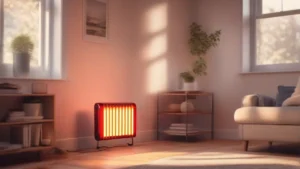
Where to Place an Infrared Heater for Maximum Warmth
On this page 5 sections
The common mistake is hiding the heater behind a sofa or aiming it at an empty wall. You lose the direct warmth and may run a 1,500-watt heater longer; at 8 hours a day and 17 cents per kWh, that is about $2.04 a day before the wasted comfort.
Infrared heat works best as line-of-sight warmth, while the heater’s blower or natural convection still warms some surrounding air. Placement should match the heater design, the people in the room, and the manufacturer’s clearance diagram.
Where to Place an Infrared Heater for Maximum Warmth

For the most useful infrared heater warming, aim the heating face at the people or objects you want warm: a main seating area, desk, workbench, or the foot of a bed. Keep its radiant path open, leave at least 3 feet from curtains, furniture, bedding, and other combustibles, and follow the model’s manual if it calls for more clearance.
Do infrared heaters work? Yes: how an infrared heater works is by sending radiant energy toward surfaces it can see, which then warm the people or objects touching or near them. A wall, sofa, or other furniture can block that path; fan-assisted models also move heated air, but the fan can’t make blocked radiation pass through a wall.
| Goal | Placement to try |
|---|---|
| Spot warmth | Face the heater toward the chair, desk, or workbench where you spend time. |
| Broader room heating | Use an open position with a clear view across the occupied part of the room; furniture and walls can interrupt radiant heat. |
There’s no fixed square-footage promise that applies to every 1,500-watt infrared heater. Insulation, ceiling height, drafts, thermostat settings, heater design, and whether you want spot warmth or whole-room heating all affect what it can do. Reflective surfaces may redirect some radiant energy, but they don’t replace clear space or a heater sized for the job.
The heater still consumes electricity when its radiant path misses you. Pointing it at the occupied area is a small adjustment; the electric meter is less interested in your aim than your comfort is.
When the Best Placement Changes
The best infrared heater placement depends on what you want warm, the heater’s footprint, and the room’s layout. Infrared heaters have pros and cons: they can warm people and surfaces directly, but their line-of-sight heat does little for a spot blocked by furniture. They use electricity at the same rate per watt as other resistance heaters, so they aren’t automatically cheaper to run.
| Heating goal | Preferred position | Main limitation |
|---|---|---|
| Chair or desk | Several feet away, aimed at your legs or torso | Don’t put it under a desk or against upholstery; furniture can block the radiant path. |
| Living room | Facing the seating zone | A sofa, alcove, open door, or traffic path can block heat or leave the unit vulnerable to being knocked over. |
| Bedroom | Facing the occupied area, away from bedding and curtains | Keep the unit clear of the bed and follow the manual’s rules for unattended or overnight use. |
| Garage or workshop | Aimed at the occupied work area, with drafts in mind | Use only a model rated for that environment; a household portable heater may be unsuitable around dust, solvents, or vehicles. |
For a chair or desk, aim the heater from several feet away rather than tucking it under the desk, where legs and furniture can obstruct the heat. In a living room, face the seating zone; behind a sofa or inside an alcove is a poor trade. A door or walkway can also turn a stable-looking spot into a trip or tip-over hazard.
In a bedroom, keep the heating face pointed away from bedding and curtains, and check the manual before running the unit unattended or overnight. For a garage or workshop, account for drafts and choose a heater specifically rated for that environment. Hot surfaces or grille areas can burn, so keep people and combustible materials clear.
Multiple heaters can overload one circuit if their combined electrical load is too high. A typical 1,500 W plug-in heater draws about 12.5 A at 120 V, so two on one 15 A circuit are too much. Use separate suitable circuits when needed; never use a power strip or extension cord to handle the load.
Set Up an Infrared Heater Safely
Yes, infrared heaters are safe when you follow the model’s infrared heater installation guide instead of improvising around furniture. Start with the manual’s placement diagram: its required clearances, intake and exhaust directions, and mounting instructions outrank generic advice, especially for a wall-mounted unit.
A portable electric heater needs a direct connection to a wall outlet. Never use an extension cord or power strip, and stop using the heater if the plug, infrared heater wire, housing, or grille is damaged. Keep at least 3 feet between the heater and curtains, furniture, bedding, clothing, or other combustibles.
Set the unit on a stable, level surface with its air intakes clear. Never cover it or dry clothing on it. Look for tip-over protection, overheat protection, automatic shutoff, and a UL, ETL, or CSA listing before you put it to work.
Quartz infrared heater, infrared heater ceramic, PTC, and dual-heating labels don’t change the basic rules. The heating method may differ, but every design still needs clearance, airflow, and sound electrical connections.
A portable model with the required safeguards can be useful when you need focused heat without mounting hardware, but those features don’t excuse a blocked intake or a bad outlet.

A wall-mounted infrared heater needs the listed mounting hardware and clearances, not a shelf, improvised bracket, or nearby power cord draped across the room. If the manual calls for fixed wiring or professional installation, use a qualified electrician rather than turning the installation into a winter science project.
 Winter Heating Bill CutterSee what every heater in your home really costs, heat the rooms you use, and cut the waste in 30 days.Cost-per-hour tables for every heaterThermostat schedule and draft-proofing planRunning-cost and bill calculator (Excel)
What to Do Next in Your Room
If your infrared heater is not working, first check the outlet, thermostat setting, and manual before assuming the heating element has failed. Use this placement order to remove the common problems safely.
For how to clean infrared heaters, unplug the unit and let it cool first. Remove dust from the intake and grille only as the manual allows, and never spray liquid into the housing. The misspelled search for infrared heater clening still leads to the same rule.
Use direct-facing placement for one person or one zone; choose a listed whole-room model or professional installation when the manual calls for mounting; choose another heat source when drafts or room heat loss overwhelm a small infrared heater.