

Propane heat is useful because the fuel stores well, starts working fast, and does not need household electricity for the flame itself. That makes it handy in a blackout, but only the right heater belongs indoors.
The mistake to avoid is treating every propane heater like a home heater. Some are for garages or patios only, and some indoor-rated models still need clearances, ventilation, and a working carbon monoxide alarm.
Emergency Propane Heaters
Emergency propane heaters can warm one occupied room, a small garage, or another limited area during an outage, but only an indoor-rated model belongs inside. Propane itself isn’t the deciding factor: the heater’s listing, combustion design, ventilation instructions, and safety controls determine whether the setup is suitable.
Propane burns to make heat, and that combustion produces exhaust gases, including carbon monoxide. Keep a working CO alarm powered, maintain at least 3 feet of clearance from walls, furniture, curtains, and other combustibles, and plug any electric auxiliary directly into a wall outlet—never an extension cord or power strip.
Emergency Heat On A Thermostat
The emergency heat setting on a thermostat is for a heat-pump system, not a portable propane heater. It switches on the system’s backup heat, often electric resistance heat, when the heat pump can’t keep up or has failed; use it temporarily because backup heat usually costs more to run. A propane heater doesn’t connect to that thermostat setting. See the guide to emergency heat on thermostat if your question starts at the wall control.
| Heater type | Where it fits | Main caution |
|---|---|---|
| Vented propane | A fixed or properly vented space where the flue terminates as required | The vent, clearances, and installation must follow the heater listing and local code. |
| Ventless propane | Only an indoor-rated model used exactly as its manual and local rules allow | Combustion gases and moisture stay in the room; some states and cities restrict or ban vent-free gas heaters. |
| Radiant indoor-rated portable | A small occupied room or one work area where directional warmth helps | Use only the listed indoor model, keep clearance, and don’t assume an outdoor radiant heater is equivalent. |
| Outdoor forced-air propane | Outdoor construction or jobsite heating only | Never use it in a room, tent, garage, vehicle cabin, or other enclosed space. |
A wrong choice creates three different problems: carbon monoxide exposure, poor comfort, or wasted fuel. A forced-air outdoor heater may move plenty of heat but still be unsafe indoors; a ventless heater may warm the room while adding moisture and requiring rules your local code does not permit.
Where The Heat Actually Goes
The best forced air propane heater depends on where you’ll use it: moving air warms a whole small space faster, while radiant heat warms your body and nearby surfaces with less noise and no blower electricity. For forced air propane heaters indoors, use only a model explicitly approved for indoor use; many portable forced-air units are outdoor or construction heaters and don’t belong in a room.
Radiant heat travels in a straight line, so a chair, desk, or workbench in front of the heater feels warm before the room does. That makes a small propane heater a good fit for one occupied zone. A propane heater stove usually works by this same radiant principle; the stove-like shape matters less than the listed heat type, output, and indoor approval.
Forced-air heat uses a burner and fan to move warmer air around the room. It can feel faster across a garage bay, but the blower adds noise, moves dust, and creates more noticeable drafts. Electricity dependence matters during an outage because the fan needs a power source, while a radiant unit can heat without a blower.
| Heat type | Comfort | Noise | Electricity dependence | Best room fit |
|---|---|---|---|---|
| Radiant | Directional warmth on people and nearby surfaces | Quiet | No blower required | Desk, chair, or small occupied zone |
| Forced air | Warms room air faster | Fan noise and more draft | Blower needs power | Garage bay or space needing air circulation |
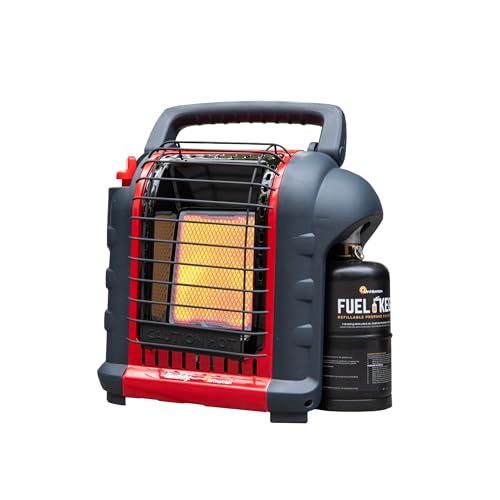
Product 1 runs at either low or high, so propane heaters do turn up and down, but the setting changes both warmth and runtime. Low is for a nearby chair or desk; high makes sense when the space is colder or larger.

What It Costs To Run
Propane cost is simple: fuel burn rate × hours used × fuel price. The catch is that manufacturers often give you runtime by cylinder size, so compare the cylinder you’ll actually carry or refill rather than trusting the BTU number alone.
For emergency power failure in your home, a 1 lb cylinder is short-duration backup, while a 20 lb cylinder stretches a low-setting runtime. Product 1 runs 5.4 hours on low or 2.4 hours on high from a 1 lb cylinder; Product 2 lists up to 108 hours on a 20 lb cylinder at low with the optional Buddy hose and fuel filter.
| Example setting | Runtime basis | Illustrative fuel cost |
|---|---|---|
| Product 1, low, 4,000 BTU/hr | 5.4 hours on one 1 lb cylinder | $5 ÷ 5.4 = about $0.93 per hour |
| Product 1, high, 9,000 BTU/hr | 2.4 hours on one 1 lb cylinder | $5 ÷ 2.4 = about $2.08 per hour |
| Product 2, low, 4,000 BTU/hr | 108 hours on one 20 lb cylinder | $20 ÷ 108 = about $0.19 per hour |
At eight hours a day for 30 days, the same example would use about 44.4 one-pound cylinders at low, or roughly $222; high would use 100 cylinders, or $500. A 20 lb cylinder at the listed 108-hour low-setting runtime would last about 13.5 days and cost roughly $44 for 30 days at that assumed refill price.
If you’re asking why is my propane heater using so much gas, compare actual hours and setting with the nameplate runtime first; why your propane heater is using so much gas may point to the calculation or a fuel-flow problem before you replace the heater.
Indoor Use And Venting Rules
Vented propane heaters and direct vent propane heaters send combustion gases outdoors, so they fit permanent installations better than a portable emergency heater. A flue carries exhaust outside; a direct-vent propane heater uses a sealed vent system that brings in combustion air and sends exhaust out through the wall. Neither type should be improvised with a window, dryer duct or loose pipe.
A ventless propane heater, also called a vent-free heater, releases its combustion products into the room. Some propane heaters indoor ventless are listed for indoor use, but only where local code allows; states and cities restrict or ban ventless propane heaters in some locations. Check the local building or fire department before buying, not after mounting it to the wall.
Are ventless propane heaters safe? They can be used only within the model’s listing, room-size limits, clearance rules and ventilation instructions. The dangers of ventless propane heaters include carbon monoxide from incomplete combustion, oxygen depletion, excess moisture and fire from nearby materials; a safety shutoff reduces some risks without removing them.
Before first light, check the heater and the room together. The label and manual should agree with every item on this list.
Keep the CO alarm operating even when the heater has an ODS, tip-over switch or overheat shutoff. Those devices respond to different problems: the ODS watches oxygen, the tip-over switch watches position, and the alarm watches carbon monoxide. Leave immediately for fresh air and call emergency services if the alarm sounds; don’t silence it and relight the heater.
Garage Heat, Wall Heat, And Installation
Propane heaters for garages need more caution than a room heater because door gaps, vehicle exhaust, stored flammables, and changing air exchange all affect the risk. For home use, choose only an indoor-rated heater approved by its manual for that location; an outdoor, patio, torpedo, or construction heater does not become safe indoors because the garage door is cracked open.

| Use case | Better fit | Why |
|---|---|---|
| Detached garage used occasionally | Indoor-rated portable heater, if the manual allows garage use | Easy to store and suitable for short, supervised outages |
| Workshop used often | Wall-mounted direct-vent propane heater | Combustion gases leave through the vent, and the fixed installation stays clear of tools and fuel |
| Attached garage or larger space | Listed direct-vent unit installed by a qualified professional | The shared wall and nearby living space raise venting, clearance, and carbon-monoxide concerns |
The best wall mounted propane heaters make more sense for frequent use, a larger garage, or an attached garage because a direct-vent model draws combustion air and sends exhaust outdoors through its listed vent. Small direct vent propane heaters suit a fixed room or compact workshop, but the wall opening, clearances, gas piping, and vent termination still have to follow the model’s instructions and local code.
A high altitude propane heater may need a manufacturer-specified orifice or other setup, but there is no universal altitude setting. Check the manual and the rating plate before installation, and use the adjustment the manufacturer lists for your elevation.
When The Heater Won’t Light
A propane heater that won’t light usually has no fuel, an unopened valve, restricted airflow, a dirty burner, or a hose or regulator problem. A Rinnai propane heater troubleshooting check or a Ryobi propane heater not firing check starts with the same safe basics; the brand changes the procedure, not the need to follow its manual.
What To Buy Before The First Storm
Product 1 is the practical choice for a small room, outage backup, or one garage bay when you need indoor-rated radiant propane heat without electricity. It offers 4,000 or 9,000 BTU per hour, covers approximately 225 square feet, and includes an emergency low-oxygen safety system.
The 4,000 BTU setting stretches a 1 lb cylinder to about 5.4 hours, while 9,000 BTU gives stronger heat for about 2.4 hours. That lower setting is useful for maintaining comfort after the room and nearby surfaces warm up; the high setting is the faster recovery tool. Keep the cylinder upright, follow the manual’s ventilation instructions, and run a working CO alarm.
Product 2 makes sense only if you specifically want the Midnight Series variant and understand its location limits: indoor use isn’t approved in Canada or Massachusetts. Connected to a 20 lb propane cylinder with the optional Buddy hose and fuel filter, it can run up to 108 hours, which is valuable for a long outage. The same 4,000/9,000 BTU choices let you trade heat output for fuel life.
Searches for mr heater propane heaters at Amazon, the best indoor emergency propane heater, or the best propane heaters for home use should lead you back to approval, coverage, fuel supply, and CO protection—not popularity alone. A tabletop propane heater may suit a patio, but an outdoor-only model doesn’t belong indoors. Reviews for Habitio propane heaters are less useful than checking the exact approval and runtime for the model in front of you; a forced-air unit may also be a different fit, covered in habitio vs mr heater.
Frequently Asked Questions
What is emergency heat on a thermostat?
When should you use emergency heat on a thermostat?
Are propane heaters safe indoors?
Do propane heaters give off carbon monoxide?
What is the best indoor propane heater for a power outage?

I am a mechanical engineer and love doing research on different home and outdoor heating options. When I am not working, I love spending time with my family and friends. I also enjoy blogging about my findings and helping others to find the best heating options for their needs.
Related guides

PT-1 Pilot Thermocouple Kit: A Reliable Fix for Your Gas Appliances
Upgrade your heating system with the PT-1 Pilot Thermocouple Replacement Kit G45 G46. Reliable, easy to install, and…
Smart Propane Water Heater: App-Controlled Temperature Mastery
Control your hot water from anywhere! Adjust your Westinghouse smart propane water heater's temperature instantly via mobile app…
Industrial Torpedo Diesel Heaters (Job Site Ready)
What makes the best diesel torpedo heater? See our top picks for powerful, portable heat in any space.