Bathroom Safe Space Heaters Built for Steam & Splash Zones
On this page 9 sections
- Bathroom Heater Specs at a Glance
- Best Bathroom-Safe Space Heaters
- How To Choose A Bathroom Safe Space Heater
- Bathroom-Safe Space Heaters Built For Steam & Splash Zones
- How Much Heat And Room Size You Actually Need
- Bathroom Heater Safety And Certification Checks
- What The Running Cost Looks Like In A Small Bathroom
- Before You Buy Or Plug It In
- Frequently Asked Questions
The common mistake is buying a plain room heater for a bathroom and trusting the box to do the rest. In a wet room, that can mean nuisance trips, a dead heater, or a bad day at the outlet.
Pick for the room and the splash zone first, then compare wattage, shutoff features, and mounting or floor placement. A heater that fits the vanity corner but lacks bathroom protection is the wrong bargain.
Bathroom Heater Specs at a Glance
| Model | Best for | Heat output | Bathroom protection | Controls | Best for | Price |
|---|---|---|---|---|---|---|
| DREO Bathroom & Indoor Space Heater with ALCI | Best for most | 1,500 W ceramic, 3 settings (900 W, 1,300 W, 1,500 W) | ALCI safety plug, tip-over, overheat, V-0 materials | 5 modes (H1, H2, H3, ECO, fan), 24h auto shutoff | Small bathrooms needing instant heat and water-short protection | Why it is here |
| HUMHOLD Wall Heater with Towel Warmer & IP24 | Wall-mount with towel bar | 1,500 W PTC ceramic | IP24 splash-proof, UL-listed, overheat, tip-over, child lock | Remote, 24h timer, 41°F–95°F thermostat | Wall-mount bathrooms up to 200 sq ft with towel warming | Why it is here |
| DREO Atom One with 70° Oscillation & Remote | Wide-angle heat | 1,500 W PTC ceramic | ETL Shield360°, enhanced plug, tip-over, overheat, V-0 materials | Remote, 12h timer, 70° oscillation, 41°F–95°F in 1°F steps, ECO mode | Larger bathrooms or dressing areas needing wide heat spread | Why it is here |
| ROSEKM 1,500 W Portable with Thermostat | Compact budget pick | 1,500 W ceramic, 3 heat levels | ETL, tip-over, 167°F overheat, reinforced plug, V-0 materials | Thermostat control, 3-level heat | Tight spaces where you carry the heater room to room | Why it is here |
| Amazon Basics 500 W Ceramic Mini Heater | Ultra-compact 500 W | 500 W ceramic | Tip-over protection | Single 500 W setting | Vanities or powder rooms for personal spot heat | Why it is here |
Best Bathroom-Safe Space Heaters
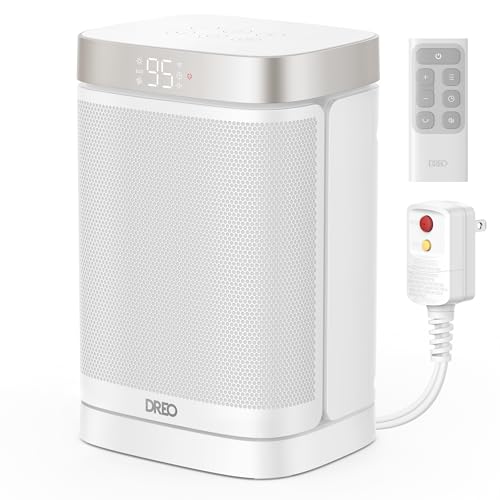
DREO Bathroom & Indoor Space Heater with ALCI

HUMHOLD Wall Heater with Towel Warmer & IP24

DREO Atom One with 70° Oscillation & Remote

ROSEKM 1,500 W Portable with Thermostat

Amazon Basics 500 W Ceramic Mini Heater
How To Choose A Bathroom Safe Space Heater

The one spec that separates a bathroom safe space heater from an ordinary plug-in model is water protection: look for an ALCI safety plug, which cuts power the instant moisture reaches the cord, or an IPX rating that confirms splash resistance. Without that layer, you’re trusting tip-over switches and thermostat clicks to keep things safe in a room where steam condenses on every surface and a dropped towel can cover a vent.
Wattage sets the boundary between warming a person and heating the room. A 500 W model throws heat at your feet while you dry off; it won’t lift the air temperature in even a 50-square-foot bathroom. A 1,500 W heater, drawing about 12.5 A, is the practical ceiling for a standard 120 V outlet and the minimum for bringing a small bathroom up to comfortable before a shower. Anything between 900 W and 1,300 W splits the difference—enough for a half bath or powder room, not quite enough for a full bath with a tub.
Floor placement works when you’ve got the space and can keep towels, bath mats and the shower curtain three feet back. Wall-mount designs solve the clearance problem in tight rooms: they sit above counters and hampers, keep the floor clear, and put controls at eye level instead of down by the baseboard where you’re crouching to adjust them with damp hands.
| Mounting | Best for | Clearance trade-off |
|---|---|---|
| Floor, portable | Bathrooms over 40 sq ft, easy to move | Needs 3 ft of open floor space |
| Wall-mounted | Tight bathrooms, above counters | Permanent install, harder to reposition |
Controls matter more in a wet room than anywhere else. A built-in thermostat means the heater cycles off when the air hits your target, saving you from babysitting it. A timer lets you set a shutoff before you step into the shower. A remote keeps you from leaning over the unit with wet hands. Physical buttons beat touch panels here—touch screens fog up and need a dry fingertip every time.
Tip-over and overheat protection aren’t bathroom-specific features, but they’re just as necessary here. Bathrooms collect clutter—towels on hooks that fall, bath mats that slide, toiletry baskets that get nudged. A heater that doesn’t cut power when it tips is a fire risk whether it tips in a bedroom or next to a sink. Overheat shutoff does the same job when a damp towel lands on the grille and blocks airflow.
 Winter Heating Bill CutterSee what every heater in your home really costs, heat the rooms you use, and cut the waste in 30 days.Cost-per-hour tables for every heaterThermostat schedule and draft-proofing planRunning-cost and bill calculator (Excel)
Bathroom-Safe Space Heaters Built For Steam & Splash Zones
The DREO Space Heater for Bathroom and Indoor use is the top pick for most small bathrooms because it pairs an ALCI safety plug with 1,500 W output and tip-over protection in a compact body that fits beside the toilet or under a towel rack. ALCI cuts power the instant moisture reaches the plug, which matters more in a bathroom than an extra 200 watts ever will. That safety layer, combined with overheat shutoff and a body that stays cool enough to brush against while you’re getting dressed, makes it the straightest answer for anyone typing bathroom safe space heater into a search box at midnight.
ROSEKM Portable Space Heater for Indoor Use lands as the runner-up for larger bathrooms—anything over about 120 square feet—where 1,500 W takes longer to cut the chill. It heats quickly and runs quieter than most ceramic tower units, but the product data doesn’t specify an ALCI plug, so treat it as a general indoor heater that works in a bathroom only if you keep it three feet from the tub, the shower curtain, and anything that might splash or drip. Good for a master bath with floor space; skip it if your bathroom is tight or if water protection is the reason you’re shopping in the first place.
For readers who want the floor back, the HUMHOLD Space Heater Wall Heater for Indoor Use mounts near the bathroom wall and delivers heat from above shoulder height, which keeps the unit away from wet floors and gives you room to move. Fixed installation means you’ll need to find a stud or use the mounting hardware the manual specifies, and the cord still needs an outlet within reach, but once it’s up you won’t kick it over or crowd it with laundry. Best for a bathroom you use every day and where a permanent spot makes sense; not worth the effort for a guest bath that gets used twice a month.
| Model | Output | ALCI Plug | Best For |
|---|---|---|---|
| DREO Bathroom model | 1,500 W | Yes | Most small bathrooms, 80–100 sq ft |
| ROSEKM Portable | 1,500 W | Not specified | Larger bathrooms with clearance |
| HUMHOLD Wall | 1,500 W | Check manual | Fixed install, reclaiming floor space |
| DREO Portable | 1,500 W | Check manual | Bedroom and bath, moved daily |
| Amazon Basics Ceramic | 500 W | No | Desk-side or sink warmth only |
DREO Space Heater, Portable Electric Heaters for Indoor Use is the choice for anyone moving one unit between the bedroom at night and the bathroom in the morning. It’s light, the handle folds flat, and 1,500 W is enough for a small bathroom if you give it ten minutes before you step in. Check that your model includes tip-over and overheat protection—most do—but confirm ALCI in the product data or the manual before you use it anywhere steam collects. Readers searching small bathroom heaters who already own a portable unit can usually make it work; just confirm the safety specs and keep the three-foot clearance rule.
The Amazon Basics Ceramic Portable Mini Space Heater is the budget pick, but only if you understand what 500 W actually does: it takes the edge off the chill within arm’s reach, which makes it useful while you’re standing at the sink or perched on a stool doing makeup, and not much else. It won’t heat a 60-square-foot bathroom to a comfortable temperature before your shower, and it won’t keep up if the door opens twice. Plug it in for personal warmth at a desk or vanity, not as the answer to walmart bathroom electric heater if what you really need is whole-room heat. No ALCI plug, so keep it away from the tub and the toilet tank.
How Much Heat And Room Size You Actually Need
Most bathroom heating jobs are about quick comfort while you shower and dress, not holding the room at 68°F all day. That shifts the sizing question: you’re matching output to a short burst rather than steady heat loss through walls and windows. A 500 W personal heater pointed at the spot where you stand works for one person in a small room. Bump to 1,500 W when the bathroom exceeds about 100 sq ft or you want the whole space warmed before you step out of the shower.
Wall-mounted units rated at 1,500 W can cover small bathrooms up to roughly 200 sq ft, but only if the layout gives you the clearances the manual requires and the circuit can handle the draw. Plug-in models like the DREO and ROSEKM heaters sit on the floor or a shelf and move when the job’s done. Mounted heaters stay put, which helps in a tight space but limits where you can place them.
Readers who’d rather skip a plug-in heater have a few other routes. Warm your towel on a heated rack or in the dryer before you shower. Run the exhaust fan only after you’ve finished, so rising steam warms the air instead of venting it. Install a permanent wall heater or a radiant ceiling panel; both need a licensed electrician and cost more up front, but they’re out of the way and designed for damp spaces. No bathroom heater—portable or fixed—can safely ignore the outlet type, clearance rules, and installation steps the manufacturer lays out.
Bathroom Heater Safety And Certification Checks
Tip-over switches and overheat cutoffs matter in every room, but bathroom use adds another layer: moisture. Look for an ALCI safety plug, which shuts off power the instant it detects a ground fault, or a splash-proof housing where the product literature explicitly says the heater suits bathrooms. Generic space heaters without those features belong in dry rooms only.
Plug straight into a wall outlet, never an extension cord or power strip. Bathroom circuits sometimes serve multiple outlets and a light fixture, so the combined load can trip a 15 A breaker if you’re running a hair dryer and a 1,500 W heater at the same time. A 12.5 A heater draw leaves just 2.5 A of headroom on a standard circuit, and resistance in an extension cord raises the risk of overheating at the connection.
UL, ETL, and CSA listings tell you the heater passed third-party safety tests, which is a good baseline. The listing doesn’t override the installation instructions, though. If the manual says the heater is for dry indoor use only, it stays out of the bathroom no matter what the certification mark promises. Wall-mounted units need their own rules: follow the height, clearance, and circuit requirements exactly, and hire a licensed electrician if the job involves new wiring or a dedicated 240 V line.
Portable models like the DREO and Amazon Basics heaters carry ALCI plugs and the certifications you want, which is why they appear in bathroom guides. Wall units such as the HUMHOLD heater mount high and out of splash range, but installation still has to respect local code and the maker’s clearance specs. Read the manual before you drill or plug in, and double-check that the outlet circuit isn’t already loaded with other high-draw devices.
What The Running Cost Looks Like In A Small Bathroom
Running a portable heater for bathroom use costs less than most readers expect because bathroom sessions are short. For a 1,500 W heater used 15 minutes after a shower, you’ll burn 0.375 kWh (1,500 ÷ 1,000 × 0.25 hours). At 17 cents per kWh, that’s about 6 cents per session, or roughly $1.80 a month if you run it once a day for 30 days.
| Heater | Watts | Per hour | Per day (8 h) | Per month (30 days) |
|---|---|---|---|---|
| 1,500 W heater, 15 min/day | 1,500 W | 26¢ | $2.04 | $61.20 |
| 900 W heater, 20 min/day | 900 W | 15¢ | $1.22 | $36.72 |
| 500 W heater, 30 min/day | 500 W | 8.5¢ | 68¢ | $20.40 |
Wattage matters, but so does how long you’re actually heating. Running a 500 W heater for 30 minutes uses 0.25 kWh; a 1,500 W model for 15 minutes uses 0.375 kWh. You’ll spend a bit more with the bigger heater, but it warms the room faster and shuts off sooner if you’re using a thermostat.
ECO modes and built-in thermostats cut cycling once the bathroom hits your set temperature, which trims cost in longer sessions. How much depends on insulation, ceiling height and how often the unit has to kick back on. Don’t expect dramatic savings in a ten-minute warm-up, but they help if you’re keeping a small bathroom heater running while you get ready.
Before You Buy Or Plug It In
Outlet placement decides whether a bathroom safe space heater will work safely in your room. Measure the distance from the nearest grounded outlet to where you plan to set the heater, then check that spot sits outside the splash zone and at least three feet from the tub, shower or sink.
Wall-mounted models solve the footprint problem but need screws and a nearby outlet or hardwired power. Confirm mount height, stud spacing and whether the cord will reach before you order. For a small bathroom wall heater that requires a dedicated circuit or hardwiring, stop and call a licensed electrician: bathroom circuits have GFCI protection and code-required spacing that a DIY install can violate.
Once it’s plugged in, keep the area around the heater clear and check that the tip-over switch works by gently tilting the unit. Never leave it running when you’re not in the room unless the manual says the model is designed for unattended use.