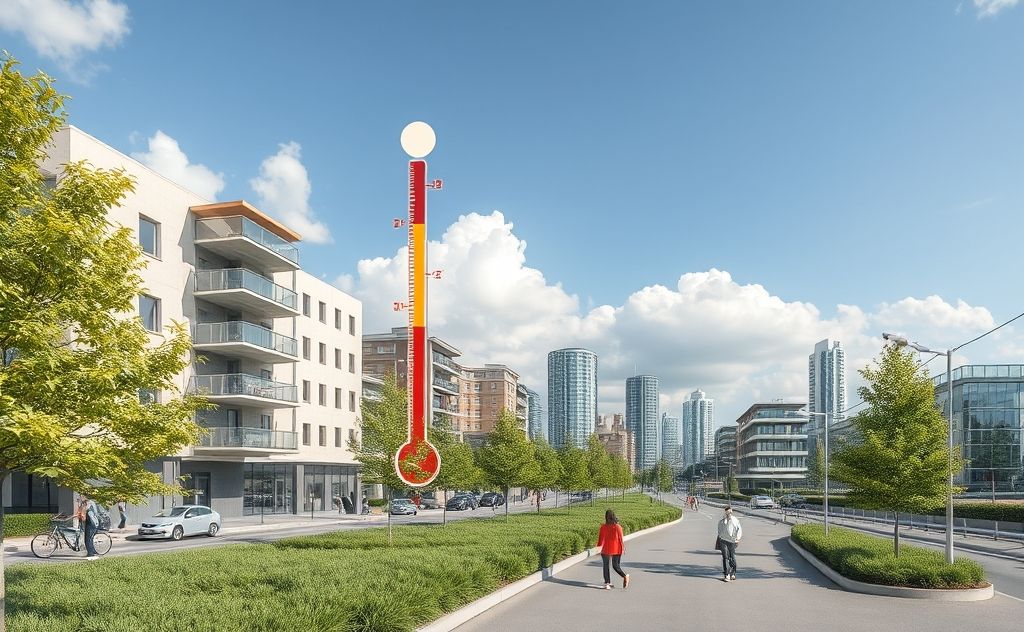
You’re standing on a downtown sidewalk in July. The air shimmers off the asphalt, the building walls radiate heat like a brick oven, and the temperature reads 97°F. But your phone’s weather app says it’s only 88°F outside the city. That gap isn’t a glitch—it’s the urban heat island effect, and it’s reshaping how we design every street, roof, and park.
This article walks through the mechanics of how temperature regulation transforms urban planning, from the physics of reflective surfaces to the policy levers that actually get projects built. You’ll leave with specific numbers, failure modes to avoid, and a clear sense of what works where. No vague platitudes about ‘greening’ cities—just the engineering and economics of cooler places.
For a deeper reference on the strategies discussed here, the book Urban Heat Islands: Strategies for a Cooler, Greener Future by Majosta covers the design details and maintenance schedules in practical depth. It’s a useful desk copy when you’re drafting specs for a retrofit project. You can check the current price on Amazon if you want a physical reference.

The Urban Heat Island: Why Cities Are 10°F Hotter
The numbers are stark. A dense downtown core can hit surface temperatures of 120°F on a day when surrounding rural land reads 85°F. Air temperatures in the canopy layer—the zone where people live and breathe—run 5°F to 10°F hotter than nearby farmland. That’s not a minor discomfort; it’s a public health crisis in waiting.
Three physical drivers create this gap. First, dark surfaces like asphalt and tar roofs absorb 80% to 95% of incoming solar radiation and re-emit it as heat throughout the evening. Second, cities replace vegetation with impermeable surfaces, eliminating evapotranspiration—the process where plants release water vapor and cool the surrounding air. A single mature tree can transpire 40 gallons of water per day, producing the cooling equivalent of two air conditioners running for 20 hours. Third, urban canyons trap heat between tall buildings, reducing the sky view factor and preventing longwave radiation from escaping to space.
The result is a feedback loop. Hotter air increases energy demand for cooling, which drives more power plant emissions, which warms the climate further. Cities like Phoenix now see minimum nighttime temperatures above 90°F for weeks at a stretch, which means the human body never gets a chance to recover from daytime heat exposure.
The Physics of Cooling: Albedo, Evapotranspiration, and Thermal Mass
Every cooling strategy boils down to manipulating one of three variables: reflectivity (albedo), moisture (evapotranspiration), or heat storage (thermal mass). Get the combination right for your climate, and you can cut peak temperatures dramatically.
How Trees and Green Roofs Actually Work
Vegetation cools through two mechanisms. Shade provision blocks solar radiation before it hits a surface—a tree with a dense canopy can intercept 70% to 90% of incoming sunlight. But the bigger effect comes from evapotranspiration. When a leaf transpires, it converts liquid water to vapor, absorbing latent heat from the surrounding air. That process can drop leaf surface temperatures 10°F to 20°F below ambient air temperature.
Green roofs deliver measurable results. A study of Toronto’s green roof bylaw found that extensive green roofs (4 to 6 inches of substrate) reduce rooftop surface temperatures by 40°F to 60°F compared to conventional black membranes. The air temperature directly above the roof drops by 2°F to 5°F. That might sound small, but across a city block, it compounds.
But green roofs aren’t a silver bullet. They’re heavy—a saturated extensive roof can load a structure with 15 to 25 pounds per square foot. Retrofitting an old building to support that weight often requires structural reinforcement, which can double the project cost. And in arid climates like the Southwest, the irrigation demand can strain water supplies. A drought-tolerant sedum mix might survive, but it won’t transpire much when it’s stressed.
The Underrated Power of Blue Infrastructure
Water features get less attention than trees, but they punch above their weight. A study in Melbourne measured a 4°F air temperature drop downwind of a 2-acre urban lake. Fountains and misting systems add evaporative cooling on top of the water body’s thermal mass—the water absorbs heat during the day and releases it slowly at night, moderating the diurnal swing.
The key is that water’s specific heat capacity is about five times that of concrete. A canal running through a district acts as a heat sink, absorbing excess energy during peak hours. Cities like Paris and Amsterdam have used their existing waterways as cooling corridors, and newer developments in Singapore integrate rain gardens and detention ponds into the street network to capture stormwater while cooling the microclimate.
Blue infrastructure has a failure mode, though: stagnant water breeds mosquitoes and algae. Moving water, regular maintenance, or biological controls are non-negotiable. A poorly designed pond can become a liability that generates complaints and legal exposure.
The Equity Problem: Heat Maps and Vulnerable Neighborhoods
Heat doesn’t hit everyone equally. A landmark study of 108 US cities found that neighborhoods that were redlined in the 1930s—classified as ‘hazardous’ for mortgage lending—are now 5°F to 12°F hotter than their non-redlined counterparts. The cause isn’t mysterious: those districts were systematically under-invested in, leaving them with less tree canopy, more impervious surfaces, and fewer parks.
You can see this on any land surface temperature map. The city’s wealthiest quarter might have 40% tree canopy cover, while a working-class district a mile away has 8%. That difference translates directly into heat-related illness and mortality. During the 2026 Pacific Northwest heat dome, 85% of the 600+ deaths in Oregon occurred in the state’s two most populous counties, with the highest rates in lower-income neighborhoods.
Planning for thermal equity means targeting interventions where the need is greatest, not where the political pressure is loudest. That starts with a heat mapping campaign—many cities have used citizen-science efforts to create block-level temperature maps. Then prioritize tree planting and cool pavement in the hottest census tracts, measure the change, and publish the results.
It’s not just about trees, either. Cooling centers, shade structures at bus stops, and reflective bus shelter roofs all help. But the structural fix is changing the built environment itself.
Policy Levers: Zoning, Building Codes, and Incentive Programs
Good intentions don’t build shade. Policy does. Here’s what actually moves the needle.
Building codes: The International Green Construction Code now includes optional provisions for cool roofs and green roofs. Cities like New York and San Francisco mandate that new roofs meet specific solar reflectance index (SRI) values—typically 64 or higher for low-slope roofs. The result is that the roof reflects 60%+ of incoming solar energy instead of absorbing it.
Zoning ordinances: Setback rules can require that buildings be positioned to allow east-west street canyons that maximize shade. Some cities mandate tree planting along street frontages, with the developer bonding the trees for two years to ensure survival. Parking lot shading ordinances—like those in Tucson and Orlando—require a minimum percentage of parking spaces to be shaded within five years of construction.
Incentive programs: Density bonuses are the most effective tool. Chicago’s Green Roof Grant program offers $5,000 to $10,000 per project, but the real driver is the zoning bonus that allows extra floor area in exchange for green roof coverage. Portland’s Ecoroof program has used this to fund over 600 projects.
The economics work out. A 2026 analysis by the US EPA found that the lifetime cost of a green roof (including installation and maintenance) is about $15 to $25 per square foot, but the benefits—reduced energy use, extended roof membrane life, stormwater management—reach $30 to $50 per square foot over the same period. Cool pavements are even cheaper: a reflective coating costs $0.50 to $2.00 per square foot and can cut surface temperatures by 20°F to 30°F.
Case Study: How Melbourne Cut Peak Temperatures by 5°F
Melbourne’s urban forest strategy is the most cited example of a city actually hitting its heat mitigation targets. In 2026, the city set a goal to increase canopy cover from 22% to 40% by 2040. They didn’t just plant trees—they changed the whole system.
The city mapped every street tree, assessed its health, and created a species palette based on climate projections. They removed thirsty, short-lived species like plane trees and replaced them with drought-hardy natives like eucalyptus and lophostemon. They also changed the soil spec: instead of compacted road base, they used structural soil cells (like Silva Cells) that allow root growth under pavement without breaking the surface.
Measured outcomes: surface temperatures on shaded streets dropped by 9°F to 14°F compared to unshaded streets. Air temperatures at pedestrian level fell by 4°F to 5°F during peak afternoon hours. The city also documented a 10% reduction in heat-related ambulance callouts in the retrofitted precincts during the 2026 heatwave, compared to adjacent control areas.
The cost? About $1.2 million per kilometer of street retrofit, including pavement replacement and soil cells. That’s not trivial, but against the economic cost of heat-related productivity loss (estimated at $6.2 billion annually in Australia), it pays back in under a decade.
The Hidden Costs and Failure Modes of Heat Mitigation
Let’s be honest about what goes wrong. Not every strategy survives contact with reality.
Reflective pavement glare: High-albedo coatings bounce sunlight in every direction, which can blind drivers and pedestrians at certain angles. A study in Phoenix found that some cool pavement treatments increased glare by 30% during morning and evening hours. The fix is to use coatings with controlled reflectance that scatters light diffusely, not specularly.
Green roof die-off: A sedum roof in a dry climate can survive, but it won’t thrive. Many extensive green roofs in California have turned brown by late summer, losing their evapotranspirative cooling just when it’s needed most. The failure is usually an irrigation system that’s undersized or a species selection that prioritizes looks over survival. Plan for irrigation from day one, or accept that the roof is a stormwater tool, not a cooling tool.
Tree mortality: Urban trees die at alarming rates—often 10% to 20% in the first two years without proper watering. The classic mistake is planting in a 2-foot-wide pit surrounded by concrete, which gives the roots no room and no water. The solution is soil volume specification: a mature tree needs at least 600 cubic feet of uncompacted soil to reach its full canopy size. If you can’t provide that, pick a smaller species.
Albedo trade-offs: Reflective roofs are great in summer, but they also reflect heat in winter, increasing heating loads in cold climates. A study in Chicago found that white roofs increased annual heating costs by about 10%, partially offsetting the cooling savings. The answer is a ‘smart’ roof that changes color seasonally—some products do this, but they’re still niche.
What Your Master Plan Should Actually Say
You can’t just add a ‘sustainability’ chapter and call it done. Here’s the practical roadmap for integrating thermal strategy into your city’s master plan.
- Set a measurable target. Not ‘increase green space’ but ‘reduce peak summer land surface temperature by 4°F in the downtown core by 2030.’ Tie it to a heat vulnerability index.
- Map the hotspots. Use satellite land surface temperature data at 30-meter resolution, then ground-truth it with mobile transects. Publish the map publicly—it builds political will.
- Prioritize equity districts. Rank census tracts by a combination of surface temperature, canopy cover, and socioeconomic vulnerability. Allocate 60% of your heat mitigation budget to the top 20% of tracts.
- Change the code first. Amend the zoning ordinance to require shade coverage in parking lots and street trees on all new developments. This costs nothing and shifts the burden to developers.
- Budget for maintenance. A green roof doesn’t maintain itself. Set aside 1% to 2% of the capital cost annually for irrigation, weeding, and membrane repair. A dead green roof is worse than none—it’s a liability.
- Monitor and publish. Install a network of low-cost air temperature sensors across the city. Publish the data quarterly. What gets measured gets managed.
One more thing: don’t silo this work. The stormwater team, the parks department, and the transportation division all need to be at the table. A tree planted in the right-of-way is a stormwater asset, a shade provider, and a traffic calming device all at once. Treat it that way.
Frequently Asked Questions
How much can trees actually reduce local temperatures?
A single mature tree can lower peak air temperatures under its canopy by 2°F to 5°F, and surface temperatures by 20°F to 45°F. At the neighborhood scale, increasing tree canopy from 20% to 40% can reduce afternoon air temperatures by about 2°F to 3°F. The effect is strongest in the late afternoon, which is exactly when heat stress peaks.
What is the most cost-effective heat mitigation strategy?
Cool roofs and reflective pavement coatings are the cheapest per square foot—often under $2 per square foot—and deliver immediate surface temperature drops. But the most durable and socially beneficial strategy is street trees, because they provide shade, evapotranspiration, and aesthetic value. The cost-benefit ratio depends on climate: in hot, dry cities, trees need irrigation, which eats into the savings.
Do green roofs work in all climates?
No. They work best in temperate and humid climates where rainfall is reliable and evapotranspiration is effective. In arid climates, they require significant irrigation, which can make them net energy consumers if the water needs to be pumped. In cold climates, the soil layer provides insulation, which is a benefit in winter, but the cooling benefit in summer is smaller because the ambient temperature is lower. Always model the specific climate before committing.
How does albedo affect the urban heat island?
Albedo is the fraction of solar energy a surface reflects. Black asphalt has an albedo of about 0.05, meaning it absorbs 95% of incoming sunlight. White concrete has an albedo of 0.7 to 0.8. Raising the albedo of a city’s roofs and pavements by 0.2 can reduce peak air temperatures by 2°F to 4°F. The effect is stronger for roofs than roads because roofs receive more direct sunlight.
What are the health risks of urban heat islands?
Excess heat kills more people in the US than all other weather events combined. Urban heat islands amplify heatwaves, raising nighttime minimum temperatures that prevent the body from recovering. This increases the risk of heat exhaustion, heat stroke, and exacerbates cardiovascular and respiratory conditions. The most vulnerable are the elderly, young children, outdoor workers, and people without air conditioning.
Actions You Can Take This Week
- Pull your city’s land surface temperature map from the USGS EarthExplorer—it’s free and takes ten minutes. Look for the hottest blocks in the poorest neighborhoods.
- Call your city’s public works department and ask what the tree pit spec is. If it’s less than 3 feet wide, that’s a problem. Advocate for structural soil cells on the next street project.
- Check your building code for an SRI requirement on low-slope roofs. If there isn’t one, draft a simple amendment and bring it to the next planning commission meeting.
- Find one parking lot owned by the city that’s over 10,000 square feet. Propose a shade canopy retrofit and price out the tree pit and irrigation costs. Present it as a pilot project.
- Read the case study on Melbourne’s urban forest strategy—the full report is public and free. Steal their species selection criteria and soil volume specs.
- If you’re working on a private development, run the numbers on a cool roof versus a green roof. The cool roof is cheaper upfront; the green roof pays back in stormwater fee reductions and roof longevity.
Temperature regulation is not a luxury amenity. It’s core infrastructure, like water pipes and power lines. The cities that treat it that way will be the ones that stay livable as the mercury climbs. The playbook exists, the data is public, and the tools are proven. The only missing ingredient is the willingness to change the code and spend the money.
For more on how these principles apply to specific systems, see our guide on improving urban air quality and how heatwave mitigation strategies differ from long-term planning. The connection between renewable energy and cooling demand is another angle worth exploring when you model future energy loads.
Related guides
5 Proven Ways to Regulate Temperature in Wetlands
You've walked past a wetland on a hot July afternoon and felt the air drop ten degrees the…
How Temperature Changes Impact Groundwater Recharge Rates
Temperature regulation significantly influences groundwater recharge by affecting evaporation rates, soil moisture retention, and the overall hydrological cycle.…
How Temperature Control Transforms Agricultural Success
Temperature regulation enhances agriculture by optimizing crop growth, improving yield consistency, reducing pest outbreaks, and enabling year-round farming…