
Skip to content
Heater GuidesHeaterGuides
Water Heater

120°F Is the Recommended Maximum Water Heater Temperature to Prevent Burns

Quick answer
The recommended maximum temperature setting for a home water heater to prevent burns is 120°F for most homes. That setting balances scald protection and everyday use; many tanks ship at 140°F, which can burn a child in seconds, so a quick check is worth your time.
Key takeaways
Set most residential water heaters to 120°F unless your house has a specific medical or code-based reason to go higher.
Check the temperature at a sink or tub with a thermometer, not by touch; skin lies, thermometers do not.
If children, older adults or anyone with reduced sensation lives there, add an anti-scald valve instead of just turning the tank down.
Gas and electric heaters adjust differently, and a tankless unit may need a lower setpoint at the heater plus a mixing valve at the tap.
Recheck the setting after maintenance, power outages or thermostat replacement; dials drift and people twiddle them.
Our picks at a glance
1
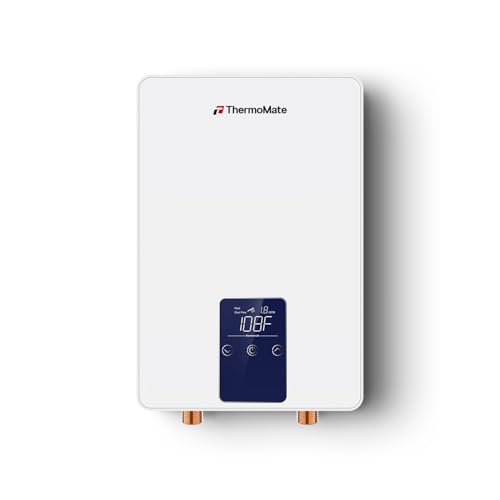
Best for point-of-useThermoMate 6kW Electric Tankless Sink Heater
Under-sink faucets in bathrooms and kitchens where you want instant water at a set temp
View on Amazon
2
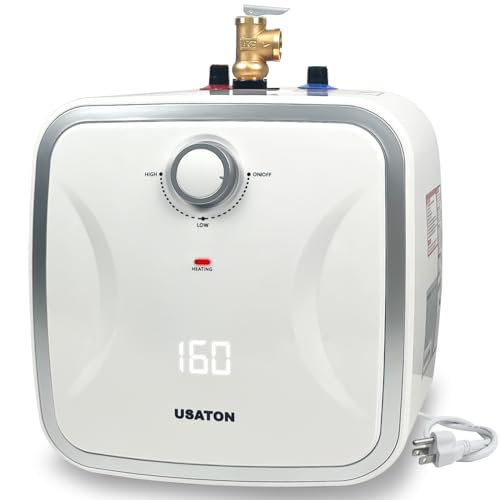
Best small tankUSATON 2.5 Gallon Mini Tank Heater
Single sinks or hand-washing stations where a small reserve and wide temp range help
View on Amazon
3
Budget 110V pickXWDZSWGS 3kW 110V Instant Heater
Renters or tight budgets who need instant hot water from a standard 110 V outlet
View on Amazon

A half-true idea floats around this topic: hotter water does clean better, and that part is true up to a point. The part that goes wrong is assuming you need 140°F or more for normal home use; for most houses, 120°F is hot enough for washing and much less likely to scald.

The hard part is that the number on the dial is only a starting point. Outlet temperature can drift with tank age, sediment, plumbing length and a mixing valve, so the setting, the faucet reading and the household risk all need to line up.

At a Glance

ModelBest forTemp rangePower / electricalSafety featuresBest fitPrice
ThermoMate 6kW Electric Tankless Sink HeaterBest for point-of-use85°F to 131°F6 kW, 240 V hardwired, 30 A breaker, 10 AWG wireETL listed, water and electricity separation, IP25 waterproofUnder-sink point-of-use with precise temp controlView on Amazon
USATON 2.5 Gallon Mini Tank HeaterBest small tank65°F to 161°FElectric, voltage not specifiedT&P relief valve, glass enamel lined tank, pressure-resistant designSmall storage tank for sinks or hand-washing stationsView on Amazon
XWDZSWGS 3kW 110V Instant HeaterBudget 110V pickUp to 131°F3 kW, 110 V plug-inIPX4 waterproof, leakage protection, dry boil protection, automatic shutoffBudget point-of-use for standard outletsView on Amazon

Heaters and Controls That Make Temperature Setting Easier

#1Best for point-of-use

ThermoMate 6kW Electric Tankless Sink Heater

Best for Under-sink faucets in bathrooms and kitchens where you want instant water at a set temp
This unit tops out at 131°F and adjusts in 1° increments from the touch panel, so you can dial in a safe outlet temperature without touching the main tank. Cast aluminum heating element resists scale buildup better than cheaper coil designs. ETL listed with digital display that shows exactly what temperature is coming out.
Temperature range 85°F to 131°FPower 6 kW at 240 V, 25 A drawFlow rate 1.0 GPM at 35°F risePipe fitting 1/2″ NPTCircuit requirement 30 A breaker, 10 AWG wire minimum
Why it made the cut
Caps at 131°F, slightly above the recommended safe limit of 120°F
1° increment control from the touch panel
99.8% efficient, heats only when you draw water
Compact 11 × 7.4 × 2.52 inches fits well under most sinks
Good to know
Requires 240 V hardwired circuit with 30 A breaker and 10 AWG wire
Flow rate limited to 1.0 GPM at 35°F rise
Installation cost adds up if you don’t already have 240 V at the sink
Skip it if Skip it if you need higher flow or don’t have 240 V service near the sink.
View on AmazonPaid link · live price on Amazon
#2Best small tank

USATON 2.5 Gallon Mini Tank Heater

Best for Single sinks or hand-washing stations where a small reserve and wide temp range help
Adjustable from 65°F to 161°F with a rotary knob and LED readout, so you can set and see the tank temperature in real time. Glass enamel lined tank with T&P relief valve and a three-year warranty. Thickened stainless steel heating element and PUF insulation hold heat longer between uses.
Capacity 2.5 gallonsTemperature range 65°F to 161°FHeating element 316 stainless steelDimensions 13.4 × 13.4 × 12.88 inchesWarranty Three years
Why it made the cut
Wide 65°F to 161°F range with LED temperature display
Glass enamel lined tank with three-year warranty
Includes T&P valve, tee, hoses and fittings in the box
Wall-mount, bracket or floor installation options
Good to know
Larger dimensions than competing 2.5 gallon units due to thicker insulation
Electric only, no option for gas
Small 2.5 gallon capacity runs out quickly with continuous draw
Skip it if Skip it if you need more than a couple gallons at a time or can’t spare 13.4 inches of wall space.
View on AmazonPaid link · live price on Amazon
#3Budget 110V pick

XWDZSWGS 3kW 110V Instant Heater

Best for Renters or tight budgets who need instant hot water from a standard 110 V outlet
Plugs into a standard 110 V outlet and heats water quickly at low flow, with an LED display showing outlet temperature. Features IPX4 waterproof housing and automatic shutoff to prevent dry boil and overheating.
Power 3 kW at 110 VTemperature rise 82°F at 0.3 GPM, 131°F at 0.5 GPMWaterproof rating IPX4Pipe fitting 1/2″ NPTInstallation Vertical only
Why it made the cut
Runs on 110 V, no hardwiring or electrician needed
LED display shows current temperature
Multiple safety features including leakage and dry boil protection
Good to know
Flow rate drops to 0.3 GPM at higher temperature rise
Vertical installation only, no horizontal mounting allowed
Lower 3 kW power limits how much water you can heat at once
Skip it if Skip it if you need more than a trickle of hot water or plan to install it horizontally.
View on AmazonPaid link · live price on Amazon

The recommended maximum temperature setting for a home water heater to prevent burns is 120°F for most households. At that setting, an adult has about two minutes of contact before a serious burn occurs, and a child has roughly 30 seconds—enough time to pull a hand away or turn off the tap. Many water heaters leave the factory set to 140°F, a temperature that can cause second-degree burns in five seconds and scald a young child in under three. If your heater still carries the factory setting, a quick adjustment could prevent a trip to the emergency room.

Some households raise the thermostat to 125°F for a bit more heat at the tap, especially in homes with long pipe runs or a dishwasher that calls for hotter water. That’s a workable compromise, but scald risk climbs noticeably: burn time drops to about 90 seconds for an adult and closer to 20 seconds for a child. Vulnerable groups—young children, older adults, and anyone with diabetes, neuropathy, or reduced mobility—face the highest risk because they may not pull away quickly or feel the heat in time.

2.5 seconds
Burn time for a child at 140°F
Factory settings are often too hot for safe household use, which is why checking and adjusting the thermostat matters before someone gets hurt.

The 120°F target isn’t arbitrary. It sits at the point where everyday tasks—handwashing, bathing, laundry—work as expected, soap and detergent dissolve and clean effectively, and the margin for error stays wide enough to matter. Water at 120°F still feels uncomfortably hot to the touch, but it won’t inflict a burn in the few seconds it takes to react. Raising the setting to 130°F or higher shrinks that window fast, and the supposed benefit—marginally hotter showers or slightly faster dishwashing—rarely justifies the added risk.

Myth
Water heaters must run at 140°F or higher to kill bacteria and prevent illness.
Fact
Legionella bacteria can grow between 77°F and 108°F, but 120°F is hot enough to slow growth in a residential system with regular use. Homes without immunocompromised residents or long stretches of stagnant plumbing do fine at 120°F, and the scald protection is worth far more than the small theoretical reduction in bacterial risk.

A handful of situations call for a higher setting: homes with a dishwasher that lacks a booster heater and requires 140°F inlet water, or a household where someone is severely immunocompromised and a doctor has recommended hotter tank temperatures. In those cases, install a thermostatic mixing valve at the tank outlet to bring the temperature back down to 120°F at every fixture. That keeps the tank hot enough for the appliance or medical need while protecting everyone at the tap.

How To Check Water Temperature The Right Way

Run the hottest tap—usually the kitchen or bathroom sink—for one to two minutes, then hold a kitchen or probe thermometer under the stream until the reading steadies. That’s the temperature someone will actually touch, and it’s the only number that matters for scald safety. Measuring at the tank alone misses problems downstream: a malfunctioning mixing valve, a long uninsulated pipe run that cools the water, or a cartridge that blends cold water inconsistently.

Where to test
Kitchen sink faucet, hot side only
Bathroom sink closest to bedrooms
Shower or tub if the valve is accessible
Any fixture a child uses regularly

Test each fixture separately. A shower valve with a different cartridge or a bathroom sink on a long branch line can read five to ten degrees cooler than the kitchen, and you won’t know which fixture poses a risk until you measure. After adjusting the heater thermostat, retest the same fixtures an hour later, then again the next morning. Mixed water in the tank takes time to settle, and the first reading after an adjustment doesn’t always reflect the final temperature.

Skip the touch test
Water at 120°F already feels painfully hot to most people, so your hand can’t tell the difference between a safe setting and a dangerous one. A thermometer costs a few dollars and gives you the actual number.

If the reading at the tap sits above 125°F and you’ve confirmed the heater is set to 120°F, check for a recirculation pump running too hot, an old mixing valve stuck open, or sediment in the tank that’s fooling the thermostat. Gas heaters with a dial marked “Low, Medium, High” instead of degrees require a bit of trial: start at the mark closest to 120°F, wait a day, then measure and adjust. Electric heaters and most tankless units show the setpoint in degrees, which makes the job faster but doesn’t guarantee the outlet temperature will match without a measurement to confirm it.

How To Adjust Gas And Electric Water Heaters

Gas and electric water heaters have different thermostat locations, but the adjustment process is similar. Set your thermostat dial to 120°F, wait a few hours for the water to reach that temperature, then measure the water at the tap to confirm. Gas heaters usually have one dial on the gas valve at the tank’s bottom, marked with settings like “Low” or “Hot” or specific temperatures. Electric heaters have two thermostats—one for the upper element and one for the lower—behind panels on the tank’s side; both should be set to the same temperature to keep the tank uniform. Tankless units often feature a digital control panel that lets you set the outlet temperature precisely, sometimes in 1°F increments.

1
Turn off power or gas
For a gas heater, turn the dial to the pilot or vacation setting, or leave the gas on if you’re making a small adjustment. For an electric tank, flip the breaker labeled for the water heater; the panel work involves live 240 V wiring, and the breaker keeps you safe.
2
Remove the access panel on electric tanks
Unscrew or pop off one or both panels on the side of the tank. You’ll see insulation; pull it aside to expose the thermostat behind it. Some tanks have a single panel covering both thermostats; others have two separate covers.
3
Set the thermostat
On a gas valve, turn the dial to the 120°F mark or one notch above “Low” if the dial isn’t numbered. On electric thermostats, use a flathead screwdriver to turn the adjustment screw until the arrow or indicator points to 120°F on the printed scale. Set the upper thermostat first, then match the lower one exactly.
4
Reassemble and restore power
Replace the insulation and panels on an electric tank, then flip the breaker back on. For gas, return the dial to the desired setting if you’d turned it to pilot. On a tankless unit, press the temperature buttons on the display until it reads 120°F.
5
Wait and measure
Give the tank three to four hours to stabilize, or about 20 minutes for a tankless model. Run the hottest tap and measure the outlet temperature with a thermometer. If it’s still above 120°F, lower the setting a bit more; if it’s below, raise it. The tap reading is what counts, not the number on the dial.
Breaker off before you touch the panel
Electric water heater thermostats sit behind live 240 V terminals. Flip the breaker and confirm power is off with a voltage tester before you remove the access panel or touch any wiring.
When to call a pro
Adjusting a thermostat is straightforward, but if the heater won’t hold a steady temperature, leaks around the valve, or has corroded wiring or vent connections, a licensed plumber or electrician should handle the repair. Gas valve and vent work in particular falls under code in most places, and a mistake with either can mean carbon monoxide or a flood.

What Anti-Scald Devices Actually Help

A thermostatic mixing valve installed at the water heater blends hot supply water with cold to deliver a steady, safer temperature to every fixture in the house, and it’s the most reliable whole-house scald control you can add. The valve sits downstream of the tank, letting you keep the heater at 140°F to discourage bacterial growth while capping outlet temperature at 120°F. Tempering valves do much the same job but with less precise control; they’re common in commercial settings and older homes.

Pressure-balancing shower valves stop the sudden surge of scalding water when someone flushes a toilet or starts the washing machine, but they don’t set or limit the maximum temperature leaving the heater. They equalize hot and cold pressure so the mix stays constant, which helps during a shower but offers no protection at a kitchen sink or tub faucet.

Point-of-use heaters with built-in temperature limiters—like the ThermoMate 6kW and the 2.5 Gallon Electric Mini Tank—cap outlet temperature right at the fixture. That feature suits a powder room or a prep sink where kids or elderly guests wash hands, but it won’t protect the rest of the house if the main tank still runs hot.

DeviceWhere It InstallsWhat It Does
Thermostatic mixing valveAt the water heater outletBlends hot and cold to a set delivery temp, whole house
Tempering valveAt the heater or near fixturesReduces outlet temp with less precision than a mixing valve
Pressure-balancing valveInside the shower or tubKeeps shower mix steady when pressure shifts; no temp limit
Built-in limiterInside the point-of-use heaterCaps temperature at that fixture only
Each device solves a different part of the scald problem.

For anyone with reduced sensation in the hands or feet—diabetic neuropathy, stroke survivors, elderly adults—even a few seconds at 125°F can cause injury before the person feels pain. The maximum temperature setting on the home water heater for a patient who has reduced sensation in the extremities should be 120°F or lower, confirmed with a thermometer at every tap they use regularly.

Code and installation
Local plumbing code in some cities requires a thermostatic mixing valve on new tank installations or when replacing a heater, and a few jurisdictions restrict vent-free or high-temperature settings. Check with your building department or ask a licensed plumber before buying a valve; installation involves soldering or threaded fittings on both the hot and cold supply lines, work that most codes reserve for a licensed tradesperson.
Testing after installation
Run the hottest tap for two minutes, then hold a probe thermometer under the stream until the reading steadies. If it climbs above 120°F, adjust the mixing valve’s set screw a quarter turn and test again in an hour.

120°F Cleans Dishes and Saves Energy

Water at 120°F is hot enough for soap and detergent to lift grease and kill most germs in normal household cleaning, and modern dishwashers heat their own rinse water to 140°F or higher when the cycle calls for it. You won’t see dirty dishes or a film on glassware unless the detergent is old or the machine’s heating element has failed.

Dropping the tank setting from 150°F to 120°F cuts standby heat loss—the energy that bleeds through the tank jacket into the basement or garage—and the difference adds up. Estimates put the annual savings at about 12%, depending on how much hot water the household uses, the fuel price, and where the heater sits. A tank in an unheated garage loses more standby heat than one in a conditioned closet, so the payback is bigger in colder spaces.

HeaterWattsPer hourPer day (24 h)Per month (30 days)
Tank heater at 150°F380 W6.5¢$1.55$46.51
Tank heater at 120°F334 W5.7¢$1.36$40.88
Calculated at 17¢ per kWh. Standby power estimates for a typical 50-gallon electric tank; actual draw varies by insulation and ambient temperature.

Some cleaning jobs—sanitizing cutting boards, dissolving baked-on grease in a roasting pan—still benefit from hotter water at the faucet. That’s where a thermostatic mixing valve or a small point-of-use heater under the kitchen sink earns its keep: the main tank stays at a safe 120°F for showers and handwashing, and the dedicated unit delivers 140°F when you need it.

The short version
The recommended hot water heater temperature setting of 120°F cleans dishes, saves roughly 12% on water heating costs, and keeps everyone safe at the tap. A mixing valve or point-of-use heater handles the rare times you need hotter water for a specific task.

Frequently Asked Questions

What is the safest maximum temperature for a household water heater?
120°F is the safest maximum for most homes, especially those with young children, elderly residents, or anyone with slower reaction times. For households without vulnerable individuals and with specific needs—say, a large commercial-grade dishwasher—125°F offers a narrow margin of extra capacity while still allowing more than 30 seconds before a burn occurs. Going above 125°F shifts the risk sharply: at 130°F, a serious burn takes about 15 seconds, and at 140°F just 5 seconds.
How quickly can a burn happen at 140°F water?
An adult can suffer a second-degree burn in about 5 seconds at 140°F, and a child’s thinner skin burns in roughly half that time—around 2 to 3 seconds. At 150°F the window drops to 2 seconds for a child and not much longer for an adult. That’s why most water heaters ship from the factory at 140°F yet need adjustment the day they’re installed.
Should gas and electric water heaters be set differently?
No, both should be set to 120°F for scald protection; the fuel type doesn’t change the safety threshold at the tap. The adjustment process differs—gas units have an exposed dial near the bottom, electric units hide thermostats behind panels and insulation—but the target temperature and the need to verify it with a thermometer afterward are identical.
How often should you check a water heater temperature setting?
Check it once when the heater is installed or replaced, then once a year as part of routine maintenance—the same visit when you test the T&P valve and drain sediment from the tank. If anyone in the house gets scalded or if hot water suddenly feels much hotter or cooler than usual, test it that day; a failing thermostat or a bumped dial can change the output without warning.
Share
Written by Joye

HeaterGuides covers home heating, water heating and HVAC: how the equipment works, what it costs to run, and how to use it safely.

Free newsletter

Heater deals and guides, worth opening

Price drops, new guides and safety recalls. One email, only when it matters.

No spam. Unsubscribe in one click. Privacy policy.