For most standard 240V electric tanks that call for a 4500W screw-in element, the Camco foldback element is the clearest pick: it has low watt density, a listed 1-inch NPSM threaded bushing and a gasket. Confirm your tank’s nameplate and old element before ordering; wattage alone does not guarantee fit.
What to remember
Match voltage and wattage to the tank’s nameplate and the old element.
Choose low watt density if mineral scale is a concern and the element fits your tank.
The DROMIX two-pack is high watt density, so don’t treat it as interchangeable with a low-watt-density element.
Shut off the breaker and drain the tank below the element before removal; never energize an empty tank.
Ordering the wrong element can leave you with a part that won’t thread into the tank, or one that doesn’t match its electrical rating. A mismatch can damage the heater or create an electrical hazard.
The products below are limited to the supplied, relevant 4500W screw-in options; the other listed products are unrelated heaters, not water-heater elements.
Best 4500W Screw-In Water Heater Elements
#1Best Match
Camco 4500W Foldback Element
Best for Most compatible 4500W, 240V tanks, especially in hard-water areas
The low watt density is intended to reduce lime deposit buildup in hard water. It has a listed 1-inch NPSM threaded bushing, rubber gasket and foldback plated-copper tubing, making its fit details especially clear for a common replacement. Check your tank’s requirements before ordering; “universal” doesn’t mean every tank fits.
Power 4500W at 240VWatt density LowThreaded bushing 1-inch NPSMTank diameter Minimum 13 inchesWarranty Limited 1-year warranty
Why it made the cut
Low watt density
Includes a rubber gasket
UL listed for the US and Canada
Good to know
Requires a tank diameter of at least 13 inches
Compatibility still depends on the tank’s requirements
Skip it if Skip it if your tank calls for a different wattage, voltage, thread or element shape.
Best for A compatible 4500W, 240V tank when you want two replacement elements
The listed 4500W, 240V rating and low watt density make this a close alternative to the Camco for matching tanks. Its foldback plated-copper tubing, 1-inch NPSM bushing and rubber gasket are stated in the product details; the two-pack can be useful when replacing both elements, if your tank calls for them.
Power 4500W per piece at 240VWatt density LowThreaded bushing 1-inch NPSMPack size 2Tank diameter Minimum 13 inches
Why it made the cut
Two elements per pack
Low watt density
Lists a 1-inch NPSM bushing and rubber gasket
Good to know
Requires a tank diameter of at least 13 inches
The listing says to match the replacement to the tank’s voltage and wattage
Skip it if Skip it if you need only one element or your tank’s specifications don’t match.
Best for Compatible 4500W, 240V tanks where a high-watt-density element is specified
This two-pack is explicitly high watt density, with a stated density of 208 W/sq. in. at 240V and a copper outer sheath. Its listed element length and 1-1/2-inch socket size give you useful details to compare with the old part, but confirm the exact thread and tank fit before buying.
Power 4500W at 240VWatt density High; 208 W/sq. in. at 240VOuter sheath CopperElement length 13-9/16 inches, flange to tipPack size 2
Why it made the cut
Two elements per pack
Lists 4500W at 240V and 208 W/sq. in.
Copper outer sheath
Good to know
High watt density may not suit a tank that calls for low watt density
The listing does not state a 1-inch NPSM threaded bushing
Skip it if Skip it if your old element or tank specifications call for low watt density.
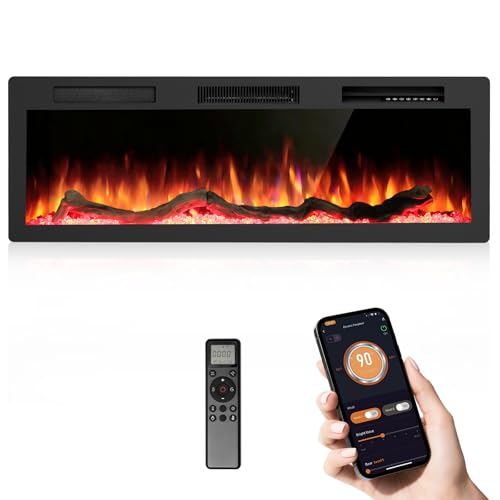
Best for Supplemental room heat and an electric fireplace feature
This is a wall-mounted or recessed electric fireplace, not a water heater element. Its 750W and 1500W heating modes are for supplemental zone heating, with flame settings and remote, touch, smartphone and voice controls.
Heating modes 750W and 1500WDimensions 50 inches long × 17.32 inches high × 5.71 inches wideInstallation Wall-mounted or recessedTemperature setting range 59–95°F
Why it made the cut
Wall-mounted or recessed installation
750W and 1500W heating modes
Remote, touch, smartphone and Alexa controls
Good to know
Does not heat water
Requires an opening sized for the fireplace if recessed
Skip it if Skip it if you need a replacement part for a water heater.
Best for Portable supplemental heat in an office or room
This is a portable ceramic room heater, not a water heater element. It offers 950W and 1500W heating settings, plus tip-over and overheat protection; its listed heating area is 108–130 square feet.
Heating settings 950W and 1500WHeating area 108–130 square feetDimensions 6.22 × 6.22 × 8.78 inchesPower cord 6 feet
Why it made the cut
950W and 1500W settings
Tip-over and overheat protection
ETL certified
Good to know
Does not heat water
The listing gives a limited heating area of 108–130 square feet
Skip it if Skip it if you’re shopping for a tank element.
The Camco 4500W 240V Screw-in Foldback Water Heater Element is the best 4500 watt screw-in water heater element for most compatible tanks: its low-watt-density design, foldback construction, listed 1-inch NPSM threaded bushing and included gasket make the fit details easy to check. For a two-pack, choose TOP-HEATER if its minimum tank diameter and element specs match your heater; choose DROMIX only when your existing element matches its high-watt-density rating and style.
Rank and model
Watt density and construction
Pack and listed fit details
1. Camco 4500W 240V Screw-in Foldback Water Heater Element
Low watt density; foldback
One element; 1-inch NPSM threaded bushing; gasket included
2. TOP-HEATER 02582 Foldback Screw-in Water Heater Element
Low watt density; foldback
Two elements; 240V, 4500W per element; minimum tank diameter 13 inches; 1-inch NPSM bushing
3. DROMIX Water Heater Element
High watt density; straight style
Two elements; 208 W/sq. in.; 1-1/2-inch socket size; check its dimensions against your tank
Choose by the tank’s required specs and the element’s actual fit, not by brand name alone.
For the DROMIX vs Camco water heater element choice, the key difference is watt density: DROMIX lists 208 W/sq. in., while Camco specifies low watt density. Low watt density spreads the heating load over more surface area, which can reduce mineral buildup, but it won’t prevent scale. Broad brand-compatibility wording isn’t a guarantee for every model, so verify the tank model and element specifications before ordering.
Myth
A universal replacement fits every water heater from the listed brands.
Fact
Universal is a broad compatibility claim, not a fit guarantee. Tank models can require different voltage, mounting style or part numbers; check your nameplate and old element.
From HeaterGuides · our own guideNo hot water? Page 9 is the electric flowchart: breaker, reset, thermostats, elements.Water Heater Owner's ToolkitFix the common faults yourself, keep it running for years, and know when a repair is money wasted.No-hot-water flowcharts, gas and electricFlush, anode, relief valve and descaling stepsRepair-or-replace calculator (Excel)$14.99$9.99Get it for $9.99See what's inside and watch the 2-minute video →18-page printable PDF + Excel calculator · instant download · 30-day refund
How to Choose a 4500W Screw-In Element
To choose a 4500 watt water heater element, match the tank’s nameplate and old element for voltage, wattage, mounting style and any model-specific part number. The right size screw-in element is the one that matches those requirements and clears the tank—not simply any part labeled 4500W or universal.
Check Before You Order
Read the water heater nameplate and note the model number, voltage and required element wattage.
Check the old element’s label or part number, voltage, wattage and mounting style.
Confirm the thread specification and compare the element’s listed dimensions with the available tank clearance.
Verify the replacement is approved for your specific tank model; don’t rely on a broad brand-compatibility claim alone.
18.75 A
Current drawn by a 4,500W element at 240V
The calculation is 4,500 W ÷ 240 V = 18.75 A while the element is heating. That number alone doesn’t establish that a different element suits your tank or its circuit.
Low watt density spreads the heating load over more surface area and can reduce mineral buildup; it doesn’t prevent scale or guarantee longer element life. Match the density and style to the existing element and tank requirements rather than treating low density as a universal upgrade.
Model
Listed thread or size
Listed clearance detail
Camco
1-inch NPSM threaded bushing
Minimum tank diameter 13 inches
TOP-HEATER
1-inch NPSM bushing
Minimum tank diameter 13 inches
DROMIX
1-1/2-inch socket size
13-9/16-inch flange-to-tip length
Compare these listed details with your tank and old element; similar wattage doesn’t mean identical fit.
Myth
Are water heater elements universal?
Fact
No. A universal label doesn’t confirm the voltage, mounting style, thread or clearance your particular tank needs. Match the nameplate and old element before ordering.
Will a 4500W Element Heat Your Tank Faster?
A 4500W water heater element uses 4.5 kWh for each hour it runs, but it won’t necessarily heat your tank faster than the same-rated element it replaces. It draws its rated power only while the thermostat calls for heat; once the water reaches the set temperature, the element switches off.
At an assumed electricity rate of $0.17 per kWh, one hour of element-on time costs 4.5 kWh × $0.17, or about $0.77. That’s the cost for an hour of active heating, not a prediction of your daily bill.
Heater
Watts
Per hour
Per day (1 h)
Per month (1 days)
4500W water heater element
4,500 W
77¢
77¢
77¢
Calculated at 17¢ per kWh. Assumes 17 cents per kWh and one hour of element-on time.
A same-rating replacement restores the heater’s intended operation; it doesn’t inherently improve efficiency or increase the tank’s capacity. Actual recovery depends on the tank and the temperature of incoming water. On many dual-element tanks, the controls energize one element at a time, so don’t add both element ratings to estimate household draw.
Daily use depends on how much hot water you draw, incoming water temperature, tank insulation and standby heat loss. Rated wattage alone can’t tell you what the monthly bill will be; element-on time varies with use and conditions.
Replacing a Screw-In Element Safely
To replace a screw-in water heater element, shut off and verify power, drain water below the element, fit the matching element and gasket, then refill the tank completely before restoring power. Yes, you need to drain the tank below the element, but you don’t usually need to empty it entirely.
Power and Dry-Fire Hazards
Turn off the water-heater breaker and verify power is off with a suitable tester before touching wiring. Never energize an exposed element or a tank that isn’t completely full; a dry-fired element can fail quickly. If you’re unsure about safe isolation, the wiring or the breaker, stop and call a licensed electrician. 240V electrical work may require one in most places.
1
Shut off power and water
Switch off the water-heater breaker and verify the wiring is de-energized with a suitable tester. Close the cold-water supply. Let hot water cool enough to handle safely.
2
Drain below the element
Connect a hose to the drain valve and drain enough water to bring the level below the element opening. Hot water can scald, so keep clear of the discharge and wear suitable protection.
3
Remove and replace
Have a suitable element wrench and the replacement gasket ready. Remove the old element, then install the matching element and gasket carefully. Keep the threads straight; cross-threading can damage the tank fitting.
4
Refill before restoring power
Close the drain valve and reopen the cold-water supply. Open a hot tap and leave it running until water flows steadily without air. That confirms the tank has filled. Only then restore power.
Before You Turn the Breaker Back On
Breaker is off, and a suitable tester confirms power is off at the wiring.
Tank water is below the element before removal.
Replacement element and gasket match the tank and old part.
Tank is completely full; a hot tap ran until air was purged.
If you turn on a water heater with no water, the exposed element can overheat and fail quickly. Don’t rely on the thermostat to protect it; make sure the tank is full before restoring power.
When the Element Is Not the Real Problem
An electric water heater may stop heating because an element, thermostat, breaker, or wiring connection has failed; running out of hot water quickly can also point to a lower-element fault or heavy tank sediment. A failed upper element or thermostat can leave you with little or no hot water, while a failed lower element often leaves some hot water but less usable supply. Those are clues, not a diagnosis.
Symptom
Possible cause
No hot water or very little
Upper element, upper thermostat, breaker, or wiring fault
Some hot water, then it runs out quickly
Lower element or thermostat fault; sediment may also reduce usable tank capacity
Element tests correctly, but heating still fails
Thermostat, wiring, or another tank fault
Symptoms help narrow the check; they don’t prove which part failed.
To tell if an element is bad, have it tested with power off and verified at the breaker; a continuity test can identify an open element. A tripped breaker or loose connection can look similar, so don’t open electrical compartments while they’re energized. If the replacement element tests correctly and the problem remains, stop swapping parts and have the thermostat, wiring, and tank checked.
Keep the discharge line clear
The T&P valve and its discharge line must remain unobstructed. Never cap or plug the line; the valve needs a clear path to release pressure and hot water if it opens.
Questions People Ask
Can I replace a 3500W water heater element with a 4500W element?
Only if the tank’s nameplate and manufacturer allow 4500W elements. The higher wattage draws more current and can overload wiring or exceed the thermostat’s rating, so don’t make the swap based on physical fit alone.
Do I need to replace both elements in a dual-element water heater?
No; replace the failed element, then check the other one for continuity and visible damage while power is off. Many dual-element tanks energize only one element at a time, but the tank’s wiring diagram determines how its controls work.
What wrench do I need for a screw-in water heater element?
Use a water-heater element wrench sized to the element’s hex, commonly a dedicated 1½-inch-style tool, and confirm the fit before turning. A snug fit helps avoid rounding the metal; shut off and verify power before touching the element.
Why does a new water heater element trip the breaker?
A shorted element, damaged wiring, a loose connection, or an element that doesn’t match the tank can trip the breaker. Turn the breaker off and leave it off; have a qualified electrician or plumber check the element and circuit rather than repeatedly resetting it.
Before you go · a welcome giftGet the Water Heater Owner's Toolkit for $4.99Fix the common faults yourself, keep it running for years, and know when a repair is money wasted. Normally $14.99; your welcome price saves $10.00. We'll email your link right now.or buy it now for $9.99 without the gift →One email with your link now. We never share your address.




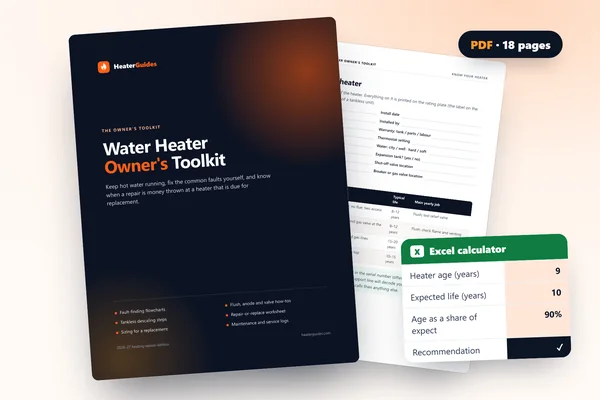 Water Heater Owner's ToolkitFix the common faults yourself, keep it running for years, and know when a repair is money wasted.No-hot-water flowcharts, gas and electricFlush, anode, relief valve and descaling stepsRepair-or-replace calculator (Excel)