An outdoor tankless water heater with a natural gas battery ignition system lights the burner with batteries instead of a standing pilot or wall power. Outdoor means the cabinet and venting are built for exterior use, but the unit still needs the right gas supply, freeze protection and clearances.
For an outdoor install, the ignition system is the small part; the gas line, inlet water temperature and freeze protection do the heavy lifting. A unit can be labeled outdoor and still be a poor fit if the service gas pressure is weak or the enclosure traps moisture.
Battery ignition helps when you do not want a 120 V feed at the heater, but it does not change hot-water capacity. Comfort still depends on flow rate and temperature rise, which is why a tiny control detail can hide a very ordinary shower.
What to remember
Battery ignition starts the burner; it does not power freeze protection or create hot water on its own.
Outdoor-rated units belong outdoors or in a code-approved enclosure, not in a spare room or closet.
Natural gas fits sites with gas service; electric outdoor tankless models are uncommon and often need heavy electrical service.
For an outdoor shower, check flow rate at cold inlet temperatures, not only BTU input.
Outdoor Tankless Water Heater Natural Gas Battery Ignition System
An outdoor tankless water heater natural gas battery ignition system uses a small electrical spark to light the burner only when hot water is needed, instead of keeping a standing pilot lit. The ignition starts combustion; the gas line supplies the heat, and the unit’s flow rate and temperature-rise capacity determine whether your shower stays hot.
Some models use replaceable batteries, while others draw battery power through the control board, so the installation manual—not the product title—settles which batteries you need and where they go. Outdoor-rated means the cabinet is listed for exterior exposure, but clearances, drainage and freeze protection still have to match that listing.
Natural gas suits a site that already has a correctly sized gas line and adequate supply pressure. The battery doesn’t heat the water or make up for an undersized gas supply; it only creates the ignition spark and powers the controls during a demand.
Option
Power source
Install burden
Best fit
Natural gas battery ignition
Natural gas burner; battery-powered ignition
Gas piping, outdoor clearances and drainage
A home with an available natural gas line
Propane
Propane burner; ignition may use batteries or another listed power source
Propane supply, regulator, clearances and drainage
A site without natural gas service
Electric outdoor tankless
Electric heating elements
Substantial electrical service, weather-rated installation and drainage
A site with suitable electrical capacity and no gas service
The ignition method starts the heater; the fuel or electrical supply does the heating.
What To Compare First
A Navien outdoor tankless water heater, or any competing outdoor model, deserves comparison by usable flow rate, temperature-rise range, gas or electrical requirements and freeze protection before you worry about the ignition label. outdoor tankless water heaters are easier to compare once those four checks are on the same page.
In short
Choose natural gas battery ignition when the property has the right gas service and the model’s output matches your demand. A reliable spark won’t rescue a heater with poor flow capacity, low gas pressure or an unprotected water path.
Can You Put A Tankless Water Heater In An Outdoor Enclosure
You can put a tankless water heater in an outdoor enclosure only when the manufacturer lists that exact installation; a homemade weather box isn’t automatically safe for an indoor-only heater. An outdoor model still needs its listed clearances, service space, drainage path and local-code approval.
Most outdoor units vent through the cabinet, so they don’t need a long improvised flue run. Don’t add indoor vent parts, block the cabinet openings or squeeze the heater into a sealed box; those changes can affect combustion, exhaust and servicing.
Before You Build The Housing
Confirm the model is listed for outdoor installation or for the exact enclosure you plan to use.
Measure the required clearances to combustibles and leave enough room for service access.
Provide the condensate and pressure-relief drainage required by the manual and local code.
Plan freeze protection for the heater, water lines and any drains; an enclosure alone isn’t a heating system.
Check whether the controls or freeze protection need a GFCI outlet or hardwired feed.
Arrange licensed plumbing or electrical work where required for gas connections, venting or power.
Don’t Enclose An Indoor Unit
An indoor-only tankless water heater cannot be made outdoor-safe with plywood, insulation or a plastic weather cover. Combustion air, exhaust routing, moisture and service access all have to follow the unit’s listing.
Check The Manual Before Buying Parts
For an outdoor tankless water heater electric installation, verify voltage, amperage, disconnect and weather-exposure requirements before ordering cable, breakers or a receptacle. For gas models, confirm the gas pipe size and vent-clearance requirements first; the cabinet and mounting hardware must suit the listed model.
Compare Natural Gas, Propane, And Electric
Natural gas is usually the simplest outdoor choice when a gas main already reaches the house and the service can provide the heater’s required input. Outdoor tankless water heaters gas models burn fuel only while water flows, so the gas line, meter capacity and installation matter more than the small battery ignition system.
An outdoor tankless water heater electric model avoids combustion and gas piping, but tankless electric hot water heaters outdoors can demand substantial amperage and may struggle to raise cold inlet water to a comfortable shower temperature. Check the home’s service size and the heater’s electrical requirements before treating an outdoor electric tankless water heater as a straightforward swap.
Propane suits a property without a gas main, although the tank must be sized, supplied and refilled; that fuel logistics changes the installation from a pipe connection to a fuel-storage system. For “best outdoor tankless propane water heater,” choose a unit listed for outdoor propane use whose input and flow match your fixtures, rather than choosing by the label alone.
Source
Starting method
Install burden
Cold-weather comfort
Main limitation
Natural gas
Battery spark or electronic ignition
Gas line, venting and clearances
Usually strong when gas input is adequate
Needs a gas main and sufficient supply
Propane
Battery spark or electronic ignition
Propane tank, regulator, gas line and clearances
Usually strong when tank and supply are adequate
Tank refills and fuel storage
Electric
Electronic controls and electric ignition
Large electrical circuit and weather-listed installation
Can suffer as inlet water gets colder
Amperage, service capacity and heating rate
The exact gas, propane or electrical requirements come from the heater’s installation manual.
Running cost follows the energy used during hot-water flow: fuel burn rate multiplied by hours and fuel price for gas or propane, or watts divided by 1,000 multiplied by hours and the electric rate. Battery ignition barely moves that calculation because the batteries start the burner; they don’t supply the heat.
In short
Pick natural gas when an adequate gas main is already available, propane when a tank is practical, and electric only after confirming the service and cold-water performance. The battery choice affects starting reliability far more than monthly energy cost.
From HeaterGuides · our own guidePilot keeps going out? Page 10 takes the gas checks in order: pilot, thermocouple, gas valve.Water Heater Owner's ToolkitFix the common faults yourself, keep it running for years, and know when a repair is money wasted.No-hot-water flowcharts, gas and electricFlush, anode, relief valve and descaling stepsRepair-or-replace calculator (Excel)$14.99$9.99Get it for $9.99See what's inside and watch the 2-minute video →18-page printable PDF + Excel calculator · instant download · 30-day refund
Protect The Heater From Freezing
An outdoor-rated tankless water heater is weather-listed, not automatically freeze-proof: the cabinet may tolerate rain and snow while water trapped in the heat exchanger, valves or connected pipes still freezes. Follow the model’s freeze-protection instructions before the first hard freeze, including whether it needs power, heat protection or a complete drain-down.
Battery ignition only starts the burner, so it cannot protect the heat exchanger or water passages when the heater is idle. Keep the specified spare batteries indoors and check their condition before winter; dead batteries can leave you without ignition when hot water is needed.
Myth
An outdoor heater is maintenance-free once it is mounted outside.
Fact
Freezing weather, blocked drains, lost power and weak batteries can still damage or disable it. Outdoor installation reduces exposure concerns; it doesn’t remove the need to follow the freeze procedure.
Before The First Freeze
Find the manual’s drain points and freeze-protection instructions now, then confirm the discharge path won’t hold trapped water. If the unit will be shut down, use the manufacturer’s drain-down procedure rather than guessing which valves to open.
Don’t Box It In
A tight homemade enclosure is a bad winter fix because it can block the required air path, combustion air or exhaust clearance. You also can’t use an outdoor tankless water heater indoors simply to escape freezing: its listing, venting and combustion requirements may not permit that installation, so follow the manual and local code.
Size It For The Shower, Not The Spec Sheet
The best tankless water heater outdoor shower setup is sized by shower flow and winter temperature rise, not by the largest BTU number on the label. BTU input tells you how much heat the burner can add; flow rate tells you how much water receives that heat at the tap.
Measure the fixture demand first, then compare it with the manufacturer’s output at your coldest expected inlet temperature. A 2.5-gallon-per-minute shower needs more heater capacity than a hand-wash sink, and two fixtures running together need their flows added.
Worked Example
Say an outdoor shower uses 2.5 gallons per minute. A hypothetical unit can supply 3 gallons per minute with a 40°F temperature rise, so it feels fine when summer water enters at 65°F and the shower needs about 105°F. In January, 45°F inlet water requires a 60°F rise. With the same burner input, available flow falls to about 2 gallons per minute, so the shower can turn lukewarm even though the heater’s BTU label hasn’t changed.
Summer inlet65°F
Winter inlet45°F
Shower demand2.5 GPM
Winter resultPossible lukewarm water
Use case
Likely flow demand
Inlet water to plan for
Disappointment risk
Outdoor shower
1.5–2.5 GPM
Seasonal; use winter design temperature
High if sized from summer comfort
Patio or cabana sink
0.5–1.5 GPM
Usually moderate, but exposed piping can be colder
Low with one fixture
Cabin shower plus sink
2–4 GPM combined
Cold-season inlet temperature
High without enough gas capacity
Whole-house outdoor unit
Several fixtures at once
Coldest local supply temperature
High if gas service is undersized
Flow ranges are planning examples; check each fixture and the heater’s performance chart.
Outdoor showers, pool decks, patios, cabanas and cabins with exterior service space can be good fits. A whole-house setup is a poor fit when the gas line, meter or electrical service can’t support the heater and the other appliances running with it.
An outdoor tankless water heater in an enclosure still has to meet the exact manufacturer’s listing; an enclosure doesn’t fix undersized gas supply, cold inlet water or insufficient flow capacity.
Install It In This Order
To install a tankless water heater outdoors safely, confirm the model, utilities and location before anyone connects a gas line. You can’t use an outdoor tankless water heater indoors because its listing, combustion-air arrangement and venting are intended for exterior installation; indoor use can put combustion gases and moisture in the building.
1
Confirm the listing
Check that the exact model is listed for outdoor use or for the specific enclosure you plan to build. Follow its required clearances and installation instructions.
2
Verify the utilities
Confirm gas pipe size, available gas capacity, electrical requirements, battery access and freeze protection before approving the location.
3
Choose the site
Provide the listed clearances, a safe discharge path, drainage and enough room to remove the front cover and service the unit.
4
Arrange qualified installation
Have a licensed plumber handle gas connections and required venting work, and a licensed electrician handle any required electrical work, as local rules require.
5
Test the finished installation
Run hot water at the farthest fixture, then check temperature, ignition behavior, leaks, drainage and any error codes.
Before Sign-Off
Exact outdoor or enclosure listing confirmed
Gas supply matches the manual
Freeze protection and drain path planned
Service clearances remain usable
Working carbon monoxide alarm installed where required
Don’t Improvise The Gas Work
Never extend a gas line, alter venting or bypass a safety control to make the heater fit. A licensed professional can verify combustion, leak checks and local code requirements before the first freeze.
Questions People Ask
Can you install a tankless water heater outdoors?
Yes, but the unit must be specifically listed for outdoor installation. Follow its required clearances, gas and water connections, electrical grounding, drain routing, and freeze-protection instructions; an indoor model isn’t an outdoor model with better luck.
Can you put a tankless water heater in an outdoor enclosure?
Only if the manufacturer allows that enclosure or installation method. Walls can block combustion air, trap exhaust, restrict service access, or create a freeze problem, so a homemade weather box can make a listed heater unsafe.
Why can’t you use an outdoor tankless water heater indoors?
An outdoor unit’s cabinet, combustion-air path, and exhaust arrangement aren’t approved for an occupied interior. Moving it indoors can send combustion products into the building or violate the installation listing, even if the gas connection works.
Are outdoor electric tankless water heaters practical?
They can work for a point-of-use fixture, but whole-house use usually demands substantial 240-volt electrical capacity. Check the heater’s required amperage against the service and panel before buying; the electrical upgrade can outweigh the heater’s appeal.
What does battery ignition do on a tankless water heater?
Battery ignition creates the spark that lights the burner when water flow calls for heat, so the heater doesn’t keep a standing pilot burning. Replace the specified batteries when ignition becomes intermittent, and remember that batteries don’t provide freeze protection or run the water pump.
Is a tankless water heater good for an outdoor shower?
It can be a good fit when the heater is outdoor-rated, the gas supply supports its input, and the installation can drain or protect the water circuit from freezing. Long pipe runs also waste heat and add wait time, so place the heater close to the shower when the layout allows.
Before you go · a welcome giftGet the Water Heater Owner's Toolkit for $4.99Fix the common faults yourself, keep it running for years, and know when a repair is money wasted. Normally $14.99; your welcome price saves $10.00. We'll email your link right now.or buy it now for $9.99 without the gift →One email with your link now. We never share your address.

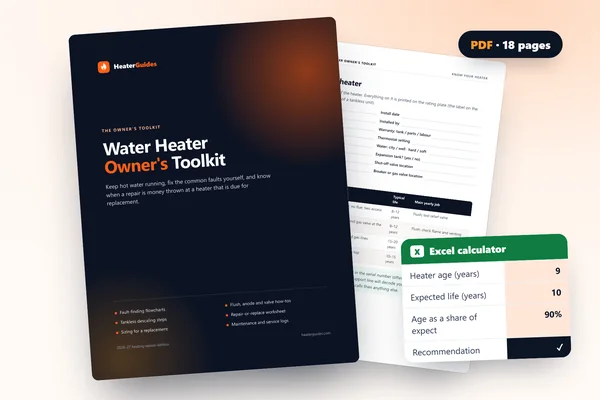 Water Heater Owner's ToolkitFix the common faults yourself, keep it running for years, and know when a repair is money wasted.No-hot-water flowcharts, gas and electricFlush, anode, relief valve and descaling stepsRepair-or-replace calculator (Excel)


