A tankless water heater heats water only when you open a tap, and a typical whole-house unit can deliver hot water continuously as long as gas and flow are there. A tankless water heater is a heater that warms water on demand rather than storing a full tank at temperature.
Getting this wrong costs money and comfort first. A unit that is too small gives you lukewarm showers; one that is sized or vented wrong can waste fuel, trip on safety controls, or leave you waiting for hot water.
Navien is a popular name in the tankless gas market, but the basic physics is the same for every brand. Water passes through a heat exchanger, a burner fires to match the flow, and the unit modulates up or down so it does not boil water you are not using.
The essentials
A tankless heater saves standby losses, but it still uses fuel every time you run hot water.
Sizing depends on flow rate and temperature rise, not just the brand name on the front panel.
Indoor gas tankless units need the venting and combustion air the manual calls for.
Long hot-water waits usually come from pipe length, not from the heater being “bad.”
Navien Tankless Water Heater: How It Works
A Navien tankless water heater heats water as you use it: when a fixture opens, cold water flows through a heat exchanger and a gas burner heats it on demand. To answer “nabin is tankless,” Navien is a brand and tankless describes the design; the brand name doesn’t change how the basic system works.
That’s how a tankless water heater works, and how tankless water heaters work in general: a flow sensor detects water moving through the unit, then the controls ignite and adjust the burner. Gas models modulate the burner to match the water flow and the temperature rise needed. At very low flow, a faucet may not meet the unit’s activation threshold, or the burner may not deliver its full output.
With no storage tank, there’s no tank of water being kept hot between uses, so standby heat loss is avoided. The tradeoff is that there’s no reserve: if several fixtures need more hot water than the unit can heat at once, the water may run cooler or the flow may need to be reduced. Continuous hot water depends on the unit’s capacity, gas supply and water flow.
1
A fixture opens
Water begins moving through the heater, and a sensor detects the flow.
2
The burner responds
The control system ignites the burner and adjusts its output to the flow and temperature demand.
3
Heated water travels to the tap
Water passes through the heat exchanger on its way to the fixture; the unit keeps heating while the required flow continues.
In short
Navien is the manufacturer; tankless means water is heated as it flows rather than stored hot. The unit can keep supplying hot water only within its flow and heating capacity.
A tankless water heater’s running cost depends mainly on your gas rate, the temperature of incoming water and how many gallons you heat each day. That’s the useful answer to tankless water heater cost, monthly cost and yearly cost: there isn’t one bill that fits every household.
Fuel use tracks the water you heat, not the amount of water the heater stores. Tankless models avoid standby loss, which can help when hot-water use is intermittent, but a more efficient heater can still cost more if you start using more hot water than before.
A daily shower estimate
Say one person uses 20 gallons of hot water for a shower each day, heated by 70°F above the incoming-water temperature. Using about 8.34 Btu to raise one gallon of water by 1°F, that’s roughly 11,700 Btu of heat delivered each day. At 90% efficiency, the burner would use about 13,000 Btu of gas per day. Multiply that by your gas price per therm, then by the number of days in the billing period; the result is an estimate, not a bill forecast.
Hot water used20 gallons per day
Temperature rise70°F
Estimated gas inputAbout 13,000 Btu per day at 90% efficien
For a family, add the hot water used by showers, laundry, dishwashing and other fixtures. Colder incoming water in winter means the heater must add more heat to each gallon; your gas rate determines what that extra fuel costs. Actual efficiency and usage vary, so use the unit’s rated efficiency and your utility’s gas rate for a closer estimate.
The purchase and installation cost is separate from fuel cost, and depends on the unit and the work your home needs. See what a tankless water heater costs for that side of the calculation.
What You’ll Need If You Are Replacing a Tank
An electric tankless replacement can fit where a storage tank stood, but check the unit’s power and flow requirements before you buy.
Tank replacement
Rheem 18kW Electric Tankless Heater
The self-modulating controls adjust power as hot-water demand changes, while the LED display shows the set temperature. Its threaded 3/4-inch NPT connections and field-serviceable copper elements can simplify a replacement, provided the home’s electrical setup and hot-water demand fit the unit.
Installing a tankless water heater inside is suitable only when the unit’s manual and local code allow the location and installation. The instructions specify the vent system, combustion air, gas-line size, condensate handling and clearances; they also give the required service access. Use the manufacturer’s installation instructions and installation guidelines for the exact model, not a generic diagram.
How to install a tankless water heater depends on those site requirements and on the home’s existing gas and vent setup. Gas connections, venting changes and condensate drains usually call for a licensed plumber or HVAC professional, and permits or inspections may be required locally. A tank replacement is not automatically a simple swap.
Check Before Choosing A Location
Confirm the model is approved for indoor installation and identify its required vent materials and route.
Verify the combustion-air arrangement and whether the existing gas line meets the unit’s specifications.
Plan a permitted condensate drain and keep the specified clearances around the heater.
Leave enough space to access components for service, and check permit and inspection rules with your local building department.
Don’t Improvise The Vent
A gas tankless unit must vent combustion products as its manufacturer specifies. Incorrect venting or inadequate combustion air can create carbon-monoxide hazards. Don’t connect a new unit to an existing vent unless the manufacturer and a qualified installer confirm it’s suitable; keep a working CO alarm in the home.
A Closet Needs More Than A Door
An enclosure is acceptable only if the manual allows it and the required clearances and service access remain available. Vent-free gas water heaters are restricted or banned in some states and cities, so check local code before considering one.
From HeaterGuides · our own guideWater Heater Owner's ToolkitFix the common faults yourself, keep it running for years, and know when a repair is money wasted.No-hot-water flowcharts, gas and electricFlush, anode, relief valve and descaling stepsRepair-or-replace calculator (Excel)$14.99$9.99Get it for $9.99See what's inside and watch the 2-minute video →18-page printable PDF + Excel calculator · instant download · 30-day refund
Standard Tank Versus Tankless
In a comparison of standard vs tankless water heaters, the better choice depends on hot-water demand, space and installation scope. A tank stores a reserve that can run out; tankless heats water on demand and can provide hot water for longer only while the demand stays within its flow capacity.
Factor
Standard tank
Tankless
Standby loss
Loses some stored heat while water waits in the tank.
No full tank is kept hot between draws.
Upfront cost
Often costs less to replace when existing connections and venting suit the new unit.
Gas models usually cost more to install than a straight tank replacement because venting and gas sizing often change.
Hot-water duration
Stored hot water is finite and needs time to recover after heavy use.
Can run longer if total flow stays within the unit’s capacity.
Space use
Needs floor space for the tank.
Often fits a smaller utility closet or wall space better.
Maintenance
Tank and components need maintenance according to the manufacturer.
May need periodic descaling, especially where water is hard; follow the manual.
Typical trade-offs; actual installation requirements vary by home and model.
For tankless water heater vs tank water heater, a tank often suits homes that want simpler replacement and can spare the floor space. Tankless can suit a smaller utility area or households with steady, moderate demand, but it can be a poor fit when several showers and fixtures may run at once. Check the unit’s rated flow against your peak simultaneous use before choosing.
Myth
Tankless means unlimited hot water for every fixture at once.
Fact
It means the heater doesn’t run out of stored water. Its flow capacity still limits how much hot water it can deliver at one time, particularly when incoming water is cold.
In short
Choose a tank for a stored reserve and a potentially simpler like-for-like replacement. Choose gas tankless when space matters and the home’s gas supply, venting and peak demand fit the model.
Hot Water Delays And Winter Problems
Most complaints about tankless water heaters come from delivery time, scale or settings—not a burner that can’t make heat. After a hot tap opens, the flow sensor must call for heat, the burner must light, and water must travel through the heat exchanger and plumbing; a long run of cool pipe can make the wait reach 30 seconds.
Winter can stretch that delay because colder inlet water needs more heat, while the pipe walls begin at room temperature or below. A tankless unit may be heating correctly while you wait for the cooled water already sitting in the line to pass. See why tankless water heaters can delay hot water by up to 30 seconds before treating the delay as a failure.
Myth
Tankless means instant hot water.
Fact
The heater starts on demand, but it still has to sense flow, ignite, heat the water and push it through the supply pipe. A short pipe run usually responds sooner than a long one; a recirculation system can reduce waiting, but it adds installation and operating considerations.
1
Check the inlet filter
Turn off the water as the manual directs, then inspect the cold-water inlet filter for sediment. A restricted filter can reduce flow enough to affect ignition or temperature.
2
Check the temperature setting
Confirm the setpoint has not been changed and compare it with the fixture’s actual temperature. A setting near 120°F is commonly used to limit scald risk; hotter settings need care.
3
Check for firing
Open a hot tap and look for the unit’s burner or operation indicator. No firing, an error code or repeated temperature swings calls for the manual’s fault checks and possibly a technician.
4
Flush the heat exchanger
In hard-water areas, flush annually or on the schedule in the manual. For a Rinnai tankless water heater, isolate the unit and circulate only the manufacturer-approved descaling chemical, then rinse fully; don’t improvise with an unapproved acid or mix chemicals.
Why Scale Matters
Mineral scale forms a rough insulating layer inside the heat exchanger, so heat transfer falls. The result can be slower heating, temperature swings and error codes. Hard-water homes may need more frequent flushing than the annual interval.
More Questions, Answered
How does a tankless water heater work?
Opening a hot-water tap starts the flow sensor, which signals the burner and adjusts heat as water moves through the heat exchanger. The unit keeps heating while flow continues, then shuts the burner off when the tap closes. A short wait can still occur while water in the supply pipe travels to the fixture.
Is a tankless water heater cheaper to run than a tank?
Often, yes, because a tankless unit avoids repeatedly reheating stored water that has lost heat. Your result depends on gas and water rates, daily gallons, incoming-water temperature and recirculation use. A higher installation cost can outweigh fuel savings for a household with light hot-water demand.
Can you install a tankless water heater inside?
Yes, an indoor-rated model can go inside when its venting, clearances, condensate drainage and local code requirements are met. Gas models need the specified combustion-air and exhaust arrangement, and the vent termination must be placed correctly outside. Have a licensed plumber handle gas connections and venting.
What size tankless water heater do I need?
Size it for the highest flow you expect at one time and the temperature rise from your cold-water supply to the setpoint. Add the gallons-per-minute ratings of simultaneous showers, sinks or appliances, then compare that demand with the unit’s performance at your winter inlet temperature. A large BTU number alone doesn’t guarantee enough hot water.
Do I need to flush a tankless water heater every year?
Annual flushing is a sensible starting point in hard-water areas, but the manual and water conditions set the real interval. Mineral scale can narrow the heat exchanger passages, reduce flow and make the burner work harder. Use the service valves and the manufacturer’s approved descaling method, or hire a technician if those valves aren’t installed.
Before you go · a welcome giftGet the Water Heater Owner's Toolkit for $4.99Fix the common faults yourself, keep it running for years, and know when a repair is money wasted. Normally $14.99; your welcome price saves $10.00. We'll email your link right now.One email with your link now. We never share your address.

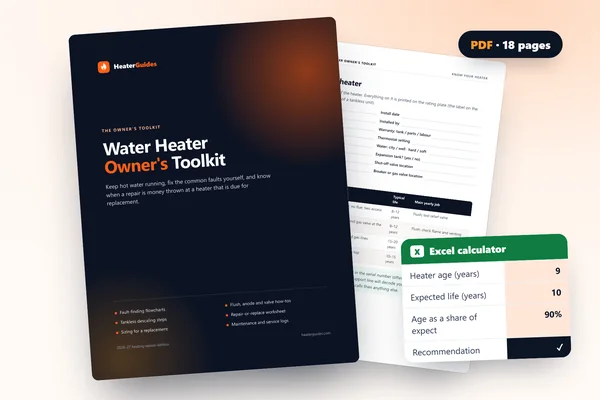 Water Heater Owner's ToolkitFix the common faults yourself, keep it running for years, and know when a repair is money wasted.No-hot-water flowcharts, gas and electricFlush, anode, relief valve and descaling stepsRepair-or-replace calculator (Excel)