

People often think oil filled radiator heaters are hard to get or service in island locations like the Bahamas. Half true: local radiator specialists exist but focus mostly on automobile radiators, so for home heating models you’ll likely depend on shipping or specialized suppliers.
This article explains how oil filled radiator heaters work, where and how to buy them in the Bahamas, what specs and safety standards to check, and what to expect for running costs and maintenance.
How To Contact and Buy Oil Filled Radiator Heaters in the Bahamas
For oil filled radiator heater contact in the Bahamas, start with a Nassau radiator specialist for a local lead, then compare international sellers that ship to the islands. Where to buy oil filled radiator heaters in the Bahamas isn’t fully settled by the local listing: Radiator Specialist is a useful contact point, but its published business categories cover automobile radiator repair, automobile parts, and air conditioning equipment rather than home heating.

Radiator Specialist is listed at 39 Palm Beach Street, off Wulff Road, Nassau, Bahamas. Its published business hours are Monday to Friday, 8:00 am to 5:00 pm, and Saturday, 8:00 am to noon; it’s closed Sunday. No phone number or customer reviews are provided in the checked listing, so confirm the current contact information and ask specifically about home electric heaters before making the trip. A radiator shop may know local distributors without stocking a single oil-filled unit. Cars, rather sensibly, remain its main business.
| Buying route | What to confirm | Main limitation |
|---|---|---|
| Local specialist | Whether it knows a home-heater distributor or can identify a suitable supplier | It may handle automobile radiator repair only |
| International seller | Bahamas shipping, delivery address, returns, plug type, and heater specifications | Freight, import charges, and returns can complicate the purchase |
| Local electrical or appliance retailer | Current stock, warranty handling, and replacement parts | Selection may be seasonal or limited |
International shipping is the practical alternative when local distributors have no stock. Before paying, check that the seller ships the exact heater model to the Bahamas, provides a tracking method, states who handles import charges, and accepts returns from your location. Confirm the electrical rating on the product label and arrange delivery to a usable address; a heavy finned heater is an awkward parcel to send back.
If local suppliers can’t answer those questions, compare shipped models by heater specifications and after-sales support rather than by the lowest listing price. A seller that can explain returns and parts is usually more useful than one that merely says “available.”
How Oil Filled Radiator Heaters Work and What That Means For You
Oil filled radiators work by using an electric heating element to warm sealed oil inside metal fins; the hot fins radiate heat into the room while nearby air slowly circulates. There is no oil to refill, and the sealed fluid carries heat across the fins after the element switches off.
Warm-up is gradual because the metal and oil have to heat before the room feels noticeably warmer. Operation is nearly silent apart from the thermostat click, which suits bedrooms and work areas better than a fan heater. Heat also fades gradually after shutdown, although the room won’t stay warm indefinitely.
Heating capacity of oil filled radiators depends on wattage and the room’s heat loss, including drafts, insulation, windows and ceiling height. A larger oil reservoir doesn’t create extra heat; the electrical input does. A 1,500 W heater is near the practical ceiling for a standard plug-in space heater, so it won’t overcome a very leaky large room simply because its fins look substantial.
| Heater | Watts | Per hour | Per day (8 h) | Per month (30 days) |
|---|---|---|---|---|
| 1,500 W oil filled radiator | 1,500 W | 26¢ | $2.04 | $61.20 |
The thermostat controls cost by stopping the element at the selected room temperature and restarting it after the room cools. Lowering the setpoint or heating one occupied room usually cuts runtime; the heater still draws its selected wattage whenever the element is on. Compared with a fan heater, an oil-filled model trades fast air movement for quieter, steadier radiant comfort.
For a closer look at thermostat behavior and settings, see oil filled radiator heaters with thermostat. The useful distinction is simple: the heater’s wattage sets its maximum heat rate, while the thermostat decides how often that maximum is used.
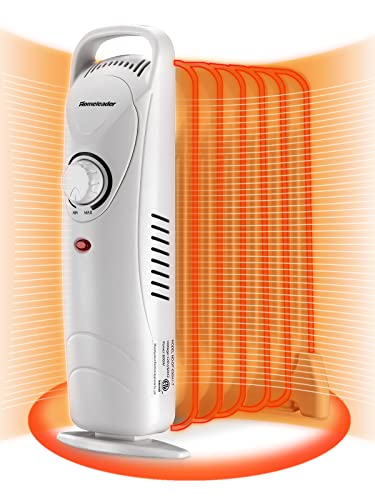

Safety Standards and What To Check Before You Buy or Use
Oil filled radiator heater safety standards start with a listed electrical product, working tip-over and overheat protection, and the right outlet for its load. These heaters are generally safe when used as directed because the oil is sealed and the unit burns no fuel, but a damaged cord, blocked airflow or loose connection can still start a fire.
Check The Safety Label
- Look for a UL, ETL or CSA listing on the heater or its packaging. Product 2 specifies ETL safety standards for its plug, cord and critical components; don’t assume an unmarked heater has the same approval.
- Confirm the heater’s voltage and frequency match the Bahamas supply and the outlet you plan to use. A standard US-style 120-volt, 15-amp circuit can supply about 1,800 watts, but a 1,500-watt heater already draws about 12.5 amps.
- Use the tip-over switch and overheat shutoff as backup protection, not permission to place the heater against curtains, bedding or furniture. Keep at least 3 feet of clearance.
- Plug the heater straight into a wall outlet. Skip extension cords and power strips, which can overheat under a sustained heater load.
Bahamas rules may depend on the building, circuit and imported product, so check local electrical requirements and the heater’s rating label before purchase. A safety listing helps confirm construction and testing, but it doesn’t replace correct wiring, clearance or the manufacturer’s instructions. For a closer look at the features that matter, see oil filled radiator safety.
Typical Specifications and Models Available for Bahamas Buyers
Heater specifications for Bahamas buyers usually fall between 700W and 1,500W, with the best oil filled radiator heater model depending mainly on room size, outlet capacity and how much control you want. A 700W unit suits a small room or personal heating; a 1,500W model gives a larger room more output but draws about 12.5 amps on a 120-volt circuit.

| Model option | Power and controls | Best fit | Useful details |
|---|---|---|---|
| Product 1 | 700W; thermostat knob | Small to medium rooms | Carry handle, compact size and overheat safety |
| Product 2 | 600W, 900W or 1,500W; adjustable thermostat | Larger spaces | Seven fins, caster wheels, tip-over and overheat protection |
Match Output To The Room
Maintenance, Repair, and Customer Feedback for Bahamas Users
Local maintenance options for an oil filled radiator heater are limited, and Bahamas-specific customer reviews aren’t formally available. Nassau’s Radiator Specialist is at 39 Palm Beach Street off Wulff Road, but its listed work centers on automobile radiator repair, automobile parts, air conditioning equipment and service—not household electric heaters. Its business hours are Monday to Friday, 8:00 am to 5:00 pm, and Saturday, 8:00 am to noon.
More Questions, Answered
Where can I buy oil filled radiator heaters in Nassau?
Are oil filled radiator heaters safe for indoor use in the Bahamas?
Can oil filled radiator heaters be shipped to the Bahamas from the US?
How much electricity does an oil filled radiator heater typically use?

I am a mechanical engineer and love doing research on different home and outdoor heating options. When I am not working, I love spending time with my family and friends. I also enjoy blogging about my findings and helping others to find the best heating options for their needs.
Related guides

PELONIS Oil Filled Radiator Heater: Remote Control Convenience!
Stay warm this winter! Read our PELONIS Oil Filled Radiator Heater review to find out why it's the…
1500W Space Heater: Why This Portable Heater Stands Out!
Stay warm this winter! Read our 1500W Space Heater review for insights on efficiency, safety, and the best…
Solving Challenges with Forced Air Torpedo Heaters for Rapid Heating of Large Industrial Spaces
Garvee 175000 BTUs Kerosene/Diesel Forced Air Heater, Kerosene Fan Forced Heater with Thermostat ... ✅ Prime Shipping Available…
