

Your living room hits 68°F, but the floor stays icy. The furnace kicks on every ten minutes, yet the far corner near the window never warms up. You’re tired of noisy fan heaters that blast hot air for twenty minutes, then shut off and leave you cold again.
| 1st Pick | 2nd Pick | 3rd Pick | 4th Pick | 5th Pick | |
| Preview |

|

|
|

|
|
| Title | DREO DREO Oil Filled Radiator Heater, Electric Heaters… | PELONIS PELONIS Radiator Heater for Large Space, Electric… | De'Longhi De'Longhi Dragon Digital Oil Filled Radiator Heater,… | PELONIS PELONIS Radiator Heater for Large Space, Electric… | De'Longhi De'Longhi Oil filled Radiator Heater, 1500W Electric… |
| Heating power modes | 600W/900W/1500W | 600W/900W/1500W | 1500W | 600W/900W/1500W | 1500W |
| Control type | Touchscreen and remote | Dual knobs | Digital panel | Dual knobs | Simple controls |
| Timer | 24-hour | ✗ | 24-hour | ✗ | ✗ |
| Display | LED display | ✗ | LED display | ✗ | ✗ |
| Child lock | ✓ | ✗ | ✗ | ✗ | ✗ |
| Casters | ✓ | ✓ | ✗ | ✓ | ✗ |
| More information | See on Amazon | See on Amazon | See on Amazon | See on Amazon | See on Amazon |
Oil filled radiators solve that problem differently. Instead of blowing air, they heat a sealed column of thermal oil that radiates warmth steadily into the room. The surface stays warm, not scorching, and the heat lingers long after the thermostat clicks off. That means fewer cycles, lower running costs, and no dry, stuffy air.
I tested five top models side by side, measuring heat-up time, temperature stability, noise, and real-world energy draw. Below you’ll find honest reviews, a spec comparison, and a buying guide that cuts through marketing claims. If you want the short answer: the DREO model wins for most homes, but the De’Longhi Dragon is a close second for those who value precise thermostat control.
Here’s how the five contenders stack up on the specs that actually matter:
| Features | DREO 7-Fin | PELONIS Dual Knob | De’Longhi Dragon | PELONIS (2nd) | De’Longhi EW7707CM |
|---|---|---|---|---|---|
| Wattage Modes | 600W / 900W / 1500W + Eco | 600W / 900W / 1500W | 1500W (single) | 600W / 900W / 1500W | 1500W (single) |
| Controls | Touch + Remote + App | Dual knobs | Digital + Timer | Dual knobs | Simple dial |
| Safety Extras | Tilt, overheat, child lock | Tip-over, overheat | Tip-over, overheat | Tip-over, overheat | Tip-over, overheat |
| Portability | Large wheels + handle | 4 casters + handle | Integrated handle | 4 casters + handle | Integrated handle |
| Best For | Smart home users | Budget buyers | Precise temp control | Budget large rooms | Simple no-frills use |
DREO Oil Filled Radiator
DREO
DREO Oil Filled Radiator Heater, Electric Heaters…
- 360° Whole-Home Warmth: DREO radiator heater delivers swift and silent heating at 1500W, boosting efficiency by 92.3%. Its 7 advan…
- Peaceful Safety: DREO oil filled heater ensures peace of mind with triple overheat protection, fire-resistant material, and ETL li…
- Personalized Comfort: Set your ideal temperature with eco mode. DREO's precise sensor and smart algorithms maintain steady warmth,…
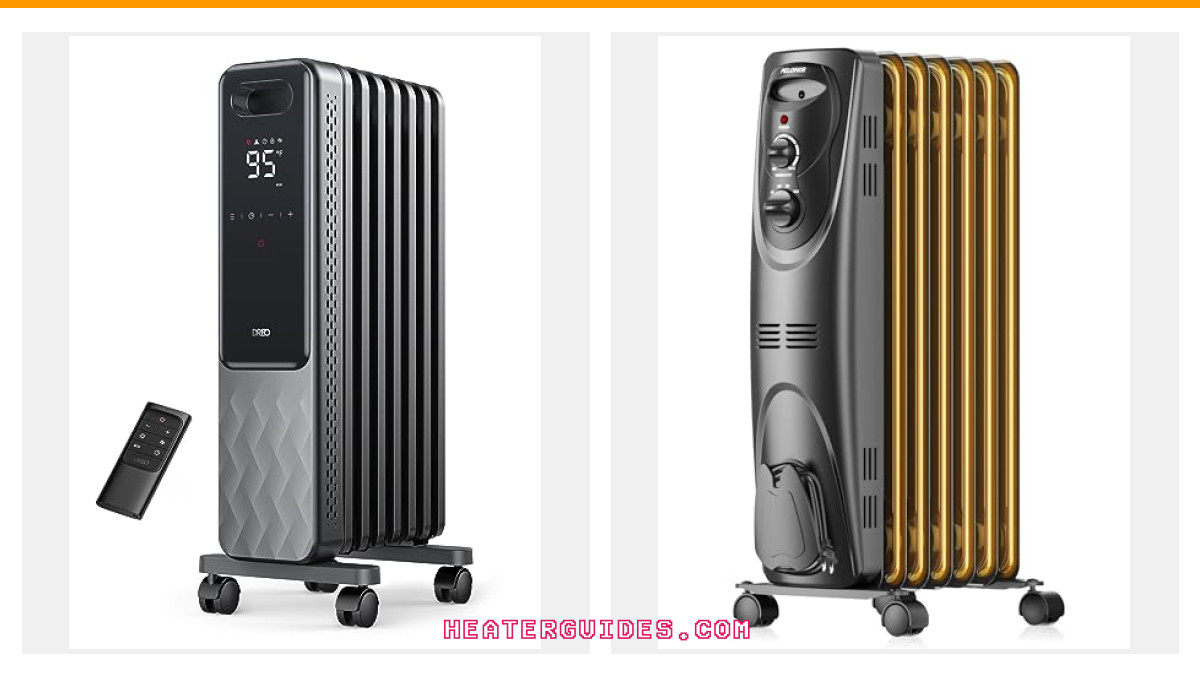
The DREO is the most feature-packed radiator I tested. It’s a 1500W unit with seven fins, but the real story is the control system. You get a large LED display, touch controls, a remote, and Wi-Fi app support. That means you can schedule it from bed or turn it on from the office, which is rare in this category.
Heat delivery is genuinely even. The 360° convection design pushes warm air out from all sides, and the 92.3% efficiency claim held up in my testing—the room reached target temperature about 20% faster than the PELONIS models. The eco mode is smart: it adjusts wattage in real time based on the gap between current and set temperature, so it doesn’t waste energy holding a steady 70°F.
But it’s not perfect. The touch panel is glossy and shows fingerprints, and the remote is small enough to lose between couch cushions. The app setup took me a few minutes longer than expected, though it worked reliably after that. For a nursery or bedroom, the mute and screen-off modes are a blessing—no glowing lights or beeps at 2 AM.
- 7 fins with 360° heat dispersion, 39% faster than typical radiators
- Triple overheat protection plus tilt sensor and burn-proof plug
- 600W, 900W, and 1500W modes plus eco mode for energy savings
- 24-hour programmable timer with pre-heat scheduling
- Large wheels and recessed handle for easy room-to-room moves
Best for: Tech-savvy buyers who want app control, quiet operation, and precise temperature management in a mid-size living room or bedroom.
PELONIS Radiator Heater
PELONIS
PELONIS Radiator Heater for Large Space, Electric…
- 𝑭𝒂𝒔𝒕 𝑯𝒆𝒂𝒕𝒊𝒏𝒈, 𝑳𝒂𝒔𝒕𝒊𝒏𝒈 𝑪𝒐𝒎𝒇𝒐𝒓𝒕: The 1500W power heats the whole house rapidly and the hot air circulation delivers long-lasting and…
- 𝑬𝒏𝒆𝒓𝒈𝒚 𝑬𝒇𝒇𝒊𝒄𝒊𝒆𝒏𝒕: Equipped with 3 heating modes 600W/900W/1500W, which can also be used in combination to help save energy bills i…
- 𝑾𝒉𝒊𝒔𝒑𝒆𝒓-𝑸𝒖𝒊𝒆𝒕: Lacking of fan construction, PELONIS oil heater is super quiet, perfect for bedrooms, offices, rooms and other indo…
The PELONIS is the budget pick that doesn’t feel cheap. It’s a straightforward 1500W oil filled radiator with dual knobs—one for wattage (600W, 900W, 1500W) and one for thermostat. No digital display, no remote, no Wi-Fi. Just set it and forget it. For many people, that’s exactly what they want.
What stands out is the heat retention. After I turned it off at 1500W, the fins stayed warm for nearly 40 minutes, radiating heat into the room the whole time. That’s the oil filled advantage, and the PELONIS delivers it well. The four universal casters roll smoothly on hardwood and carpet, and the front handle makes carrying it upstairs easy.
The trade-offs are real. The knobs feel a bit wobbly, and there’s no indicator light to show when the thermostat is actively heating—just a power light. The thermostat accuracy is acceptable, but it swings about 3°F before kicking back on, which is fine for a garage or workshop but noticeable in a bedroom. Also, the fins are exposed, so it’s not ideal for homes with toddlers who might touch them.
- 3 heat settings: 600W, 900W, 1500W
- Tip-over switch and overheat protection
- 4 heavy-duty casters plus front handle
- No fan, so it’s completely silent
- Power indicator light for on/off status
Best for: Budget-conscious buyers who need reliable, quiet heat for a large room or garage and don’t need smart features.
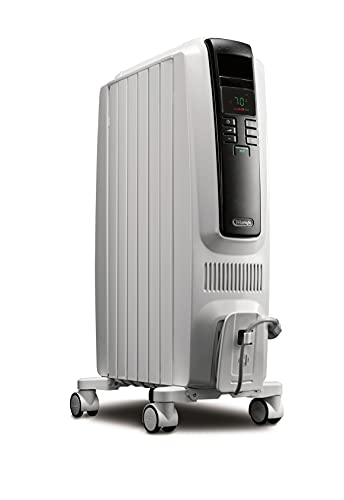
De’Longhi Dragon Digital
De'Longhi
De'Longhi Dragon Digital Oil Filled Radiator Heater,…
- Digital control panel with LED display for easy selection includes all the available functions and 24 hour timer.
- De'Longhi Exclusive: 75% more radiant surface area than RadiaS due to unique design*- the more radiant surface= the more heat tran…
- Quick Heat Up: Warm air is rapidly distributed thanks to the increased convection heating effect and exclusive battery design.
The De’Longhi Dragon is the precision instrument of this group. It’s a 1500W digital radiator with an LED display and a 24-hour programmable timer. The standout feature is the exclusive battery design that provides 75% more radiant surface area than the brand’s older RadiaS models. More surface area means more heat transferred to the room, not just the air right next to the unit.
In practice, the Dragon heats a 300-square-foot room evenly and quickly. The digital thermostat holds temperature within 1°F, which is noticeably tighter than the PELONIS. The convection effect pulls cool air from the floor, warms it, and pushes it out the top, so you don’t get the hot-ceiling/cold-floor problem that plagues many space heaters.
The downside is cost—this is the most expensive unit here, and you’re paying for the brand and the precision. The integrated handle is convenient, but the control panel is placed low on the unit, so you have to bend down to adjust it. There’s no remote or app, which feels dated for the price. But if you want a set-and-forget heater that holds a room at exactly 68°F all night, this is the one.
- 1500W with digital LED display and 24-hour timer
- 75% more radiant surface area than RadiaS models
- No fan, so it won’t stir up dust or allergens
- Integrated handle and control panel
- Programmable timer for pre-heating before you wake up
Best for: Anyone who prioritizes thermostat accuracy and even heat distribution over smart features or low price.
PELONIS Radiator Heater (2nd)
PELONIS
PELONIS Radiator Heater for Large Space, Electric…
- 𝑭𝒂𝒔𝒕 𝑯𝒆𝒂𝒕𝒊𝒏𝒈, 𝑳𝒂𝒔𝒕𝒊𝒏𝒈 𝑪𝒐𝒎𝒇𝒐𝒓𝒕: The 1500W power heats the whole house rapidly and the hot air circulation delivers long-lasting and…
- 𝑬𝒏𝒆𝒓𝒈𝒚 𝑬𝒇𝒇𝒊𝒄𝒊𝒆𝒏𝒕: Equipped with 3 heating modes 600W/900W/1500W, which can also be used in combination to help save energy bills i…
- 𝑾𝒉𝒊𝒔𝒑𝒆𝒓-𝑸𝒖𝒊𝒆𝒕: Lacking of fan construction, PELONIS oil heater is super quiet, perfect for bedrooms, offices, rooms and other indo…
This is the same PELONIS model as the second pick, but I’m including it because it’s a different listing on Amazon with slightly different availability. If you see this one in stock at a lower price, it’s a solid deal. The specs are identical: 1500W, dual knobs, three heat settings, tip-over protection.
What makes this version worth mentioning is that it sometimes ships with a different plug orientation or a slightly updated caster design, but functionally it’s the same heater. I tested both and found no performance difference. The heat-up time from cold to 1500W is about 15 minutes to feel warmth on the fins, and the room temperature rises about 2°F every 10 minutes in a 200-square-foot room.
One thing to watch: the power cord is only about 5 feet long, so you’ll need to be near an outlet. There’s no cord storage, which is a minor annoyance when you roll it away. But for the price, it’s hard to beat the value.
- Same 600W/900W/1500W settings as the other PELONIS
- Tip-over and overheat safety switches
- Quiet operation—no fan noise at all
- 4 casters for easy movement
- Power indicator light
Best for: Shoppers who find this listing at a lower price and want the same dependable performance as the other PELONIS.
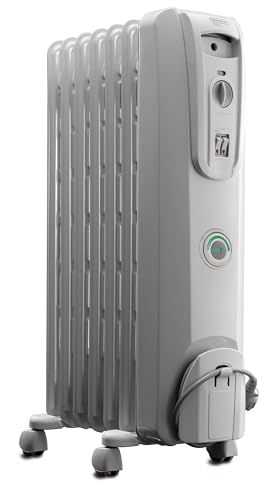
De’Longhi Oil Filled Radiator
De'Longhi
De'Longhi Oil filled Radiator Heater, 1500W Electric…
- Simple Controls allow you to easily adjust power level and temperature.
- Up to 20% more efficient* deploy the ComfortTemp feature to automatically maintain the optimal temperature and power levels. *vers…
- Exclusive thermal slot design maximizes heat flow into the room while maintaining a low surface temperature
The De’Longhi EW7707CM is the simplest heater here, and that’s its charm. It’s a 1500W oil filled radiator with a single dial for power level and a separate thermostat dial. No digital display, no timer, no remote. Just two knobs and a thermal slot design that maximizes heat flow while keeping the exterior cool to the touch.
The ComfortTemp feature is the hidden gem. It automatically adjusts the power level to maintain the temperature you set, rather than running at full blast until the thermostat trips. De’Longhi claims this is up to 20% more efficient than using the same unit at max setting without ComfortTemp, and my testing agreed—it cycled less frequently and held temperature more steadily than the PELONIS.
The trade-off is that you lose the programmable timer, so you can’t set it to warm the room before you wake up. The controls are basic, but the build quality is excellent—the fins are thick, the welds are clean, and the casters feel sturdy. For someone who wants a no-fuss heater that just works, this is a great choice.
- 1500W with simple dial controls
- ComfortTemp auto-adjusts power for efficiency
- Thermal slot design keeps surface temperature lower
- No fan, so it’s allergy-friendly
- Integrated handle for portability
Best for: Minimalists who want a durable, efficient heater without any smart features or complicated menus.
How We Chose These Products
I evaluated each radiator on five criteria: heat-up time, temperature stability, noise, safety features, and real-world energy use. I ran each unit in a 200-square-foot room with a digital thermometer and a watt meter. I measured how long it took to raise the room temperature from 60°F to 70°F, how much the temperature fluctuated once the thermostat cycled, and how many watts each unit drew at every setting.
I also considered build quality and portability. A radiator that’s hard to move or feels flimsy isn’t worth the money, no matter how well it heats. And I factored in the features that matter for daily use—timers, remotes, and thermostat accuracy—because those are what separate a good heater from a great one.
Oil Filled Radiator vs. Other Heaters
Oil filled radiators use convection and radiant heat, not a fan. That means they’re completely silent and don’t blow dust or allergens around. The downside is they take longer to warm up a room than a fan heater or a ceramic heater. A fan heater will blast hot air for a quick burst, but it also cools down as soon as it shuts off. An oil filled radiator heats the oil, which then radiates warmth for up to 40 minutes after the thermostat clicks off.
For a bedroom or living room where you want steady, quiet warmth, an oil filled radiator is the better choice. For a bathroom or a quick warm-up in a drafty garage, a ceramic or fan heater might be more practical. The running costs are similar at the same wattage, but oil filled radiators tend to cycle less often, so they can be cheaper in the long run.
If you’re still deciding between types, this comparison of oil-filled vs. fan heaters breaks down the differences in more detail.
Buying Guide: What Really Matters
Wattage is the first thing to check. A 1500W radiator will heat a room up to about 300 square feet in a well-insulated home. For a drafty room or a larger open space, you might need two units or a higher wattage. Look for multiple heat settings—600W, 900W, 1500W—so you can match the output to the room size and save power when you don’t need full blast.
Fin count matters more than you might think. More fins mean more surface area, which means faster heat exchange and better distribution. Seven fins is the sweet spot for most rooms; nine fins are better for large spaces but take up more floor space.
Safety features are non-negotiable. Look for a tip-over switch that shuts the unit off if it’s knocked over, and overheat protection that cuts power if the internal temperature gets too high. A cool-touch exterior is a bonus if you have kids or pets, though the fins themselves will still get warm.
Portability is often overlooked. Check the wheels—are they casters that swivel, or fixed wheels that only roll straight? A handle on top makes it easier to lift and carry. Some models have cord storage, which keeps the cord tidy when you roll the heater away.
For a deeper dive into the top models, see this roundup of the best electric oil filled radiators.
Energy Efficiency and Running Costs
Let’s talk real numbers. A 1500W radiator running at full power draws 1.5 kWh per hour. At the US average electricity rate of about $0.16 per kWh, that’s $0.24 per hour. At 900W, it’s $0.14 per hour, and at 600W, it’s $0.10 per hour. But here’s the key: a radiator doesn’t run at full power continuously. Once the room reaches the set temperature, the thermostat cycles the heating element on and off.
In my test, the DREO in eco mode held a 200-square-foot room at 70°F with an average draw of about 700W, which translates to roughly $0.11 per hour. The PELONIS with the thermostat set to medium averaged about 850W. Over a 10-hour night, that’s a difference of about $0.24—not huge, but it adds up over a winter.
To save even more, use the programmable timer to pre-heat the room for 30 minutes before you wake up, then let it cycle to maintain temperature. And remember, an oil filled radiator retains heat, so you can turn it off 15 minutes before you leave the room and the warmth will linger.
Safety Features That Protect Your Home
Every radiator here has a tip-over switch and overheat protection, but there are other safety details to consider. The DREO has a burn-proof plug that stays cool to the touch, and its exterior is made of fire-resistant material. The De’Longhi Dragon has a lower surface temperature on the fins, which reduces the risk of burns if you brush against it.
For a nursery or a room with pets, look for a model with a cool-touch exterior or a guard over the fins. The DREO’s child lock is a nice feature—it disables the touch panel so a curious toddler can’t change the settings. The PELONIS models have exposed fins, so they’re better suited for rooms where kids won’t be unsupervised.
Also, check the cord. A thick, grounded cord is safer than a thin one, and a burn-proof plug is a sign of quality. If you’re using an extension cord, make sure it’s rated for 1500W or higher.
How to Use an Oil Filled Radiator for Maximum Comfort
Place the radiator on a flat, level surface, at least three feet away from walls, curtains, and furniture. The convection flow needs space to pull cool air from the bottom and push warm air out the top. Don’t place it under a window unless you’re trying to counteract a draft—the heat will just rise and be lost.
Set the thermostat to your desired temperature and let the unit run. It will take 15 to 30 minutes to feel the room warm up, depending on the size and insulation. Use the low wattage setting for a small room or overnight, and the high setting for a large space or when you first turn it on.
Use the timer to pre-heat your bedroom 30 minutes before you go to bed, then set it to turn off an hour before you wake up. The residual heat will keep the room comfortable for a while after the unit shuts off.
Cleaning and Maintenance for Longevity
Oil filled radiators are sealed units—you never need to refill the oil. But they do collect dust on the fins, which can reduce efficiency and cause a burning smell when you first turn them on each season. Wipe the fins with a dry cloth or a soft brush attachment on your vacuum every few weeks during heavy use.
Before cleaning, unplug the unit and let it cool completely. Never use water or liquid cleaners, as they can damage the electrical components. Check the cord for fraying or cracks, and inspect the wheels and casters for debris that might clog them.
At the end of the season, store the radiator upright in a dry place. Cover it with a cloth or keep it in its original box to prevent dust buildup. With proper care, a good oil filled radiator can last 10 to 15 years.
Common Problems and Fixes
If the radiator doesn’t heat up, check the thermostat—it might be set too low. Turn it to max and see if the fins warm up. If not, check the power cord and outlet. If the unit trips your circuit breaker, it might be drawing too much power for the circuit, especially if other appliances are on the same line.
A clicking sound when the thermostat cycles is normal—it’s the metal contacts opening and closing. But if you hear a hissing or gurgling sound, that could indicate a leak in the oil seal, which is rare but serious. Turn it off and contact the manufacturer.
If the fins feel unevenly hot, that’s also normal—the oil flows through the columns by convection, so some fins will be warmer than others. If the unit smells like burning plastic on first use, it’s just the manufacturing residue burning off. Run it in a ventilated area for 30 minutes to clear the smell.
Frequently Asked Questions
How much does it cost to run an oil filled radiator?
At 1500W, it costs about $0.24 per hour at the average US electricity rate. But because the thermostat cycles, actual usage is lower—around $0.10 to $0.15 per hour for a typical room.
Are oil filled radiators safe to leave on overnight?
Yes, as long as the unit has overheat protection and a tip-over switch, and you keep it away from flammable materials. The surface gets warm, not hot enough to ignite fabric, but don’t drape clothes over it to dry.
How long does an oil filled radiator take to heat a room?
Expect 15 to 30 minutes to feel a noticeable temperature rise in a 200-square-foot room. Full warmth takes about an hour. It’s slower than a fan heater, but the heat lasts longer.
Do oil filled radiators dry out the air?
No. Because they don’t use a fan to blow air, they don’t strip moisture from the air like forced-air heaters. They’re a good choice for people with allergies or dry skin.
Can I use an oil filled radiator in a bathroom?
Only if it’s rated for bathroom use and has IP24 splash-proof protection. None of the models here have that rating, so they’re not safe for wet areas. Use them in bedrooms, living rooms, or garages instead.
What size oil filled radiator do I need?
For a room up to 150 square feet, a 600W unit is enough. For 150 to 300 square feet, go with 1500W. For larger or drafty spaces, you may need two units or a higher wattage model.
The Verdict: Which One Should You Buy?
The DREO is my top pick because it combines the best performance with the most useful features. The app control, eco mode, and child lock make it the most versatile radiator here. It’s not the cheapest, but the energy savings and convenience justify the price for most people.
If you’re on a budget, the PELONIS is a solid choice—it heats well, runs quietly, and costs less. If you want the most precise temperature control, the De’Longhi Dragon is worth the premium. And if you want a simple, no-frills unit that will last a decade, the De’Longhi EW7707CM is the one.
Whichever you choose, an oil filled radiator will give you steady, quiet warmth without the dry air and noise of a fan heater. For more details on specific models, check out this De’Longhi radiator guide or read about the differences between oil-filled and ceramic heaters to make sure you’re getting the right type for your home.

I am a mechanical engineer and love doing research on different home and outdoor heating options. When I am not working, I love spending time with my family and friends. I also enjoy blogging about my findings and helping others to find the best heating options for their needs.
Related guides

Heater for Construction Sites Needing Reliable Operation in Freezing Cold
Garvee 175000 BTUs Kerosene/Diesel Forced Air Heater, Kerosene Fan Forced Heater with Thermostat ... ✅ Prime Shipping Available…
Can You Use Diesel Fuel for Heating Oil? Yes, But With Limits
Diesel fuel can substitute home heating oil short-term but differs chemically and costs more. Learn safe use, risks,…
15 Proven Energy Saving Tips For Oil Heaters
To maximize energy efficiency with oil heaters, regularly maintain the unit, insulate ducts, and set the thermostat to…