For most readers, the best oil-filled space heater for a large room is Product 4 because it combines 1500W output, digital control, remote operation, and ETL-listed safety features. If you want quiet, steady heat without a fan, that’s the one to start with.
What to remember
Choose a 1500W oil-filled heater for most large rooms that already have some insulation.
Pick a model with a thermostat, timer and tip-over shutoff if the heater may run for hours.
Expect gentle heat, not instant blast heat; oil-filled units warm the room more gradually.
A higher fin count can help spread heat, but controls and safety matter more than the fin number alone.
Plug the heater directly into a wall outlet and keep 3 feet of clear space around it.
Say your family room is 18 by 22 feet, the windows leak a little, and the furnace takes the edge off but leaves one cold corner near the couch. An oil-filled radiator can hold that room at a steadier temperature than a blast-style heater, but only if you size it for the space and use it with enough clearance.
Oil heaters are slow to start and slow to stop for a reason: the internal oil heats up, then keeps releasing warmth after the element cycles off. That makes them good for long stretches in bedrooms, offices and living rooms, and less useful when you want a quick ten-minute burst of heat.
Best Oil-Filled Space Heaters for Large Rooms
#1Best Overall
DREO Oil-Filled Radiator, Digital
Best for Large rooms needing quiet heat and remote control
Product 4 is the easiest starting point for most large-room shoppers: it combines 1500W output, three power levels, ECO mode, and a digital thermostat. The remote, large LED display, child lock, wheels, and handles suit living rooms and bedrooms where you want steady heat without walking over to the radiator.
Best for Large rooms where precise temperature settings matter
Product 2 gives you 1500W full-power heating with eight M-shaped fins for broad heat distribution. Its 600W, 900W, and 1500W modes, 41–95°F ECO range, remote, and digital thermostat fit readers who want to tune the room closely rather than simply turn a heater on.
Best for Bedrooms and workspaces where fanless, quiet heat matters
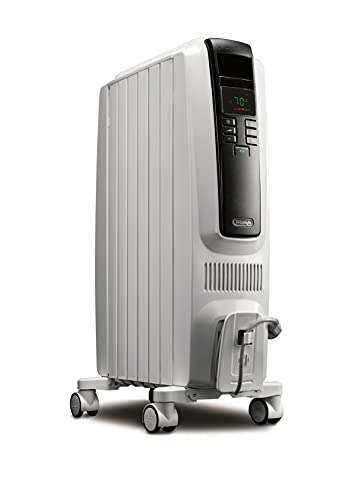
Product 3 uses a digital control panel, LED display, 24-hour timer, and ECO Plus to manage a 1500W radiator. Its fanless heating avoids stirring dust, pollen, and dander, while the integrated handle makes repositioning easier.
Heat output 1500WFins —Controls Digital control panel, LED display, 24-hour timer, ECO PlusSafety Safety features
Why it made the cut
Fanless operation for quiet heating
Digital controls with LED display and 24-hour timer
ECO Plus regulates power flow and temperature
Good to know
The product data does not mention a remote control
The product data does not state a fin count
Skip it if Skip it if remote operation or a child lock is a priority.
Best for Readers who prefer physical knobs and silent radiator heat
Product 5 keeps operation straightforward with separate heat and temperature knobs. Its 1500W output, seven M-shaped fins, 600W/900W/1500W settings, and fanless design suit someone who wants quiet warmth without a remote or touchscreen.
Heat output 600W/900W/1500W modesFins 7 M-shaped finsControls Dual knobs; adjustable thermostatSafety ETL-listed; 8 protections, auto temperature limiter, tip-ove
Why it made the cut
Dual knobs for heat level and temperature
Fanless operation for silent heating
ETL-listed with tip-over shutoff and auto temperature limiter
Good to know
No remote, digital display, or timer is listed in the product data
The controls are less precise than a 1°F digital setting
Skip it if Skip it if you want remote control, a digital thermostat, or a 24-hour timer.
Best for Small rooms, offices, and desks where oil-filled heat isn’t required
Product 1 is a compact 1500W ceramic heater rather than an oil-filled radiator, so it makes sense only when fast heat matters more than radiator-style warmth. It adds a remote, thermostat, 24-hour timer, ECO mode, child lock, and 45° tip-over shutoff for small spaces up to 200 sq. ft.
How To Choose An Oil-Filled Space Heater For A Large Room
For a large room, choose an oil-filled space heater with a useful thermostat, stable heat spread and controls you’ll actually use; most plug-in models can’t exceed 1,500W on a standard 120V circuit. Oil-filled space heaters, also called oil filled space heaters or oil space heaters, are good for quiet, gradual warmth, but one unit can struggle in a very large or drafty room.
How good are oil filled space heaters? They suit rooms where you want steady, fanless heat and don’t need the temperature to rise quickly. Are oil space heaters efficient? They turn nearly all the electricity they use into heat, as other electric resistance heaters do. Are oil filled space heaters more efficient than other plug-in electric heaters? Not in the basic conversion of electricity to heat; a thermostat can help avoid overheating, but the oil itself doesn’t make the heater use less electricity for the same heat output.
Feature
What to look for
What it changes
Thermostat
A set temperature, not only low/high settings
Helps limit overshooting and unnecessary cycling
Fins or heating surface
A larger radiant surface can spread warmth more evenly
Heat distribution, not the room’s heat-loss rate
Controls
Digital display, remote, timer or ECO mode if useful to you
Convenience, not maximum heat output
Noise
Fanless operation
Usually quieter than a fan heater; warmth builds more slowly
At the common 1,500W limit, compare how a heater controls and distributes heat before counting extra modes.
The thermostat deserves more attention than a long mode list. It lets you set a target temperature, while a basic dial may only give you a rough setting; neither creates extra heating capacity, but better control can keep the room from getting warmer than you need.
More fins or more radiant surface area can help distribute heat across the heater and into the room. They can’t make up for heat escaping through leaky windows, thin walls or an open doorway. If the room remains cold after the heater has run steadily, address drafts and insulation or plan on a second heat source rather than expecting a different control panel to solve it.
In short
Pick an oil-filled model for quiet, gradual heat and a thermostat you can set. For a large, drafty space, improve heat retention or add capacity; convenience features don’t raise the 1,500W ceiling.
From HeaterGuides · our own guidePage 6: heat only the rooms you use. Page 10 covers space-heater safety.Winter Heating Bill CutterSee what every heater in your home really costs, heat the rooms you use, and cut the waste in 30 days.Cost-per-hour tables for every heaterThermostat schedule and draft-proofing planRunning-cost and bill calculator (Excel)$14.99$9.99Get it for $9.99See what's inside and watch the 2-minute video →14-page printable PDF + Excel calculator · instant download · 30-day refund
Which Oil-Filled Heater Fits Your Room
The best space heater for a large room is Product 4, the DREO Oil Filled Radiator Heater, Electric Heaters for indoo… It gives you 1,500W, digital control, a remote, a timer and an ETL listing, so it balances heat output with controls you’re likely to use. Choose the model below that matches your room and tolerance for extra features.
Use case
Pick
Why it fits
Best overall
Product 4: DREO Oil Filled Radiator Heater, Electric Heaters for indoo…
1,500W output, digital controls, remote, timer and ETL-listed safety features.
Best for large rooms
Product 3: De’Longhi Dragon Digital Oil Filled Radiator Heater
Its finned radiator design gives heat more surface area to spread through the room.
Quietest
Product 5: DREO Radiator Heater, Quiet Electric Space Heater for Indoo…
A good match for bedrooms and offices where fan noise is irritating.
Best budget
Product 1: R.W.FLAME Small Space Heaters for Indoor Use
The simpler control layout suits a smaller room or a buyer who doesn’t need digital features.
Best smart controls
Product 2: DREO Oil Filled Radiator Heater for Indoor Use
Digital thermostat, ECO logic and remote control make temperature changes easier.
The 1,500W models are the sensible starting point for a large room; furniture, insulation and drafts still decide how warm it feels.
Searches for electric space heaters for large rooms, including “space heaters for large rooms walmart,” can mix ceramic fan heaters with oil-filled radiators. Compare the exact model, wattage and safety listing rather than the store name. A ceramic heater usually warms the air faster and may oscillate; an oil-filled heater warms more gradually and quietly, with heat continuing from the radiator after the element cycles off.
An oscillating space heater for a large room can spread moving air, but oscillation doesn’t create more heat. A 1,500W heater still has the same ceiling of electrical output, so choose oil-filled heat for steady, quiet coverage and ceramic for faster spot heating.
Good fit
You want quiet heat without a fan.
You can leave the heater in one room and use a thermostat.
You prefer gradual, less drafty warmth.
Choose something else if
Warm-up takes longer than with a fan heater.
One plug-in heater may struggle with a very large, drafty or open-plan room.
For a large bedroom or office, start with Product 5 if quiet operation matters most. Pick Product 2 when remote control and ECO behavior matter more; choose Product 1 only when the space is modest and simple controls are worth more than whole-room reach.
How Long A 1500W Oil Heater Runs And Costs
An oil filled space heater can be economical when its thermostat limits how long it runs, but it doesn’t use less electricity per unit of heat than another electric resistance heater. Oil-filled heaters are effectively 100% efficient at the point of use, so are oil space heaters more efficient? No—not inherently. Savings come from thermostat control and run time.
At full power, a 1,500W heater draws 1.5 kW. Run it for 8 hours and it uses 1.5 × 8 = 12 kWh; at 17 cents per kWh, that’s about $2.04 for the night. On a 600W setting, 0.6 × 8 = 4.8 kWh, or about 82 cents at the same rate—assuming the heater actually runs at that lower setting for most of those 8 hours.
Heater
Watts
Per hour
Per day (8 h)
Per month (30 days)
1,500W oil-filled heater
1,500 W
26¢
$2.04
$61.20
600W setting
600 W
10¢
82¢
$24.48
Calculated at 17¢ per kWh. Monthly estimates assume each heater draws its listed power for 8 hours every day; thermostat cycling can reduce actual use.
A heater that clicks off isn’t wasting heat: the hot oil keeps releasing warmth after the element stops, while the thermostat waits for the room to cool. For how to heat a room with space heaters, start with one heater and let its thermostat cycle rather than running multiple units without checking your circuit capacity.
One heater in a drafty room
Say a large room stays chilly even with a 1,500W heater running often. A leaky window or door lets warmed air escape, so sealing those gaps usually helps more than adding another heater. One oil-filled heater may still fall short on the coldest night.
Full-power use1.5 kW × 8 hours = 12 kWh
Cost at 17¢/kWhAbout $2 per night
First checkLook for drafts before adding heat
An oil space heater isn’t automatically safer than electric ceramic heat; both are electric resistance appliances and need safe placement and operation. Oil-filled models have no fan, but their surfaces can still get hot. Check the safety features and clearances before choosing a spot.
Safety And Certification Checks
Choose an oil-filled space heater with a UL, ETL or CSA listing, plus built-in tip-over and overheat protection. Those checks help answer searches for UL or ETL compliant and UL rated oil space heaters: verify the listing on the heater or its packaging, not just in a product title.
Before You Plug It In
Confirm a UL, ETL or CSA listing and built-in tip-over and overheat protection.
Leave 3 feet of clearance on all sides; keep clothing, curtains, paper and furniture away.
Plug the heater straight into a wall outlet—never use an extension cord or power strip.
Set it on a stable, level surface and follow the manual’s placement instructions.
Keep It Out Of Closets
A closet is the wrong place for a portable oil-filled heater unless the manufacturer explicitly allows that installation; most do not. Enclosed space limits clearance and can put fabric or stored items close to hot surfaces.
Can an oil-filled heater touch clothing? No. Don’t drape clothes over it or let fabric rest against the casing; the heater needs its full clearance even when it feels only warm. Keep the same space clear around curtains, bedding and furniture.
Oil-filled heaters can be safe when listed, protected and used as directed, but they can still start a fire if clearance or electrical instructions are ignored. Don’t leave one running when you leave home or go to sleep unless the manual specifically says that model is designed for unattended or overnight use.
Myth
Oil-filled heaters are safe anywhere because they don’t have an exposed flame.
Fact
They have no flame, but the casing gets hot and nearby items can ignite. For a bedroom, use a listed model with tip-over and overheat protection, keep the 3-foot clearance, and follow its manual’s rules for overnight operation.
Common Misunderstandings About Oil-Filled Heaters
Yes, an oil-filled space heater uses radiation to warm nearby surfaces, but it also relies on natural convection: the hot fins warm surrounding air, which rises and pulls cooler air toward the heater. No fan is needed.
How do oil space heaters work? An electric element heats sealed thermal oil inside the metal body. The oil carries heat across the radiator, and the fins release it gradually into the room. The oil is a heat-transfer fluid, not fuel.
Fin Count Isn’t The Whole Story
Fin count is a rough guide to surface area, so more fins can help spread heat. Fin shape, spacing and placement matter too, and extra fins won’t overcome a heater hidden behind a sofa or a room with severe drafts. The product cards here don’t provide a dependable fin-count comparison, so don’t treat one model as the winner from its name alone.
A room that stays cold usually has drafts, thin insulation, high ceilings or a heater blocked by furniture. Check the window edges and door sweep, move the radiator into open space, and give the warm air a clear path before buying a larger unit.
Myth
You can drain an oil-filled heater and refill it with waste engine oil.
Fact
Portable electric radiators are sealed appliances. Don’t pour anything into one, and never use waste engine oil as heating fuel. If the casing leaks oil or the heater smells strongly like burned insulation, unplug it and stop using it until a qualified technician inspects it or you replace it.
A Leak Is A Stop Sign
Oil around the heater, a damaged casing, scorching at the plug or a persistent burned-insulation smell calls for removal from service. Don’t open the housing or keep running it to see if the odor clears.
What To Do Before The First Cold Snap
To heat a room with space heaters safely, measure the space first, choose controls you’ll use, then place and test the oil-filled space heater before the coldest night arrives.
1
Measure Before Buying
Record the room’s length and width, note high ceilings or obvious drafts, and match the heater to that room rather than the whole floor. A drafty large room may need a second heater or another heat source.
2
Pick The Controls
Choose a digital thermostat and timer for set-and-forget use, or dual knobs if simple manual control suits you better. Product 4 fits the first group; simpler oil-filled models may suit the second.
3
Place It In The Open
Set the heater on a hard, level floor with 3 feet of clearance from bedding, curtains, furniture and walls. Plug it directly into a wall outlet, never an extension cord or power strip.
4
Watch The First Cycle
Set the thermostat, stay nearby through the first heating cycle, and check that the room reaches a steady temperature without the breaker tripping. A 1,500W heater draws about 12.5A on a 120V circuit.
5
Check Bedroom Use
For safe space heaters in a bedroom, use a listed model with tip-over and overheat protection, follow its manual, and don’t sleep with it running unless the manufacturer says that use is allowed.
In short
Seal easy drafts and keep the heater clear before adding more output. If the room remains cold after that, use a second heater only after checking the circuit load, or choose a different heat source.
Questions People Ask
Are oil-filled space heaters more efficient than ceramic heaters?
No. Both convert nearly all the electricity they use into heat, so a 1,500 W model costs the same to run for the same amount of time at the same electricity rate. An oil-filled heater may run less often if its thermostat and the room’s insulation let it maintain the set temperature.
Are oil-filled space heaters safe in a closet?
No; don’t run one in a closet. Keep the heater at least 3 feet from clothing, bedding and other combustibles, and leave the air around its fins unobstructed. A closet’s tight space can trap heat and put fabric too close to hot surfaces.
How do oil-filled space heaters work?
An electric element heats sealed oil inside the radiator, and the oil transfers heat to the metal fins. Those fins warm nearby surfaces and the surrounding air, which circulates through the room by natural convection. The oil stores heat, so the fins can stay warm briefly after the element switches off.
How many watts do I need for a large room?
Most plug-in oil-filled radiators top out at 1,500 W on a standard 120 V outlet, so room size and heat loss matter more than choosing a higher-wattage plug-in model. As a rough starting point, estimate about 10 W per square foot, then account for insulation, ceiling height, drafts and outdoor temperatures; a cold or poorly insulated large room may need more than one heat source.
Do oil-filled heaters need a fan to heat a room?
No. Their hot fins warm the air, which rises and draws cooler air toward the radiator; that circulation spreads heat without a fan. A fan can move warmth faster, but it adds noise and isn’t required for the heater to work.
What does the fin count on an oil-filled radiator mean?
Fin count describes the radiator’s metal sections, not its wattage or guaranteed room coverage. More fins can provide more surface area for heat transfer, but the heater’s maximum output and thermostat still determine how much heat it can supply.
Can I leave an oil-filled space heater on overnight?
Only if the manufacturer says the specific model is designed for unattended operation, and you follow its instructions. Keep it at least 3 feet from combustibles, plug it directly into a wall outlet, and use a model with tip-over and overheat protection and a UL, ETL or CSA listing. Turn it off before sleeping if the manual doesn’t clearly allow overnight use.
Before you go · a welcome giftGet the Winter Heating Bill Cutter for $4.99See what every heater in your home really costs, heat the rooms you use, and cut the waste in 30 days. Normally $14.99; your welcome price saves $10.00. We'll email your link right now.or skip the email and buy it now for $4.99 →One email with your link now. We never share your address.




 Winter Heating Bill CutterSee what every heater in your home really costs, heat the rooms you use, and cut the waste in 30 days.Cost-per-hour tables for every heaterThermostat schedule and draft-proofing planRunning-cost and bill calculator (Excel)